

Orientation. The chamber will want to debate “should U.S. tax dollars prop up dictators and human-rights abusers” — and framed that way, the advocates win, because almost nobody will defend funding repression. But that is not what the bill decides. The United States already conditions aid on human rights through the Leahy Law and already publishes annual human-rights assessments, so the substantive core is largely existing law. What the bill actually decides is whether to impose an automatic, across-the-board aid cutoff “as determined by the United States government,” administered through an agency — USAID — that was dismantled in 2025. The round turns on three things the sympathetic framing hides: the redundancy, the strategic cost of cutting aid to non-democratic allies (who pivot to China and Russia), and a text that names a defunct agency and an undefined standard. Control whether the debate is about punishing abusers or about what this bill adds, and you control the room.
Part I — The Policy Pro/Con Brief
Why this debate is live right now
Aid conditionality is not a blank slate — it is a decades-old, active legal regime. The Leahy Law already prohibits U.S. assistance to foreign security-force units credibly implicated in gross human-rights violations, with separate State and Defense provisions, and the State Department already produces annual human-rights assessments. So a bill “conditioning aid on human rights” enters a field that is already occupied.
The institutional ground also just shifted dramatically. In 2025, Executive Order 14169 froze foreign aid and folded USAID into the State Department, with about 86% of USAID grants canceled — so a bill directing the State Department to act “in coordination with USAID” names an agency that no longer exists as an independent body. That is a currency problem baked into the text.
And the strategic stakes are live. The United States gives non-humanitarian aid to many non-democratic partners — Egypt, Jordan, Gulf states, and others — for basing, counterterrorism, and regional stability, and cutting that aid risks pushing those partners toward China, whose economic reach is already expanding across the developing world. The tension between values-based conditionality and strategic interest is exactly what makes this contested rather than obvious.
The Case FOR the Bill (Pros)
The advocates’ best ground is that aid should reflect American values, that conditionality creates leverage for reform, and that a transparent annual standard adds accountability.
Aid should not subsidize repression. Tying non-humanitarian assistance to governance and rights standards keeps U.S. dollars from underwriting abusive regimes, aligning spending with stated values.
Conditionality creates reform leverage. A credible threat of suspension gives the United States a tool to press recipient governments toward democratic and rights improvements, building on the logic of the existing Leahy framework.
It adds transparency. An annual public Foreign Aid Compliance Report would give Congress and the public a clear, regular accounting of where aid goes and how recipients are rated.
It protects humanitarian aid. By excluding emergency disaster relief and food assistance, the bill targets strategic and military aid while shielding life-saving humanitarian programs from the conditions.
It redirects toward reformers. Reallocating suspended funds to democratic nations and governance-reform organizations rewards good actors rather than simply withdrawing engagement.
It builds in a grace period. Requiring two consecutive noncompliant reporting periods before suspension gives recipients notice and a chance to correct course rather than an abrupt cutoff.
The Case AGAINST the Bill (Cons)
The opponents’ best ground is that the bill duplicates existing law, names a defunct agency, hands itself an undefined standard, and risks driving allies toward U.S. rivals.
It is largely redundant. The Leahy Law already conditions assistance on human rights and the State Department already publishes annual human-rights assessments, so much of the bill restates existing authority.
It names an agency that no longer exists. The bill directs coordination “with USAID,” but USAID was dismantled and folded into the State Department in 2025, so the enforcement structure is built on an institution that isn’t there.
The standard is undefined and subjective. Compliance is judged by “minimum democratic governance and human rights standards as determined by the United States government,” with no benchmark in the text — inviting politicized, inconsistent application.
It forfeits strategic leverage. Cutting non-humanitarian aid to non-democratic partners can push them toward China and Russia, trading a values gesture for lost basing, counterterrorism cooperation, and regional influence.
The automatic-suspension trigger is blunt. A two-period cutoff applied mechanically ignores cases where engagement does more for reform than withdrawal, and where abrupt suspension destabilizes a fragile partner.
The “null and void” clause is dangerous here. Declaring “all laws in conflict null and void” in a field built on the Foreign Assistance Act and the Leahy provisions could disrupt the very statutes the bill relies on.
How to Weigh It
The strongest pro is that aid should reflect American values and that conditionality, transparently applied, creates leverage for reform. The strongest con is that the United States already conditions aid on human rights, that the bill’s enforcement runs through a defunct agency on an undefined standard, and that mechanically cutting aid to strategic non-democracies hands ground to China and Russia.
The crux is whether the bill adds an accountability tool or merely restates existing law while creating strategic and drafting problems. If the room reads it as “stop funding dictators,” advocates win on sympathy. If opponents show the Leahy Law already does the substantive work, that USAID no longer exists to enforce it, and that the strategic cost is real, opponents win. Advocates must argue the existing regime is too weak and this strengthens it. Opponents must argue it is redundant where clear, unworkable where new, and strategically costly.
Source List (grouped by theme)
Existing conditionality and reporting
The 2025 restructuring
Strategic competition
Part II — Congressional Debate Bill Analysis
What the bill does
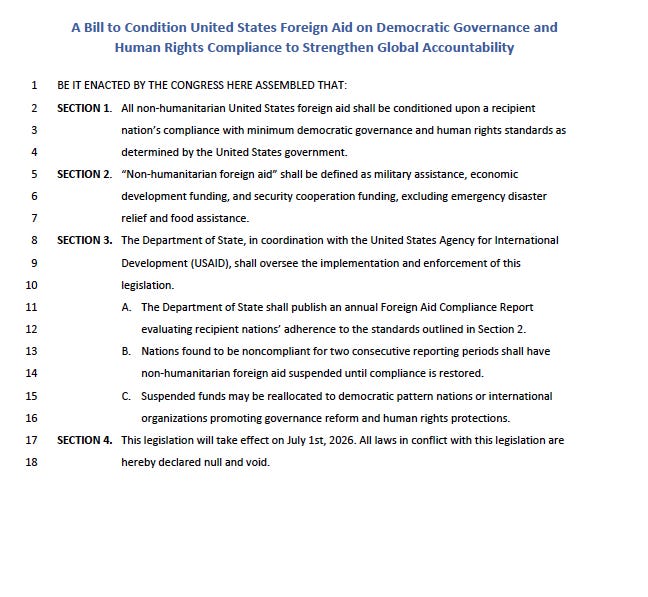
The bill conditions all non-humanitarian U.S. foreign aid — military assistance, economic development, and security cooperation, but not disaster relief or food aid — on a recipient’s compliance with democratic-governance and human-rights standards “as determined by the United States government.” The State Department, coordinating with USAID, publishes an annual compliance report; nations noncompliant for two consecutive periods have aid suspended until they comply; and suspended funds may be reallocated to democratic nations or reform organizations. It takes effect July 1, 2026, and voids conflicting laws. The factual baseline both sides start from: the Leahy Law already conditions aid on human rights, and USAID, named as co-enforcer, was dismantled in 2025.
The strongest case for the bill
The advocates’ best ground is that aid should reflect American values and that transparent conditionality creates leverage — so lead with the principle the chamber accepts.
The first argument is values alignment. Tying non-humanitarian aid to rights standards keeps U.S. dollars from underwriting repression, which most of the chamber will treat as self-evidently right.
The second argument is leverage. A credible suspension threat presses recipients toward reform, extending the logic of the existing Leahy framework from security units to the broader aid relationship.
The third argument is transparency. An annual public compliance report gives Congress and the public a regular, on-the-record accounting of who receives aid and how they’re rated.
The fourth argument is the humanitarian carve-out. Excluding disaster relief and food assistance shields life-saving programs, so the conditions fall on strategic and military aid, not the vulnerable.
The fifth argument is rewarding reformers. Reallocating suspended funds to democratic nations and reform groups channels resources toward good actors rather than merely withdrawing.
The sixth argument is the grace period. Requiring two consecutive noncompliant periods gives recipients notice and a chance to correct rather than a sudden cutoff.
The strongest case against the bill
The opponents’ best ground is that the bill restates existing law, names a defunct agency, and trades leverage for a values gesture — lead with redundancy and the USAID currency error, then the strategic cost.
The first and sharpest argument is redundancy. The Leahy Law already conditions aid on human rights and the State Department already reports on it annually, so the substantive core is a restatement.
The second argument is the currency catch most of the chamber will miss: the bill names USAID as co-enforcer, but USAID was dismantled and absorbed into the State Department in 2025, so the enforcement structure is built on an agency that no longer exists.
The third argument is the undefined standard. Judging compliance by standards “as determined by the United States government,” with no benchmark in the text, invites politicized and inconsistent application — aid as a partisan cudgel rather than a neutral rule.
The fourth argument is the strategic cost. Cutting non-humanitarian aid to non-democratic partners can drive them toward China and Russia, forfeiting basing, counterterrorism, and influence for a symbolic stand.
The fifth argument is the blunt trigger. A mechanical two-period suspension ignores the cases where engagement reforms more than withdrawal and where an abrupt cutoff destabilizes a fragile partner.
The sixth argument is the null-and-void risk. In a field built on the Foreign Assistance Act and Leahy provisions, voiding “all laws in conflict” could disrupt the statutes the bill depends on.
Cross-examination questions
Questions for advocates to ask opponents.
“Do you believe U.S. tax dollars should fund governments that commit gross human-rights abuses — yes or no?”
“The bill protects disaster relief and food aid. So who exactly gets hurt by conditioning military assistance?”
“An annual public compliance report adds transparency. What’s your objection to knowing where aid goes?”
“We already use the Leahy Law for security units — why not extend that logic to the broader aid relationship?”
“Two consecutive noncompliant periods are required before suspension. Isn’t that a fair warning, not a cliff?”
“If the only flaw is the USAID reference, isn’t that a one-word amendment, not a reason to keep funding abusers?”
Questions for opponents to ask advocates.
“The Leahy Law already bars aid to units committing gross rights violations. What does this bill make illegal that isn’t already?”
“The State Department already publishes annual human-rights assessments. How is your annual report not a duplicate?”
“Your bill names USAID as co-enforcer. Are you aware USAID was dismantled in 2025 — who actually administers this?”
“’Standards as determined by the United States government’ — who defines them, and what stops this from becoming a political weapon?”
“If we cut aid to a strategic non-democratic ally, what stops them from turning to China or Russia?”
“Does suspending aid to a fragile partner make its people more free, or just more desperate?”
“Your bill voids ‘all laws in conflict.’ Does that include the Foreign Assistance Act and the Leahy provisions you’re relying on?”
“Has cutting aid historically produced democratization, or just lost the U.S. a seat at the table?”
Drafting and definitional traps
The bill’s text rewards close reading and punishes the drafter.
The standard is undefined. “Minimum democratic governance and human rights standards as determined by the United States government” sets no benchmark, so the operative criterion is whatever the executive says it is — an invitation to inconsistent, politicized enforcement.
The enforcement structure names a defunct agency. Directing the State Department to coordinate “with USAID” ignores that USAID was folded into State in 2025, so the bill’s administrative machinery is partly fictional.
It overlaps existing law without reconciling it. The bill never references the Leahy Law or the existing human-rights reporting regime, so it layers a new process on top of established statutes with no integration.
The suspension trigger is mechanical. “Two consecutive reporting periods” of noncompliance forces suspension regardless of strategic context, with no waiver for national-security interest — unusual for aid statutes, which typically include such waivers.
Section 4’s “all laws in conflict are null and void,” applied to the densely cross-referenced Foreign Assistance Act, is a non-specific implied repeal that could knock out the framework the bill builds on, and the July 1, 2026 effective date arrives with no transition.
Logical flaws
The deepest problem is a redundancy non-sequitur. The bill’s premise is that U.S. aid is unconditioned on human rights; its conclusion is a new conditioning regime — but the Leahy Law already conditions it, so the premise (an unconditioned status quo) doesn’t hold.
The enforcement design rests on a false factual premise. The bill assumes USAID exists to co-administer the program, but it was dismantled in 2025, so the mechanism is built on an institution that isn’t there.
The means may defeat the end. If the goal is to advance democracy and rights abroad, mechanically cutting aid can push partners toward China and Russia and remove U.S. influence, producing less leverage for reform, not more.
The standard is circular. Compliance is judged against standards “as determined by the United States government,” so the rule is defined by the enforcer’s discretion rather than any fixed benchmark — a criterion that can justify any outcome.
And the null-and-void clause is self-undermining. Voiding “all laws in conflict” can erase the statutory framework the bill relies on to function, so the enforcement scheme can disable its own foundation.
Verdict / how to play it
The chamber will saturate the advocate side, because “stop funding dictators” is easy applause and most competitors will argue the morality of aid without checking what U.S. law already does. Expect several speeches that treat unconditioned aid as the status quo.
The rare, higher-value speech is the informed opposition: the competitor who knows the Leahy Law already conditions aid, that the State Department already reports annually, and that USAID — named in the bill — was dismantled in 2025. That speech breaks because nobody else will have done the reading.
If you are advocating, concede the overlap and argue the existing Leahy regime is too narrow (it covers security units, not whole governments) and too weak, so this broadens and hardens it; treat the USAID reference as a fixable amendment and lean on transparency and the humanitarian carve-out.
If you are opposing, the highest-leverage move is the redundancy-and-currency one-two: the U.S. already conditions aid on human rights, and the bill hands enforcement to an agency that no longer exists. Stack the undefined-standard problem (aid as a political weapon) and the strategic cost (allies pivoting to China and Russia) behind it, and hold the null-and-void risk for when an advocate insists the bill is carefully drafted.
Do not let the round collapse into “should we fund abusers,” which the advocates win; force it onto “does this bill add anything current law doesn’t already do, and can a defunct agency enforce it,” which the opponents win. One cross-apply: the redundancy/currency frame ties to the medical-advertising and infrastructure bills in the docket, and the allies-pivot-to-China concern connects to the great-power-competition measures.
Bibliography
• U.S. Department of State. “Leahy Law Fact Sheet.” Bureau of Democracy, Human Rights, and Labor, January 2025. https://www.state.gov/bureau-of-democracy-human-rights-and-labor/releases/2025/01/leahy-law-fact-sheet
• “Leahy Law” (statutory conditions; EO 14169; USAID folded into State Department, 2025). Wikipedia. https://en.wikipedia.org/wiki/Leahy_Law
• Congressional Research Service. “Global Human Rights: Security Forces Vetting (’Leahy Laws’).” IF10575. https://www.congress.gov/crs-product/IF10575
• Council on Foreign Relations. “China’s Massive Belt and Road Initiative.” CFR Backgrounder. https://www.cfr.org/backgrounders/chinas-massive-belt-and-road-initiative