

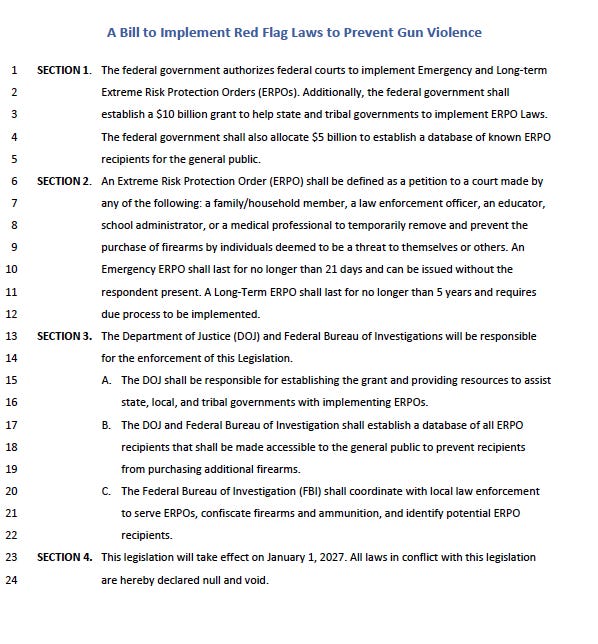
Orientation. The chamber will want to debate “are red flag laws good or bad” — and that fight is more settled than it looks: ERPOs already exist in 21 states and D.C., the Supreme Court’s Rahimi decision (2024) upheld disarming dangerous people, and the suicide-prevention evidence is real. But that is not what this bill decides. This bill bolts onto the familiar ERPO model one feature no existing red-flag law has: a $5 billion public database of everyone who has received an ERPO, open to the general public. That single provision turns a targeted, court-supervised tool into a public registry of people flagged for mental-health and suicide crises — which stigmatizes them, deters the help-seeking the law depends on, and broadcasts who has been disarmed. The round turns not on whether red flag laws work, but on what this bill adds to them, and the side that puts the public database at the center controls the room.
Part I — The Policy Pro/Con Brief
Why this debate is live right now
Red flag laws are an established, spreading, and court-tested policy. Twenty-one states and the District of Columbia have enacted Extreme Risk Protection Order laws, and the 2022 Bipartisan Safer Communities Act created federal grants to help states implement them — so federal support for ERPOs already exists. The constitutional ground also firmed up: in United States v. Rahimi (2024), the Supreme Court upheld disarming individuals subject to domestic-violence restraining orders, signaling that temporarily disarming demonstrably dangerous people fits the nation’s historical tradition.
The evidence base is strongest for suicide. Connecticut’s law averted roughly one suicide for every 10 to 20 gun removals, and a multi-state study found about one suicide prevented for every 13 orders; Indiana’s law was associated with a 7.5% decrease in suicides. Firearm suicide, not mass shootings, is where ERPOs do most of their measurable good.
That backdrop is what isolates this bill’s distinctive move. Existing ERPO laws keep records within the courts and the background-check system; none publish a public list of recipients. By adding a public database and federalizing issuance, this bill departs from the model that earned the evidence and the Rahimi-era constitutional comfort — which is precisely what makes it debatable rather than routine.
The Case FOR the Bill (Pros)
The advocates’ best ground is that ERPOs demonstrably save lives, that Rahimi supports their constitutionality, and that federal funding scales a proven tool.
ERPOs prevent suicides. The evidence shows roughly one suicide averted for every 10–20 removals in Connecticut and one per 13 orders across multiple states — a concrete, measurable benefit.
The constitutional footing is solid. Rahimi upheld temporarily disarming dangerous people, so the core mechanism — removing firearms from those a court finds dangerous — rests on recent Supreme Court support.
It scales a proven policy. With 21 states and D.C. already using ERPOs, a $10 billion grant helps the rest adopt and properly run a tool with a track record.
It builds in due process for long-term orders. A long-term ERPO requires a full hearing and lasts no longer than five years, and emergency orders are capped at 21 days, limiting the duration of any pre-hearing removal.
It uses a broad but sensible petitioner pool. Allowing family, law enforcement, educators, and medical professionals to petition reflects the people most likely to see warning signs first.
It targets the leading firearm-death driver. Because firearm suicide is the largest category of gun death, an ERPO program is aimed where the data says lives can most be saved.
The Case AGAINST the Bill (Cons)
The opponents’ best ground is that the public database is a serious privacy and safety harm no existing law has, that emergency ex parte orders raise due-process concerns, and that the federal design is unusual.
The public database is the core flaw. A public, searchable list of ERPO recipients exposes people in mental-health and suicide crisis to stigma and retaliation — something no current red-flag law does, because records are kept within courts and the background-check system.
It deters the help-seeking the law needs. If being flagged means public exposure, families and clinicians will hesitate to petition, undermining the very reporting ERPOs depend on to work.
It can endanger the people it lists. Publicizing who has been disarmed signals which households are now without firearms and which individuals are in crisis — information that can be exploited.
Emergency ex parte orders compress due process. A 21-day emergency ERPO issued without the respondent present removes a constitutional right before any hearing; the model survives only because the deprivation is brief and narrowly justified, and a sloppy federal version strains that.
Federalizing ERPOs is unusual. ERPOs are state civil court orders; routing issuance through federal courts and tasking the FBI to “identify potential ERPO recipients” injects federal surveillance into a state function.
Much of it is redundant. Federal ERPO grant funding already exists through the Bipartisan Safer Communities Act, so the grant piece partly duplicates current law.
How to Weigh It
The strongest pro is that ERPOs measurably prevent suicides, rest on solid post-Rahimi constitutional footing, and would reach more people with federal funding. The strongest con is that this bill grafts onto the proven model a public database that no existing law has — one that stigmatizes people in crisis, deters the reporting ERPOs need, and can endanger those it lists — alongside ex parte due-process strain and an unusual federalization of a state tool.
The crux is whether the bill’s additions strengthen or sabotage the proven ERPO model. If the room debates red flag laws in the abstract, advocates win on the evidence and Rahimi. If opponents isolate the public database and the federal-surveillance elements as departures that the successful state laws deliberately avoided, opponents win. Advocates must argue the core tool works and the database is severable. Opponents must argue the database poisons the tool and the federal design oversteps.
Source List (grouped by theme)
ERPO adoption, evidence, and federal support
Constitutional footing
Part II — Congressional Debate Bill Analysis
What the bill does
The bill authorizes federal courts to issue Emergency (up to 21 days, ex parte) and Long-Term (up to 5 years, after a hearing) Extreme Risk Protection Orders, funds a $10 billion grant to help states and tribes implement ERPOs, and funds a $5 billion public database of ERPO recipients open to the general public. Family members, law enforcement, educators, school administrators, and medical professionals may petition; DOJ administers the grants and database, and the FBI coordinates with local law enforcement to serve orders, confiscate firearms, and “identify potential ERPO recipients.” It takes effect January 1, 2027, and voids conflicting laws. The factual baseline both sides start from: ERPOs already exist in 21 states with federal grant support and have evidence behind them, but none of them publish a public registry of recipients.
The strongest case for the bill
The advocates’ best ground is the life-saving evidence and the constitutional footing — so lead with suicide prevention, the part the data supports.
The first argument is the evidence. ERPOs avert suicides at a measurable rate — about one per 10–20 removals in Connecticut and one per 13 orders across states — so this is a tool with proven results, not a theory.
The second argument is constitutionality. Rahimi upheld disarming dangerous people, so the core mechanism sits on recent Supreme Court support rather than untested ground.
The third argument is scale. With 21 states already using ERPOs, federal grants help the remaining states adopt and run a tool that works.
The fourth argument is due process for the serious orders. Long-term ERPOs require a full hearing and cap at five years, and emergency orders expire in 21 days, so the pre-hearing deprivation is brief and bounded.
The fifth argument is the petitioner pool. Letting family, police, educators, and clinicians petition reflects who actually sees the warning signs first, widening the chance to intervene before a tragedy.
The sixth argument is targeting. Because firearm suicide is the largest share of gun deaths, an ERPO program aims federal resources where the evidence says the most lives can be saved.
The strongest case against the bill
The opponents’ best ground is the public database — lead with it, then the due-process and federalization problems.
The first and sharpest argument is the public registry. A searchable public list of ERPO recipients exposes people in mental-health and suicide crisis to stigma and retaliation, and no existing red-flag law does this — state laws keep records within the courts and the background-check system for good reason.
The second argument, which most of the chamber will miss, is that the database sabotages the tool. ERPOs work only if families and clinicians are willing to petition; if a petition means public exposure of a loved one or patient, the reporting the evidence depends on dries up, so the bill undercuts the very mechanism it funds.
The third argument is that it endangers the listed. Publishing who has been disarmed and who is in crisis broadcasts which homes are now unarmed and which people are vulnerable — usable information for predators or abusers.
The fourth argument is ex parte due process. A 21-day emergency order issued without the respondent present removes a right before any hearing; the model is defensible only because the deprivation is brief and individualized, and a loose federal version strains that.
The fifth argument is the federalization. ERPOs are state civil orders; routing issuance through federal courts and having the FBI “identify potential ERPO recipients” turns a local protective tool into a federal surveillance function.
The sixth argument is redundancy. Federal ERPO grant money already exists via the Bipartisan Safer Communities Act, so the $10 billion grant partly duplicates current law.
Cross-examination questions
Questions for advocates to ask opponents.
“ERPOs avert about one suicide for every 13 orders. Do you dispute the life-saving evidence?”
“Rahimi upheld disarming dangerous people. Is your Second Amendment objection consistent with that ruling?”
“Twenty-one states already use ERPOs. Why shouldn’t federal grants help the rest?”
“Long-term orders require a full hearing. Where’s the due-process violation in that?”
“Emergency orders expire in 21 days. Isn’t a brief, reviewable removal worth preventing a suicide?”
“If your only objection is the public database, isn’t that a severable provision, not a reason to reject ERPOs?”
Questions for opponents to ask advocates.
“No existing red-flag law publishes a public list of recipients. Why does yours?”
“If a family knows petitioning will put their son on a public database, are they more or less likely to seek help?”
“A public list shows which homes were just disarmed and who’s in crisis. How is that not a safety risk?”
“ERPOs are state civil orders. Why are you routing them through federal courts?”
“The FBI is to ‘identify potential ERPO recipients.’ Isn’t that federal pre-crime surveillance?”
“The Bipartisan Safer Communities Act already funds state ERPOs. What does your $10 billion grant add?”
“A 21-day order can issue without the person present. What stops abuse of the emergency process?”
“How does publicly stigmatizing people in mental-health crisis advance suicide prevention?”
Drafting and definitional traps
The bill’s text rewards close reading and punishes the drafter.
The public database is the central defect. A $5 billion public registry of ERPO recipients is unprecedented — existing laws route records to courts and the confidential background-check system — and it converts a protective order into public exposure of people in crisis.
Federalizing issuance breaks the model. ERPOs are state civil court orders; having federal courts issue them and the FBI identify recipients grafts a federal surveillance and enforcement structure onto a state function, with attendant commandeering and jurisdiction questions.
“Identify potential ERPO recipients” is dangerously open-ended. Tasking the FBI to flag people who haven’t been petitioned against invites pre-emptive watchlisting with no standard in the text.
The petitioner list lacks safeguards. Allowing educators, administrators, and others to petition with no penalty for false or malicious petitions named in the bill leaves the process open to abuse.
The emergency ex parte order has no explicit evidentiary standard or rapid-review guarantee beyond the 21-day cap, and Section 4’s “all laws in conflict are null and void” plus the January 1, 2027 effective date arrive with no transition or reconciliation with existing state ERPO regimes.
Logical flaws
The deepest problem is that the public database is self-defeating. ERPOs prevent suicides only when people are willing to report at-risk loved ones, but a public registry deters that reporting, so the bill’s signature addition undermines the mechanism the rest of the bill funds.
There is a means-end inversion on safety. A tool meant to protect people in crisis publishes their crisis to the world, exposing them to stigma and harm — the opposite of protection.
The federalization is a non-sequitur. The goal is to expand a working state tool, but routing it through federal courts and the FBI changes its nature into federal surveillance rather than scaling the state model that produced the evidence.
The redundancy undercuts the rationale. The premise that ERPOs lack federal support is false — the Bipartisan Safer Communities Act already funds them — so the new grant rests on a gap that is partly already filled.
And the design ignores its own evidence base. The studies that justify ERPOs come from confidential, court-supervised state programs; inferring that a public, federalized version will perform the same way assumes away the features that made the originals work.
Verdict / how to play it
The chamber will likely split and saturate the broad “red flag laws good / red flag laws bad” debate, with advocates citing the suicide evidence and opponents citing the Second Amendment — and most competitors will never read closely enough to find the public database. That provision is the opening.
The rare, higher-value speech on either side isolates the database: this bill takes a proven, court-confidential tool and publishes its recipients, which no working ERPO law does, sabotaging the reporting the evidence depends on and endangering the people it lists. A competitor who centers that reframes the whole round.
If you are advocating, do not defend the public database — concede it’s a flaw and argue it’s severable, then lean on the suicide evidence, Rahimi, and the due-process protections for long-term orders, framing the bill as scaling a tool that works.
If you are opposing, do not argue “red flag laws don’t work” — the evidence cuts against you. Run the database instead: it’s unprecedented, it deters the help-seeking the law needs, and it broadcasts who’s been disarmed and who’s in crisis. Stack the FBI “identify potential recipients” surveillance language and the ex parte due-process strain behind it, and hold the Bipartisan Safer Communities Act redundancy for the grant piece.
Do not let the round collapse into “are you for or against gun safety,” which splits the room unproductively; force it onto “does this bill’s public registry strengthen or sabotage a tool that already works,” which the opponents win on the merits. One cross-apply: the privacy/database concern and the federal-surveillance frame transfer to any bill in the docket that creates a public list or hands the FBI an open-ended identification mandate.
Bibliography
• Everytown Research. “Extreme Risk Laws Save Lives” (21 states + D.C.; Bipartisan Safer Communities Act funding; how ERPO records are handled). https://everytownresearch.org/report/extreme-risk-laws-save-lives/
• “Updated Estimate of the Number of Extreme Risk Protection Orders Needed to Prevent 1 Suicide.” PMC (Connecticut ~1 per 10–20 removals; ~1 per 13 orders multi-state; Indiana 7.5% decrease). https://www.ncbi.nlm.nih.gov/pmc/articles/PMC11170301/
• “Red flag law” (21 states + D.C.; United States v. Rahimi, 2024). Wikipedia. https://en.wikipedia.org/wiki/Red_flag_law
American Academy of Pediatrics. “Extreme Risk Protection Orders (ERPO) or ‘Red Flag’ Laws.” https://www.aap.org/en/advocacy/state-advocacy/extreme-risk-protection-orders-erpo-or-red-flag-laws/