
A Resolution to Amend the Constitution to Abolish the Electoral College (NSDA Congress 2026)

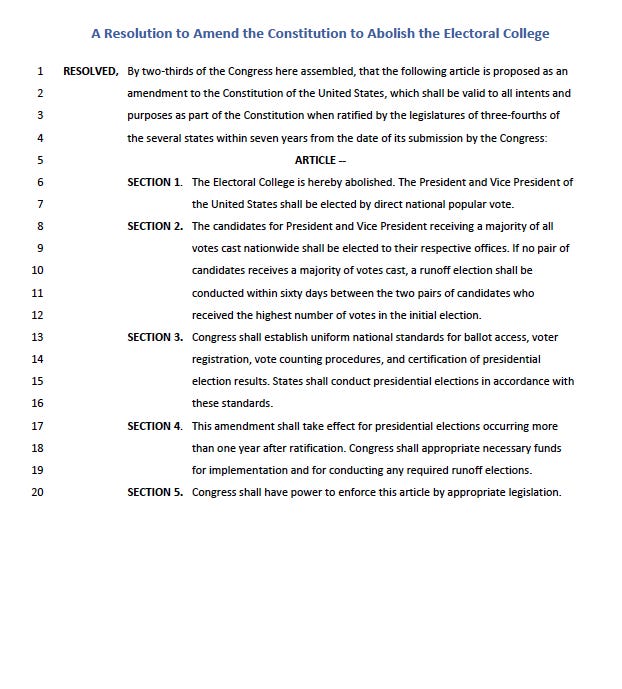
Orientation. The chamber will want to debate “should the popular-vote winner become president” — and framed that way the advocates win, because two of the last seven presidents took office after losing the popular vote and “one person, one vote” is a powerful banner. But that is not what the resolution decides. This is a constitutional amendment, so the real question isn’t whether direct election is better in the abstract — it’s whether this text can clear the highest bar in American law (two-thirds of Congress plus three-fourths of the states), and whether what it does beyond abolishing the Electoral College is wise. And it does a great deal beyond that: Section 3 federalizes election administration nationwide, and Section 2 imposes a national majority requirement with 60-day runoffs. The round turns on the ratification wall and the buried federalization, not on the popularity of direct election — and the side that moves the debate from “is the popular vote fairer” to “can this pass, and what else does it do” controls the room.
Part I — The Policy Pro/Con Brief
Why this debate is live right now
Electoral College reform is a perennial fight with a near-miss history and a live alternative. The closest the country ever came was the Bayh-Celler amendment, which passed the House 338-70 in 1969 but died in a 1970 Senate filibuster led by small-state and Southern opponents. That history is the warning: the idea is popular in the abstract and still cannot clear the Senate and the states, because the smaller states that benefit from the Electoral College can block ratification.
The amendment route is now competing with a faster workaround. The National Popular Vote Interstate Compact — under which member states award their electors to the national popular-vote winner — had reached 18 states and D.C., totaling 222 electoral votes (82% of the 270 needed to take effect) by 2026, with Virginia joining that year. The compact aims to deliver a de facto national popular vote without a constitutional amendment, which is exactly the harder path this resolution chooses.
And the bar is the story. A constitutional amendment requires two-thirds of both houses of Congress and ratification by three-fourths of the states (38) within the resolution’s seven-year window, which means 13 states can block it. The smallest states are structurally advantaged by the current system and have repeatedly resisted change. So the live question is less “is direct election fairer” — many think it is — than “can any version actually be ratified, and does this version do more than it should.”
The Case FOR the Resolution (Pros)
The advocates’ best ground is democratic legitimacy: the popular-vote winner should win, every vote should count equally, and a majority requirement guarantees a real mandate.
It honors majority rule. Two of the last seven presidents won the Electoral College while losing the popular vote, an outcome direct election would prevent, aligning the result with the will of the most voters.
It makes every vote equal. Under the Electoral College a vote in a small state carries more weight than one in a large state; a national popular vote gives every citizen’s ballot the same value regardless of where they live.
It ends swing-state distortion. Candidates currently lavish attention on a handful of battleground states; a national vote forces them to campaign everywhere, broadening whose concerns matter.
The majority-plus-runoff structure ensures a mandate. Requiring a majority, with a runoff between the top two if no one reaches it, guarantees the winner has majority support rather than a plurality.
It uses the proper constitutional vehicle. Unlike a simple resolution, a joint resolution proposing an amendment is exactly how the Constitution is changed, so the form matches the goal.
Uniform national standards could reduce chaos. Setting national rules for registration, counting, and certification could end the patchwork of conflicting state procedures that produces disputes.
The Case AGAINST the Resolution (Cons)
The opponents’ best ground is that it cannot be ratified, that Section 3 federalizes elections far beyond abolishing the Electoral College, and that national runoffs and recounts would be a nightmare.
It almost certainly can’t be ratified. Small states benefit from the Electoral College and 13 of them can block any amendment; the Bayh-Celler amendment died in the Senate for exactly this reason, and nothing has changed that math.
Section 3 is a massive federalization of elections. Giving Congress power to set uniform national standards for ballot access, registration, counting, and certification strips states of their traditional control over election administration — a far bigger change than abolishing the Electoral College, smuggled into the same amendment.
National runoffs would be enormous and frequent. A majority requirement with a 60-day runoff means any multi-candidate race could trigger a second nationwide election — costly, exhausting, and far more disruptive than the 40% threshold Bayh-Celler used to avoid runoffs.
A close national race means a nationwide recount. Under the Electoral College a disputed result is usually contained to one or two states (Florida 2000); under a single national tally, a razor-thin margin could force a recount across all 50 states at once.
There is a faster path it ignores. The National Popular Vote Compact is already at 82% of the votes it needs and requires no amendment, so the resolution chooses the hardest available route.
Small and rural states lose influence. Abolishing the Electoral College concentrates campaign attention on population centers, which is precisely why smaller states resist — and why the resolution faces a structural veto.
How to Weigh It
The strongest pro is that direct election honors majority rule, equalizes every vote, and ends the distortion of swing-state politics. The strongest con is that the resolution faces a near-insurmountable ratification wall, that Section 3 federalizes election administration far beyond its stated purpose, and that national majority-plus-runoff elections invite nationwide recounts and repeat votes.
The crux is whether to judge the resolution as a statement of principle or as a workable change to the Constitution. As a principle — the popular-vote winner should win — it’s popular and defensible. As an enactable amendment, it confronts a small-state veto that has killed every prior attempt, and it bundles in a sweeping federalization of elections and a runoff system that create new problems. Advocates must argue the principle is worth pursuing and the design details are secondary. Opponents must argue it can’t pass, and that even if it could, Section 3 and the runoff structure make it worse than the problem it solves.
Source List (grouped by theme)
History and the ratification bar
Electoral College abolition amendment (Bayh-Celler; runoff structure)
Newsweek — the Bayh-Celler amendment that nearly abolished the Electoral College
National Archives — The Constitutional Amendment Process (two-thirds Congress, three-fourths states)
The alternative path
Reform debate
Part II — Congressional Debate Bill Analysis
This is a resolution proposing a constitutional amendment — note its real status first. Unlike a simple resolution, this is the correct vehicle for changing the Constitution, so the form is right. But it is not self-executing: it only proposes the amendment, which then needs ratification by three-fourths of the states. Half the chamber will debate abolishing the Electoral College as a done deal; naming the ratification wall, early, is itself a strategic move.
What the resolution does
The resolution proposes a constitutional amendment abolishing the Electoral College and electing the president and vice president by direct national popular vote, with a majority required and a 60-day runoff between the top two if no pair wins a majority. Section 3 empowers Congress to set uniform national standards for ballot access, registration, vote counting, and certification, which states must follow; Section 4 delays effect until more than a year after ratification and appropriates funds; Section 5 gives Congress enforcement power. The factual baseline both sides start from: amending the Constitution requires two-thirds of Congress and three-fourths of the states, the last serious attempt died in a Senate filibuster, and a non-amendment alternative is already near its threshold.
The strongest case for the resolution
The advocates’ best ground is democratic legitimacy — so lead with majority rule, the principle the chamber accepts.
The first argument is majority rule. Two of the last seven presidents won while losing the popular vote; direct election ensures the candidate most voters chose actually wins.
The second argument is equal weight. The Electoral College makes some citizens’ votes count more than others’; a national popular vote gives every ballot the same value.
The third argument is ending swing-state distortion. A national vote forces candidates to campaign everywhere rather than concentrating on a few battlegrounds, broadening whose concerns get heard.
The fourth argument is the mandate guarantee. Requiring a majority with a runoff means the winner has majority support, not just a plurality in a fractured field.
The fifth argument is the proper vehicle. A joint resolution proposing an amendment is exactly how the Constitution is changed, so the resolution uses the right tool for a constitutional change.
The sixth argument is uniformity. National standards could replace the conflicting state procedures that generate disputes with a single, consistent system.
The strongest case against the resolution
The opponents’ best ground is feasibility and the buried federalization — lead with the ratification wall, then Section 3, then the runoff and recount problems.
The first and sharpest argument is that it can’t be ratified. Small states are advantaged by the Electoral College and 13 of them can block any amendment; the Bayh-Celler amendment passed the House 338-70 and still died in the Senate, and the math is unchanged.
The second argument, which most of the chamber will miss, is that Section 3 federalizes elections. Empowering Congress to set national standards for registration, counting, and certification strips states of their traditional control over running elections — a far larger change than abolishing the Electoral College, bundled into the same amendment and likely to harden state opposition.
The third argument is the runoff problem. A majority requirement with a 60-day runoff could trigger a second nationwide election in any multi-candidate race — vastly more costly and disruptive than the 40% threshold Bayh-Celler used to avoid exactly this.
The fourth argument is the recount nightmare. A national tally means a close margin forces a recount everywhere at once, rather than the contained, single-state disputes the current system localizes.
The fifth argument is the ignored alternative. The National Popular Vote Compact is already at 82% of its threshold and needs no amendment, so the resolution chooses the hardest path when an easier one is nearly done.
The sixth argument is the structural veto. Abolishing the Electoral College concentrates influence on population centers, so the small and rural states that lose out have both the motive and the votes to stop ratification.
Cross-examination questions
Questions for advocates to ask opponents.
“Two of the last seven presidents lost the popular vote and still won. Do you think that’s democratic?”
“Why should a vote in one state count more than a vote in another?”
“Candidates ignore most states to chase a few battlegrounds. Isn’t a national vote fairer to everyone?”
“A majority requirement guarantees a real mandate. What’s your objection to that?”
“This is the proper amendment process. Are you against even letting the states decide by ratification?”
“If your worry is the runoff design, isn’t that an amendment to the text, not a reason to keep the Electoral College?”
Questions for opponents to ask advocates.
“Amendments need three-fourths of the states. Which 38 states ratify this, given small states lose influence?”
“Bayh-Celler passed the House 338-70 and died in the Senate. What’s different now?”
“Section 3 lets Congress run elections nationwide. Isn’t that a far bigger change than abolishing the Electoral College?”
“A 60-day national runoff in every close multi-candidate race — have you costed that out?”
“Under a single national tally, what happens in a razor-thin election — a 50-state recount?”
“The National Popular Vote Compact is already at 82% and needs no amendment. Why choose the hardest path?”
“Why bundle a sweeping federalization of election administration into an amendment about the Electoral College?”
“Do you concede that nothing in this resolution becomes law unless 38 state legislatures agree?”
Drafting and definitional traps
The resolution’s text rewards close reading and punishes the drafter.
Section 3 is a sleeper federalization. Granting Congress power over ballot access, registration, counting, and certification is a sweeping transfer of authority from states to Congress that goes far beyond the resolution’s stated purpose and would be a major fight on its own — yet it’s bundled into the abolition amendment.
The runoff trigger invites repeated national elections. Requiring a majority and a 60-day runoff, rather than a plurality or a lower threshold, means a crowded field forces a second nationwide vote, with all its cost and turnout problems.
The recount mechanism is unaddressed. The resolution creates a single national count but says nothing about how a disputed national margin is recounted or resolved, leaving the hardest administrative question open.
“Majority of all votes cast nationwide” is undefined at the edges. It doesn’t specify how spoiled ballots, write-ins, or territories are treated, each of which can change whether a majority exists and a runoff is triggered.
Section 4 appropriates “necessary funds” without a figure, and the seven-year ratification window — standard for amendments — runs against a small-state veto that has historically run out the clock.
Logical flaws
The deepest problem is a feasibility non-sequitur. The resolution treats abolishing the Electoral College as achievable by passing this text, but ratification requires three-fourths of the states and small states can block it, so passing the resolution does not produce the outcome it asserts — the conclusion doesn’t follow from the act.
The bundling undercuts the goal. Adding a sweeping federalization of election administration to an already-hard amendment makes ratification harder, not easier, so Section 3 works against the resolution’s own success.
The runoff design contradicts its mandate rationale. Requiring a majority with national runoffs to guarantee a mandate creates a system so cumbersome that prior reformers deliberately avoided it with a lower threshold — the means to the mandate undermines the workability the resolution needs.
And it ignores the dominant strategy. With the National Popular Vote Compact already near its threshold, choosing the amendment route is choosing the path most likely to fail to reach the very goal both share.
Verdict / how to play it
The chamber will saturate the advocate side, because “the popular-vote winner should win” is intuitive, well-supported by recent elections, and easy to deliver. Most competitors will argue the fairness of direct election and never engage the ratification wall or read Section 3.
The rare, higher-value speech on either side moves the debate off principle and onto feasibility and design: this amendment faces the small-state veto that killed Bayh-Celler, it federalizes election administration far beyond its title, and it builds in national runoffs and recounts. A competitor who establishes that reframes the round.
If you are advocating, do not get stuck defending the abstract fairness of direct election — concede it’s contested only on feasibility and argue the principle is worth putting to the states, that uniform standards are a feature, and that the runoff guarantees legitimacy; treat Section 3 as severable if pressed.
If you are opposing, do not defend the Electoral College on the merits if the room is hostile — concede direct election has appeal and attack feasibility and design. The highest-leverage move is the ratification wall paired with Section 3: this can’t clear three-fourths of the states, and even its supporters should worry that it quietly federalizes election administration. Stack the national-runoff and recount problems behind it, and note the National Popular Vote Compact as the faster path the resolution ignores.
Do not let the round collapse into “is the popular vote fairer than the Electoral College,” which the advocates win; force it onto “can this amendment be ratified, and should it federalize elections and mandate national runoffs,” which the opponents win. One cross-apply: the “right goal, wrong and unpassable vehicle” frame and the federalism concern connect to other structural-reform and federal-power bills in the docket.
Bibliography
Electoral College abolition amendment. Wikipedia (Bayh-Celler; runoff structure; 40% threshold).
Newsweek. “2020 Democrats Are Calling for Abolishing the Electoral College — It Nearly Happened a Few Decades Ago“ (House 338-70; Senate filibuster).
National Archives. “The Constitutional Amendment Process“ (two-thirds Congress; three-fourths states).
Cornell Legal Information Institute. “U.S. Constitution, Article V“ (amendment and ratification requirements).
National Popular Vote Interstate Compact. Wikipedia (18 states + D.C.; 222 EV; 82% of threshold).
Time. “U.S. Takes Step Closer to Popular Vote as Virginia Joins Compact.” April 2026.
Ballotpedia. “National Popular Vote Interstate Compact.”
League of Women Voters. “What is the National Popular Vote Interstate Compact?“
National Popular Vote. “Agreement Among the States to Elect the President by National Popular Vote.”
Common Cause. “National Popular Vote.”
Rock the Vote. “The National Popular Vote Interstate Compact: An Explainer.”
The Hill. “Another state joins effort to change Electoral College process.”
Efforts to reform the United States Electoral College. Wikipedia (popular-vote/EC splits; swing-state critique).
U.S. House of Representatives, History, Art & Archives. “A Constitutional Amendment to Abolish the Electoral College (1969).”
HISTORY. “How the Electoral College Was Nearly Abolished in 1970.”
Washington Post. “Abolishing the electoral college: Before Trump, George Wallace nearly scared Congress into a constitutional amendment.”
FairVote. “Past Attempts at Reform.”
Plural Policy. “The Electoral College: Purpose and Process.”
Mental Floss. “The First (And Last) Serious Challenge to the Electoral College System.”
Time. “Electoral College: What Happened to the Amendment to Abolish It.”