

All DebateUS data centers evidence.| Intro Essay | AI Good & Bad Essay
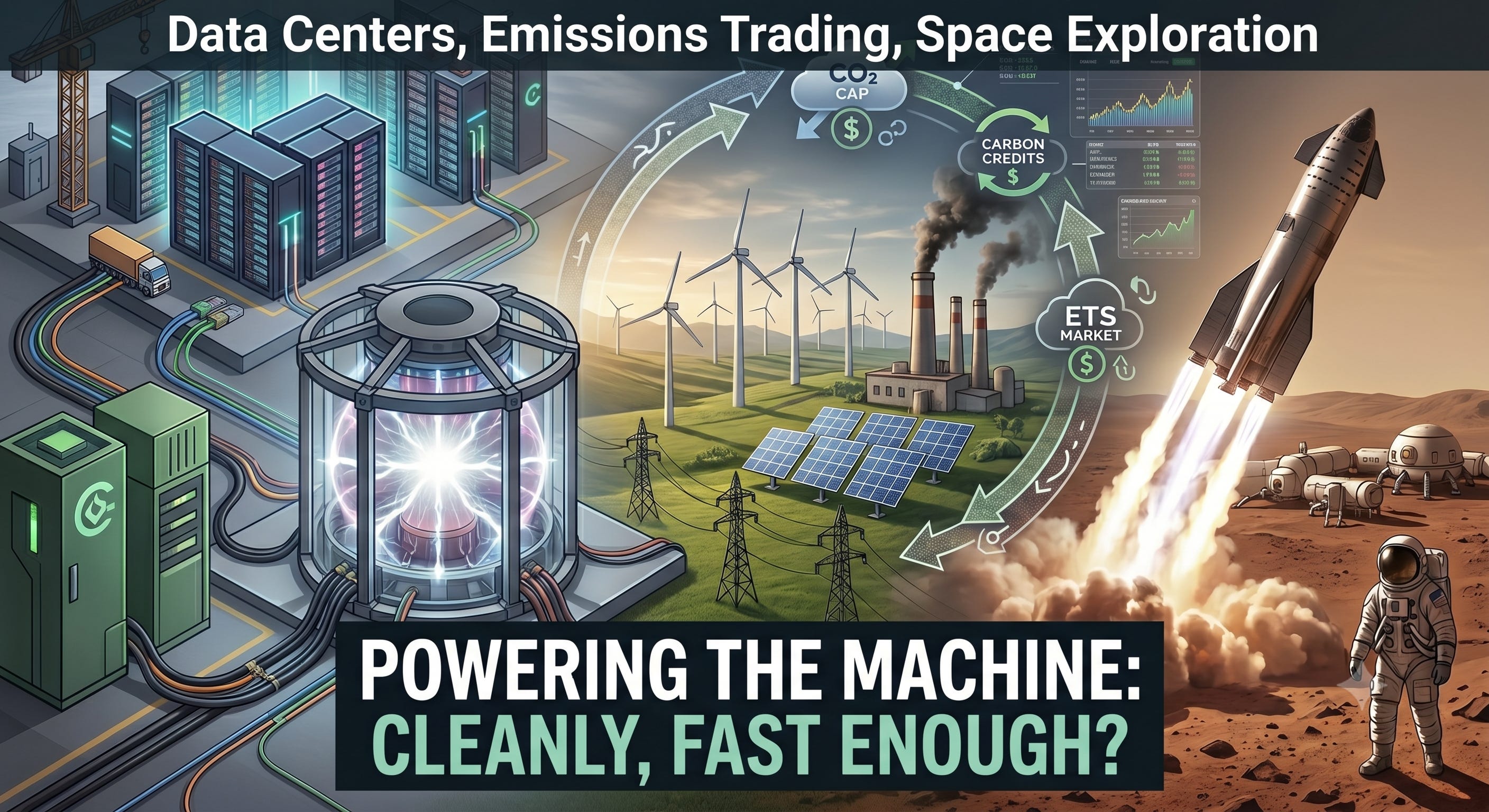
A data-center moratorium, an emissions market, and a Mars resolution all ask the same question: can we power the machine, cleanly, fast enough?
This year hands competitive debaters three resolutions that look like they were drawn from three different universes.
PF Options for September-October
Resolved: The United States federal government should enact a moratorium on hyperscale data center construction.
Resolved: The United States federal government should enact an emissions trading system.
(Likely L-D topic) Resolved: Outer Space Colonization Is a Moral Imperative.
One is a tech-infrastructure fight. One is a climate-economics fight. One is a moral-philosophy fight. They are the same fight.
What welds them together is a fact that wasn’t true five years ago: artificial intelligence has become one of the fastest-growing sources of electricity demand on the planet. Global data-center electricity hit roughly 415 TWh in 2024 — about 1.5% of world consumption — and it has been climbing at a 12% compound rate since 2017, more than four times faster than total electricity demand. The United States is 45% of that market, and the IEA expects American data-center demand to grow 130% by 2030. Anthropic’s own projection is that training a single frontier model will require five gigawatts by 2027, and that the US AI sector will need 50 GW of new capacity by 2028 to stay in front — roughly twice the peak electricity demand of New York City.
Once that’s true, everything reorganizes. Electricity becomes the binding constraint on AI — not talent, not chips, not capital. And the moment electricity is the constraint, any policy lever that touches energy is an AI policy, whether or not it says “AI” anywhere in the text. A moratorium on data centers is an energy policy. An emissions-trading system is an energy policy. And the thing that energy ultimately powers — including, eventually, the machines we would send to colonize Mars — runs on the same constraint.
So here is the single question all three resolutions are really litigating: can we power the AI build-out cleanly, fast enough — or do we have to choose between AI dominance and decarbonization?
The Same Debate, Three Times
A data-center moratorium, an emissions market, and a Mars resolution all ask the same question: can we power the machine, cleanly, fast enough?
This year hands competitive debaters three resolutions that look like they were drawn from three different universes.
Resolved: The United States federal government should enact a moratorium on hyperscale data center construction.
Resolved: The United States federal government should enact an emissions trading system.
Resolved: Outer Space Colonization Is a Moral Imperative.
One is a tech-infrastructure fight. One is a climate-economics fight. One is a moral-philosophy fight. They are the same fight.
What welds them together is a fact that wasn’t true five years ago: artificial intelligence has become one of the fastest-growing sources of electricity demand on the planet. Global data-center electricity hit roughly 415 TWh in 2024 — about 1.5% of world consumption — and it has been climbing at a 12% compound rate since 2017, more than four times faster than total electricity demand. The United States is 45% of that market, and the IEA expects American data-center demand to grow 130% by 2030. Anthropic’s own projection is that training a single frontier model will require five gigawatts by 2027, and that the US AI sector will need 50 GW of new capacity by 2028 to stay in front — roughly twice the peak electricity demand of New York City.
Once that’s true, everything reorganizes. Electricity becomes the binding constraint on AI — not talent, not chips, not capital. And the moment electricity is the constraint, any policy lever that touches energy is an AI policy, whether or not it says “AI” anywhere in the text. A moratorium on data centers is an energy policy. An emissions-trading system is an energy policy. And the thing that energy ultimately powers — including, eventually, the machines we would send to colonize Mars — runs on the same constraint.
So here is the single question all three resolutions are really litigating: can we power the AI build-out cleanly, fast enough — or do we have to choose between AI dominance and decarbonization?
Where the two PF resolutions are the same
Start with what the moratorium and the emissions market share, because it’s the same wall.
The optimistic case on both sides assumes we can build clean, firm power quickly enough to have it both ways — keep scaling AI and cut emissions. The problem is time-to-power. New generation and transmission in the US routinely takes five to seven years to permit and build, with interconnection queues running 40 to 70 months. Meanwhile China added more than 400 gigawatts of new capacity in a single year. That gap — a decade of American permitting against a year of Chinese construction — is the hard constraint sitting under both resolutions.
Nuclear is the answer that solves the technical problem on paper: carbon-free, available around the clock, exactly what a data center that can’t be switched off when the wind dies actually needs. But the US has not historically built nuclear plants on time or on budget, so the near-term gap gets filled by gas. Goldman Sachs models the new capacity serving data-center growth as roughly 60% gas, 40% renewables; Brookings projects 64% of incremental generation through 2035 coming from fossil fuels simply because that’s what can be dispatched now. So the marginal megawatt powering the AI build-out, today, is disproportionately fossil. Both resolutions are arguments about what to do about that.
Where they diverge — and this is the actual essay
They’re built on the same wall, but they push on it from opposite ends, and the difference is the part worth writing about.
A moratorium is the most direct possible hit on AI. It doesn’t price energy or nudge behavior at the margin — it forbids the physical thing AI runs on. And here the training-versus-inference distinction matters more than almost anything else in the debate. Training a model is a one-time, energy-intensive build. Inference is the recurring cost of actually using it — every query answered, every agent run, every classroom, clinic, and business that puts the model to work, every time. Inference is the larger and faster-growing share: by some estimates 80 to 90% of all AI compute is inference, and the IEA projects electricity for AI servers, predominantly inference, growing around 30% a year. Scaling AI into society is, physically, an inference problem, and inference lives in data centers. Cap their construction and you cap the deployment: AI gets slower, more expensive, rationed to whoever can afford the constrained capacity — and at the limit, simply capped. You don’t just slow the labs; you slow everyone downstream who was going to use what the labs built.
It’s also a badly targeted instrument. It stops construction regardless of how clean the power behind it would have been — it blocks a data center fed by a restarted nuclear plant exactly as hard as one fed by a new gas turbine — which makes it at once overbroad (it kills clean capacity along with dirty) and underbroad (it touches none of the rest of the economy’s emissions). And it leaks. The compute demand doesn’t evaporate when you ban the buildings; it relocates offshore, quite possibly onto dirtier grids than the ones it left. The Netherlands has already run a version of this experiment, imposing a nine-month moratorium on new hyperscale permits to assess grid impact. A US version at scale forfeits the capacity and the leverage to make that capacity clean, while global emissions barely move.
An emissions-trading system is a hard cap on total CO₂, applied economy-wide. Unlike a carbon tax — which fixes a price and lets the quantity of emissions float — cap-and-trade fixes the quantity and lets the price float. That feature is the whole game for this debate. If the cap binds, total emissions are fixed, and so long as the grid is still fossil-heavy, that means total available energy is effectively fixed too. Everyone who needs to emit is now bidding against everyone else for the same shrinking pool of allowances.
