

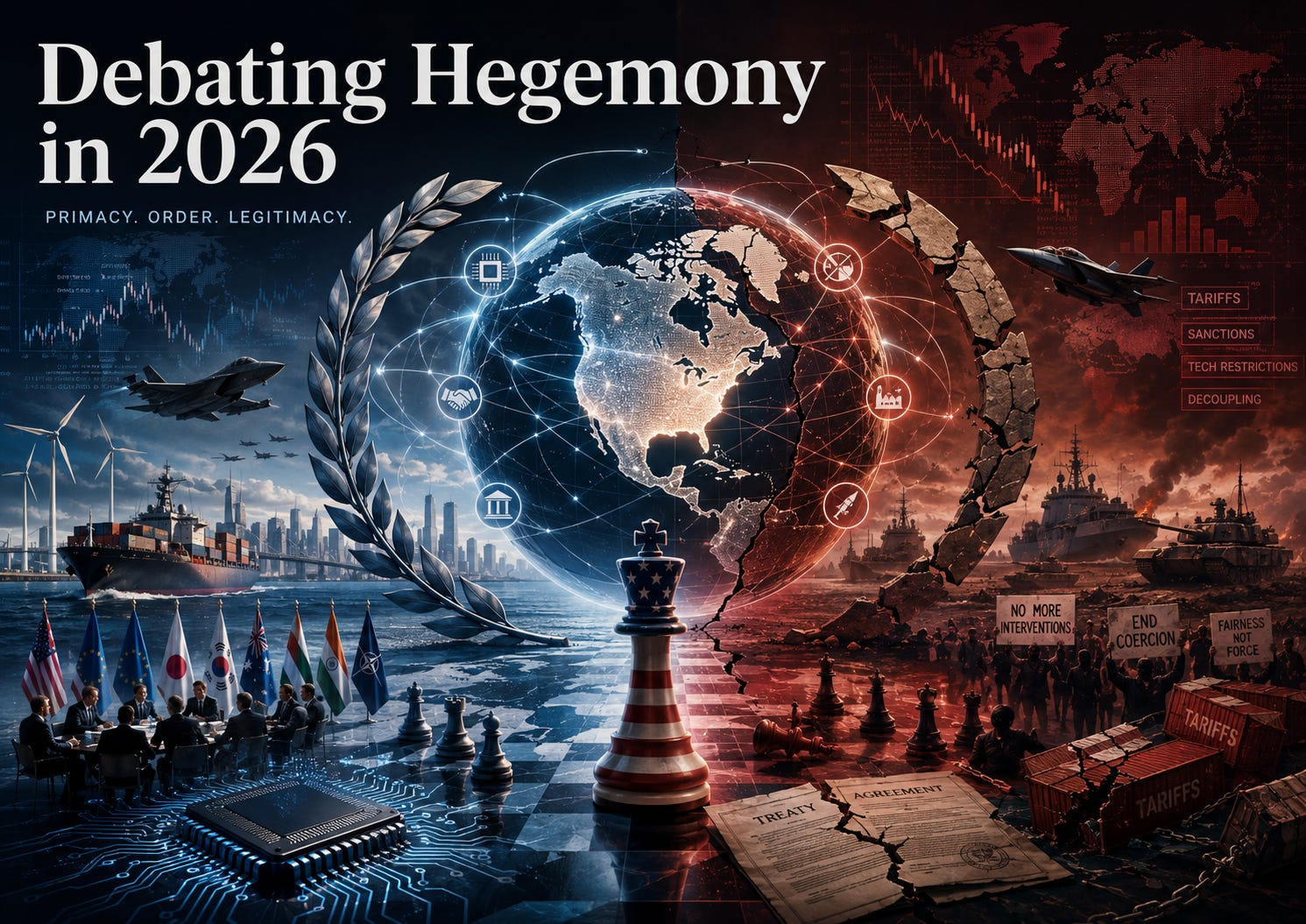
The full argument map for the U.S. leadership debate — every heg-good and heg-bad argument, the six scenarios worth building out on each side, the kritiks, and the grand-strategy choices. Updated for 2026.
Download files Stefan Bauschard
You may also find these files to be helpful
See also — US military force deployments @ DebateUS
What Changed
Hegemony is still the most common advantage you will debate, and you will still hear the same two old scripts. The affirmative says the plan props up American leadership and staves off global war. The negative says American decline is inevitably coming (it’s unsustainable) and the plan only artificially props it up, risking conflict. Throw both scripts out.
The 2026 version of this debate is not decline versus dominance. The United States is still the system’s leading power by almost every material measure that matters, but it now runs that system through coercion and bargaining instead of consent, and the consent half of hegemony is collapsing.
The frame to teach yourself is three words: primacy, order, legitimacy. A state can be first in raw power, lose the ability to organize a stable order, and shed legitimacy all at the same time — and under Trump the United States is doing all three at once.
Primacy is intact, and Trump is wielding it hard — which helps both sides. Raw American power is unmatched, and the networks it sits on top of — the dollar, sanctions, export controls, chips, AI compute, the alliance system — are still the most consequential on earth.
Jamie Dimon (2026) ties military reach, economic weight, and reserve-currency centrality together as a single edifice, and Brooks and Wohlforth (2023) show no rival comes close to that global span.
The declinists are wrong about the material picture, and the affirmative leans hard on it. But “intact” is not automatically an affirmative asset, because the negative contests what the power is for. This administration is not husbanding the advantage; it is spending it, and spending it in two revealing ways. First, it wields force in a manner that makes wars rather than preventing them — regime change in Caracas, a decapitation strike on Tehran, coercion as the default setting.
Second, it wields that same dominance selectively: it has not been spent to push Russia out of Ukraine, where the war has reached year five with U.S. mediation stalled, or to keep global markets open, where the administration runs tariffs and the Mar-a-Lago Accord in place of free trade. So the affirmative gets “the United States still dominates”; the negative gets “it dominates in the service of war and leverage, not the stabilizing goods you are selling.”
To the extent the affirmative protects material power, the world probably gets all the bad and none of the good.
The capacity to organize order is what’s cracking. Primacy is the ability to coerce; order is the ability to get other states to arrange their own behavior around you without being coerced each time — and that machinery is being dismantled on purpose. In short order Washington withdrew from sixty-six international organizations and treaties, dissolved USAID, and rebranded raw hemispheric assertion as the Donroe Doctrine. You can still bomb a capital; you cannot run a rules-based system you are walking out of. Some affirmative teams still claim to protect the “global liberal order,” but the US is walking away from it; we aren’t going to use our power protect something we don’t support.
Legitimacy is the leg in free fall, and it is self-inflicted. Legitimacy is what made American leadership cheap — allies cooperated because they trusted Washington more than they feared it. Two years of transactionalism have liquidated that trust: Pew’s 2025 surveys put U.S. favorability at its lowest since 2017, with double-digit collapses among allies like Canada and Mexico. So allies hedge — even treaty partners now build out their own deterrents — and rivals adapt, coordinating around a hegemon they no longer expect to lead by consent.
Call it networked hegemony under stress: the hard power and the networks are all still there, but the trust and the order-making capacity that turned them into a stable system are draining out. The affirmative says the dysfunction is a correctable error and the plan is the correction; the negative says coercion without stewardship is the new permanent condition and the plan just empowers a flailing regime. That clash is the whole 2026 debate.
The Transactional Turn
Another thing you need to understand is the transactional turn in US policy. The administration’s November 2025 National Security Strategy dropped the “leader of the free world” language for burden-shifting, hemispheric assertion, and open transactionalism — a revival of the Monroe Doctrine that Trump rebranded the “Donroe Doctrine” after the January 2026 operation that captured Nicolás Maduro.
In January 2026 the United States withdrew from sixty-six international organizations and treaties, thirty-one of them UN bodies. Stephen Miran’s “Mar-a-Lago Accord” framework — weakening the dollar and pressuring allies to swap Treasuries for century bonds in exchange for security guarantees — has moved from paper to partial policy.
The State Department stood up Pax Silica, a dozen-country coalition locking down chip, mineral, and AI supply chains. And the February 2026 strikes on Iran that killed Ali Khamenei applied the same posture to the Gulf. None of this is decline — it is structural power exercised through leverage instead of consent. That distinction is the seam the whole debate now runs along.
What Each Side Has to Win
Before you flow a single card, get the shape of the clash. A hegemony advantage is a chain, and the two sides carry very different burdens: the affirmative has to win four links in order, while the negative can win either by snapping any one of them or by carrying its own offense. That asymmetry is the most important strategic fact in this debate — the affirmative has to run the table; the negative picks its path.
The affirmative has to win four things.
Hegemony is sustainable. If primacy is finished anyway, the plan is just an expensive delay and you have conceded the negative’s whole frame. Carry it with Beckley, Kagan, and Brooks and Wohlforth — decline is a choice, and by net power the gap is not closing (the Sustainability section is the full version). The 2026 difficulty: you have to argue the dysfunction — treaty withdrawals, gutted aid, alienated allies — is a correctable error, not a terminal condition.
There are reasons it’s good. Sustainable-but-pointless loses. You need live impacts, and in 2026 that means leading with the families that survive the transactional turn — great-power-war deterrence, nonproliferation, freedom of the seas, the dollar — and not the ones it gutted (the liberal order, human rights, climate, aid). Run goods the current hegemon is actually still providing.
The alternative is worse. Heg-good is a comparative claim; it only matters against what replaces American primacy. You have to win that the realistic alternative — Chinese dominance, Russian expansion, or unmanaged multipolarity — is more dangerous than the status quo. The axis of upheaval makes that concrete and citable; Brands and Beckley give you the authoritarian-order impact and Brooks and Wohlforth the multipolar-instability impact. This is where you beat restraint, offshore balancing, and multipolarity-good.
The transition causes wars. Even granting that primacy ends someday, you argue the descent is violent — power vacuums, proliferation cascades, miscalculation, the scramble to fill the gap. Wright’s “folly of retrenchment” is the card: there is no graceful exit. This is your direct answer to the negative’s managed-decline alternative, and it is the link that collides head-on with the negative’s second burden.
The negative works from a wider menu — one clean break on defense, or its own offense.
It’s not sustainable — and the transition is inevitable. Primacy is in structural, hard-to-reverse relative decline: Layne and Kennedy on overstretch, the debt and manufacturing trajectories, and the self-inflicted 2026 evidence that legitimacy is collapsing even among allies. The sharp version — your point of maximum leverage — is that the descent is inevitable: there is no “keep primacy” button to push, only managing the transition or botching it. Win this and the affirmative’s costs are wasted motion, and your offense below stops being optional and becomes the only question left.
Artificially propping it up is bad. The turn that makes your position offense, not defense. A hegemon clinging to a slipping position lashes out — preventive war, the wrenching adjustment, the peaking-power “now or never” logic (danger-zone, Min-hyung Kim) — while the benefits drain away. You pay the violence and forfeit the returns. Win that clinging produces more violence than a managed transition would, and defend a deliberate descent rather than the cliff.
This hegemon is uniquely dangerous — we will all get killed. Your biggest-magnitude 2026 burden. The claim is not that some hegemon clinging is bad; it is that this one — transactional, unilateral, willing to capture a head of state in Caracas and decapitate Iran’s leadership — is uniquely likely to tip a great-power crisis into catastrophe. The asymmetry (coercion without stewardship), the contradictory Taiwan signaling that invites miscalculation, the shredded norm against conquest, and the security-dilemma spiral all point the same way: the odds of nuclear or great-power war run higher with this hegemon holding on than with a managed handoff. The affirmative’s answer is that you are indicting one administration rather than hegemony itself — so be ready to say it is the posture, not the person, and that lashing-out is the structurally predictable behavior of a declining hegemon, not a quirk of 2026. Do not let them recast the plan as “do hegemony better”; pair this with burden one so there is no corrected version to retreat to.
The alternative is better. You have to win that the realistic alternative — managed retrenchment, offshore balancing, a deliberate multipolar transition — beats clinging. Posen and Mearsheimer and Walt are the architecture; the retrenchment debate is where it gets fought live. This is the burden that answers the affirmative’s “alternative is worse” and “transition causes wars” head-on: you concede a transition is coming and argue a deliberate one is far less violent than the forced, lashing-out version the affirmative’s clinging produces.
The crux. Strip everything else away and the round comes down to the affirmative’s fourth burden against the negative’s second and third: does the violence come from letting hegemony go or from holding on past its expiration? The affirmative says the transition is the bloodbath; the negative says the clinging is — and in 2026 the negative adds that this hegemon makes the clinging uniquely likely to get everyone killed. Whoever owns that question — where the bodies come from — usually wins.
The Heg-Good Argument Map
Twenty-five families, grouped by what they actually do in a round. Each gets a verdict: is it strong in 2026, is it a trap, what beats it. The six worth building into full scenarios get their own section after this; here you get the map.
The Security Core
This is the spine of every heg-good case: great power war prevention, deterrence, regional stability, prevents power vacuums, credibility, and prevents multipolar instability. The through-line is that overwhelming, credible U.S. power keeps revisionists deterred, allies reassured, and vacuums unfilled, and that unipolarity is simply more stable than the multipolar alternative. In 2026 this is your strongest territory because the axis of upheaval gives the deterrence story a live referent and Brooks and Wohlforth’s “Myth of Multipolarity” (2023) gives you the cleanest version of the stability claim — the United States is the only state that can punish revisionists globally, so the system is not actually multipolar.
Run credibility carefully: the interconnection claim (”abandon Ukraine and China moves on Taiwan”) is powerful but the negative will read credibility-is-a-myth defense, so anchor it in Kendall-Taylor and Kofman (2025) rather than asserting it.
Prevents power vacuums is durable and hard to turn — when the United States leaves, someone worse arrives, and the negative has to defend the vacuum.
Prevents multipolar instability is your framing-level argument; pair it with Kagan (2021) that the alternative is “power vacuums, chaos, conflict, and miscalculation.”
Alliances and Nonproliferation
Alliance reassurance and nonproliferation are a single mechanism: U.S. security guarantees keep allies from going nuclear. This is one of the best heg-good arguments you can run because the link is empirically grounded and the impact is enormous. Brooks and Wohlforth’s survey of the deterrence literature shows alliances with nuclear patrons measurably suppress proliferation, and the cascade list — Japan, South Korea, Taiwan, Saudi Arabia, Turkey, Germany, Poland — writes the impact for you. The verdict: do not let this sit as a one-line claim. Build it into the prolif scenario below. It is cleaner than most heg-good impacts because you only have to win the specific dynamic of allied nuclearization, not that hegemony stops every war.
The Theater Scenarios
Prevents Chinese hegemony, prevents Russian expansion, and protects Taiwan are the three theaters where the security core becomes concrete. All three are strong in 2026 and all three have dedicated deep-dives below. The verdict on running them: pick the one your link actually reaches, because a generic “heg deters China and Russia” card loses to a specific “the plan provokes the encirclement” turn. The China and Taiwan scenarios share evidence (Beckley and Brands’ Danger Zone (2022), Colby’s Strategy of Denial, the January 2026 NDS); the Russia scenario runs on Kendall-Taylor and Kofman (2025) and Snigyr (2025).
Order, Trade, and Money
Liberal international order, free trade and economic stability, freedom of the seas, dollar hegemony, and sanctions power are the economic-institutional pillar. Here is the 2026 problem you cannot dodge: do not run the liberal international order version. Your own government just withdrew from sixty-six institutions, so “the plan defends the rules-based order” gets the treaty withdrawals read back at you. Pivot to the harder-nosed versions. Freedom of the seas is excellent and has its own scenario below. Dollar hegemony and sanctions power are strong and current — Dimon (2026) ties military primacy, economic preeminence, and reserve-currency status together explicitly, and sanctions only bite because the United States controls the financial plumbing. Free trade and economic stability is weaker than it was — the hegemon is now running tariffs and the Mar-a-Lago Accord, so the “U.S. keeps markets open” claim is in tension with the facts; run it as open-sea-lanes economics, not free-trade-ideology economics.
Values: Democracy and Human Rights
Democracy promotion and human rights protection are the values pillar, and you should be honest about their weight class. Brands and Beckley (2023) give you a sharp version — a China-led order means authoritarian technology standards, surveillance exports, and a world less safe for democracy, which turns the case against the kritik crowd. That is the strong form. The weak form is humanitarian-intervention rhetoric: human rights protection invites the negative’s best answers (Iraq, Libya, the interventions that made things worse), so do not lead with Kosovo and Bosnia. Use the democracy argument as an impact module on a China scenario, not as a standalone advantage.
Functional Goods: Terror, Climate, Pandemics, Crisis
Counterterrorism, climate cooperation, pandemic response, and crisis response are the transnational-public-goods family, and in 2026 they are mostly weak for the affirmative — which is awkward, because they used to be reliable. The reason is the transactional turn: the government that dissolved USAID and triggered hundreds of thousands of projected deaths from aid cuts, left the WHO, and pulled out of climate bodies cannot easily be the actor that provides global health and climate leadership. Counterterrorism still works as a hard-power argument (bases, intelligence, partnerships keep ISIS and al-Qaeda from holding territory) and crisis response is durable (logistics and reach the United States uniquely has). But climate cooperation and pandemic response are now easier for the negative to turn — the hegemon is the one defunding the cooperation. Run terror and crisis response; be cautious with climate and pandemics unless your plan specifically rebuilds that capacity.
The Tech Domains: AI, Space, Cyber
Technology leadership, space leadership, and cyber stability are the newest and fastest-rising heg-good family. The claim is that U.S. dominance keeps AI, chips, quantum, orbit, and cyberspace developing under democratic rather than authoritarian control. Pax Silica makes the tech-leadership version live and citable. The verdict: these are strong on the link (the United States genuinely leads at the frontier) but watch the double-edge — the same dominance the affirmative calls “stability” the negative calls an “arms race” (see the tech-arms-race turn below), so whoever frames the tech competition first usually wins it. Space and cyber are good impact modules (satellite attacks, debris cascades, grid and nuclear-command disruption) but thin as standalone advantages.
Hegemony Good — Impact Scenarios
The map tells you which arguments are alive. These six are the ones worth building into full chains — setup, internal link, payoff, and how you win the clash.
Taiwan: Denial Fails
The link. China builds the capability and will to take Taiwan; only a credible U.S. denial posture stops it. Beckley and Brands’ Danger Zone (2022) lays out the nightmare — a missile barrage on Taiwan and on Okinawa and Guam, a carrier hit, cyber blackout, amphibious assault, and a president choosing between losing Taiwan and going nuclear. How you win it. Brooks and Wohlforth (2023) is your deterrence-link defense — Taiwan’s GDP is under five percent of China’s, the strait is a hundred miles wide, and a knowledge economy cannot be seized by conquest, so the U.S. military balance really is the thing standing between deterrence and disaster. Be ready for the security-dilemma turn, and for the negative’s 2026 wrinkle that the administration’s own transactional signaling is hollowing out the deterrent it claims to provide; have the modeling debate loaded.
Russia: The Eastern Flank
The link. A reconstituted Russian military tests NATO’s eastern flank once Ukraine freezes. Kendall-Taylor and Kofman (2025) is the anchor — Russian reconstitution is “not an if but a when,” and Moscow moves on a NATO member precisely if it reads American resolve as hollow, most dangerously while the U.S. is pinned in Asia. Snigyr (2025) adds that only forceful deterrence produces peace. How you win it. Loftus (2026) is the fresh uniqueness card — demonstrated U.S. hard power in Iran and Venezuela is already shrinking the coalition that lets Russia withstand pressure, so the deterrent is visibly working now. Expect the encirclement turn in response — Mearsheimer’s “West’s Fault” thesis (2014) that NATO expansion provoked the war — so have your “Russia is greedy, not insecure” answer (Kendall-Taylor and Kofman) loaded.
The Two-Front Squeeze
The link. The axis coordinates, forcing the United States to fight two theaters at once. Ignatieff (2024) is the scenario — a simultaneous offensive against Ukraine and Taiwan the United States could not surge into fast enough. How you win it. This is your answer to “retrench because we’re overstretched” — overstretch is exactly why you cannot signal weakness in either theater. The negative says primacy fused the axis; have the modeling debate ready.
The Proliferation Cascade
The link. U.S. guarantees are what keep allies non-nuclear. Stephens (2022) spells out the dominoes — Japan, then Saudi Arabia and Turkey following Iran — and Brooks and Wohlforth supply the deterrence-suppresses-proliferation link. How you win it. Cleanest scenario on the board because you only have to win allied nuclearization, not universal war prevention. The Khamenei strike makes the Middle East leg live: analysts note the assassination removed the supreme leader who had acted as an internal brake on weaponization, so a humiliated Iran dashes for a weapon and pulls Riyadh and Cairo with it.
The Commons
The link. Freedom of the seas is a public good only the U.S. Navy provides. Bonnar (2020) argues maritime freedom is indivisible — concede the South China Sea and you set the precedent for Hormuz, the Black Sea, and the Arctic. Rapp-Hooper (2020) reframes it as “openness” — preventing any closed sphere that locks the United States out. How you win it. Best scenario for an oceans or trade affirmative because the link is direct and the impact is systemic rather than a single flashpoint.
The Dollar and the Economic Order
The link. Dimon (2026) — military primacy, economic preeminence, and dollar centrality stand or fall together; without American leadership the dollar loses reserve status and the system fragments. How you win it. Use it as a link amplifier paired with a security scenario so the judge sees the pillars reinforcing each other. The negative’s de-dollarization evidence is mostly rhetoric so far; make them show actual displacement.
The Heg-Bad Argument Map
Forty families, grouped. The headline news for 2026: the transactional turn has made the offense-heavy families much stronger and the pure-defense families about the same. Build turns, not just defense.
The Asymmetry: Coercion Yes, Stewardship No
Put this on the flow early, because it ties the whole 2026 heg-bad case together: this administration is enthusiastic about the coercive half of hegemony and has walked away from the cooperative half. It will capture a head of state in Caracas, decapitate Iran’s leadership, and authorize the largest arms package in the history of the Taiwan relationship — but it will not do human-rights promotion, foreign aid, alliance reassurance, or the patient credibility work that actually deters a great-power war. Trump likes the war; he is not interested in the stabilizing goods the affirmative is trying to buy. That asymmetry is your answer to almost every heg-good advantage, because it means those goods are not on the menu in the first place.
Walk the receipts, all from 2026. In Venezuela the January strike removed Maduro but left the same authoritarian government in power under Delcy Rodríguez, with the oil economy cratering — regime change without the democracy that was supposed to justify it. In Iran the decapitation killed Khamenei but analysts at the Quincy Institute argue it may have strengthened the regime by creating a martyr and inflaming anti-American sentiment across the Shiite world, while removing the supreme leader who had acted as an internal brake on weaponization — war that makes proliferation more likely, not less. On Taiwan the Center for American Progress observes the administration is arming the island for a war it has signaled it has no interest in fighting, and Colby himself calls Taiwan “important” but not “existential” — transactional signaling that erodes the very deterrence the heg-good case depends on. On foreign aid the picture is starkest: with USAID dissolved, modelers attribute hundreds of thousands of projected deaths to the PEPFAR and humanitarian cuts, and the comfortable assumption that other donors would step into the gap simply has not held. Even the Ukraine “diplomacy” delivered a symbolic three-day Victory Day ceasefire while Secretary Rubio conceded real mediation has stagnated.
The strategic payoff: when the affirmative claims hegemony delivers deterrence, nonproliferation, human rights, global health, or alliance reassurance, you do not have to argue those goods are bad. You argue they are no longer being provided, so the advantage has no uniqueness — the United States is spending the costs of primacy without buying the stabilizing benefits. The coercion is real and turnable (modeling, blowback, the security dilemma); the stewardship is gone. Run both halves at once.
Hegemony Causes War
Hegemony causes war, nuclear escalation, preventive war, endless war, and arms races are the core impact-turn family — the claim that dominance manufactures the conflict it claims to prevent through constant intervention, forward deployment that creates flashpoints, and the incentive of a declining hegemon to lash out. In 2026 this is your best territory, because the Venezuela operation, the Donroe Doctrine, and the Iran strikes are the vivid unilateralism link the turn always wanted. Preventive war has its own deep-dive (Min-hyung Kim 2020 on the declining-hegemon variant). Endless war is durable but watch Carafano (2019), who argues there are no actual endless wars and weakness invites aggression — the aff will read it. Arms races and nuclear escalation are best as internal links into a specific flashpoint, not standalone impacts.
Encirclement and the Security Dilemma
China containment causes war, Russia encirclement causes war, and the security dilemma are the structural-realist family, and they are the strongest causal turns you have. The mechanism is Glaser’s (2024) — when you face an insecure state rather than a greedy one, the moves you call defensive read as offensive, and deterrence policies backfire. The argument writes itself: Taiwan arms, AUKUS, the Quad, the bases, and missile defense look like encirclement to Beijing, and the Quincy Institute (2023) argues the U.S. posture in Asia provokes “otherwise avoidable, hostile counter-balancing and costly arms racing,” raising the chance of great-power war. The nuclear version is the Arms Control Association’s (2024) “security paradox” — a self-perpetuating spiral as each side reads the other’s modernization as a threat. For the Russia leg, Mearsheimer’s “Why the Ukraine Crisis Is the West’s Fault” (2014) is the canonical NATO-expansion-provoked-it card. The verdict: this is your cleaner companion to modeling for an Asia round — instead of arguing the United States greenlights others, you argue it provokes the specific war the affirmative fears. The affirmative’s best answer is that China and Russia are greedy, not insecure — Mearsheimer’s own “Inevitable Rivalry” (2021) cuts against you here, arguing the rivalry is structural and deterrence is the only option, and a 2025 Foreign Affairs response sharpens that line. Mind the double-bind with your own defense: you cannot say China is easily deterred and that it is being provoked into breakout. Pick the spiral.|
Overstretch, Decline, and Balancing
Overextension, hegemony is unsustainable, legitimacy decline, and balancing are the decline family.
Overextension and unsustainability are the classic Kennedy/Rome story — too many commitments, not enough resources, a snap rather than a glide (Layne 2012). Be honest: the material overstretch card is weaker in 2026 than in 2014, so run it as offense (”the plan clings and burns resources,” see the deep-dive) not as a confident prediction of collapse.
Legitimacy decline is your best argument in this family and the heart of the 2026 case, and it now has hard current numbers behind it: Pew’s 2025 Global Attitudes survey found U.S. favorability fell to its lowest level since 2017 while China’s rose, and a companion Pew release recorded double-digit favorability collapses in allies — Canada from 54 to 34 percent, Mexico from 61 to 29 percent. Concede the hard power and attack the consent, because the erosion is political and self-inflicted.
Balancing is real but mostly in its soft form: hedging, BRICS expansion (Indonesia joined as a full member in 2025, with a wave of partner states and new local-currency payment rails built to dodge sanctions), de-dollarization, and China-Russia-Iran cooperation. Read it honestly, though — the same analysis shows the hard version stalling: Trump’s threat of 100 percent tariffs scared BRICS off a common currency, leaving de-dollarization “highly fragile.” Read soft balancing and hedging; the hard-balancing-coalition-against-America version still loses because no one is actually pulling it off.
Empire and Blowback
Imperialism, blowback, the terrorism turn, regime change bad, humanitarian intervention bad, bases bad, drone warfare bad, international law violation, and human rights hypocrisy are the empire family — the largest and most internally consistent block on the heg-bad side. The spine: U.S. power is not neutral leadership but empire, exercised through bases, sanctions, regime change, and force, and it generates resentment, radicalization, and the very terrorism it claims to fight.
In 2026 the international law and regime change versions are unusually live — capturing a head of state in Caracas and decapitating Iran’s leadership are textbook material. The verdict: these are strong as impact turns and as kritik links, but the affirmative has a real answer in Deudney and Ikenberry (2015), who argue the United States is the first anti-imperial great power that drove global decolonization — so do not assume the empire framing is uncontested. Human rights hypocrisy (Saudi Arabia, Egypt, past dictatorships) is best as a soft-power/legitimacy internal link, not a terminal impact.
The Home Front
Military-industrial complex, domestic tradeoff, and democracy-at-home tradeoff are the inward-facing family. The MIC argument (threats inflated to justify spending) and the tradeoff (dominance dollars could fund healthcare, infrastructure, climate) are evergreen and play well in front of lay judges, but they are weak terminal impacts against a nuclear-war scenario — a competent affirmative outweighs on magnitude. The democracy-at-home version (secrecy, executive war powers, surveillance, fear-based politics) is the most interesting of the three in 2026 because the same administration expanding hemispheric force is testing domestic constraints, so the link is fresh. Run these as case-defense and tradeoff offense, not as your headline impact.
The Kritiks
Racism/colonialism, capitalism/neoliberalism, anti-Blackness/settler colonialism, and the feminist/security kritik are the critical family, and they function differently from the policy turns — the link is the affirmative’s representations and assumptions, the impact is structural violence, and the alternative is a rejection or reorientation rather than a policy. The racism/colonialism link (the war on terror, “failed state” rhetoric, treating the non-Western world as a space to manage and bomb) traces to Hemmer and Katzenstein and is the most portable. The cap kritik (IMF structural adjustment, debt dependency, extraction) and the security kritik (hegemony rests on masculine domination; real security is care and ecological survival) round it out. The verdict for the policy debater: you will mostly be answering these, and the affirmative answers are well developed — Deudney and Ikenberry on anti-imperialism, Karlson (2021) that capitalism is sustainable and the alt touches off transition wars and elite backlash, and the classic alt-fails/no-praxis answers (Condit, McCormack) that abstract rejection produces violence or nothing rather than change. If you are reading the K, your burden is the alternative; if you are answering it, make them defend what the world looks like the day after the rejection.
Economic Coercion
Sanctions bad, dollar hegemony bad, and development bad are the economic-harm family. Sanctions bad (civilian suffering, entrenched regimes — Iran, Cuba, Venezuela, 1990s Iraq) is a strong, concrete turn with a clean impact and is harder for the affirmative to outweigh than the kritiks.
Dollar hegemony bad (financial coercion breeds resentment and drives de-dollarization) pairs with the balancing argument and is rising in relevance as the Mar-a-Lago Accord deliberately weaponizes the dollar; analysts trace the post-2022 de-dollarization push directly to that weaponization, which is your best current link.
Development bad (Western institutions force austerity and dependency) is more of a kritik link than a standalone. Run sanctions and dollar-coercion; treat development as support.
Environment
Environmental destruction and the climate cooperation turn are the ecological family. The direct version (the military is a massive emitter, bases pollute, war wrecks ecosystems) is true but a weak terminal impact. The stronger version is the cooperation turn: hegemony intensifies great-power rivalry, and a United States and China that treat each other as enemies cooperate less on climate, so primacy worsens warming. In 2026 this turn has more bite because the rivalry is sharper and the United States left the climate bodies. Run the cooperation turn, not the emissions accounting.
The Tech Arms Races
AI/military tech arms race and space militarization are the mirror image of the heg-good tech family. The claim: U.S. dominance in military AI, autonomous weapons, cyber, and orbit pushes rivals to race, lowering the threshold for conflict and ceding human control over escalation. Pax Silica and the chip war make the AI version live (see the tech-pre-emption deep-dive). Space militarization (anti-satellite weapons, debris cascades, nuclear-command disruption) is a good internal link into faster, less-controllable crises. Run these as accelerants into an existing conflict scenario, not as terminal impacts on their own.
Alliance Pathologies
Allied free-riding and moral hazard are the alliance-dysfunction family, and they are the most useful heg-bad arguments that are not impact turns. Free-riding (allies underinvest because the U.S. covers them) is now partly endorsed by the U.S. government itself — Colby’s whole denial strategy is built on making allies spend more — so you can read the administration’s own posture as evidence. Moral hazard (guarantees make allies reckless — Taiwan provokes China, NATO states harden against Russia, Gulf states act aggressively expecting backup) is the sharper turn because it gives you a war scenario the affirmative’s own solvency causes. Run moral hazard as offense; use free-riding to support restraint.
Hegemony Bad — Impact Scenarios
The six turns worth building into full chains.
Modeling: The Greenlight
The link. When the hegemon discards the norm against territorial coercion and regime-change-by-force, it hands revisionists a permission slip. Operation Resolve, the Donroe Doctrine, and the Iran decapitation each erode the exact norm Brooks and Wohlforth (2023) admit makes conquest costly.
The payoff. China reads it toward Taiwan, Russia toward Ukraine, and the hegemon has no standing to condemn either.
How you win it. Your single best 2026 turn — the link is the affirmative’s own government, on the front page. Their answer is “norms favor the U.S.”; yours is that norms only bind when the norm-setter follows them.
Power Transition: Clinging Causes the War
The link. Min-hyung Kim (2020) — power-transition theory cuts both ways, and the initiator can be the declining power that prefers preventive war to accepting decline; pair with Layne (2012).
The impact. U.S.-China hegemonic war driven by Washington.
How you win it. The plan is the clinging. You need offense on relative decline (China’s manufacturing share, debt trajectory) to beat Kagan’s “the U.S. isn’t actually declining” card.
The Security Dilemma
The link. Beijing reads the ring of bases, alliances, and Taiwan policy as encirclement, so every assertion of primacy feeds the breakout spiral — Glaser (2024) on the insecure-state dynamic, the Quincy Institute (2023) on provoked counter-balancing, and the Arms Control Association (2024) on the nuclear version.
The impact. The posture sold as deterrence produces the war.
How you win it. Cleaner than modeling for an Asia round — you provoke the specific war rather than greenlighting others. Watch the double-bind with your deterrence defense; pick the spiral.
Tech-Race Pre-emption
The link. Pax Silica and the AI-and-chips race split the world into a U.S. bloc and an excluded China, shortening decision timelines toward first-strike logic. The payoff. A lowered conflict threshold in whatever theater the race is hottest. How you win it. Read it as the accelerant into your conflict scenario, not the explosion. Pairs with the security dilemma.
Overstretch: The Wrenching Adjustment
The link. Posen (2013) and the overstretch literature — propping up unsustainable commitments sets up a sudden, disorderly collapse, Britain after 1945, vacuums faster than anyone can fill.
The impact. The chaotic transition the affirmative fears, caused by the affirmative’s own spending.
How you win it. This is the discipline that loses rounds when debaters forget it: you defend restraint, not collapse. Posen and Mearsheimer and Walt both keep a capable military in reserve. Never defend the cliff.
Blowback and Soft Balancing
The link. Primacy exercised through force generates resistance — anti-Americanism, soft balancing, asymmetric and nuclear offsets to U.S. conventional dominance — that erodes the leadership it projects.
The impact. Proliferation and slow strangulation of influence, even without a hot war.
How you win it. Converts the affirmative’s own soft-power internal link against them. Weaker as a terminal impact, so run it as support for modeling, not your headline.
The Sustainability Debate
This is its own axis, and you should run it as one. Every other section argues whether hegemony is good; this one argues whether it lasts — and what happens if Washington tries to hold a position it can no longer afford. The affirmative says primacy is sustainable and the plan is the course-correction that keeps it that way. The negative says primacy is finished, and propping it up artificially buys a great deal of violence without the benefits. A lot of rounds are decided on which of those two stories the judge believes, so build the block for it.
The affirmative: sustainable, and the plan is the correction. Your anchor is Beckley’s Unrivaled (2018) — measure net power instead of gross GDP and the declinist story falls apart: the United States is the only great power with no regional rival, the best demographics and energy position of any major economy, the deepest capital markets, and universities and alliances no rival can match. Kagan (2021) adds that decline is a choice, not a fate, and Brooks and Wohlforth (2023) that the system is not actually sliding into multipolarity. The move that wins the round is framing judo: concede the dysfunction the negative points at — overstretch, free-riding allies, a hollowed industrial base, eroded trust — and argue the plan is precisely the correction that makes primacy durable, not the doomed clinging the negative describes. Daalder and Lindsay (2022) and Zelikow (2022) are your proof of concept — the order looked finished before Ukraine and the West rallied. Declinism has been wrong for fifty years; bet against it again.
The negative: not sustainable, and the propping-up is the violence. Your anchor is Layne (2012) on the end of Pax Americana, backed by Kennedy’s overstretch classic — relative decline is structural: China’s manufacturing and shipbuilding base, the U.S. debt trajectory, domestic polarization, the diffusion of technology. But the decline claim alone does not win the debate; the turn does. Power-transition theory cuts toward the declining power, not just the rising one — Min-hyung Kim (2020) shows a hegemon facing decline has the incentive to launch a preventive war while it still can, and the peaking-power logic the danger-zone literature applies to China — act now or miss the chance forever — cuts against a clinging America just as hard. So the chain is: the plan props up a position the United States cannot hold, which buys lashing-out now and a wrenching adjustment later — and it buys all of that without the benefits, because the legitimacy and consent that made primacy cheap are already draining away. You pay empire’s violence and forfeit its returns. The alternative is managed decline — adjust deliberately now rather than snap later.
How the clash resolves. Both sides concede something is broken; they split on whether the plan fixes it or just postpones a bloodier reckoning. Frame it as correction versus clinging and make the other side own the hard half. The 2026 evidence is the negative’s exhibit A — the asymmetry above, coercion without stewardship, is exactly what violent propping-up looks like in real time: a hegemon spending force to hold its position while the stabilizing goods evaporate. Two traps to avoid. Affirmative: do not run “we are unrivaled and sustainable” next to “without the plan, collapse” — pick a lane, because the panic undercuts the confidence. Negative: do not let the affirmative turn you into the collapse scenario; you defend a managed descent (Posen, Mearsheimer and Walt), never the cliff.
The Grand-Strategy Menu
These are the “middle” arguments — the named strategies and the framing claims both sides reach for. Know the vocabulary cold, because judges do.
Deep engagement is the academic name for the pro-hegemony grand strategy: forward presence, standing alliances, active leadership. That is what the affirmative defends. Restraint and offshore balancing are the two alternatives. Restraint (Posen) cuts commitments, avoids regime change, and shifts burden to allies. Offshore balancing (Mearsheimer and Walt 2016) passes the buck to local powers and intervenes only when a regional hegemon is about to emerge. Selective engagement is the moderate middle — stay active in Europe, East Asia, and the Gulf, but not everywhere. Multipolarity good (Acharya‘s territory) argues distributed power means more diplomacy, more Global South autonomy, and checks on U.S. overreach. The verdict for the negative: pick restraint or offshore balancing as your alternative and defend the transition, never the collapse — and know the heg-good side now has a direct rebuttal in Foreign Affairs’ “Should America Retrench?” (2025), which argues offshore balancers wave away proliferation and misread the Cold War record.
The framing claims cut across both sides. Hegemony is inevitable and hegemony is resilient are affirmative tools — the United States has geography, allies, capital markets, universities, energy, demographics, and military reach no rival matches, and Daalder and Lindsay (2022) and Zelikow (2022) argue the post-Ukraine moment proved the order’s resilience. Hegemony is already declining is the negative’s mirror — China’s rise, debt, polarization, failed wars, and alternative institutions; the full version of that clash has its own section just above. The most useful distinction in 2026 is primacy versus leadership: coercive military primacy is not the same as cooperative leadership, and the negative’s sharpest framing is that the United States now has the first without the second. That is the whole debate in four words.
Will the U.S. Even Do It
The oldest negative solvency argument — the United States has the capability but will not use it the way the affirmative needs — cuts in a strange new direction in 2026. On the use-of-force side it is dead: this administration will use military power unilaterally, so do not argue it will sit on its hands — and that actually helps your hegemony-bad turns, because it proves the aggression is real. On the public-goods side it is stronger than ever: the United States has shown it will not reliably provide aid, institutional stewardship, or multilateral leadership, which is gold for your soft-power and legitimacy answers. Split it. Concede American willingness to coerce, deny American willingness to lead, and feed the two halves into different parts of your strategy.
Mind the interaction. If you go for the impact turns (hegemony causes war) you cannot also win that the United States will never act aggressively — the solvency take-out kills the turn. If you go for the solvency take-out (the United States won’t project power) you give up the turns. Pick a lane in the block, and make a nuanced affirmative choose between a big impact you can turn and a small impact you can take out.
Where to Cut Cards
The think tanks: Brookings, Carnegie, CSIS, CFR, CNAS for the axis-of-upheaval material, and the Atlantic Council and Eurasia Group for Pax Silica and Donroe. The journals: Foreign Affairs, Foreign Policy, International Security, The National Interest, The Washington Quarterly.
For the affirmative, anchor on Brands, Colby, and Kendall-Taylor and Fontaine for threat framing, then Kagan, Brooks and Wohlforth, and Dimon for the “primacy prevents collapse” impacts; for the K answers, Deudney and Ikenberry, Karlson, and Wright. For the negative, build off Posen, Mearsheimer and Walt, and Layne for the alternative, Min-hyung Kim for power transition, and the modeling and security-dilemma turns for offense. Track the events, because uniqueness moves week to week: the November 2025 National Security Strategy, the January 2026 NDS, the sixty-six-organization withdrawal, the Venezuela operation, and the Iran strikes. As of spring 2026 the aftershocks are the live cards: Venezuela’s Rodríguez government has survived with the oil economy in free fall, Iran has moved through an opaque succession to Mojtaba Khamenei, the foreign-aid death toll keeps climbing even after Congress restored a partial $50 billion, the contradiction between Taiwan arms sales and transactional signaling is sharpening ahead of a Trump-Xi summit, Ukraine has reached year five with mediation stalled, and whatever Pax Silica and the Mar-a-Lago Accord become. The team that cuts the newest card on whether American primacy is producing order or producing chaos usually wins the hegemony debate, and in 2026 that card is being written in real time.
Vocabulary
The terms you need to use correctly to sound like you know the literature. Grouped so you can find them fast.
Grand strategy — what to do with the power
Hegemony — one state’s preponderance of power in the system; here, U.S. global leadership. Not the same as empire (direct rule over others); the affirmative leans on that distinction.
Primacy — being the single most powerful state. It is the material fact, separate from how the power gets used — which is why “primacy is intact” does not by itself win the round for either side.
Deep engagement — the pro-hegemony grand strategy: forward military presence, standing alliances, active leadership. What the affirmative defends.
Restraint — cutting commitments, avoiding regime change, shifting burden to allies, relying on diplomacy (Posen).
Offshore balancing — pass the buck to local powers and intervene only if a regional hegemon threatens to emerge (Mearsheimer and Walt).
Selective engagement — stay active in the regions that matter (Europe, East Asia, the Gulf), not everywhere.
Retrenchment — deliberately reducing global commitments; “managed decline” is the careful version the negative defends, as opposed to collapse.
Burden-sharing / burden-shifting — pressing allies to pay or do more; the premise of the 2026 National Defense Strategy.
Multilateralism — acting through institutions, alliances, and coalitions, with others’ buy-in. This is the consent half of hegemony — the order-making machinery the sixty-six-organization withdrawal walked away from.
Unilateralism — acting alone, on your own authority, without allied or institutional sign-off. The 2026 default: Venezuela and Iran were run this way, and the negative reads it as proof the order leg is gone — primacy exercised without legitimacy.
Power and polarity
Unipolarity / bipolarity / multipolarity — one dominant power (the post-1991 “unipolar moment”), two (the Cold War), or three-plus great powers. The affirmative calls multipolarity unstable; the negative calls it freer.
Balance of power — states aligning to stop any one state from dominating; the engine behind “balancing.”
Hard power / soft power — coercion (military, economic) versus attraction (legitimacy, values, the appeal of your model). The 2026 story is hard power up, soft power down.
Net vs. gross power — Beckley’s distinction: subtract the costs of running a huge population and economy, and China looks far weaker than GDP suggests.
Relative vs. absolute decline — losing ground compared to rivals versus getting weaker outright. The United States is, at most, in relative decline — a key affirmative point.
Core theory and mechanisms
Security dilemma — defensive moves look offensive to a rival, who arms in response, and the spiral runs (Glaser).
Spiral model vs. deterrence model — is the rival insecure (so de-escalate) or greedy (so deter)? The entire China and Russia debate turns on which one you pick.
Power transition theory — war risk peaks as a rising power nears the dominant one; crucially, it cuts toward the declining power too, which may launch a preventive war (Min-hyung Kim).
Thucydides Trap — Graham Allison’s label for the war risk when a rising power threatens a ruling one.
Peaking power / danger zone — Brands and Beckley’s thesis that a power which has peaked and is sliding is more dangerous than a rising one, because it acts on “now or never.” The negative borrows the logic and points it at a clinging America.
Offensive vs. defensive realism — do great powers maximize power (Mearsheimer) or seek just enough security to survive (Waltz)? Decides whether China’s rise is inherently threatening.
Imperial overstretch — commitments outrunning the resources to sustain them; the classic decline mechanism (Paul Kennedy, The Rise and Fall of the Great Powers).
Blowback — the unintended hostile reaction to intervention: resentment, radicalization, anti-Americanism.
Soft balancing / hard balancing / hedging — resisting the hegemon without arms (diplomacy, institutions, de-dollarization) versus military build-up and counter-alliances versus simply keeping your options open. In 2026 the real-world version is mostly soft balancing and hedging.
Modeling / norm erosion — when the hegemon breaks a norm (say, against conquest), rivals read it as permission to do the same.
Deterrence and alliances
Deterrence by denial — make the adversary’s objective physically unachievable; Colby’s Taiwan strategy.
Deterrence by punishment — threaten costs so high the adversary won’t try, even if it could win.
Extended deterrence — stretching your protection over an ally (the “nuclear umbrella”); the mechanism that keeps allies non-nuclear.
Credibility — the belief that you will actually honor commitments; underwrites the interconnection claim (”abandon Ukraine and China doubts us on Taiwan”).
Moral hazard — guarantees make protected allies reckless because they expect backup.
Free-riding — allies underinvest in their own defense because the United States covers them.
Nonproliferation cascade — allies (Japan, South Korea, Saudi Arabia, others) going nuclear if they stop trusting the umbrella.
The 2026 proper nouns
Transactional turn — running hegemony through coercion and bargaining instead of consent; the through-line of the current administration’s posture.
Networked hegemony — power exercised through the networks the United States sits on top of: the dollar, sanctions, export controls, chips, AI compute, the alliance system.
Donroe Doctrine — Trump’s hemispheric-assertion revival of the Monroe Doctrine, named after the Venezuela operation (Eurasia Group).
Pax Silica — the U.S.-led coalition locking down chip, mineral, and AI supply chains (State Department).
Mar-a-Lago Accord — Stephen Miran’s framework: weaken the dollar and press allies to swap Treasuries for long-dated bonds in exchange for security guarantees (CFR).
Axis of upheaval (a.k.a. CRINK) — the loose China-Russia-Iran-North Korea alignment (Kendall-Taylor and Fontaine, CNAS).
Strategy of Denial — Elbridge Colby’s 2021 book and the intellectual core of the 2026 NDS: deny China a quick, decisive win over Taiwan.
National Security Strategy (NSS) / National Defense Strategy (NDS) — the November 2025 and January 2026 documents that codified the transactional, denial-focused, burden-shifting posture.