

Interested in evidence and more resources? Subscribe to DebateUS!
Why this debate is live right now
For a decade the question of U.S. aid to Syria was an argument about how to help people around a hostile regime. That framing is gone. Assad fell in December 2024, and the question now is whether to fund a transition led by a former jihadist the United States still lists as a terrorist.
Two things scrambled the old positions at once. First, the U.S. walked away. After the January 2025 foreign-aid freeze and the dismantling of USAID, stabilization programming in Syria was terminated and humanitarian activities were paused — some later restarted under State Department management, others ended — and the FY2026 budget request contained no specific amount for Syria. This from the country that had been the single largest donor to the Syria response, roughly $17 billion since 2012 and over $1.1 billion in 2024 alone. “Increasing” aid, in 2026, means reversing that withdrawal.
Second, the U.S. lifted the hammer it had held over Syria for years. On December 18, 2025, the NDAA for FY2026 repealed the Caesar Syria Civilian Protection Act, the sanctions regime that had blocked reconstruction financing — the first repeal action following al-Sharaa’s November 10, 2025 visit to the White House, the first by a Syrian head of state since independence in 1946. So the cheaper, market-based tool is already deployed. That changes what additional grant aid is being asked to do.
The need is not in dispute. UN OCHA puts 16.5 million Syrians — nearly 70% of the population — in need of humanitarian support, the World Food Programme lists Syria among its 18 “hunger hotspots” for 2026, and the 2025 UN appeal of $3.2 billion was only about 36% funded. What is in dispute is whether more American grant money helps or hurts at this particular hinge.
The Case FOR increasing aid (Pros)
The proponents’ best ground is timing: a uniquely high-need, high-access, low-cost moment to lock in influence and prevent collapse.
1. The marginal life-saving value is unusually high. With 70% of the population in need and the appeal barely a third funded, dollars now buy survival rather than marginal improvement. The UN relief coordinator estimated the global system could save 87 million lives in 2026 on $23 billion by concentrating on those in greatest need — Syria is squarely in that highest-need tier, and a withdrawn donor leaving a one-third-funded appeal is the gap most directly measured in deaths.
2. This is emergency relief, which even aid’s sharpest critics exempt. The strongest academic case against aid carves this out explicitly. The Deaton/Worstall critique of foreign aid concedes that when disaster strikes, aid should be freely given — the argument is about development aid, not emergency aid. Syria’s crisis — famine-risk hunger, mass displacement, destroyed hospitals — is the emergency category, not the long-horizon transfer category. Most of the canonical anti-aid evidence targets multi-decade development flows in Africa, not famine-level relief in an active crisis.
3. Access is finally open, so aid can actually reach people. Under Assad, aid was throttled at the border and barred from huge swaths of territory. Now, for the first time in years, international NGOs can move across the whole country, including areas long closed to expatriates. The standard objection that aid never reaches intended recipients is weaker here than almost anywhere, because the access constraint that defined the Assad years has lifted.
4. Aid is the cheapest remaining instrument of U.S. influence. The U.S. has finalized the redeployment of its forces out of Syria and handed bases to the interim government. With troops gone and sanctions lifted, humanitarian assistance is one of the few levers left to shape a transition that Saudi Arabia, Turkey, and Qatar are already moving to dominate. Ceding the field entirely forfeits leverage over governance, minority protection, and counterterrorism cooperation.
5. Stability is a counterterrorism and migration interest, not charity. A failed Syrian transition means renewed refugee outflows toward Europe and a vacuum ISIS exploits — a live risk given the unresolved Al-Hol camp and ISIL detainee-transfer problems in the northeast. Aid that keeps water, power, and hospitals running in return areas is stabilization spending with a direct national-security payoff, not pure humanitarianism.
6. Reconstruction needs a stable floor first, and only aid provides it. The World Bank estimates reconstruction will cost roughly $216 billion. Private investment and trade — the tools sanctions relief unlocked — will not flow into a country where people are still starving and displaced. Humanitarian aid is the precondition that makes the investment case viable, not a competitor to it.
7. Conditioned aid can buy reform the market won’t. The model is already visible: the EU committed €620 million for 2026–2027 explicitly conditioned on progress on stability and governance. Aid with strings is a tool to extract minority protections and inclusive-governance commitments from a government that wants legitimacy — leverage that vanishes the moment the U.S. is purely a bystander.
The Case AGAINST increasing aid (Cons)
The opponents’ best ground is that this is exactly the wrong moment to make a fragile new state dependent on external transfers — and that the cheaper, better tool was already used.
1. Aid undermines the state capacity Syria is trying to build from scratch. This is the sharpest objection, and Syria is the textbook case. The Deaton/Worstall argument holds that when aid is large relative to a government’s own budget, the state needs no contract with its citizens, no parliament, and no tax-collection system — and aid undermines the development of local state capacity. Syria is designing its institutions right now, under a constitutional declaration that already concentrates power in the executive with no checks. Flooding that moment with external grants lets the al-Sharaa government skip the hard, accountability-building work of taxing and answering to its own people — the one thing that actually produces a functioning state.
2. Aid makes capturing the government worth fighting for — in a country already killing over it. Dambisa Moyo’s core finding in Dead Aid is that aid is easy to steal because it goes directly to governments, and it makes control over government worth fighting for. Syria’s transition has been marked by sectarian massacres of Alawite and Druze civilians by government and allied forces in March and July 2025. Pouring resources through a contested center raises the prize for whoever controls the spigot — potentially financing, not dampening, the intercommunal violence everyone says they want to prevent.
3. The money gets physically stolen. This is not theoretical. Even tightly tracked health commodities get diverted: USAID’s own inspector general found millions of dollars of antimalarial drugs stolen and resold on the black market, with arrests for reselling U.S.-issued drugs and separate USAID money-laundering schemes. Syria today has a fragmented state apparatus and armed factions still being integrated — diversion conditions are worse here than in the African cases where the theft was documented.
4. Aid crowds out the recovery tool already deployed. The Birdsall/Rodrik/Subramanian argument in Foreign Affairs is that development is largely determined by countries themselves, outside aid has only a limited ability to trigger growth, and the energy spent on aid crowds out other ways rich countries could do more good. For Syria the “more good” tool — sanctions relief — has already been delivered with the Caesar repeal. The opportunity-cost case is that the U.S. should let private investment and trade do the work now, rather than substituting grant dependency for the market reintegration it just unlocked.
5. Multiplying donors fragments an already-fractured response. The same authors warn that recipient countries get overwhelmed by a multiplicity of donors with inconsistent objectives, which contributes to rather than offsets a lack of institutional capacity. Syria already shows the pathology: 2025 funding was split, with over half of declared funding recorded outside the coordinated UN plan, illustrating the fragmentation of flows. More uncoordinated U.S. money risks adding noise rather than relief.
6. Aid finances a government that has not met basic governance benchmarks. Al-Sharaa remains a U.S.-designated terrorist, and a bipartisan bloc in Congress argues his government has more to prove on inclusive governance, minority protection, and religious freedom. Increasing grant aid before those benchmarks are met spends the leverage the pro side wants to use — you don’t get to both fund unconditionally and hold reform hostage to the funding.
7. The dependency trap is structural, not a delivery problem. Moyo’s broader claim is that aid functions like a resource curse — the most aid-dependent countries showed negative average growth, and African poverty rose during the peak-aid decades. Even reformers concede the deeper point: the UN’s own envoy urged accelerating Syria’s economic reintegration specifically to reduce its long-term dependence on humanitarian assistance. A larger, sustained U.S. transfer cuts directly against that goal — the better Syria’s aid pipeline, the longer it can avoid building a self-sustaining economy.
8. Aid is not a substitute for state-led services — and pretending it is delays the handoff. The UN’s relief chief made the point against his own side: aid is not a substitute for state-led services. Humanitarian partners reaching 200,000 people a month is a stopgap, and a generous external stopgap reduces the pressure on Damascus to stand up its own service delivery. The con read: every month the U.S. runs the hospitals is a month the Syrian state doesn’t have to learn how.
9. Volatility makes U.S. aid an unreliable foundation anyway. The deeper structural critique is that donor aid is volatile and uncertain, making it hard for recipient governments to plan budgets — and the U.S. just proved the point by freezing and dismantling its entire aid apparatus in 2025. Building Syria’s recovery around a donor that lurches from $1.1 billion to near-zero and back invites exactly the planning chaos that deepens, rather than resolves, the crisis.
How to Weigh It
The strongest pro is the emergency exemption: this is famine-and-displacement relief in a newly accessible country, the one category even aid’s harshest critics say should be funded freely. The strongest con is the state-capacity trap: this is the precise moment a new state’s institutions are forming, and external grants let it skip the accountability-building that makes a state real — while raising the prize for the factions already killing over control.
The crux is categorization plus counterfactual. The whole dispute turns on which bucket “increasing aid to Syria” falls into. If it is emergency relief keeping people alive while access is open, the pro case is very strong and the file’s best evidence concedes it. If it is a quasi-development transfer to a fragile, unaccountable, corruption-prone new government at the exact moment its institutions and its sectarian balance are being set, the con case lands — and the fact that sanctions relief and private investment are already in play means the marginal grant dollar is no longer the only thing standing between Syrians and recovery.
To win, the pro side has to believe that lives saved now outweigh institutions distorted later, and that conditioned aid can buy reform faster than market reintegration can. The con side has to believe that the recovery tools already deployed — sanctions relief, regional investment, returning trade — are enough to carry the humanitarian load, and that a fragile state is better forced to build its own capacity than cushioned into dependency on a donor that has already proven it will leave.
One honest caveat on the evidence base: the canonical anti-aid sources (Moyo 2009, Deaton 2015, Birdsall/Rodrik/Subramanian 2005, the 2017 theft reporting) are about sub-Saharan African development aid, not Syrian emergency relief, and a sharp pro advocate will press both the dated-and-off-topic objection and Deaton’s own emergency carve-out. The con arguments are strongest when their mechanisms are explicitly mapped onto Syria’s 2026 facts — the untested government, the sectarian massacres, the fragmented funding, the volatility the U.S. itself just demonstrated — rather than left as generic claims that aid is bad.
Source List (grouped by theme)
Syria’s current situation and government
HRW World Report 2026: Syria — al-Sharaa transition, constitutional declaration concentrating power, Alawite and Druze massacres
House of Commons Library: Syria one year after Assad — humanitarian situation — 16.5M in need, WFP hunger hotspot, reconstruction and sanctions
House of Commons Library: Syria one year after Assad — interim government — integration agreements, “visible relief” framing
UN OCHA: Syrian Arab Republic — 70% of population in need, 2026 response plan
U.S. aid posture and the cuts
CRS: Syria — Transition and U.S. Policy — USAID stabilization terminated, humanitarian paused, FY2026 request, 36% appeal funding
Refugees International: Beyond the Fall — $17B since 2012, $1.1B in 2024, largest single donor, the cut “lifeline”
Syria Direct: U.S. funding freeze — January 2025 freeze, USAID absorbed into State, life-saving waiver
USAFacts: U.S. foreign aid to Syria — FY2024 obligations
Center for Global Development: Humanitarian assistance needs more U.S. finance — 2026 appeal, 87M lives on $23B, funding collapse
Sanctions relief
Curtis: U.S. Repeals the Caesar Act — NDAA Section 6211, repeal mechanics, al-Sharaa White House visit
Just Security: Caesar Act Repeal report card — sanctions-relief sequence, $216B World Bank reconstruction figure
The Hill / AOL: Pressure on Mast over Syria sanctions — al-Sharaa still designated terrorist, congressional caution on governance
UN/regional response and access
Security Council Report: Syria April 2026 — aid not a substitute for state services, 200K/month, reduce dependency
Security Council Report: Syria May 2026 — U.S. troop redeployment, 2026 HNRP launch
Security Council Report: Syria February 2026 — Al-Hol camp, ISIL detainee transfers, SDF integration
Défis Humanitaires: Syria one year after Assad — NGO access restored, funding fragmentation, EU €620M conditional
The anti-aid evidence base (from the provided file)
Worstall / Deaton, Forbes (2015) — state-capacity erosion, the emergency-vs-development carve-out, resource-curse dependency
Moyo, Dead Aid (2009), via the Ferguson foreword — corruption, aid as prize worth fighting for, negative growth correlation (note: the file reproduces this as a card; the load-bearing claims overlap the Deaton source above)
Birdsall, Rodrik & Subramanian, Foreign Affairs (2005) — development is internally determined, crowding out, donor fragmentation, volatility
Simons, Los Angeles Times (2017) — antimalarial drug theft, USAID money-laundering cases
Note on the file: the provided document also contains a Post & Banihashemi card on the Israel-Iran war (”if the U.S. stops, Israel continues”). It concerns the regional war’s escalation dynamics, not humanitarian-aid mechanics, so it is not load-bearing for this brief and is not folded into the arguments above.
Bill Analysis: A Bill to Provide Aid to Syria to Reform and Rebuild Syria
The brief above is the evidence base. This section works the specific legislation — what it does, the case each side runs, cross-examination, the drafting and logic problems, and how to play it in chamber. Terminology follows Congressional Debate convention: advocates argue the bill should pass, opponents argue it should not. This analysis integrates a second provided breakdown of the same bill; where verification corrected a figure in that draft, the correction is noted in the open.
A correction that runs through the whole analysis. A widely circulated breakdown of this bill puts the five-year total at “$22 billion.” That figure is wrong. The bill commits $10 billion in 2027 plus $4 billion per year across 2028, 2029, 2030, and 2031 — four years, not three. The correct total is $26 billion ($13 billion humanitarian, $13 billion government). The error matters because the scale-mismatch argument below is built on the total; rebuilt on the right number, the argument is slightly stronger, not weaker.
What the bill does
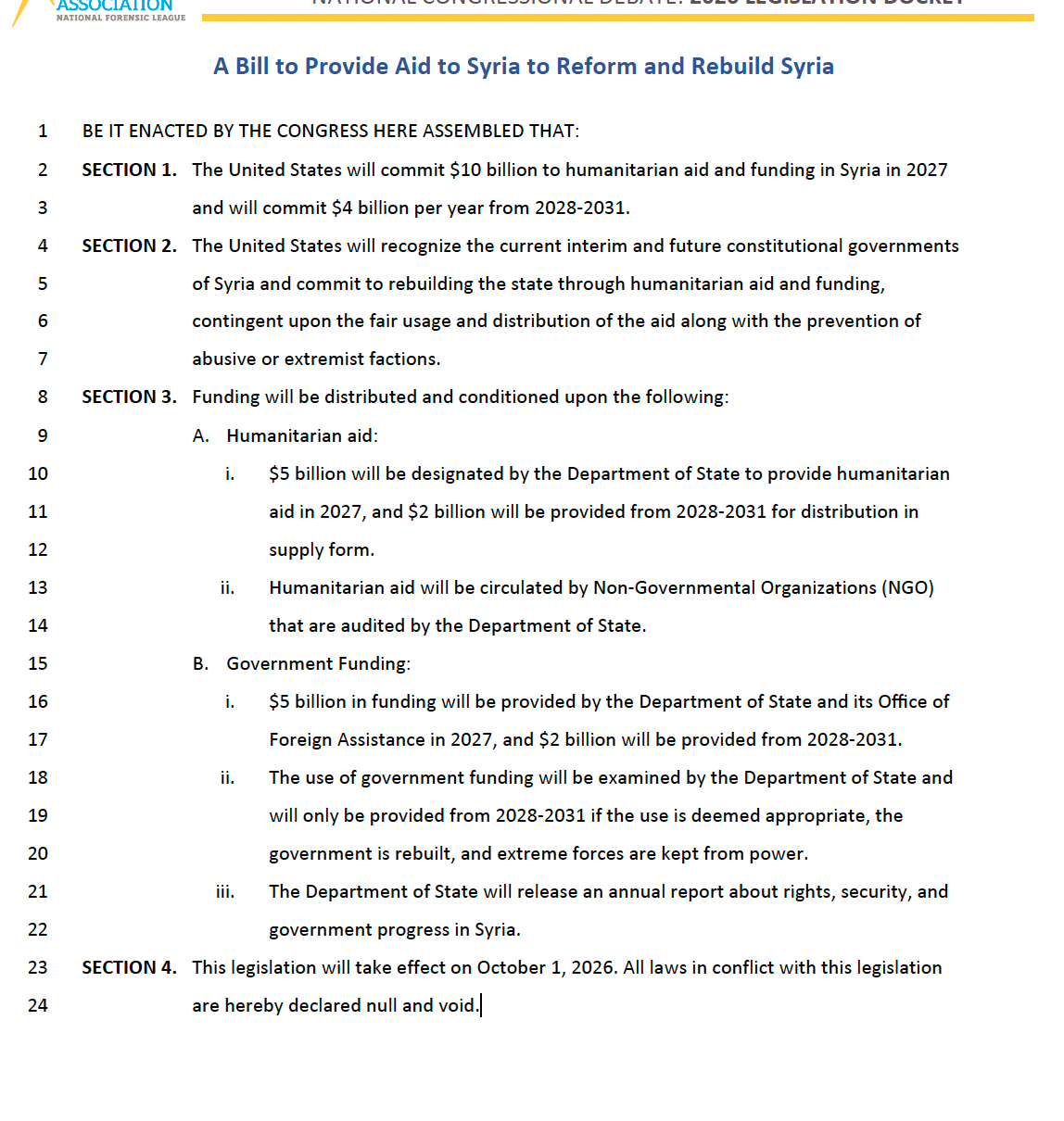
The bill authorizes $10 billion in 2027 and $4 billion per year from 2028 through 2031 — $26 billion over five years — split evenly each year between two streams, both run by the Department of State. The humanitarian stream ($5 billion in 2027, $2 billion annually thereafter) is distributed “in supply form” through NGOs that State audits. The government stream ($5 billion in 2027, $2 billion annually thereafter) flows through State’s Office of Foreign Assistance. The bill directs the United States to recognize Syria’s interim and future constitutional governments, gates the 2028–2031 government tranche on a State finding that the money was used appropriately, the government is “rebuilt,” and “extreme forces” are kept from power, and requires an annual State report on rights, security, and governance. It takes effect October 1, 2026, and voids all conflicting law.
The strongest case for the bill
The advocates’ best ground is that the executive branch has already moved in this direction, the strategic stakes are real, and the bill attaches more conditionality than most aid programs carry.
The first argument is that the policy is already in motion, and the bill simply supplies the structure the executive actions lack. Assad fell in December 2024; the U.S. terminated its comprehensive Syria sanctions program by Executive Order 14312, signed June 30, 2025 and effective July 1, 2025; and Congress permanently repealed the Caesar Act in the FY2026 NDAA in December 2025. Advocates argue the bill operationalizes a direction both branches have already endorsed — it builds the appropriations architecture the executive orders never could, turning a posture into a program. This is the advocates’ single best framing, because it casts the bill as ratifying settled policy rather than gambling on a new one.
The second argument is the strategic vacuum. Syria’s stabilization is the precondition for refugee return, for keeping ISIS contained in the SDF-held detention camps that still hold tens of thousands of fighters and family members, and for limiting Russian and Iranian re-entry into the Levant. The scale of the displacement is the stake: per UNHCR, over 1.4 million refugees and 1.7 million internally displaced people have returned since December 2024, while internal displacement remains around 5.5 million. Advocates argue a coordinated U.S. package gives Washington leverage to shape the transition rather than ceding the field to adversaries who fueled the war.
The third argument is that the conditionality is unusually rigorous. The bill separates humanitarian funding (through audited NGOs) from government funding (gated on appropriate use, reconstruction progress, and exclusion of extremist factions), with annual State reporting on rights, security, and governance. Advocates argue this is more structured conditionality than most U.S. aid programs carry, and the humanitarian half never touches the government at all — which lets them answer the bad-actor objection by pointing to the NGO firewall and the annual off-ramp.
The strongest case against the bill
The opponents’ best ground is uncomfortable on the facts: the bill bets $26 billion on a designation reversal barely a year old, the conditionality doesn’t bind the money that matters, and it commits the U.S. to recognize a government that doesn’t yet exist. There is also a clean procedural objection most of the chamber will miss.
The first argument is the HTS-history problem. Interim president Ahmed al-Sharaa led the al-Qaeda-affiliated Jabhat al-Nusra before it rebranded as Hay’at Tahrir al-Sham, and HTS’s foreign-terrorist-organization designation was removed only in July 2025 — while al-Sharaa himself remains on the Specially Designated Nationals list pending review. The opponents’ point is that the bill commits $26 billion over five years to a government led by a man who was a designated terrorist roughly a year before it takes effect, and that the track record of comparable post-conflict reconstruction bets — Iraq, Afghanistan, Libya — is poor. Even with the Section 3 conditionality, this is a large wager on the durability of one man’s transformation.
The second argument is that the conditionality is a mirage on the money that counts — and this is the finding the circulated breakdown missed. Read Section 3.B closely: the examination gate (”appropriate use,” “government rebuilt,” “extreme forces kept from power”) applies, by its own terms, only to the 2028–2031 tranche. The first $5 billion in direct government funding goes out in 2027 with no conditionality check at all — the single largest government transfer in the bill is unconditioned, paid before a word of the first annual report is written. An opponent who quotes that clause beats the “rigorous conditionality” framing on the text itself.
The third argument is the recognition problem. Section 2 commits the U.S. to recognize the “current interim and future constitutional governments of Syria,” but Syria operates under a March 2025 constitutional declaration that concentrates power in the executive with no checks — there is no settled constitutional government yet, and no certainty about the form a future one takes. Opponents argue recognition is a serious diplomatic act that ordinarily depends on knowing what government you are recognizing, and the bill pre-commits to one that does not exist. There is a constitutional layer beneath this: recognition of foreign governments is the President’s exclusive power. In Zivotofsky v. Kerry (2015) the Supreme Court held that the recognition power belongs to the President alone and “disables Congress from acting upon that subject”. A statute directing recognition is the one foreign-affairs move the Court has squarely said Congress cannot make.
The fourth argument is the minority-protection gap. The transition has included documented sectarian massacres of Alawite and Druze civilians by government and allied forces. Opponents argue that reconstruction aid without robust minority-protection conditionality risks funding a government presiding over that violence, and the Section 3 “extreme forces” language addresses factions taking power, not atrocities committed by the receiving government itself. The condition is pointed at the wrong actor.
The fifth argument is procedural and is the cleanest opposition point because most of the chamber reads past it. The bill is an authorization speaking as if it were an appropriation — “the United States will commit $10 billion” does not move money through the appropriations process. Worse, Section 4 voids “all laws in conflict with this legislation.” Direct government funding to a person still on the SDN list runs into federal material-support-for-terrorism law; the “null and void” clause would have to silently repeal those statutes, the designation itself, and ordinary appropriations law — an overreach a careful opponent can hold up as proof the drafters did not think through what “conflict” sweeps in.
The sixth argument is enforcement capacity. The bill makes State the auditor of $13 billion in NGO supply flows and the examiner of $13 billion in government funding, after the 2025 freeze gutted the U.S. aid workforce and folded what remained into State. The agency assigned the monitoring lacks the staff to do it, which makes the conditions unenforceable in practice even where they exist on paper.
Cross-examination questions
Questions for advocates to ask opponents. “Section 3 lets State suspend funding annually on the government’s conduct — given the sectarian-violence record you cite, what’s your alternative to engagement: Russian and Iranian re-entry and ISIS resurgence in the SDF camps?” “The U.S. removed sanctions by executive order in July 2025 and Congress repealed the Caesar Act in December 2025 — are you arguing the U.S. should now reverse its own diplomatic posture?” “You say $26 billion is too small against a $216 billion need — why is seed funding that catalyzes allied and private investment worthless because it isn’t the total?” “You attack the conditionality as too discretionary — wouldn’t rigid conditions tie the government’s hands in a fluid transition, and isn’t executive flexibility a feature there?” “The brief’s own anti-aid economists exempt emergency relief — do you dispute that famine-risk hunger for 70% of the population is an emergency?” “Saudi Arabia, Turkey, and Qatar are funding Syria regardless — how does U.S. abstention do anything but hand them the influence?”
Questions for opponents to ask advocates. “Point me to the language conditioning the 2027 government tranche — or do you concede the first $5 billion in government funding goes out with no check?” “Al-Sharaa is still on the SDN list; how does the bill fund his government without violating material-support law, given Section 4 would have to void that statute?” “The government’s own forces committed the Alawite and Druze massacres — under your bill, are they the ‘extreme forces’ the aid is conditioned on excluding, or the recipient of it?” “Section 2 commits the U.S. to recognize a ‘future constitutional government’ that doesn’t exist yet — what exactly are you recognizing, and what if that future government is worse than the interim one?” “Recognition is the President’s exclusive power under Zivotofsky — what’s your authority for Congress directing it by statute?” “The World Bank puts the need near $216 billion and your bill funds $26 billion with no coordination provision for EU, UK, or Gulf aid — how does a tenth of the need keep Russia and Iran out?” “After USAID was dismantled, what’s your evidence State can audit $13 billion in supply flows?”
Drafting and definitional traps
The undefined terms carry the conditionality and none is pinned down. “Abusive or extremist factions” and “extreme forces” decide when the money stops, yet neither is defined, leaving State open-ended discretion that makes the multi-year commitment far less binding than it looks. “The government is rebuilt” is a funding trigger with no threshold — nothing says when a government crosses from un-rebuilt to rebuilt. “Fair usage and distribution” (Section 2) sets no measurable bar. “In supply form” reads like a safeguard but imports its own problem: large-scale in-kind dumping is the mechanism behind the brief’s mosquito-net example, where free imported goods put local producers out of business, so the phrase chosen to prevent cash diversion invites market distortion instead. Section 2’s recognition commitment reaches a “future constitutional government” that does not yet exist, which is not how diplomatic recognition works. The bill says nothing about coordinating with the EU, UK, and Gulf-state reconstruction efforts that would have to supply the rest of a $216 billion need — an omission that is operationally serious, not cosmetic. And the split-tranche structure is the trap a close reader springs: the conditions in 3.B.ii are drafted to bite only on 2028–2031, leaving the biggest single payment, the 2027 tranche, to flow unexamined. “All laws in conflict with this legislation are hereby declared null and void” is the catch-all that sounds tidy and is a liability — pressed on what laws conflict, advocates must either disclaim the terrorism statutes (gutting their own mechanism) or own repealing them by implication.
Logical flaws
The first flaw is that the conditionality undercuts the bill’s own selling point. Advocates pitch a multi-year, $26 billion commitment as a durable signal that anchors Syria to the West. But Section 3 lets State suspend the government funding whenever conduct isn’t “appropriate,” the country isn’t “rebuilt,” or “extreme forces” gain influence — all undefined. A commitment suspendable at executive discretion on undefined triggers is not the binding anchor advocates describe; it is an annual grant dressed as a guarantee. Advocates cannot claim both that the bill is a strong durable signal and that the conditionality adequately protects the investment — the more real the off-ramp, the weaker the signal, and the reverse. They have to pick one.
The second flaw is a scale mismatch that breaks the theory of impact, and it survives the figure correction. The advocates’ frame is that U.S. money fills the vacuum and keeps Russia and Iran out. But the World Bank puts reconstruction near $216 billion and the bill funds $26 billion — about twelve percent — while saying nothing about coordinating the allied and Gulf funding that would have to supply the rest. If the geopolitical logic is “outspend the rivals for influence,” an eighth of the need with no coordination mechanism does not obviously achieve it; the vacuum could persist after the U.S. has spent $26 billion. The mechanism is too small for the stated objective, and the corrected total ($26 billion rather than the circulated $22 billion) does not close that gap.
The third flaw is that the recognition provision recognizes a blank. Section 2 pre-commits the U.S. to recognize a “future constitutional government” whose composition, conduct, and constitution are unknown. Diplomatic recognition attaches to actual governments; pre-committing to one that does not exist is recognition of nothing in particular. It also sits in direct tension with the Section 3 conditionality — the bill unconditionally pre-commits recognition while reserving the right to suspend support based on how that same government behaves. You cannot unconditionally recognize and conditionally fund the identical entity without saying which provision controls when the government behaves badly, and the bill never says.
Verdict / how to play it
This bill rewards the speaker who knows the transition has already happened — sanctions lifted by executive order in July 2025, the Caesar Act repealed that December, an interim government engaged by much of the world and hosted at the White House. A speaker still debating “should we engage post-Assad Syria” as a hypothetical will sound a year behind; the live question is whether to commit $26 billion to this particular government now. The chamber will saturate on the advocacy side — the humanitarian images are vivid and “conditions and audits” reads as responsible — which makes the competent opposition speech the one that breaks.
If you are advocating, lead with the already-in-motion framing and the strategic-vacuum argument, and use the NGO firewall to answer the bad-actor objection — the humanitarian half never touches the government, so the terrorism and recognition attacks hit only half your case. Get ahead of the absorptive-capacity and scale numbers before opponents reach them: concede $26 billion is aggressive, reframe it as catalytic seed funding, and put the burden on opponents to defend doing nothing while rivals move in.
If you are opposing, do not argue against Syrian reconstruction in the abstract — the emergency-relief carve-out blunts it and the chamber has heard it. Argue that the bill bets $26 billion on a designation reversal barely a year old without conditionality that reaches the documented harms. Your three sharpest moves, in order: the split-tranche catch (the 2027 government tranche escapes its own conditions — textual, specific, and the one point the circulated analysis missed), the minority-protection gap (the “extreme forces” language points at the wrong actor when the government itself committed the massacres), and the recognition problem (you cannot recognize a government that does not exist, and under Zivotofsky Congress cannot direct recognition at all). The highest-leverage single point on each side: for opponents, the 2027 tranche is unconditioned; for advocates, the civilian humanitarian stream is severable from the government stream the opposition spends all its time attacking. Cross-apply the brief’s crux — this turns on whether the chamber reads the bill as emergency relief or as a development-and-state-building transfer. Advocates live in the first frame; opponents win in the second.
A note on sourcing for the chamber
Several load-bearing facts here come from law-firm client alerts and a foreign-government research service (the UK House of Commons Library), which are accurate and citable but are secondary.
For a final round, cite the primary instead: Executive Order 14312 itself for the July 1, 2025 sanctions revocation, the CRS product Syria: Transition and U.S. Policy (RL33487) for U.S. policy and aid figures, UNHCR’s own operational reporting for the displacement and return numbers, and HRW’s World Report 2026 and the UN Commission of Inquiry materials for the sectarian-violence record.