

Orientation. The chamber will want to debate “should the president be able to start wars without Congress” — and framed that way the advocates win, because the constitutional answer is no and the public agrees. But that is not what the bill decides. Reasserting Congress’s war power is the easy part; the bill’s real test is its mechanism — using the power of the purse to automatically defund “unauthorized” military action, enforced by OMB and Treasury, with a 15-day emergency window. The power of the purse is the right tool in principle, and far stronger than the toothless War Powers Resolution, but the bill hands enforcement to executive agencies that answer to the president, never says who decides an action is “unauthorized,” and gives genuine emergencies a window so short it could hamstring a legitimate response. The round turns not on whether Congress should control war, but on whether this machinery actually does it — and the side that pins down the enforcement gap and the 15-day problem controls the room.
Part I — The Policy Pro/Con Brief
Why this debate is live right now
The war-powers fight is not theoretical — it just happened. On June 22, 2025, the United States struck three Iranian nuclear sites (Operation Midnight Hammer) without congressional authorization, and war-powers resolutions introduced by Senators Kaine and Representatives Massie and Khanna to require congressional approval were defeated, with members of both parties calling the strikes a constitutional violation. The bill lands directly on that controversy.
The existing legal framework is widely seen as broken. The War Powers Resolution of 1973 requires the president to notify Congress within 48 hours and bars forces from staying beyond 60 days without authorization, but presidents of both parties have circumvented it — Obama claimed it didn’t apply to the 2011 Libya campaign — and the 1983 decision in INS v. Chadha gutted its concurrent-resolution withdrawal mechanism, leaving Congress needing a veto-proof supermajority to force a withdrawal. Meanwhile the 2001 AUMF has been stretched across two decades and many countries far beyond its original target.
There is also a serious bipartisan reform model. The National Security Powers Act, introduced by Senators Murphy, Lee, and Sanders, would sunset existing AUMFs, require an automatic sunset on future authorizations, and cut off funding for unauthorized action — the same architecture this bill uses, in more developed form. That a real, bipartisan version exists is both the bill’s pedigree and the benchmark against which its gaps show.
The Case FOR the Bill (Pros)
The advocates’ best ground is that the Constitution gives Congress the war power, that the power of the purse is the strongest tool to reclaim it, and that recent events prove the need.
The Constitution puts war with Congress. Article I gives Congress the power to declare war; a statute reasserting that against decades of executive drift is constitutionally grounded, not a power grab.
The power of the purse is the right lever. Unlike the War Powers Resolution’s reporting requirements that presidents ignore, cutting off funding is Congress’s hardest constitutional power and the one presidents cannot simply wave away.
Recent events prove the need. The 2025 Iran strikes without authorization show the status quo lets presidents wage war unilaterally, and the bill responds to a live, demonstrated problem.
AUMF sunsets kill zombie authorizations. Requiring reauthorization every two years prevents the 2001 AUMF problem — an authorization stretched for twenty years far beyond its purpose by presidents of both parties.
It mirrors a serious bipartisan bill. The approach tracks the Murphy-Lee-Sanders National Security Powers Act, so it’s a credible reform, not a fringe idea.
It preserves genuine emergency response. The 15-day emergency window lets the executive act first when truly necessary, while forcing a return to Congress quickly rather than open-ended war.
The Case AGAINST the Bill (Cons)
The opponents’ best ground is that the enforcement mechanism is structurally toothless, the bill never says who decides what’s “unauthorized,” and the 15-day window is dangerously short.
Executive agencies can’t enforce against the executive. OMB and Treasury answer to the president, so directing them to defund the president’s own military action assumes they’ll defy their boss — a separation-of-powers problem that makes the mechanism weak.
No one is assigned to decide “unauthorized.” The bill never says who adjudicates whether an action lacks authorization, and a president will always claim his action is authorized, so the trigger may never fire.
The 15-day window is too short for real emergencies. Genuine crises — repelling an attack, a hostage rescue, a fast-moving conflict — may need more than 15 days; the War Powers Resolution allows 60, and an artificially short fuse could force withdrawal mid-operation.
Gridlock could lapse an AUMF mid-conflict. Requiring reauthorization every two years means a deadlocked Congress could let an authorization expire during an ongoing campaign, stranding deployed forces.
The constitutional question cuts both ways. Whether Congress can compel the executive to defund the commander-in-chief’s ongoing operation is contested, and Chadha-era doctrine complicates congressional control mechanisms.
It’s underspecified next to the real model. The Murphy-Lee-Sanders bill includes detailed expedited procedures and definitions this bill omits, so its enforcement is far vaguer than the serious version.
How to Weigh It
The strongest pro is that the Constitution assigns war to Congress, the power of the purse is the one tool presidents can’t ignore, and the 2025 Iran strikes prove the status quo fails. The strongest con is that the bill routes enforcement through agencies that answer to the president, never names who decides an action is “unauthorized,” and sets a 15-day emergency window that could hamstring a legitimate response.
The crux is whether the bill’s machinery actually constrains the executive or just restates an aspiration the War Powers Resolution already failed to enforce. If the room debates the principle, advocates win — Congress should control war. If opponents show the enforcement runs through the president’s own agencies, lacks an adjudicator, and risks tying the military’s hands in a real emergency, the bill looks like a stronger idea than the WPR with weaker plumbing. Advocates must argue the funding cutoff is self-executing enough to bite. Opponents must argue that without an independent trigger and a workable emergency window, it’s the WPR’s enforcement problem in new clothes.
Source List (grouped by theme)
The current framework and its failures
Oxford Journal of Legal Analysis — Reassessing the Legislative Veto (INS v. Chadha and war-powers enforcement)
The 2025 trigger
The reform model
Part II — Congressional Debate Bill Analysis
What the bill does
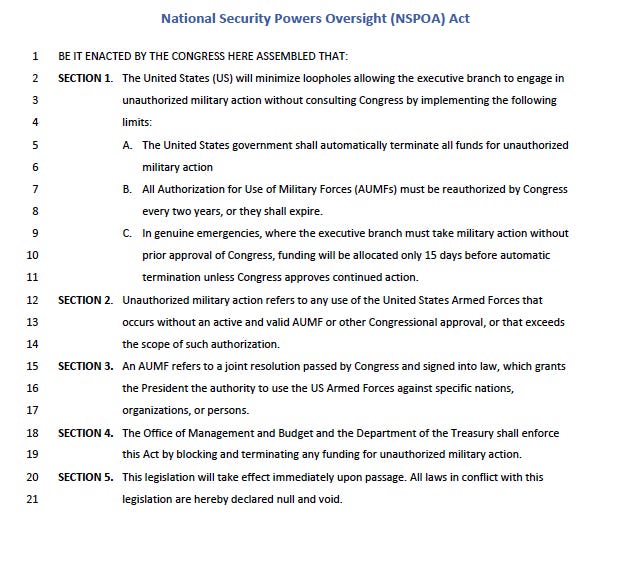
The bill limits unilateral executive war-making by automatically terminating funds for “unauthorized military action,” requiring AUMFs to be reauthorized every two years or expire, and giving emergency action 15 days of funding before automatic termination unless Congress approves. It defines unauthorized action as force without a valid AUMF or that exceeds its scope, and tasks OMB and Treasury with blocking and terminating the funding. It takes effect immediately and voids conflicting laws. The factual baseline both sides start from: the War Powers Resolution already governs this and is routinely circumvented, the 2025 Iran strikes show the gap, and a more developed bipartisan version — the National Security Powers Act — already exists.
The strongest case for the bill
The advocates’ best ground is constitutional and immediate — so lead with the Iran strikes and Article I, the part the chamber accepts.
The first argument is the constitutional allocation. Article I gives Congress the war power, and the 2025 Iran strikes without authorization show how far the executive has drifted from it, so reasserting it is overdue.
The second argument is the power of the purse. Cutting funding is stronger than the War Powers Resolution’s reporting requirements presidents ignore — it’s the one war-power lever the executive cannot simply claim doesn’t apply.
The third argument is the AUMF sunset. Two-year reauthorization prevents the 2001 AUMF problem of a single authorization stretched across two decades and many conflicts.
The fourth argument is the pedigree. The approach mirrors the bipartisan Murphy-Lee-Sanders National Security Powers Act, so it’s a serious, cross-ideological reform.
The fifth argument is emergency flexibility. The 15-day window lets the executive act first in a true crisis while forcing a quick return to Congress instead of open-ended war.
The sixth argument is public backing. After the Iran strikes, a strong majority of Americans wanted congressional authorization for further military action, so the bill tracks public sentiment as well as the Constitution.
The strongest case against the bill
The opponents’ best ground is the enforcement architecture — lead with the executive-agency problem and the missing adjudicator, then the 15-day window.
The first and sharpest argument is the procedural catch most of the chamber will miss: the enforcers answer to the president. OMB and Treasury are executive agencies, so a bill that tells them to defund the president’s own military operation assumes they’ll defy their boss — the mechanism is structurally toothless.
The second argument is the missing trigger. The bill never says who decides an action is “unauthorized,” and since a president will always assert his action is lawful, as in the contested 2025 strikes, the funding cutoff may never actually fire.
The third argument is the dangerously short window. A 15-day emergency fuse is half what the War Powers Resolution allows, and a genuine crisis — an attack, a rescue, a fast war — could be cut off mid-operation by an arbitrary deadline.
The fourth argument is the gridlock risk. Two-year AUMF reauthorization means a deadlocked Congress could let an authorization lapse during an active campaign, stranding deployed forces on a calendar technicality.
The fifth argument is the constitutional contest. Whether Congress can force the executive to defund the commander-in-chief’s ongoing operation is unsettled, and post-Chadha doctrine complicates congressional control devices.
The sixth argument is underspecification. The real National Security Powers Act includes detailed procedures and definitions this bill omits, so its enforcement is far vaguer than the model it imitates.
Cross-examination questions
Questions for advocates to ask opponents.
“Article I gives Congress the power to declare war. Do you dispute that the president needs authorization to start one?”
“The president struck Iran in 2025 without Congress. Is that the unchecked executive power you want to preserve?”
“The War Powers Resolution’s reporting rules get ignored. Isn’t a funding cutoff the one tool presidents can’t wave away?”
“The 2001 AUMF has been used for twenty years. Why shouldn’t authorizations sunset?”
“A majority of Americans wanted congressional sign-off after the Iran strikes. Why resist that?”
“If your concern is the emergency window, isn’t lengthening it an amendment, not a reason to keep unchecked war-making?”
Questions for opponents to ask advocates.
“OMB and Treasury answer to the president. Why would they defund his own military operation?”
“Who, exactly, decides an action is ‘unauthorized’ under your bill — name the official or body.”
“The president will always claim his action is authorized. So when does the funding cutoff ever trigger?”
“Fifteen days — is that enough to repel an attack or finish a hostage rescue?”
“If Congress deadlocks and an AUMF expires mid-conflict, what happens to the troops already deployed?”
“The War Powers Resolution gives 60 days. Why is your 15-day window better rather than just more dangerous?”
“The Murphy-Lee-Sanders bill has detailed procedures. Why does yours leave enforcement to a one-line agency mandate?”
“Can Congress constitutionally order the executive to cut off the commander-in-chief mid-operation — and who enforces it if the president refuses?”
Drafting and definitional traps
The bill’s text rewards close reading and punishes the drafter.
The enforcers answer to the target. Assigning OMB and Treasury — executive agencies under the president — to block the president’s own military funding builds a structural conflict into the heart of the enforcement mechanism.
No one is empowered to declare an action unauthorized. The bill defines “unauthorized” but assigns no court, inspector, or officer to make the determination, so the trigger has no puller — fatal when the executive contests the characterization.
The 15-day window has no flexibility valve. Unlike the War Powers Resolution’s 60-day period with a 30-day withdrawal, the bill provides no extension for an ongoing genuine emergency, so a legitimate operation can be defunded by the calendar.
The two-year AUMF sunset has no continuity provision. The bill doesn’t address what happens to forces deployed under an AUMF that lapses during gridlock, leaving an operational gap.
“Take effect immediately upon passage” plus Section 5’s “all laws in conflict are null and void,” applied to the War Powers Resolution and the 2001/2002 AUMFs, is a non-specific implied repeal of the entire existing war-powers framework with no transition.
Logical flaws
The deepest problem is that the enforcement is self-defeating. The bill relies on executive agencies to defund the executive, so the mechanism depends on the president’s own subordinates acting against him — the cure runs through the disease.
There is a missing-link non-sequitur. The bill assumes “unauthorized action → automatic defunding,” but with no one assigned to declare an action unauthorized, the conditional has no antecedent that can ever be satisfied over executive objection.
The emergency design works against its own goal. A bill meant to enable legitimate emergency response while preventing open-ended war sets a 15-day fuse shorter than the existing 60 days, so it could cut off exactly the legitimate response it claims to protect.
And it repeats the flaw it’s meant to fix. The War Powers Resolution failed because presidents ignored it and enforcement required a supermajority; routing this bill’s enforcement through the president’s agencies, with no independent trigger, reproduces the same enforceability gap.
Verdict / how to play it
The chamber will saturate the advocate side, because “Congress should control war” is constitutionally sound, freshly relevant after the 2025 Iran strikes, and bipartisan. Expect strong advocacy speeches on Article I and the power of the purse — and most will never examine whether the enforcement mechanism can actually work.
The rare, higher-value speech on either side examines the plumbing: the bill tells the president’s own agencies to defund the president, names no one to declare an action unauthorized, and sets an emergency window so short it could strand a legitimate operation. A competitor who establishes that turns a principle contest into a mechanism contest.
If you are advocating, do not just recite Article I — concede the enforcement needs an independent trigger and argue the power of the purse is still the strongest available lever, point to the bipartisan National Security Powers Act as proof the approach is serious, and treat the 15-day window and the adjudicator gap as amendments.
If you are opposing, do not defend unilateral presidential war-making — concede Congress should have the power and attack the machinery. The highest-leverage move is the enforcement gap: this bill orders OMB and Treasury, who answer to the president, to defund the president, and names no one to pull the trigger — so it’s the War Powers Resolution’s enforceability problem in new clothes. Stack the 15-day-window danger and the gridlock-lapse risk behind it, and hold the constitutional question for the legal exchange.
Do not let the round collapse into “should the president be able to start wars alone,” which the advocates win; force it onto “does this mechanism actually constrain the executive, or just restate an aspiration that already failed,” which the opponents win. One cross-apply: the “enforcement routed through the party it’s meant to constrain” critique and the power-of-the-purse frame connect to the shutdown and budget-process bills in the docket.
Bibliography
• War Powers Resolution. Wikipedia (48-hour notice; 60-day limit; circumvention history).
• U.S. House of Representatives. “War Powers Resolution, 50 USC Ch. 33“ (statutory text).
• Sen. Chris Murphy. “Murphy, Lee, Sanders Introduce Sweeping, Bipartisan Legislation to Overhaul Congress’s Role in National Security“ (National Security Powers Act; AUMF sunsets; funding cutoff).
• Sen. Bernie Sanders. “Sanders, Murphy, Lee Introduce Sweeping Legislation to Overhaul Congress’ Role in National Security.”
• Congressional Research Service. “War Powers Resolution: Expedited Procedures in the House and Senate.” R47603.
• EveryCRSReport. “The War Powers Resolution: After Thirty-Four Years“ (presidential circumvention; AUMF stretch).
• 2025 United States strikes on Iranian nuclear sites. Wikipedia (Operation Midnight Hammer; no congressional authorization).
• PolitiFact. “Did Trump violate War Powers Act by bombing Iran?“ June 2025 (resolutions defeated; public opinion).
• NPR. “U.S. strikes 3 nuclear sites in Iran, in major regional conflict escalation.” June 21, 2025.
• PBS NewsHour. “Fact-checking statements made by Trump to justify U.S. strikes on Iran.”
• Al Jazeera. “Trump declares ‘victory for everybody’ despite doubts over US strikes.” June 2025.
• Arms Control Association. “Trump’s Chaotic and Reckless Iran Nuclear Policy.” March 2026.
• Lawfare. “The Underappreciated Legacy of the War Powers Resolution.”
• The Conversation. “Congress once fought to limit a president’s war powers − 50 years later its successors are less willing.”
• Oxford Journal of Legal Analysis. “Reassessing the Legislative Veto: The Statutory President, Foreign Affairs, and Congressional Workarounds“ (INS v. Chadha).
• Texas National Security Review. “Policy Roundtable: The War Powers Resolution.”
• EveryCRSReport. “The War Powers Resolution: After Twenty-Five Years.”
• Friends Committee on National Legislation. “War Powers Resolution Activist Guide.”
• LegBranch. “Reclaiming Congress’ War Powers.”
• Sen. Bernie Sanders. “Sanders, Lee, Murphy Introduce War Powers Resolution to End Unauthorized U.S. Military Involvement in Yemen.”