

Why This Debate Is Unusually Testable
Most industrial-policy arguments are fought on theory. This one isn’t. The United States ran a real-world experiment — the 2022 CHIPS and Science Act, which committed roughly $52 billion in grants and incentives plus a 25% investment tax credit (later raised to 35% in 2025) — and we now have several years of outcomes to score the predictions against. The most useful thing about the resulting evidence is that it has embarrassed confident forecasters on both sides. The cost-penalty doomsayers were mostly wrong; the “build it and they will come” optimists underrated the workforce and input-supply problems. What follows is the strongest version of each side, organized so the arguments can be weighed against one another rather than just listed — and then applied, at the end, to an actual bill on the chamber floor.
A quick orientation on stakes: semiconductors are the foundational input of the modern economy. A single car needs as many as 3,000 chips, and one Javelin anti-tank missile requires more than 250. Roughly 90% of the world’s most advanced logic chips are fabricated in Taiwan, an island under sustained military pressure from China. That concentration is the entire reason this debate exists.
The Case FOR Onshoring (Pros)
1. Insurance against a genuine, irreplaceable chokepoint
The core motivation is geographic concentration risk. The 2020–2022 pandemic chip shortages idled auto plants and rippled price increases across the whole economy — a live demonstration that one disruption to a concentrated node cascades through nearly every downstream industry. A U.S. Department of Commerce report at the time described an “alarming” shortage with median demand running as much as 17% above supply. Diversifying production geographically is a hedge against the next pandemic, natural disaster, or conflict. This is fundamentally an argument about pricing insurance against a low-probability, catastrophic-impact event.
2. National security and a trusted defense supply
Beyond commercial supply, there’s a defense-industrial logic that markets won’t price on their own. The U.S. military does not want its weapons and intelligence systems dependent on chips fabricated within missile range of China. The National Academies frames the challenge as guaranteeing the Department of Defense continued access to at least one leading-edge, high-volume commercial foundry on U.S. soil over the next 10–20 years. The Trump administration’s “Secure Enclave” program — a $3.2 billion DoD-administered award to Intel for trusted manufacturing of leading-edge chips — reflects exactly this priority. Defense needs custom, low-volume, high-mix chips that the commercial high-volume model doesn’t naturally serve, which is a textbook case for government intervention.
3. The cost penalty was far smaller than the headlines claimed
This is the single most important factual update, and it cuts against decades of conventional wisdom. TSMC founder Morris Chang called the U.S. push “a wasteful, expensive exercise in futility,” suggesting U.S. fabs would cost ~50% more to operate. But a 2025 TechInsights analysis — using a detailed, tool-by-tool cost model that fabless firms and hyperscalers actually trust — found it costs less than 10% more to process a 300mm wafer in Arizona than in Taiwan. The reason is counterintuitive: modern fabs are so automated that labor is under 2% of total wafer cost, while well over two-thirds is equipment (largely ASML lithography tools that cost the same everywhere). The famous “200% labor cost difference” is what the analyst called a “head fake.” TSMC’s CEO has publicly described the real premium as roughly 2–3%, with customers willing to pay it.
4. Early operational results beat expectations
The skeptics predicted U.S. fabs couldn’t match Taiwanese yields or run profitably. Instead, TSMC’s Arizona Fab 21 reported 4nm yields reportedly matching or surpassing comparable Taiwanese lines, and the facility posted a $514 million profit in its first full production year (2025) — after accumulating roughly $1.25 billion in losses during the 2021–2024 buildout. It was the first hard data point directly challenging the long-dominant expert view that advanced chipmaking outside Taiwan can’t be economically viable. Q1 2026 alone reportedly exceeded the entire 2025 figure.
5. Large private-investment crowding-in and regional economic development
The ~$52 billion in public incentives catalyzed an estimated $450 billion in private semiconductor and electronics investment from 2021–2024 (some counts run to $540B+ across 48 projects). This transformed Arizona and New York into chipmaking hubs and produced ripple effects across construction, suppliers, logistics, housing, and services. Defenders argue this is precisely the kind of coordinated, time-compressed investment decentralized markets won’t deliver fast enough when a national-security clock is ticking.
6. Industrial policy is justified when markets won’t move fast enough on a security deadline
Even economists generally skeptical of industrial policy concede a narrow lane for it. AEI’s analysis notes the CHIPS Act has several features economists like: the money is spread around, there’s a real R&D component, and there’s no import protection (foreign firms can take the subsidies too). Economist John Van Reenen’s framing — cited approvingly there — is that industrial policy works best “when more innovation is needed to address critical issues, but decentralized markets seem unlikely to provide sufficient technological improvement within the necessary timeline.” The CHIPS Act fits: a non-economic objective (security) on a deadline, comparable to Operation Warp Speed.
7. Co-locating R&D with manufacturing protects future innovation, not just current supply
A subtle but important pro: the “lab-to-fab” feedback loop. Leading-edge process innovation happens next to high-volume manufacturing, because you learn by making at scale. Both the U.S. and EU Chips Acts direct most non-construction money toward public-private R&D organizations to enable lab-to-fab transfers. The CHIPS R&D program anchors this through the $5 billion National Semiconductor Technology Center (NSTC) and the ~$825 million EUV Accelerator at NY CREATES’ Albany NanoTech Complex. The argument: if you let manufacturing fully offshore, the cutting-edge R&D eventually follows it, and you lose design leadership too.
8. It reduces a one-sided strategic dependency on a potential adversary’s leverage
Onshoring isn’t only about Taiwan — it’s about not being hostage to chips fabricated in, or critically dependent on inputs from, geopolitical rivals. China dominates the global supply of many critical input minerals used in chipmaking, which analysts describe as a “glaring national security vulnerability.” Building domestic capacity (and domestic input supply alongside it) reduces the ability of an adversary to use the supply chain as economic coercion.
9. The reshoring trend has demonstrably created jobs and is partly self-sustaining
This is a “the policy is working” argument. The Reshoring Initiative found reshoring created 20% of U.S. manufacturing jobs over the last 15 years, with half of those in the most recent five years, and computers/electronics led job creation. Some research even suggests CHIPS accelerated an onshoring movement that supply-chain shocks had already set in motion — meaning the policy is reinforcing a real market signal, not fighting one.
10. It is part of a coordinated allied push, not a lonely bet
The U.S. is not acting alone, which lowers the risk of being competitively undercut. The EU’s European Chips Act aims to double Europe’s share of global production by 2030, with public funding roughly comparable to the U.S. and similar strategic goals. A coordinated democratic-bloc buildout spreads cost and creates redundancy across friendly jurisdictions rather than concentrating it.
The Case AGAINST Onshoring (Cons)
1. The opportunity-cost and “picking winners” critique
The classic objection: every subsidized dollar is a dollar reallocated away from where capital markets — which usually allocate investment efficiently — would have placed it. The Tax Foundation frames it directly: sector-specific policy “dragged investment and resources away from more productive sectors to the subsidized sector,” and private capital markets “generally perform this function quite well.” There’s also a built-in measurement bias: successes are visible and remembered while opportunity costs are invisible, producing a distorted retrospective scorecard for industrial policy. And there’s the planning problem — economies are complex and central planners struggle to allocate resources well even when acting in good faith.
2. The workforce gap may be the binding constraint, and money can’t fix it fast
This is arguably the most serious practical problem. The SIA/Oxford Economics study projects ~67,000 unfilled semiconductor jobs by 2030 (out of ~115,000 new ones), split across technicians (~39%), engineers (~41%), and computer science (~20%). Other estimates run higher: McKinsey puts the gap at 59,000–146,000 by 2029; some analyses warn full self-sufficiency would need ~300,000 additional engineers and ~90,000 technicians. The structural backdrop is grim: the U.S. domestic semiconductor workforce declined 43% from its 2000 peak, the training pipeline was neglected for decades, and nearly all Baby Boomers will be retired by 2030. TSMC had to fly in hundreds of experienced Taiwanese workers to hit Arizona deadlines, and talent shortages have already delayed plant openings.
3. The “silicon shield” paradox — onshoring may increase the risk of conflict
This is the subtlest strategic argument. If Taiwan’s irreplaceability is what deters a Chinese invasion (because conflict would devastate the global economy), then successfully diluting that irreplaceability by moving production to Arizona could erode the deterrent and signal to Beijing that the world could weather a Taiwan crisis — potentially emboldening aggression. By late 2025, analysts described the shield eroding into a “Silicon Paradox,” where the very assets meant to ensure safety become targets for capture, sabotage, or blockade — especially after Commerce Secretary Lutnick called for a “50-50” U.S.–Taiwan production split, reframing strategy from “protect Taiwan to save the chips” to “onshore chips to survive Taiwan’s loss.” Taiwanese opposition figures (e.g., former President Ma Ying-jeou) called the TSMC investment selling the island’s crown jewels as a “protection fee.”
4. Environmental and resource strain — especially water in the wrong places
Fabs are extraordinarily thirsty. A single large fab can consume up to ~5 million gallons per day — the daily household water of a city of ~60,000–122,000 people; the industry uses as much as 264 billion gallons annually. Yet the U.S. concentrated new fabs in Arizona, which has been officially in drought since 1994 and sits in the Colorado River basin (first-ever federal shortage declaration in 2021). The World Economic Forum warns that many fabs sit in watersheds facing severe water stress by 2030 — which means onshoring can recreate a climate-driven supply vulnerability rather than escape it. Companies counter with aggressive reclamation and “net-zero/net-positive water” goals (65%–98% recycling), but reuse has hard limits and the siting tension is real.
5. “Onshoring” is not “self-sufficiency” — the input supply chain stays foreign-dependent
Building fabs is necessary but not sufficient. Fabs use hundreds of ultra-high-purity chemicals, gases, and materials — many at parts-per-trillion purity — and “if a single input is missing or late, the whole system falters.” China dominates many of these critical inputs, and McKinsey estimates closing the domestic chemicals/materials gap needs ~$9 billion more by 2030. “Domestic” also doesn’t mean invulnerable: 2024’s Hurricane Helene shut down North Carolina quartz mines that supply nearly all the world’s ultra-high-purity quartz for chipmaking crucibles. And in even the best CHIPS scenario, the U.S. share of global manufacturing rises only from ~10% to ~14% by 2032, with more than half of advanced volume still from Taiwan.
6. Long-term viability may require permanent subsidy
Even with a smaller-than-expected cost gap, critics worry the structure only stays competitive with continued federal support. The Center for Growth and Opportunity warns that permitting and workforce delays could drive costs up and that fabs may struggle to be “cost competitive… in the absence of continued federal subsidies.” That converts a one-time program into a recurring fiscal commitment whose political durability is uncertain.
7. Friend-shoring may buy most of the resilience at a fraction of the cost
If the goal is resilience rather than autarky, full onshoring may be the wrong tool. The Council on Foreign Relations argues that if onshoring proves too expensive or hard, friend-shoring to Japan, South Korea, and Malaysia — countries with existing semiconductor or packaging experience and lower costs — would still deliver supply security in a Taiwan conflict. BofA Global Research found only 20% of firms expect significant reshoring, with friend-shoring/nearshoring more likely to benefit from tariffs given the U.S. labor shortage. The implication: pure onshoring may be paying a premium for resilience you could buy cheaper from allies.
8. The global subsidy race and trade-system friction
The CHIPS Act doesn’t exist in a vacuum — it’s one front in a worldwide “Chips Acts” subsidy race (U.S., EU, Japan, China, South Korea all subsidizing). Critics worry this is a mutually-escalating, value-destroying competition where everyone overbuilds. There’s also a legal dimension: localization and ally-shoring measures may clash with the WTO rules-based trading system, and the workarounds used to bypass trade rules carry their own downstream consequences.
9. Overcapacity / glut risk in a notoriously cyclical industry
Fabs take years to build, so capacity decisions are made years before the demand they serve materializes. The chip industry is famously cyclical, and “the new subsidies and investments into reshoring are turbocharging the current cycle, with supply being boosted just as America is reducing the sale of U.S.-made advanced chips to China.” Layer on China’s mature-node overcapacity — where Chinese manufacturers dominate global capacity investment in the 20–40nm range — and there’s a real risk of a global glut that craters prices and strands subsidized Western capacity, much as happened in solar and EVs.
10. The policy instrument itself is unstable, undermining the long-horizon certainty fabs require
This is the most current con. Fabs are 20-year, multi-billion-dollar bets that need policy stability — and they’re not getting it. The Trump administration pivoted from the Biden grant model toward (a) tariffs as the primary lever (”build in America and you won’t pay tariffs,” an approach economists question) and (b) converting CHIPS grants into government equity stakes — notably a ~10% non-voting stake in Intel (~$8.9–11.1B), with similar ideas floated for TSMC and Samsung. Both moves draw fire across the spectrum. Free-market critics (ITIF) argue equity stakes dilute the very purpose of the grants — issuing shares to the government makes it harder for firms to raise capital. Progressive critics (Sen. Warren) note the Intel deal allegedly discharged the original CHIPS conditions (union neutrality, apprenticeships, anti-buyback rules), and per Intel’s own SEC filing the subsidized fabs don’t even have to be built in America. Even people who agree onshoring is worthwhile disagree sharply about the mechanism — and that instability is itself a cost.
How to Weigh It
The strongest pro case is no longer primarily economic — the cost gap shrank dramatically once it became clear that equipment, not labor, drives wafer cost. The real pro case is risk insurance against a catastrophic, low-probability disruption to a chokepoint with no substitute, plus a defense-industrial need markets won’t price, plus protecting the lab-to-fab innovation loop.
The strongest con case isn’t “it’s too expensive to build.” It’s a bundle of execution constraints — workforce, water siting, persistent foreign input dependency — combined with a strategic paradox (partial success may destabilize the deterrence equilibrium it’s meant to protect), a cheaper alternative (friend-shoring), a macro risk (glut in a cyclical industry amid a global subsidy race), and policy instability that undermines the very long-horizon certainty fabs require.
A clean framing for argument or judging purposes: this is a dispute about how to price insurance against tail risk.
The pro side says a modest, now-quantified premium (~10% on wafers, a few points on chips) is cheap insurance against losing access to the foundational input of the modern economy — and that you protect future innovation in the bargain.
The con side says you can’t actually buy full insurance here (you’ll still be ~14% of supply, still dependent on foreign inputs, foreign talent, and foreign tools), the premium carries hidden costs (opportunity cost, water, possible strategic destabilization), and a portfolio of friend-shoring with allies plus targeted strategic stockpiles might hedge the same risk more efficiently than a go-it-alone subsidy race.
The most honest synthesis the evidence supports: onshoring is better than its harshest critics predicted on cost and yield, and weaker than its champions hoped on self-sufficiency and resilience. It meaningfully reduces — but does not eliminate — a real vulnerability, at a real but smaller-than-advertised price, with the biggest open questions being workforce, input supply, and whether U.S. policy can hold a steady course long enough for 20-year bets to pay off.
Applying the Framework: The Bill on the Floor
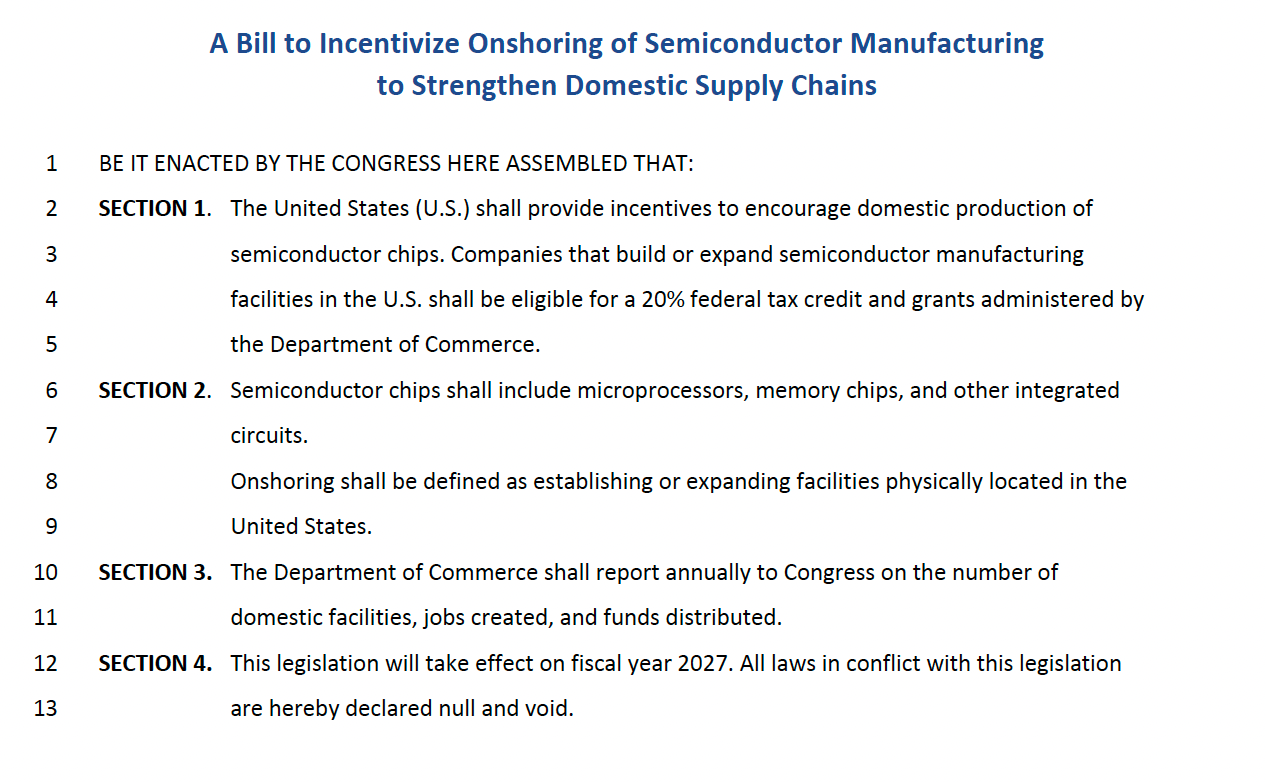
The framework above isn’t abstract. Here is an actual piece of Congressional Debate legislation on exactly this question — a 20% federal tax credit and Commerce-administered grants for companies that build or expand U.S. semiconductor facilities, effective FY2027 — analyzed for the chamber. The evidence is the same as the pro/con sections above; the work here is turning it into a speech you can give on either side, and finding where the drafting itself becomes a weapon. Side terminology follows Congressional Debate convention: advocates argue the bill should pass, opponents argue it should not.
What the bill does
The bill directs the federal government to give companies that build or expand semiconductor facilities in the United States a 20% federal tax credit plus grants administered by the Department of Commerce. It defines covered chips as microprocessors, memory chips, and “other integrated circuits,” defines onshoring as establishing or expanding facilities physically located in the U.S., and tells Commerce to report annually on facilities, jobs, and funds distributed. It takes effect in fiscal year 2027 and declares all conflicting laws null and void. Notably, it names no appropriation, no dollar ceiling, no funding source, and no eligibility guardrails on who can claim the money.
The strongest case for the bill
The advocates’ best ground is the security-insurance frame — that a modest, now-quantified premium buys protection against a catastrophic disruption to the foundational input of the modern economy. The first argument is the chokepoint and the trend line behind it: U.S. share of global chip manufacturing capacity eroded from 37% in 1990 to about 12% today (closer to 10% by 2022), and the U.S. fabricated essentially 0% of the world’s most advanced sub-10nm logic as of 2022. Roughly 90% of advanced logic is made in Taiwan, and the 2020–2022 shortages showed one disruption to that node cascades through every downstream industry, from cars to missiles. Advocates pair the decline with the Taiwan-risk clock — U.S. military assessments have cited a 2027 window for Chinese capability to invade (a capability assessment, not a forecast; verify the official attribution before you cut it) — and argue a leading-edge disruption would cascade for years, making domestic capacity national-security infrastructure rather than ordinary industrial subsidy. The second argument is that the cost objection has collapsed: TechInsights found it costs less than 10% more to process a wafer in Arizona than Taiwan, because labor is under 2% of wafer cost and equipment dominates — so a 20% credit comfortably closes a single-digit gap. The third argument is that the model works: TSMC’s Arizona fab posted a $514 million profit in its first full production year and reported yields rivaling Taiwan. The fourth argument is crowding-in: the existing federal incentive catalyzed an estimated $450 billion in private investment, so a tax credit plus grants is a force multiplier, not a handout. If you’re advocating, lead with the security frame and use the cost data defensively — it neutralizes the opposition’s single best historical talking point before they reach the lectern.
The strongest case against the bill
The opponents’ best ground is not “onshoring is bad” — it’s that this bill is a worse, blunter instrument than the law already on the books, and that its own text hands you the kill. The first argument is procedural and the cleanest in the room: the bill authorizes without appropriating. It promises grants “administered by the Department of Commerce” but names no dollar figure and no funding source. Meanwhile the existing federal program already specified $52.7 billion plus an investment tax credit that Congress raised from 25% to 35% in July 2025; this bill offers a smaller 20% credit and an empty grant account, so wherever the federal credit applies, a rational firm ignores the bill and takes the 35%.
The second argument is the missing guardrail: the bill defines onshoring purely as facilities “physically located in the United States,” with nothing about ownership. The real CHIPS framework blocks benefits for entities tied to a “country of concern” like China (and the enhanced 48D credit carries a foreign-entity-of-concern restriction); this bill would let an adversary-linked firm build in Arizona and collect the credit — which defeats the security rationale that is the advocates’ whole case.
The third argument is the legacy-chip leak: “other integrated circuits” sweeps in trailing-edge commodity chips, exactly the mature-node category China is flooding, so the subsidy may underwrite a glut instead of strategic capacity.
The fourth argument is that onshoring assembly does not secure the chain: fabs run on hundreds of foreign-sourced chemicals and minerals China dominates, and even a best case leaves the U.S. at ~14% of global manufacturing.
The fifth argument is the workforce wall: subsidizing facilities that can’t be staffed is wasted money when the projected gap runs 59,000 to 146,000 workers by 2029.
The sixth is corporate welfare: the major recipients — TSMC, Intel, Samsung, Micron, GlobalFoundries, and Texas Instruments — are profitable firms already building multibillion-dollar U.S. plants, so a fresh, weaker credit largely pays them to do what they’re already doing.
The seventh is that the bill is the wrong instrument: a PIIE assessment of CHIPS concludes more domestic production “might not provide the best security for the money” and may reduce but not eliminate import reliance — so if the existing program is working the bill is redundant, and if it’s underperforming the fix is to amend it, not bolt on a thinner duplicate. If you’re opposing, open with the appropriations gap and the country-of-concern hole, then make the advocates explain what a 20% credit adds on top of a 35% one — both are factual, both are in the text.
Cross-examination questions
Questions for opponents to ask advocates:
“Your bill says grants ‘administered by the Department of Commerce’ — can you point me to the section that appropriates the money or names the funding source?”
“Under your definition, onshoring is any facility ‘physically located in the United States.’ Does a Chinese-state-owned chipmaker that builds in Arizona qualify for the credit?”
“Congress raised the federal semiconductor investment credit to 35% in 2025, and your bill offers 20%. Why would any firm choose your credit over the one already on the books — and if Section 4 voids conflicting law, are you cutting manufacturers from 35% to 20%?”
“’Other integrated circuits’ — does that include the cheap legacy chips China already overproduces, and are we subsidizing those at the same rate as leading-edge?”
“Who fills these jobs? What’s your answer to a projected shortage of tens of thousands of fab workers this decade?”
“What’s the minimum investment to count as ‘expanding’ a facility — can a company add one tool and claim the credit?”
“If a fab is built in Arizona but its chemicals, minerals, and lithography tools all come from abroad, in what sense is the supply chain now domestic?”
Questions for advocates to ask opponents:
“Do you dispute that 90% of advanced logic chips come from one island under military threat — yes or no?”
“TechInsights put the Arizona cost premium under 10%. Do you have a current source that contradicts that, or are you relying on the 2022 estimates?”
“You say the existing law already does this. If the CHIPS Program Office is being renegotiated and its awards cut, isn’t reinforcing the incentive in statute exactly the point?”
“Is a fab that posted a $514 million profit in year one your example of a failed subsidy?”
“You’d rather rely on allies — when a chip shortage hit, did friend-shoring prevent the auto-plant shutdowns, or did it not exist yet?”
“You attack the broad definition, but the 2020–22 shortage that idled auto plants was a mature-node shortage. Why should the incentive exclude exactly the kind of chip the last crisis was about?”
“The enhanced federal credit turns on construction beginning before 2027. After that, what standing incentive exists — and isn’t a permanent successor credit worth more than a rate that phases out?”
“Is there any level of supply-chain concentration risk that would justify federal incentives, or is your objection to industrial policy categorical?”
Drafting and definitional traps
The text rewards close reading in four places. First, “other integrated circuits” in Section 2 is almost limitless — nearly every chip is an IC — so the bill draws no line between strategically vital leading-edge logic and commodity chips, and funds both at 20%. Second, the onshoring definition in Section 2 is silent on ownership and on any capital-investment threshold, so “expanding facilities” has no floor and no nationality screen. Third, Section 1 pairs a tax credit (a Treasury/IRS instrument) with Commerce-administered grants but gives Commerce no appropriation to administer — the agency is handed a checkbook with no balance. Fourth, the 20% figure sits below the existing federal credit, which Congress raised to 35% in 2025; combined with Section 4’s “null and void” clause, a literal reading either does nothing (firms keep taking the 35%) or, read as a replacement, cuts domestic manufacturers from 35% to 20%.
Logical flaws
The reasoning problems are sharper than the wording ones. The central one is redundancy masquerading as action: the case for the bill assumes no federal onshoring incentive exists, but one does, at a higher credit rate (35%) and with a real appropriation — so the bill either duplicates current law or, via Section 4, degrades it. That is a self-defeating mechanism. The advocates’ rescue is that this bill is a successor — the federal credit’s eligibility turns on construction beginning before 2027, so a permanent post-2027 credit fills the coming gap. The rebuttal is twofold: the credit is now 35%, not the 25% the successor story assumes, so the “successor” hands manufacturers less than they have today; and because the deadline is construction-start, a project that breaks ground by the end of 2026 can place property in service years later and still claim 35%, so the gap the bill claims to fill is smaller and further off than advertised. Opponents should be ready for one honest counter, though: the legacy-chip-overbreadth attack cuts both ways, because the 2020–22 auto shortage was itself a mature-node shortage — so an advocate can defend the broad definition as deliberately covering the chips the last crisis actually involved. The second flaw is a non-sequitur between premise and goal: the title promises to “strengthen domestic supply chains,” but the operative definition only requires a facility be “physically located” here, which secures final fabrication while leaving the input chain — chemicals, ultra-pure quartz, rare minerals, lithography tools — foreign and concentrated. Physical location does not equal supply-chain security; the bill’s own mechanism doesn’t reach its stated end. The third flaw is the missing country-of-concern screen actively undercutting the security justification the advocates depend on — a subsidy that an adversary-linked firm can claim cannot coherently be defended as a national-security measure. The fourth is a premise that collapses on a currency check: “jobs created” is the bill’s headline metric, but it presumes a workforce that the 43% decline in the domestic semiconductor workforce since 2000 and the looming worker gap say isn’t there to hire.
Verdict / how to play it
The chamber will saturate the advocacy side — onshoring sounds patriotic, the China frame is easy, and the security argument writes itself. That means the rare competent opposition speech breaks, and the highest-leverage opposition move is the one almost no one will make: don’t argue against onshoring, argue that this bill is a weaker, unguarded duplicate of existing law that funds nothing, screens no one, and — read against a federal credit Congress just raised to 35% — offers manufacturers less than current law. That reframes you as the pro-security realist and the advocates as the people who didn’t read their own text. If you’re advocating, you can immunize against all of this in your constructive: concede the bill should specify an appropriation and a country-of-concern restriction, frame those as friendly amendments, and pivot to the security-insurance and sub-10%-cost data, which are your strongest and most current ground. The single best point on each side is symmetrical — for advocates, the cost objection is dead and the fab is profitable; for opponents, the bill as written can pay an adversary to do what it claims protects us from one. Cross-apply the workforce and input-dependency material from the main brief above; it works as opposition substance here and as a friendly-amendment list if you’re advocating.
Round Strategy: This Bill on the National Docket
This is the official NSDA National Congressional Debate 2026 bill, which changes how the per-bill analysis above plays in practice. A national chamber is not a generic one, and three assumptions from the standard breakdown need adjusting for an elite field.
The first adjustment is to the “most of the chamber will miss it” read. At a national tournament, they won’t. The appropriations gap and the missing country-of-concern screen are exactly the kind of close-reading catches a strong national field hunts for, and they will surface early — often in the first opposition speech. So the value at nationals isn’t being first to spot them; it’s having the better answer. If you’re advocating and you’re not speaking first, assume both objections are already on the floor and pre-empt them in your opening framing rather than getting caught flat-footed in cross-examination. If you’re opposing and you’re not first, the procedural points may already be taken — have the redundancy argument (this duplicates or undercuts the existing 35% credit Congress raised in 2025) and the legacy-chip argument (”other integrated circuits” subsidizes the commodity chips China already floods) ready as your differentiated ground, because those survive even after someone else has run the funding gap.
The second adjustment is speaking position. Authorship and early sponsorship speeches set the framing, so if you have the first advocacy slot, define the bill as security insurance and bank the sub-10% cost data and the profitable Arizona fab before anyone contests them. The first opponent who cleanly lands the country-of-concern hole often defines the entire round, because it converts the advocates’ own security premise into a liability. Middle speeches are where the round is actually won or lost at nationals: they have to clash and extend, not reintroduce arguments already on the floor, and a middle speech that just re-runs the author’s case will not break. Late speeches crystallize — weigh the two or three live clashes and tell the chamber why your side controls them; do not re-explain the bill.
The third adjustment is the amendment fight, which national chambers run and lower-level ones often skip. This bill is unusually amendable: a single friendly amendment that adds a dollar appropriation and a country-of-concern restriction neutralizes the opposition’s two best arguments at once. Predict it. If you’re opposing, get your speech in before that amendment passes, or pivot immediately to the arguments an amendment can’t fix — redundancy with existing law, the legacy-chip overbreadth, the workforce wall, and the foreign-input dependency. If you’re advocating, consider authoring that amendment yourself; it lets you look like the careful legislator and strips the opposition’s cleanest points in the same motion.
Two final notes for a 2026 national round. On currency: the field will know the recent TSMC Arizona profit figures and the Trump-administration pivot to equity stakes and tariffs, and using the most current version of those facts signals preparation to a national judging pool — pull the latest the week before you compete, because this is one of the bills where the evidence moves. On tone: onshoring-plus-China is the easy, popular advocacy, so the chamber floods that side and the prepared opposition speech breaks — but only if it’s framed as pro-security realism (”this specific bill is the weak version”) rather than opposition to domestic manufacturing as such, which loses a national room fast. Run the bill’s own text against it; don’t run against the idea.
Source List (grouped by theme)
Overview & cost economics
National security & the silicon shield
Workforce
Industrial-policy critique
Friend-shoring, subsidy race & overcapacity
Inputs, environment & R&D
Bill-specific: CHIPS structure, the 48D credit & assessments
Cornell LII — 26 U.S. Code § 48D, Advanced Manufacturing Investment Credit
PIIE — Industrial Policy Through the CHIPS and Science Act (Hufbauer & Hogan, 2025)
PIIE — CHIPS Act will spur U.S. production but not foreclose China (named fab awards)
Congress.gov — Semiconductors and the Semiconductor Industry (CRS R47508)
Current policy (tariffs & equity stakes, 2025–26)