

1. The Big Picture: What This Aff Is and Why It Exists
The resolution is:
The United States federal government should establish national health insurance in the United States.
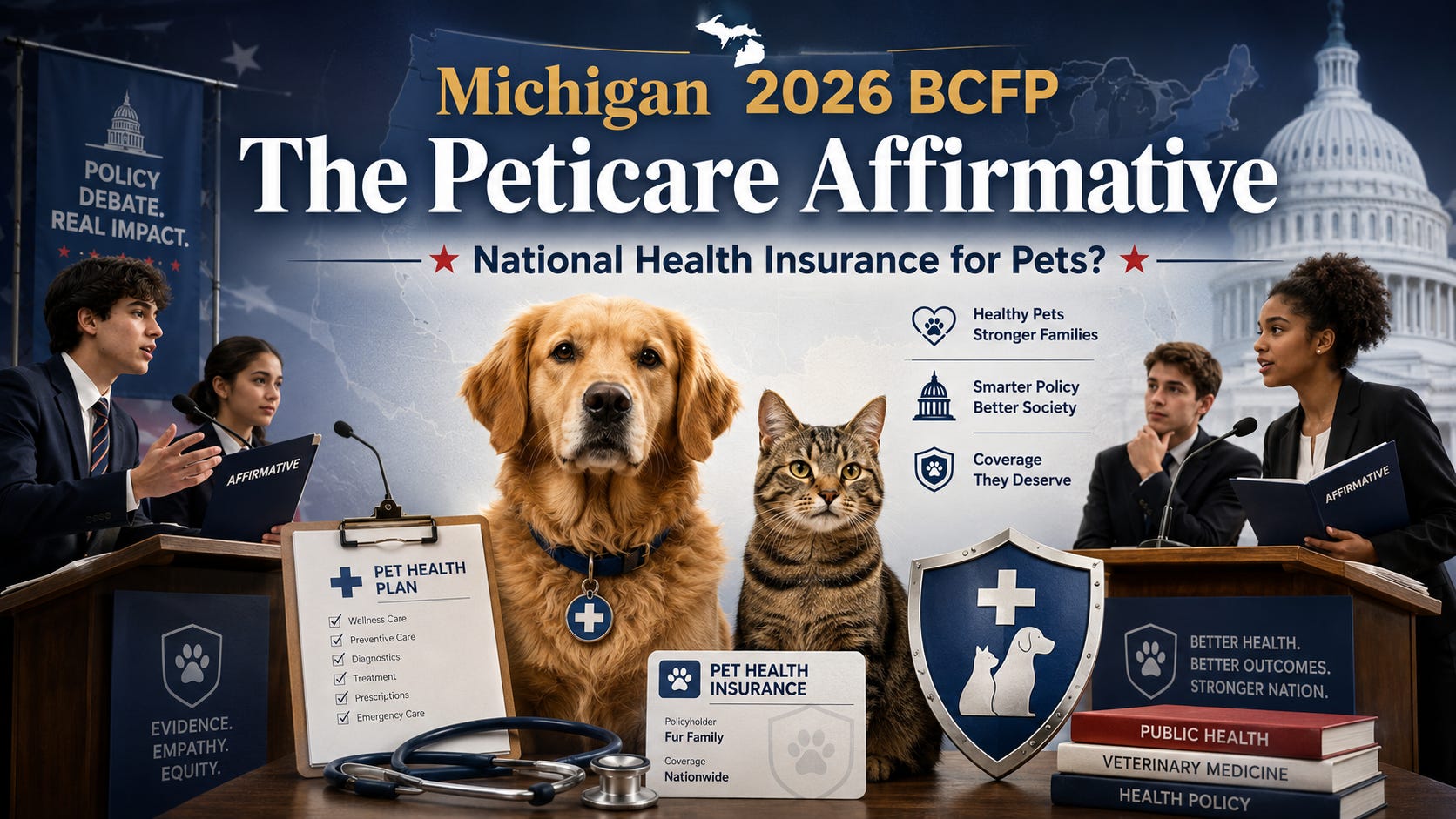
This affirmative establishes national health insurance for pets.
Before you decide whether that’s a joke, understand what it’s actually doing. There is a real veterinary cost crisis with real evidence behind it, there is a real policy literature on universal veterinary coverage, and there is a genuine ambiguity in the resolution: nothing in the words “national health insurance” specifies whose health. The aff exists to test that, and a good version of it wins rounds two ways — on the merits if the negative under-covers case, and on topicality if the negative’s interpretation can’t be defended without arbitrary line-drawing.
Three pieces of background make the file legible.
The veterinary cost crisis is documented. Overall prices rose about 25% in five years; veterinary services rose about 41%. Most pet owners in a recent Gallup survey report skipping necessary care because of cost. The drivers are the ordinary ones — drug and supply costs, tariffs, and above all labor. The aff adds a private-equity consolidation story on top.
“One Health” is a real framework in public health. It holds that human, animal, and environmental health are one system, and it’s the intellectual bridge that makes the aff’s biggest impact work: if most pandemics are zoonotic in origin, then the people who examine animals are part of the human disease surveillance system.
“Veticare for All” / “Peticare for All” is an actual, if minor, policy proposal. It has been written about in Current Affairs, the LA Times, and by Healthcare-NOW, which is a Medicare for All advocacy organization. That matters for topicality, because the aff can say the mechanism exists in the literature rather than being invented for a debate round.
What this aff is not: it is not an animal rights affirmative, it is not a kritikal affirmative, and it does not defend a critique of the resolution. It is a policy aff with a plan, and it defends fiat in the ordinary way. Keep that clear, because the negative’s kritik will try to move it.
2. The Plan
The United States federal government should establish national health insurance in the United States through Peticare for All.
Notice the construction. The plan restates the resolution verbatim and then adds “through Peticare for All.” That’s deliberate: the aff wants to claim it is doing exactly what the resolution says and merely specifying the population. Whether that works is the topicality debate, and the phrasing is the aff’s first move in it.
The 1AC reads five solvency cards:
1. Risk free. Any reconciliation with the existing private pet insurance market fails; you need to replace it rather than patch it. Sourced to a 2019 LA Times column making the Medicare-for-pets case.
2. Red light. The plan solves status quo opacity and drives out the private equity firms that are pushing owners of healthy pets out of the market. Sourced to a Healthcare-NOW podcast transcript with a practicing veterinarian.
3. Spending. The most comprehensive analysis found no statistically significant impact of pet health insurance on the number of veterinary visits once other factors were controlled, but positive effects on preventive spending before the animal gets sick. This is the aff’s answer to a utilization disadvantage, and it’s the most rigorous card in the solvency block — a peer-reviewed study in Animals with an AVMA economist as a co-author.
4. One Health. Veterinarians are the bulwark against zoonoses and preempt illness in ways that reduce antibiotic overuse. Peer-reviewed, from One Health, based on a study of families of immunocompromised children.
5. Balancing. 28% of people who live with animals had difficulty getting needed veterinary care in the last two years because of cost. Do-or-die for low-income owners.
Coaching verdict on the plan. Plank 3 is the best card here and it’s doing double duty — solvency and a preemptive answer to cost objections. Planks 1 and 2 are the weakest evidence in the 1AC: a newspaper column and a podcast transcript, both being asked to carry structural claims about market design. If you’re negative, press those two; if you’re affirmative, lead with 3, 4, and 5 and treat 1 and 2 as framing.
3. The Two Advantages
Advantage 1: Immunology
The link: veterinary costs are surging and clients are declining. The aff frames this as a structural imbalance — prices rising faster than the client base can absorb, which squeezes practices out of business.
Scenario one: Pathogens. Untreated pets are “double-vectors” — they carry disease and they bypass the natural resilience mechanisms that limit pathogens in wild populations. The impact card is Casadevall 2024 in the Journal of Clinical Investigation, a Johns Hopkins molecular microbiologist writing on a century of pandemics. It’s a strong card and its most useful line for the aff is that a common denominator of every major modern pandemic is likely zoonotic origin, so “contact with the animal world can be anticipated to be a continuing source of new pandemic agents.” A second card argues these pathogens are immune to the virulence-lethality tradeoff — the usual reason very deadly diseases burn out — and shielded from response mechanisms like lockdowns, because animal vectors don’t obey human laws.
Scenario two: AMR. Rising costs destroy incentives to participate in veterinary antimicrobial resistance research, and post-hoc treatment creates conditions for bacterial evolution. Then the chain extends: participation catalyzes AMR solutions, AMR diagnostics run parallel to CRISPR innovation, CRISPR requires data consolidation that only a unified system provides, gene editing is the linchpin for space travel and crop immortality, and space colonization solves otherwise inevitable extinction. A separate card runs food security into hotspot escalation.
Coaching verdict. The pathogens scenario is defensible. Zoonotic spillover is real, the One Health framework is mainstream, and Casadevall is an excellent source. The AMR scenario starts well and then goes somewhere else entirely — the run from veterinary research participation to CRISPR to space colonization is five internal links past where the evidence supports it, and a negative that reads the chain back to the judge slowly will make it sound like what it is. In the 2AR, go for pathogens.
Advantage 2: Resilience
The link: rising costs produce a pet debt crisis and will halve pet ownership within a generation. The card is a July 2026 New York Post shopping-section piece titled “The $50,000 Dog.”
Scenario one: Social capital. Pet ownership raises social capital — and the evidence here is genuinely good. Wood et al. 2017 in SSM Population Health, with Ichiro Kawachi of Harvard as a co-author, found pet ownership significantly associated with higher social capital across four cities in two countries, not confined to dogs. Social capital then feeds disaster response, backed by a 2025 systematic review in Frontiers in Environmental Science. Then social capital checks democratic backsliding, and democratic failure cascades into heightened extinction risk.
Scenario two: Inequality. Pet health insurance functions as a social safety net; inequality undermines resilience to existential threats. The impact card is Jehn 2026 on inequality’s contribution to global catastrophic risk — the same card the NDCA single payer and ACA affirmatives use. A final card argues pet ownership lowers cortisol in the face of nuclear war.
Coaching verdict. The social capital link is the best-evidenced claim in the entire 1AC — Kawachi is a serious name and the study design is decent. Everything downstream of it is thinner, and the cortisol card is a Medium post about emotional support animals being asked to do work on nuclear war. The inequality scenario has the same terminal impact problem it has in the NDCA files, plus a much weaker internal link, since the Bartlett card is an undergraduate journal article about Buncombe County, North Carolina.
The add-ons
The file carries four more advantages to be read as 2AC add-ons: a laundry list of veterinary contributions to agriculture, food security, wildlife, biomedical research, and public health; climate change mitigation; space colonization; and biodiversity. These are useful for forcing 1AR coverage and worthless in the 2AR. Read them when you have time; never go for them.
4. The Negative Attacks
Everything below is what the negative file throws at this aff. Answers start in section 9.
One structural fact you should know before the round: there are no disadvantages in this negative file. Nothing. The negative’s offense comes from topicality, five counterplans, one kritik, and case turns. That makes this a very different round from a standard policy debate — the negative wins by proving the aff isn’t topical, that something else solves better, or that the case is backwards. It cannot win by proving the plan causes a bad thing, because it hasn’t prepared that argument.
5. Topicality — The Central Question
This is the negative’s best ground and the reason the aff exists. Two shells.
T—Pets
Interpretation: topical affirmatives defend citizens. The definition is Nanna 2011, a health economist’s thesis chapter: “National health insurance means that the government provides health insurance for its citizens.”
Then the second step: citizens excludes animals — supported by the Fourteenth Amendment’s text, “All persons born or naturalized in the United States, and subject to the jurisdiction thereof, are citizens.”
Plus a solvency deficit, which is unusual to find inside a topicality shell and is smart: the federal definition of “common household pet” at 24 CFR § 5.306 excludes reptiles other than turtles and excludes service animals, so the aff doesn’t even cover the animals it claims to.
T—Coverage
Interpretation: coverage is inclusion within a policy — Merriam-Webster.
This shell is thin. It’s a dictionary definition of a word the aff doesn’t obviously violate, with no violation statement and no standards in the file. Treat it as a time trade rather than a position.
Coaching verdict. T—Pets is the strongest argument in the negative file by a wide margin. The Nanna definition has genuine intent to define, and the two-step structure — national health insurance covers citizens, citizens are persons — is clean. The weakness is that the definition was written about developing-country health systems and is describing who is typically covered rather than drawing a boundary against animals. The Fourteenth Amendment card is doing analytical work no card is needed for, and the aff will point out that “citizen” in a health financing context isn’t a constitutional term.
6. The Counterplans
Five, and they vary enormously in quality. Know which ones are real.
CP—Veticaid. The federal government establishes national health insurance through Peticaid rather than Peticare — a means-tested program instead of a universal one. Solvency: studies show even overestimates don’t drastically increase spending. This is the best counterplan in the file because it competes cleanly (universal versus means-tested is a real distinction), it captures most of the aff’s access claims, and it dodges the cost objections. If you’re negative, this is your counterplan.
CP—PAW. Two planks: pass the People and Animals Well-being Act, and make veterinary expenses eligible under tax-advantaged health spending accounts (HSAs and FSAs). Solvency evidence from dvm360 on the PAW Act’s reintroduction. This is the “existing bill” counterplan — smaller than the aff, politically real, and it competes on the mechanism. Solid.
CP—States. The fifty states establish Veticare using existing infrastructure. The solvency card is a Current Affairs piece arguing the political strategy for Veticare should be local, citing Burlington’s spay/neuter assistance and an LA County mobile clinic partnership, and naming Vermont and California as good candidates. Note what the card actually argues: it’s a political feasibility argument about where to start organizing, not a solvency claim that states can implement nationally. That’s a real gap.
CP—Vet Tech. The federal government certifies veterinary technicians and provides the profession legal protection. The argument is that the root cause is a shortage of vet techs, not a shortage of insurance — and, sharply, that title protection would increase supply while the aff would directly overburden the existing workforce. This is a genuine alt-cause counterplan with a turns-case component, and it’s better than it looks.
CP—Therians. The text is “The United States federal government should [xxx], excluding individuals that identify as nonhuman” — with the bracket unfilled. The solvency card is a Palo Alto University clinical psychology dissertation on the mental health of nonhuman-identified people, and it argues that validating therian identity mitigates adverse mental health effects.
Two things are true about this and you should know both. The text is incomplete, so there is nothing to advocate. And the card argues for validation while the text does the opposite, so the evidence doesn’t support the action even if the text were finished. This is not a usable position. The file’s own annotation on the card — “ignored by james, viewed with skepticism by sophia” — suggests the lab reached the same conclusion. Don’t read it; if it’s read against you, say the text is blank and move on.
7. The Kritik
K—Biophilia. The argument is that pet ownership itself is unethical — that biophilia, the human affinity for other living things, gets twisted into something unnatural when channeled through ownership. The Guardian card frames the relationship as extractive: we like relationships where the animal is well maintained, where we can hire a dog walker, where it impinges as little as possible on our lives while we extract as much emotional support as we want. Additional cards argue pet ownership contributes to extinction, biodiversity loss, the climate crisis, fisheries collapse, and harms to human health, and that the biophilia framing is backwards because pets chose domestication rather than the reverse.
Coaching verdict. The link is unusually good for a kritik — the aff’s entire case is premised on more people owning more pets and spending more on them, which is precisely what the kritik indicts. But there’s no alternative text in the file, and a kritik without an alternative is impact defense plus framework. Ask what voting negative does.
8. The Case Arguments
Against Immunology:
Uniqueness. Pet health insurance is better than Obamacare — the market works. And private pet insurance is affordable; the only barrier is awareness, not cost. That second card is the sharper one because it’s an alt-cause that the plan doesn’t fix and a cheaper counterplan implicitly solves.
Pathogens turn. Increasing the number of pets turns disease and biodiversity — more animals, more spillover surface. This is a link turn on the aff’s own advantage and it’s the negative’s best case argument.
Response times. National peticare would slow response times; Canada proves.
Solvency. Veticare is vulnerable to lobbying.
Against Resilience:
Cortisol. “Nuclear war is good for veterinarians.” This is an impact turn and it is exactly as strange as it sounds. Read it if you want the aff to spend 1AR time; do not build a 2NR on it.
9. Answering Topicality
The aff file has two T blocks and they’re serviceable.
T—Pets answers:
Counter-interpretation from a systematic literature review: “pet” means any animal that humans own and are responsible for. A systematic review is a strong source for a definition — it’s the aggregate of the field rather than one author.
“Pets are citizens too.” Use this carefully. As a legal claim it loses; as an argument that “citizen” in a health-financing definition means “the covered population” rather than “constitutional persons,” it’s fine. Make the second version.
AT: Livestock — livestock are pets, which answers the negative’s limits argument by conceding the ground rather than fighting it.
AT: Brightline — veterinary care is the line. This is the most important of the three, because the negative’s best standards argument is that there’s no principled stopping point once animals are in. “Any creature receiving veterinary care” is a real bright line and you should lead with it.
T—Doctors answers: a veterinarian is a medical doctor, holds a medical doctorate, and performs healthcare services. This is a clean answer to any interpretation that runs through what counts as health care rather than through who counts as a patient.
What the file leaves out
The negative’s own solvency deficit is a topicality argument against itself. The 24 CFR definition excludes reptiles and service animals — so on the negative’s evidence, “pet” has a federal legal definition with clear boundaries. That’s an argument that the term is definable and limited, which cuts against the limits standard. Read it back.
Press the Nanna card’s context. It’s a chapter about health insurance in developing countries, describing what national health insurance schemes typically cover. “The government provides health insurance for its citizens” is descriptive of existing programs, not a boundary-drawing definition, and it doesn’t mention animals at all — the exclusion comes from the Fourteenth Amendment card, which is about constitutional personhood and has nothing to do with health financing.
Ask for the bright line on their side. If national health insurance must cover citizens, does a plan covering lawful permanent residents violate? Undocumented immigrants? The NDCA single payer affirmative covers undocumented people by design. An interpretation that excludes that aff too is overlimiting; one that doesn’t has to explain why non-citizen humans are in and animals are out on a definition that says “citizens.”
10. Answering the Counterplans and the Kritik
The aff file has one counterplan block — CP—Deficits, arguing the only way to fix the system is to eliminate out-of-pocket fees. That’s an answer to means-tested and partial counterplans, and it’s the right frame: Veticaid, PAW, and the HSA/FSA plank all leave cost-sharing in place, and the aff’s Winograd evidence says 28% of owners already can’t afford care.
Against Veticaid, that’s your solvency deficit and you should say it in exactly those terms: means-testing preserves the out-of-pocket barrier that causes the harm, and the aff’s spending study shows universal coverage shifts spending toward preventive care rather than increasing volume.
Against PAW, add that tax-advantaged accounts are regressive — the benefit scales with your marginal rate, so it helps people who already afford care.
Against States, read their own card back. It argues for local organizing as political strategy and names two states as candidates. It does not claim states can implement nationally, and fifty-state uniformity is exactly what a zoonotic surveillance advantage requires.
Against Vet Tech, this is the one you should worry about. It’s an alt-cause with a turns-case: if the binding constraint is workforce rather than financing, the aff increases demand against a fixed supply and makes the shortage worse. Your best answer is the aff’s own spending evidence — no statistically significant increase in visit volume — which means the demand surge the counterplan assumes doesn’t materialize.
Against the kritik, you have nothing. There is no kritik block anywhere in the aff file. Answer it with framework and a permutation analytically, and press the missing alternative: ask what voting negative does about pet ownership, because the ballot doesn’t rehome anyone’s dog. Then note the link is non-unique — 5.4 million pets were acquired in the UK since 2020 without the plan.
11. Answering the Case Arguments
Against “insurance is affordable, awareness is the barrier.” Your Gallup evidence says most owners have skipped necessary care because of cost, and Winograd puts it at 28% in two years. Those are cost findings, not awareness findings. Also note the structural argument: an awareness problem gets worse, not better, as prices rise faster than incomes.
Against the pathogens turn — this is the important one. The negative says more pets means more spillover. Your answer has to be that the plan doesn’t primarily increase the number of animals, it increases the number that are seen by a veterinarian, and your One Health card says veterinarians are the people who identify zoonoses and provide deworming, immunization, and hygiene protocols. An untreated pet is the vector; a treated one is a surveillance node. The aff file also carries a “gene editing solves pets being bad” card, which is a worse version of this answer — use the One Health framing instead.
Against “response times — Canada proves.” Cross-apply the same distinction that beats the wait-times turn in the human health files: a slower appointment is not worse than no appointment, and 28% of owners currently get nothing.
Against “vet burnout.” The aff has a good block here: high costs are what drive burnout and reduce quality of care, so the plan improves working conditions rather than degrading them.
Against “nuclear war is good for veterinarians.” Don’t overthink it. Extend that your cortisol card is about the mental health of survivors, not about veterinary business models, and that an impact turn requiring nuclear war to be net beneficial isn’t going to get a ballot.
12. Analytics Against the 1AC
Against the Plan
Plank 1 and plank 2 are a newspaper column and a podcast transcript. Both are being asked to establish that the private market can’t be reformed and that public financing displaces private equity. Neither author is an economist and neither piece is analysis.
Aff answer: The structural claims are supported by plank 3, which is peer-reviewed. Route the mechanism through Williams et al. and treat 1 and 2 as framing.
The plan doesn’t specify what’s covered. “Peticare for All” names a program, not a benefit package. Wellness visits? Dental? Emergency surgery? Chronic disease management for a fourteen-year-old dog? The cost estimate changes by an order of magnitude across those answers, and the negative’s 24 CFR card shows federal definitions of covered animals already vary.
Aff answer: Defined by the solvency evidence and clarified in cross-x. Weaker than usual here, because the solvency evidence doesn’t specify either.
No funding mechanism. Universal veterinary coverage for roughly 90 million dogs and 74 million cats has a price tag nobody in the 1AC names.
Aff answer: Normal means, and plank 3 shows spending shifts rather than expands. That’s a real answer and it’s the aff’s best fiscal card.
Against Immunology
The link card is about labor costs and tariffs, not about insurance. The NPR piece attributes rising veterinary prices to medication costs, supplies, and above all wages. Private insurance appears nowhere in it. The tag says “the red-handed culprit is private pet insurance”; the card says the culprit is the cost of running a practice.
Aff answer: The insurance mechanism is in planks 1 and 2 and in the Mason evidence on private equity. But the negative should read the tag and the card back to back, because the mismatch is stark and it’s the single best analytic against this advantage.
Casadevall never mentions pets or veterinary access. It’s a century-of-pandemics essay about zoonotic origins, climate change, and preparedness. It supports “animals are a source of pandemics.” It does not support “insufficiently insured American pets are a source of pandemics.”
Aff answer: The One Health card supplies the veterinary link and Casadevall supplies the impact. Standard division of labor — but the negative should point out that the zoonotic pandemics Casadevall lists originated in wild animals and livestock, not in household pets, which is an internal link the aff never bridges.
The AMR-to-space-colonization chain has no evidence connecting its steps. Veterinary research participation to AMR diagnostics to CRISPR to data consolidation to space travel to crop immortality to colonization to extinction avoidance. Each card is about its own subject; none is about the transition to the next.
Aff answer: Don’t defend it. Go for pathogens. This chain exists to generate 1AR coverage problems, and defending it in the 2AR costs credibility you need elsewhere.
The virulence-lethality card is a science-education blog post. The Davidson Institute is an outreach arm, the piece is titled “Is The End Of The World Near?”, and it’s being used for a technical claim about pathogen evolution.
Aff answer: Concede the source and defend the mechanism, which is standard epidemiology.
Against Resilience
The uniqueness card is a New York Post shopping-section article. “The $50,000 Dog” is consumer service journalism, and it’s carrying the claim that pet ownership halves within a generation.
Aff answer: The underlying cost trend is in the NPR card and the Gallup data. Use those for uniqueness and drop the Post.
Wood et al. establishes correlation and says so. The study is cross-sectional and observational. Pet owners have higher social capital; the paper itself offers competing explanations, including that owning a pet may proxy for stability, neighborhood type, and disposable income. And crucially, the study is about ownership, not about insurance — nothing in it says subsidizing veterinary care changes social capital.
Aff answer: The link runs through the debt-crisis card: if costs halve ownership, and ownership produces social capital, then preserving affordability preserves social capital. That’s the chain and the aff has to say it explicitly, because no single card contains it.
The inequality internal link is an undergraduate capstone about one county. Bartlett is a UNC Asheville undergraduate journal article studying Buncombe County, North Carolina, and it explicitly calls for more research to determine the value of each dollar invested.
Aff answer: It’s illustrative of a mechanism, and the terminal impact is Jehn. But this is a magnitude problem: a county-level undergraduate study is carrying a global catastrophic risk impact.
The cortisol card is a Medium post about emotional support animals. It says pet ownership is associated with reduced blood pressure, cholesterol, anxiety, depression, and PTSD — and immediately adds that “sorting out correlation and causation can be tricky.” It says nothing about nuclear war.
Aff answer: Drop it. It’s the weakest card in the 1AC and defending it is worse than losing the scenario.
Cross-Cutting
Both advantages need the same disputed step: that costs reduce ownership or care enough to matter. If the negative wins its “insurance is affordable, awareness is the barrier” card, both advantages lose their uniqueness at once.
Aff answer: Correct, and it means the 2AR should invest in the cost evidence — Gallup, Winograd’s 28%, and the 41% price increase — rather than spreading across scenarios.
The aff claims the plan doesn’t increase utilization and that it dramatically increases care access. Plank 3 says no statistically significant change in visit volume. Planks 4 and 5 say the plan gets untreated animals treated. A negative should ask which.
Aff answer: The study measures visits among the already insured; the access claim is about the uninsured. Those are different populations and the reconciliation is clean, but the aff has to say it before the negative frames it as a contradiction.
Nothing in the file establishes that household pets are the zoonotic risk. The pandemics in the evidence trace to bats, birds, primates, and livestock. Dogs and cats appear in the aff’s One Health card in the narrow context of immunocompromised owners.
Aff answer: This is the aff’s biggest unfixed problem and the honest response is scope — the advantage is about veterinary capacity generally, and veterinarians who go out of business don’t examine livestock either. The laundry-list add-on actually helps here, because it establishes veterinarians work across agriculture and wildlife.
The Five That Should Actually Worry the Affirmative
First, the link card blames labor and tariffs, not insurance — and the tag says otherwise.
Second, T—Pets, which is well-constructed and is the reason this aff exists.
Third, household pets aren’t the zoonotic vector in any of the aff’s own pandemic evidence.
Fourth, the Vet Tech counterplan — an alt-cause with a turns-case that the aff has no block against.
Fifth, the Wood study is about ownership, not insurance, so the social capital advantage needs a bridge the file never builds.
13. Gaps in the File — Know These Before Round One
For the affirmative:
No kritik answers at all. The Biophilia kritik has a clean link to your case and you have nothing written. Prepare framework, a permutation, and the missing-alternative press.
One counterplan block against five counterplans. CP—Deficits answers means-testing. It does not answer States, Vet Tech, or PAW’s HSA plank. Vet Tech is the one to write first.
No answer to the “awareness not cost” card. It’s the negative’s best uniqueness argument and it undercuts both advantages.
Your best cards and your tags don’t always match. Fix the immunology link tag before someone reads it back at you.
For the negative:
No disadvantages. You have no way to prove the plan causes harm. If you want that ground, the packet’s Interest Rates and spending arguments would need importing from elsewhere.
T—Coverage has no violation and no standards. Either write them or don’t read it.
CP—Therians has a blank text and a card that contradicts the advocacy. Don’t read it.
The States counterplan’s solvency card is about political strategy, not implementation capacity. You need a card about states actually administering veterinary coverage.
No alternative in the kritik. Write one or accept that it’s framework plus impact defense.
14. Vocabulary
Most of the general debate vocabulary and the health-insurance economics in the NDCA master glossary transfers directly. What follows is what’s specific to this file.
Veterinary and Animal Health
Veterinary services price index — the CPI component tracking vet costs. Up about 41% in five years against 25% economy-wide.
Companion animal — the clinical term for a pet, as distinct from livestock or working animals.
Common household pet — the federal regulatory definition at 24 CFR § 5.306. Includes dogs, cats, birds, rodents, fish, and turtles; excludes other reptiles and excludes service animals. The negative uses it for a solvency deficit; the affirmative should use it as proof the term has a bright line.
Vet tech (veterinary technician) — the licensed support role. Title protection is the legal restriction of the job title to credentialed practitioners, and it’s the mechanism of the Vet Tech counterplan.
Practice consolidation — corporate and private equity acquisition of independent veterinary practices. The aff’s private equity story.
Wellness plan — a prepaid package covering routine care, distinct from insurance covering illness. The distinction matters because the aff’s spending study finds wellness plans predict visit frequency while insurance does not.
Spay/neuter assistance — subsidized sterilization programs. The existing municipal infrastructure the States counterplan relies on.
One Health and Disease
One Health — the framework treating human, animal, and environmental health as one system. The intellectual bridge of the entire immunology advantage.
Zoonosis / zoonotic spillover — a disease transmitted from animals to humans, and the event of transmission. Every major modern pandemic in the aff’s evidence has zoonotic origins.
Vector — an organism that transmits a pathogen. The aff’s claim is that untreated pets are “double-vectors.”
Virulence-lethality tradeoff — the principle that a pathogen killing hosts too quickly limits its own spread. The aff argues animal-vectored diseases escape it.
Antimicrobial resistance (AMR) — bacteria evolving past antibiotics. Veterinary antibiotic use is a recognized driver.
Reservoir — a population where a pathogen persists between outbreaks.
Surveillance — detecting disease early. The aff’s strongest reframe: a treated animal is a surveillance node, an untreated one is a vector.
Chytridiomycosis — the fungal pandemic that has driven frog extinctions, cited in the aff’s impact card as evidence that non-viral agents can cause catastrophic outbreaks.
Program Design
Peticare / Veticare for All — universal public veterinary insurance. The plan.
Peticaid / Veticaid — a means-tested version. The negative’s best counterplan, and the distinction between the two is universal versus income-tested, which is what makes it compete.
PAW Act (People and Animals Well-being Act) — real proposed legislation making veterinary expenses eligible for HSA and FSA funds.
HSA / FSA — tax-advantaged health spending accounts. Regressive by design, because the benefit scales with your marginal tax rate.
Kritik Vocabulary
Biophilia — E.O. Wilson’s term for an innate human affinity for other living things. The kritik argues ownership perverts it.
Species dysphoria — distress from perceived incongruence between a nonhuman identity and a human body. Appears in the Therians counterplan’s evidence.
Domestication — the evolutionary process producing companion species. The kritik’s “pets chose us” card argues this reverses the moral framing.
Reading This File’s Evidence
Camp file annotations — the initials and notes after citations (”cut by maria, approved by amber”) are lab bookkeeping, not part of the evidence. They occasionally reveal what the lab thought of a card.
Condensation markers — <<<CONDENSED>>> and <<TEXT CONDENSED, NONE OMITTED>> indicate the cutter compressed the card. Check what was removed before relying on it.
Tag-card mismatch — when the tag claims more than the evidence says. This file has a significant one on its primary link card, and finding these is the highest-value read on either side.
Consumer journalism vs. research — the New York Post shopping section and NPR’s The Indicator are reporting, not analysis. Both appear as load-bearing cards.
Undergraduate journal — a real publication with real peer review by student editors. Weaker than a professional journal, and worth naming when a global impact rests on it.
t.