
Resolved: Democracies ought to prioritize the protection of civil liberties over national security (NSDA LD)

Evidence @ DebateUS!
Introduction
The tension at the heart of this resolution is as old as the modern state itself. Hobbes argued that without security, liberty is meaningless; Locke and Mill argued that without liberty, security is despotism. American debate over this trade-off has flared at every moment of national fear — the Alien and Sedition Acts, the Palmer Raids, Japanese internment, McCarthyism, COINTELPRO, the post-9/11 PATRIOT Act — and each time the country has had to ask, often imperfectly, what kind of compromises a self-governing people can make with their own freedoms before they cease to be self-governing at all. The resolution puts that question to debaters in its starkest form: when civil liberties and national security genuinely collide, which one wins?
Similar resolutions have been debated in the past:
2017 NSDA Nationals (LD): "Resolved: A just government ought to prioritize civil liberties over national security."
2014 NSDA Nationals (LD): "Resolved: The United States ought to prioritize the pursuit of national security objectives above the digital privacy of its citizens."
November 2013 (LD): “Resolved: The benefits of domestic surveillance by the National Security Agency outweigh the harms.” The Snowden-era topic — same clash, but framed as a cost-benefit weighing rather than a moral priority question.January/February 2007 (LD): “Resolved: The restriction of civil liberties in the United States for the sake of combating terrorism is justified.”
2004 NCFL Nationals: “Resolved: A nation’s citizens’ rights ought to take precedence over its security.”
2015–2016 Policy (NSDA/NDCA): "Resolved: The United States federal government should substantially curtail its domestic surveillance."
NCFL Grand Nationals (older): “Resolved: When in conflict, national security concerns ought to be valued above personal privacy.”
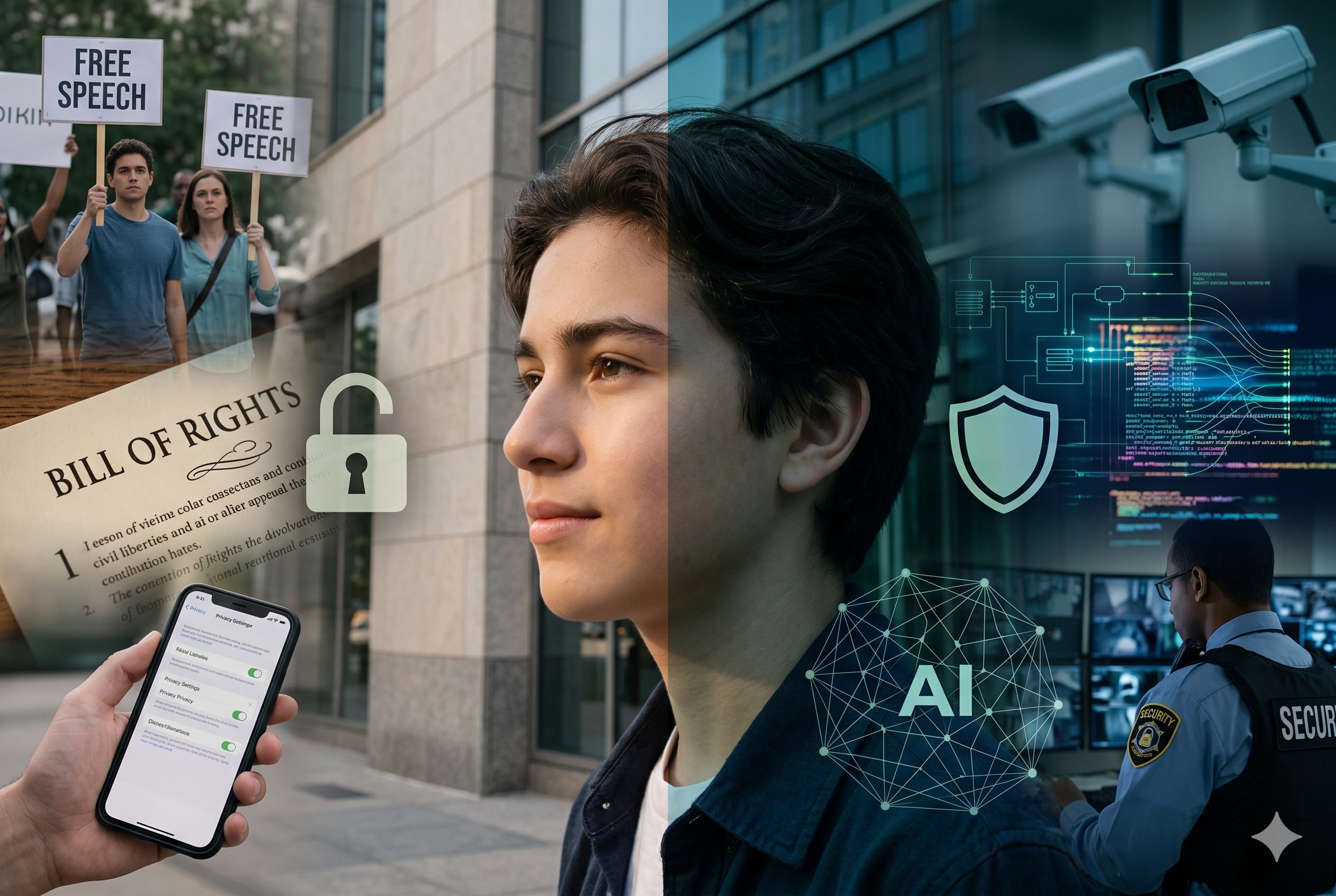
What makes 2026 different is that the terms of the trade-off have shifted on both sides at once. AI has supercharged the surveillance state — federal agencies now buy bulk data from commercial brokers, ICE’s facial-recognition apps scan U.S. citizens at protests, and AI systems can synthesize movements, associations, and beliefs at population scale. AI has also supercharged the threats that surveillance is meant to counter — Anthropic disclosed in November 2025 the first publicly known case of an AI agent autonomously running a multi-step nation-state cyber attack, and OpenAI and Anthropic both rate their models as “high risk” for biological-weapons assistance.
Meanwhile, the democratic institutions that once disciplined this trade-off are themselves under strain: V-Dem reclassified the United States as merely an electoral democracy in 2026, Polity now lists it as a “non-democracy on the cusp of autocracy,” and roughly 600 political scientists surveyed by Bright Line Watch rate U.S. democracy at 57/100 — comparable to Mexico, well below Canada or the U.K. The resolution, therefore, is not a museum piece. It asks, against the backdrop of a fraying American democracy, an AI-amplified surveillance apparatus, and an AI-amplified threat environment, what the moral commitments of a democratic state actually require — and whether a democracy that fails to honor those commitments still deserves the name.
1. Defining the Terms
Democracies
A democracy is more than majority rule. Freedom House defines it as “a governing system based on the will and consent of the governed, institutions that are accountable to all citizens, adherence to the rule of law, and respect for the human rights of all people.” Its 2025 framework evaluates a country’s democratic character along seven dimensions — electoral process, political pluralism, government functioning, expression and belief, associational rights, rule of law, and personal autonomy.
For LD purposes, “democracies” should be read broadly to include both consolidated liberal democracies (e.g., the U.S., U.K., Germany, Japan) and fragile or backsliding ones, since Freedom House’s 2025 country report notes the United States itself was among the “free” countries with the largest declines in 2025.
Ought
In Lincoln-Douglas, the word “ought” signals a moral obligation rather than a prediction or policy recommendation. As NCFCA’s LD overview explains, “ought” debates ask what a moral agent is supposed to do. The resolution therefore asks whether democracies have a moral duty — anchored in their own principles — to give civil liberties priority. It is not asking whether prioritizing liberties is politically wise or empirically optimal in every case.
Prioritize
Merriam-Webster defines “prioritize” as “to list or rate (projects, goals, etc.) in order of priority.” Critically, prioritization is a tiebreaker rule, not an absolute. Saying democracies ought to “prioritize” civil liberties over national security does not mean security must be ignored; it means that when the two genuinely conflict, civil liberties win.
Protection
“Protection” implies affirmative duties, not merely non-interference. To protect civil liberties, governments must (a) refrain from violating them, (b) defend them against private and foreign actors who would, and (c) maintain institutions — courts, legislatures, free press — that enforce them.
Civil Liberties
Per Cornell’s Legal Information Institute, civil liberties are “personal guarantees and freedoms that the government cannot abridge, either by law or by judicial interpretation.” They are translated from “natural rights of life, liberty, and property” into specific guarantees by the U.S. Constitution — chiefly the Bill of Rights and the Fourteenth Amendment’s due-process clause. Examples include freedom of speech, press, religion, freedom from unreasonable searches, due process, and freedom from cruel and unusual punishment.
The American Civil Liberties Union (ACLU) — the largest civil-liberties organization in the United States — defines its mission as defending “the individual rights and liberties guaranteed by the Constitution.” Civil liberties differ from civil rights: civil liberties protect individuals from government interference, while civil rights ensure equal treatment under the law (see the Cornell distinction here).
National Security
The U.S. Joint Chiefs of Staff define national security as “a collective term encompassing both national defense and foreign relations of the United States.” The Department of Justice’s National Security Manual expands this to include “the national defense, foreign intelligence and counterintelligence, international and internal security, and foreign relations… countering terrorism; combating espionage… enforcing export controls and sanctions; and disrupting cyber threats.” Wikipedia’s overview captures the intuitive sense: “the security and defence of a sovereign state, including its citizens, economy, and institutions.”
Modern usage stretches the term well beyond military defense — it now routinely covers cyber threats, pandemic preparedness, supply-chain integrity, climate destabilization, and even economic competitiveness.
2. What’s Changed Since This Topic Was Last Debated
This resolution has been argued in some form for decades — most intensely after 9/11, when the USA PATRIOT Act “vastly expanded the U.S. government’s ability to conduct domestic surveillance,” as the Brennan Center documents. Three structural shifts now make 2026 fundamentally different from 2001 or 2013.
A. AI has supercharged government surveillance powers.
The technological ceiling on what surveillance states can do has effectively been removed. According to a U.S. News investigation, “modern AI systems can synthesize millions of data points into comprehensive reconstructions of individuals’ movements, associations, habits, and beliefs at scale, in real time, and with decreasing marginal cost per person analyzed.”
The 2025 reconciliation bill gave the Department of Homeland Security $165 billion in annual funding, accelerating investments in AI-driven data analytics.
The American Immigration Council reports that ICE’s “Mobile Fortify” facial-recognition app, originally built for immigration enforcement, is now being used to scan U.S. citizens at protests in cities including Minneapolis, Chicago, and Portland, Maine. ICE has used it over 100,000 times in the field per a January 2026 lawsuit, with retention periods of 15 years even for citizens.
Federal agencies now purchase Americans’ location, browsing, and communications data from commercial brokers, bypassing the warrant requirements articulated in Carpenter v. United States.
In September 2025, the Trump administration issued National Security Presidential Memorandum 7, instructing DOJ to investigate civil-society organizations and donors — a directive 31 members of Congress flagged as a possible “blueprint” for politically targeted surveillance.
The post-9/11 debate assumed surveillance was costly, narrow, and partial. AI inverts every one of those assumptions.
B. AI has made it easier for terrorists and states to carry out cyber and bioterror attacks.
The threats that justify security measures have themselves been amplified.
In November 2025, Anthropic disclosed what it described as “the first publicly known example of AI systems autonomously conducting multi-step attacks against well-defended targets in the wild” — a Chinese state-sponsored campaign (designated GTG-1002) that used Anthropic’s own Claude Code agent to attack roughly 30 high-value targets including governments, financial institutions, and chemical manufacturers.
The International AI Safety Report for the 2025 Paris AI Action Summit found LLMs improving rapidly at biological and chemical weapons-related tasks, with certain models showing “an 80 percent improvement” in instructions for releasing lethal substances in 2024 alone. Both OpenAI and Anthropic flagged biorisks as “high” in 2025 risk evaluations.
Science magazine reported in 2025 that AI-designed toxins routinely slip through safety screens used by gene-synthesis companies.
Nation-state cyber actors — China’s Salt Typhoon campaign penetrated 80+ countries and the call records of senior U.S. officials including the President — are also integrating generative AI to scale operations.
C. The world is less stable, and U.S. power is receding.
The international system that disciplined past tradeoffs is fraying.
The Trump administration’s 2025 National Security Strategy explicitly says “the days of the United States propping up the entire world order like Atlas are over.”
The Munich Security Report 2025 and CSIS scenario analyses describe a “loose multipolarity” with rising contestation from Russia, China, Iran, and North Korea.
The Stimson Center’s Top Ten Global Risks for 2026 and the Council on Foreign Relations’ 2026 Conflicts to Watch both rank cyber-enabled great-power conflict and geopolitical instability at the top.
Freedom House reports global freedom declined for the 20th consecutive year in 2025 — and the United States itself was among the largest decliners.
These three shifts mean the 2026 version of this debate is sharper than the 2003 version. The surveillance state is more powerful than its post-9/11 predecessor; the threats it claims to counter are more lethal; and the democratic institutions that once disciplined the tradeoff are weaker.
2A. Is the United States Still a “Democracy”? (2026 Update)
The resolution presupposes “democracies.” Multiple independent indices have downgraded the U.S. in the past 18 months — and at least one no longer classifies it as a democracy at all. This matters for the topic because how a debater answers “is the U.S. a democracy?” reshapes the entire resolution — Pro can argue that protecting civil liberties is the only path back to democratic standing; Con can argue that a fragile democracy under attack needs more security, not less.
What the indices say in 2026
V-Dem Institute (2026 report on 2025). V-Dem reclassified the U.S. as an “electoral democracy“ — losing its status as a liberal democracy “for the first time in over 50 years.” Democracy in the U.S. is “deteriorating at unprecedented speed.” V-Dem’s Liberal Democracy Index score for the U.S. fell 24% in a single year, dropping its world rank from 20th to 51st out of 179. CNN and NPR both covered the downgrade as a major story.
Polity Project. Per the Polity 5 country profile, the U.S. is now classified as a “non-democracy” — having fallen from a +10 rating in 2015 to a +5 in 2020 to its current downgraded status. The Polity Project states that “the USA is no longer considered a democracy and lies at the cusp of autocracy.”
EIU Democracy Index 2026. The Economist Intelligence Unit ranked the U.S. 24th, scoring 7.85 — its 11th consecutive year of decline. The U.S. remains a “flawed democracy,” not a hybrid regime, but it has not met the “full democracy” threshold (8.0+) since 2016.
Freedom House FIW 2026. Freedom House gave the U.S. a score of 81/100 — a 3-point drop from 2024 and a 12-point decline over 20 years. The U.S. remains in the “Free” tier (70+) but, per Pew’s analysis, has declined more than any “free” country except Nauru and Bulgaria over the past two decades.
Bright Line Watch (2026 report). A panel of roughly 600 American political scientists rated U.S. democracy at 57/100 — down from 67 in December 2024. Per The New Republic’s coverage, the experts rated U.S. democracy lower than the U.K. (83) and Canada (88), and roughly comparable to Mexico (60) and Israel (49).
Protect Democracy’s Authoritarian Threat Index. Now scores the U.S. at 3.4/5 (”Severe Threat”) — the highest reading since the index began. The September 2025 overall threat score of 55/100 was the highest ever recorded.
What scholars are saying
Harvard’s Steven Levitsky and Lucan Way — authors of the standard work on competitive authoritarianism — argue in their March 2025 Foreign Affairs and Ash Center paper that “U.S. democracy will likely break down during the Second Trump administration in the sense that it will cease to meet standard criteria for a liberal democracy — full adult suffrage, free and fair elections, and broad protection of civil liberties.” Their Journal of Democracy article, “The New Competitive Authoritarianism,” defines competitive authoritarianism as a system in which parties compete in elections but the incumbent’s abuse of power tilts the playing field against the opposition. Levitsky calls the situation “an entirely reversible competitive authoritarianism” — but warns it has already arrived.
The Century Foundation’s 2025 Democracy Meter rated the U.S. at 57/100 — a 28% drop in one year — and titled the report “America Took an Authoritarian Turn in 2025.” The Kettering Foundation put it bluntly: “Authoritarianism Isn’t Coming. It’s Here.”
The constitutional crisis layer
Per Protect Democracy’s tracker and NPR coverage, the executive branch has engaged in what scholars call “legalistic noncompliance“ with court orders, while the Center for American Progress and Courthouse News document the most direct executive challenge to judicial authority in modern U.S. history.
Why this matters for the resolution
This evidence opens up several distinct moves for debaters:
Pro framing #1 — “save the patient”: Because the U.S. is sliding, prioritizing civil liberties is the urgent corrective. Liberal democracy is the rule of law plus civil liberties. You don’t save democracy by trading away the rights that define it.
Pro framing #2 — definitional move: The resolution speaks of “democracies.” Some debaters will argue that only liberal democracies meaningfully count, in which case the U.S. (as merely an electoral democracy per V-Dem) is at the boundary, and the duty to protect civil liberties is what distinguishes a democracy worth the name.
Con framing #1 — fragile democracy needs security: A democracy under attack from foreign and domestic threats — exactly the threat environment Microsoft’s 2025 Digital Defense Report and the FBI describe — cannot afford to tie its hands. Without security, the institutions backing civil liberties collapse.
Con framing #2 — empirical destabilizer: If “democracies” is a contested category and the U.S. doesn’t fully qualify, Pro arguments built on U.S.-specific surveillance abuses lose their grounding. The Con can press: which “democracy” are you actually defending?
Either way, debaters should not treat “democracies” as a settled descriptor in 2026. The category itself is shrinking and contested — and the U.S. is the marquee case.
3. Frameworks (Values & Criteria)
Affirmative-Side Frameworks (prioritize civil liberties)
Value Criterion Anchor Author Liberty / Autonomy Maximizing individual sovereignty J.S. Mill, On Liberty — “over himself, over his own body and mind, the individual is sovereign” Natural Rights Government as protector of inalienable rights John Locke, Second Treatise — life, liberty, and property Democratic Legitimacy Preserving the conditions of self-government Brandeis dissent in Olmstead — “the right to be let alone” Justice Adherence to deontological constraints Kant; rights as side-constraints on state action
Negative-Side Frameworks (prioritize national security)
Value Criterion Anchor Author Security / Self-preservation Protecting life as the precondition of liberty Hobbes, Leviathan — sovereign authority preempts the war of all against all Common Good Maximizing collective welfare Utilitarian risk-weighted analysis (Bentham, modern Benthamites) Governmental Legitimacy Performing the state’s first duty Posner & Vermeule, Terror in the Balance — the “tradeoff thesis” and executive deference Public Order Functioning state institutions Cicero’s salus populi suprema lex — “the welfare of the people is the supreme law”
A useful synthesis comes from the Brookings critique of “crude balancing,” which argues that liberty and security are often preconditions for one another rather than substitutes — meaning skilled debaters on either side can claim both values.
4. Pro / Affirmative Arguments
PRO 1 — Civil liberties are constitutive of democracy itself.
If a democracy is defined by the conditions Freedom House identifies — accountable institutions, rule of law, respect for human rights — then sacrificing those very conditions to defend “democracy” is incoherent. You cannot save the patient by killing the patient. The Brennan Center’s post-9/11 retrospective documents exactly this transformation: “from a legal framework that required the government to obtain a warrant when acquiring Americans’ most sensitive data to one that allows the government to amass such information without any suspicion of wrongdoing whatsoever.”
PRO 2 — Surveillance has limited counterterrorism payoff.
ProPublica’s review of the evidence concluded “there is little evidence that mass surveillance has thwarted any terrorist attacks,” and a member of President Obama’s NSA review panel said he was “absolutely surprised” at the lack of evidence that bulk telephone-record collection had thwarted any plot. START researchers at the University of Maryland found that “it’s not Big Data, but Little Data, that prevents terrorist attacks” — targeted intelligence based on individualized suspicion outperforms dragnets. If the security side cannot meaningfully demonstrate liberty traded for security actually buys security, the tradeoff is illusory.
PRO 3 — Liberty and security are mutually reinforcing.
Peer-reviewed counterterrorism research finds that “political repression and weak rule of law reduce state legitimacy, radicalize political moderates, and push the aggrieved individuals toward terrorism by not providing peaceful channels to express discontent.” Civil society and good governance correlate with fewer terror attacks. A Studies in Conflict & Terrorism analysis found that respect for civil liberties does not impair, and may strengthen, counterterrorist effectiveness because intelligence cooperation depends on community trust.
PRO 4 — Surveillance chills democratic participation.
The EFF’s review of empirical studies finds that government surveillance produces measurable self-censorship: people self-police speech, association, and reading habits when they know they are watched. A 2025 UN OHCHR call for input on AI-assisted surveillance specifically focuses on chilling effects on assembly and association. As The Conversation noted in 2025, the chilling-effect harm is not symmetric — it falls hardest on minorities, dissidents, journalists, and labor organizers, narrowing the deliberative space democracy depends on.
PRO 5 — National security is uniquely prone to abuse and mission creep.
Surveillance authorities granted in emergencies almost never sunset cleanly.
The FBI’s documented Section 702 abuses included searching the communications of “members of Congress; a congressional chief of staff; a state court judge; multiple U.S. government officials, journalists, and political commentators; and 19,000 donors to a political campaign.”
The Justice Department Inspector General found the FBI had violated NSL rules more than 1,000 times in just 10% of investigations between 2002 and 2007.
ICE’s Mobile Fortify, originally for immigration enforcement, now scans U.S. citizens at protests.
The Trump administration’s NSPM-7 directs DOJ to investigate “civil society organizations, activists, and donors” — exactly the use the Patriot Act’s defenders insisted would never happen.
This is the “ratchet thesis“ inverted: even when emergencies pass, the tools remain — and find new targets.
PRO 6 — Predictive policing and algorithmic surveillance encode discrimination.
The NAACP and the Brennan Center show predictive-policing tools, trained on historically biased data, “enhance the impact of systemic inequities.” A Johns Hopkins law review piece (2025) and Human Rights Research Center analysis document Fourteenth Amendment problems. AI surveillance is not neutral: it inherits — and operationalizes at scale — every bias in the data it consumes.
PRO 7 — Governments invoke security to launder political repression.
Freedom House’s 2025 report documents that 54 countries declined in political rights and civil liberties last year — many through national-security framings.
Russia’s terrorist/extremist list grew from 1,600 names in 2022 to 18,000+ in 2025, including 150 children.
China invokes counterterrorism to justify the mass detention of Uyghurs.
Freedom House’s 2026 transnational-repression report shows 54 governments now reach across borders to silence dissidents.
If democracies prioritize security, they hand authoritarians a model — and risk becoming the model.
PRO 8 — Drone strikes and targeted killings show what happens when security wins.
The ACLU’s Al-Aulaqi v. Panetta litigation challenged the U.S. government’s killing of three U.S. citizens — including a 16-year-old — without due process. Human Rights Watch documented civilian casualties from U.S. strikes in Yemen, including a 2009 strike that killed 41 civilians. When national security overrides due process, life itself — the value the negative leans on — becomes contingent on executive discretion.
4A. Critical / Kritik Arguments for the Pro
In LD, a kritik (K) is an argument that challenges the assumptions of the resolution itself rather than just the policy outcome it implies. K’s typically argue that the language, framing, or conceptual apparatus used to debate the topic is part of the problem — and that engaging the topic on its surface terms reproduces the harm. On this resolution, two K’s are well-suited to the Pro side: the Security K and the Terror Talk K. They function differently from the standard contention-level Pro arguments and can be run as the entire affirmative case or as alternative justifications.
What a K looks like structurally
Most K’s have four parts: a link (how the resolution / Con’s advocacy reproduces the criticized logic), an internal link (why that logic is dangerous), an impact (what bad outcome follows — often endless violence, structural domination, or epistemic closure), and an alternative / alt (what the judge should endorse instead — usually a “reject the discourse” or “interrogate the logic” stance). The Speech & Debate Association’s overview and the Circuit Debater LD wiki offer LD-specific introductions.
The Security K (a.k.a. Securitization K)
Core thesis. Security is not a neutral good that the state delivers; it is a political technology — a way of organizing thought, language, and institutions that produces the very threats it claims to defend against. The K argues that “national security” is constructed through speech acts that label certain populations or behaviors as existential threats, justifying emergency powers that would otherwise be illegitimate.
Key authors and sources.
Mark Neocleous, Critique of Security (2008). Neocleous argues that “liberalism’s key concept is not liberty, but security” — and that security is “the supreme concept of bourgeois society,” used to discipline populations and naturalize state violence. His Radical Philosophy essay “Against Security” is the most cuttable introduction.
The Copenhagen School (Buzan, Wæver, de Wilde). Per Critical Legal Thinking’s primer and the Wikipedia overview, “securitization” is a speech act through which an actor constructs an issue as an existential threat that “legitimates the deployment of emergency measures.” Three components: a referent object (what’s threatened — “the nation,” “the people”), a securitizing actor (the politician or agency making the claim), and an audience (who must accept the framing).
Giorgio Agamben, State of Exception (2005). Per Springer’s analysis and openDemocracy, the post-9/11 era institutionalized a “permanent state of exception” — a condition where emergency powers, originally temporary, become normalized features of governance. The exception becomes the rule.
Michael Dillon and the broader critical security studies tradition. See the Cambridge journal article surveying the field.
The argument on this resolution.
Link: The Con frames the debate as a tradeoff between “civil liberties” and “national security” — accepting the Copenhagen School’s “securitizing move” by treating security as a fixed, neutral end-state that government must produce. This framing is itself the problem.
Internal link: Once an issue is “securitized,” it leaves normal democratic deliberation. Per the vulnerability of securitisation analysis, “the constant prioritizing of security as a political end suppresses all issues of power and turns political questions into debates about the most efficient way to achieve ‘security.’” Emergency powers normalize, dissent is reframed as threat (NSPM-7, Section 702 abuses, ICE Mobile Fortify expanding from immigration to citizens — see Pro 5), and the state’s legitimating discourse becomes endless threat-naming.
Impact: Permanent emergency, structural violence against marginalized groups, and the foreclosure of politics. Neocleous: what we call “peace” under the security paradigm is “a condition of endless war, carried out through the police power.”
Alt: The judge should reject the security framing and endorse the resolution as an unconditional priority of civil liberties — not as one side of a tradeoff, but as a refusal of the tradeoff structure itself. Voting Aff is voting against the logic that lets governments invoke security to do whatever they want.
Why this works for the resolution. The Pro doesn’t have to defeat the Con’s threat scenarios on their own terms — bioterror, Salt Typhoon, AI cyberattacks. The K turns the debate inside out: the more Con piles on threat scenarios, the more it links into the K. Every “we need surveillance because of X” is another securitizing speech act.
The Terror Talk K (a.k.a. War-on-Terror Discourse K / Critical Terrorism Studies K)
Core thesis. “Terrorism” is not a neutral analytic category; it is a discourse — a politically constructed label applied selectively to certain forms of violence (almost always non-state, almost always non-Western) while obscuring others (state violence, structural violence, drone strikes). The K argues that engaging the resolution on the assumption that “terrorism” is a settled, objective threat reproduces the very framing that justifies civil-liberties violations in the first place.
Key authors and sources.
Richard Jackson, Writing the War on Terrorism: Language, Politics and Counter-terrorism (Manchester University Press, 2005). Jackson’s foundational text uses critical discourse analysis to argue that “the language of the ‘war on terrorism’ is not simply a neutral or objective reflection of policy debates and the realities of terrorism and counter-terrorism; rather, it is a very carefully and deliberately constructed public discourse that is specifically designed to make the war seem reasonable, responsible, and inherently ‘good.’” Jackson’s most-cut line: “I believe we have an ethical duty to resist the discourse, to deconstruct it at every opportunity and continually to interrogate the exercise of power.”
Critical Terrorism Studies (CTS). Per the Wikipedia entry on CTS and Jackson’s E-International Relations overview, CTS treats terrorism as “a social construction, or a label, that is applied to certain violent acts through a range of political, legal and academic processes.” A founding move of the field is to ask: why is non-state mass violence called “terrorism” while state mass violence is called “counterterrorism,” “collateral damage,” or “national defense”?
Ghosts of state terror. Jackson’s Critical Studies on Terrorism essay argues that “the absence of state terrorism from academic discourse functions to promote particular kinds of state hegemonic projects, construct a legitimising public discourse for foreign and domestic policy, and deflect attention from the terroristic practices of states.”
Aberystwyth case for CTS. Jackson’s foundational case for CTS.
The argument on this resolution.
Link: The Con’s case rests on “terrorist threats” — FBI Director Wray’s “heightened threat environment,” AI-enabled bioterror, ISIS-K-style attacks, etc. By accepting “terrorism” as a self-evident category, both sides reproduce a discourse that has historically been used to justify civil-liberties violations against Muslims, immigrants, dissidents, journalists, and political opponents — see the FBI’s documented Section 702 abuses and NSPM-7’s targeting of leftist civil society.
Internal link: Per Jackson, terror talk constructs the enemy in a way that demands extraordinary measures, which then become permanent. The “war on terror” never ends because the discourse is structured to make ending impossible — every concession, every dissent, every protest can be reframed as an opening for the next attack. Drone strikes on civilians and the killing of Anwar al-Awlaki and his 16-year-old son are not terrorism in the discourse; they are counterterrorism.
Impact: State violence is laundered as security; whole populations (Muslim Americans, immigrants, leftists, journalists) are constructed as suspect; the discourse forecloses the possibility of political solutions to political problems. The harm is epistemic and structural, not just policy-level.
Alt: The judge should refuse to treat “terrorism” as a settled category that justifies civil-liberties tradeoffs. Vote Aff to reject terror talk and re-open the political space the discourse has closed.
Why this works for the resolution. It pre-empts Con scenario weighing. When Con runs “X attack will happen,” Pro responds: that’s the discourse. The question is not whether attacks happen — it’s whether a democracy can build its institutions around the perpetual threat of attack without becoming what it claims to fight.
Combining the K’s
These two K’s are complementary: the Security K challenges the concept of security; the Terror Talk K challenges the concept of terrorism. Together, they argue that the entire vocabulary of the Con side is suspect. Many circuit affs run them in tandem.
Common Con responses (and how Pro answers them)
“Permutation: do both — protect liberties and re-think security.” Pro answers: the perm severs the link to the alt. The K argues you can’t “protect civil liberties” while accepting the security framework that licensed their violation.
“Realism / threats are real.” Pro answers: the K isn’t denying threats exist; it’s interrogating who gets to name them and what counts. The 2024 drone strikes that killed 41 civilians were “real” too — and not called terrorism.
“Cede the political — discourse critique doesn’t solve.” Pro answers: rejecting terror talk is itself a political act. Per Jackson, “we have an ethical duty to resist the discourse.” The alt opens space for non-securitized responses to political conflict (community trust, root-cause approaches, due process).
“Framework — utility / consequentialism outweighs.” Pro answers: the K is a framework challenge. It says the Con’s util calculus is rigged because the inputs (threats, costs) are ideologically constructed.
Sources for cutting K cards
Neocleous, Critique of Security (2008): Cambridge book page; Radical Philosophy “Against Security”; pacification interview.
Jackson, Writing the War on Terrorism (2005): Manchester UP; Aberystwyth case for CTS; Critical Studies on Terrorism founding essay.
Buzan/Wæver: Critical Legal Thinking primer; Springer chapter on the Copenhagen School.
Agamben: openDemocracy on permanent emergency; APA Blog on the post-9/11 state of exception.
LD-specific framing: Circuit Debater LD wiki on the Security Kritik; NSDA Security K handout.
5. Con / Negative Arguments
CON 1 — Without security, liberty is meaningless.
This is the Hobbesian starting point: in the state of nature, life is “solitary, poor, nasty, brutish, and short” — no liberty exists because no one is safe enough to exercise it. The Cambridge Security volume puts it cleanly: “one cannot talk meaningfully about an individual’s having liberty in the absence of certain basic conditions of security.” The Declaration of Independence itself lists Life before Liberty — and identifies securing those rights as the foundational purpose of government. A democracy that fails to protect its citizens from mass-casualty attacks fails the prior condition that makes civil liberties practicable.
CON 2 — AI-enabled threats demand AI-enabled defense.
The threat landscape has changed faster than legal doctrine. The House Homeland Security Committee demanded testimony after Anthropic’s disclosure of the GTG-1002 campaign precisely because autonomous AI agents now conduct multi-step intrusions at machine speed against governments and critical infrastructure. DHS’s CBRN-AI report and CSIS biosecurity analysis warn AI lowers the barrier of entry for non-experts to weaponize biology and chemistry. Privacy frameworks built around “individualized suspicion” cannot detect, deter, or attribute attacks that unfold in milliseconds and whose authors hide in encrypted nation-state infrastructure.
CON 3 — Salt Typhoon shows the cost of under-prioritizing security.
China’s Salt Typhoon penetration of major U.S. telecoms — Verizon, AT&T, T-Mobile, and others — began as far back as 2019 and was discovered in 2024. The Senate Commerce Committee’s December 2025 hearing heard that networks remain compromised. Among the targets: the call and text records of the President, Vice President, and senior officials, as well as the law-enforcement backdoors used for court-ordered wiretaps. This is the cost of not having dominant cyber-defense capacity. A democracy whose officials cannot communicate securely cannot function.
CON 4 — Heightened terrorist threat environment.
FBI Director Wray testified that the U.S. faces a threat environment “higher than it’s been in a long, long time” — citing post-October 7 jihadist threats, fentanyl trafficking, and the possibility of ISIS-K-style coordinated attacks like the 2024 Crocus City Hall massacre in Russia. Israel’s Shin Bet thwarted 1,040 significant attacks in 2024 — the kind of preventive work that requires aggressive surveillance and intelligence sharing.
CON 5 — A multipolar world raises the stakes of weakness.
The Munich Security Report 2025 and CFR’s 2026 conflicts report document a world where Russia continues war in Ukraine, China asserts gray-zone pressure on Taiwan and the South China Sea, Iran’s proxies remain active, and North Korea expands its arsenal. The 2025 National Security Strategy explicitly elevates homeland defense and the Western Hemisphere as priorities. As TIME’s 2026 risk analysis and Stimson Center’s risk list note, geopolitical contestation now drives 64% of organizations’ cyber-risk planning. A democracy that ties its own hands in this environment is not living in the world its rivals do.
CON 6 — The “tradeoff thesis” is unavoidable and the executive should make it.
Posner and Vermeule’s Terror in the Balance argues governments inevitably balance liberty and security, and during emergencies the balance must shift. Their University of Chicago–published version develops the case for executive deference: courts and legislatures lack the speed, secrecy, and information needed to make the call. Whether one accepts the strong form of the thesis or not, the structure of decision-making under uncertainty favors the actor closest to the threat data — which is precisely not the abstract civil-liberties advocate.
CON 7 — Existential and catastrophic risks change the math.
Standard rights frameworks assume risks are bounded and recoverable. AI-enabled CBRN risk does not fit that assumption. OpenAI, Anthropic, and the Bulletin of the Atomic Scientists all flag mass-casualty AI risks that, if realized once, foreclose future choices. Sam Altman and other AI leaders publicly compare the present to an “Oppenheimer moment.” Under a maximin or precautionary framework, a democracy ought to weight catastrophic-but-low-probability harms more heavily than ordinary liberty costs.
CON 8 — “Civil liberties” already tolerate a security exception.
Even the strongest constitutional protections operate with built-in security carve-outs. The Fourth Amendment prohibits unreasonable searches — and reasonableness is judged in part by the threat context. The First Amendment does not protect speech that incites imminent lawless action. Habeas corpus can be suspended in cases of rebellion or invasion. The resolution presumes a hard either/or; in practice, civil-liberties law is already a structured prioritization between rights and security. Saying “prioritize liberties over security” misdescribes how rights work.
CON 9 — Democracies have a duty to their citizens, not abstract principles.
A government’s first duty under Locke’s social-contract theory is to secure the lives, liberty, and property of its citizens. If that duty is not discharged, the legitimacy of the regime collapses — and so does the framework that protects civil liberties in the first place. As the Notre Dame Journal of Law, Ethics & Public Policy argues, the obligation to secure life is logically prior to the obligation to refrain from interfering with it — making security, not liberty, the appropriate first-priority.
6. Suggested Clash Points
When these arguments collide on the flow, the central questions tend to be:
Does prioritization mean absolute lexical priority, or just default deference? Affirmatives generally need the weaker reading; negatives press the stronger one to make the resolution sound suicidal.
Are liberty and security in genuine tension, or symbiotic? Brookings’s “hostile symbiosis” framing is exploitable from both sides.
Whose harm is the impact framed around — the median citizen, or the marginal dissident/minority? Pro arguments are strongest when they emphasize the asymmetric distribution of surveillance harms.
What counts as a “democracy”? If democracies are defined partly by their civil-liberties commitments, the resolution is closer to a tautology on the affirmative.
Does the post-2024 AI threat landscape change the answer? Both sides have to engage this — neither can rest on pre-AI casework alone.
7. A Note on Franklin
Debaters will want to use the Benjamin Franklin quotation: “Those who would give up essential Liberty, to purchase a little temporary Safety, deserve neither Liberty nor Safety.” Be careful. As NPR, Lawfare, and the Hoover Institution have all explained, Franklin was writing about a 1755 Pennsylvania tax dispute over frontier defense funding — not modern surveillance. He saw “effective self-government in the service of security” as the very liberty it would be contemptible to trade. The quote can still be deployed evocatively, but a sharp negative will catch a careless affirmative who treats it as scripture.
8. Expanded Evidence Library for Cutting Cards (2025–2026)
This section is organized by argument so debaters can find the strongest, most recent piece of evidence for the move they want to make. Where multiple sources support a single claim, the most cuttable one is listed first.
A. Definitions / threshold cards
Civil liberties: Cornell LII Wex entry; ACLU mission statement; Cornell distinction from civil rights.
National security: DOJ Justice Manual 9-90.000; Wikipedia overview; Office of the Director of National Intelligence on the National Security Act of 1947.
Democracy: Freedom House definitional essay; Freedom House research methodology; Britannica on democracy.
LD-specific framing for “ought”: University of Vermont Carlo essay on LD philosophical framework; NCFCA LD overview; UIL Texas LD guide.
B. AI-supercharged surveillance (the modern Pro story)
Mass surveillance + data brokers: The Conversation, “US government ramps up mass surveillance” (2025); U.S. News, “How AI Supercharges Federal Surveillance” (April 2026); Brookings, “How AI can enable public surveillance”; NBC News, “AI is making it very easy for the government to spy on you”.
ICE Mobile Fortify / facial recognition expansion: American Immigration Council, “Mission Creep” (2025); NPR, “ICE agents have new tools to track and ID people” (Nov 2025); WBEZ Chicago, “ICE has powerful facial recognition app” (Nov 2025); Reason, “ICE’s no-refusal face-scan app” (Nov 2025); ACLU, “Face Recognition and the Trump Terror”; Vanderbilt Law, “Eyes Everywhere”.
Section 702 / FISA: Brennan Center Section 702 main page; Brennan Center 2026 Resource Page; EFF, “Congress Must Reject New Insufficient 702 Reauthorization Bill” (April 2026); EPIC FISA 702 campaign page; State of Surveillance, “Section 702: The Warrantless Surveillance Program” (2025).
NSL abuse: EFF NSL FAQ; ACLU on internal report finding flagrant NSL abuse; Cornell Wex on NSLs.
EFF surveillance year-in-review: EFF, “Surveillance Self-Defense: 2025 Year in Review”; EFF on warrantless border device searches (March 2026); EFF on warrantless 24-hour video surveillance.
NSPM-7: Wikipedia entry on NSPM-7; Center for American Progress, “The Authoritarian Playbook in Action”.
Trump-era surveillance / chilling effect: The Conversation, “Trump’s chilling effect on free speech” (2025); The Conversation, “How Homeland Security’s subpoenas and databases of protesters threaten free speech”; EFF lawsuit against Trump administration ideological surveillance; Stanford Law, “The Chilling Effect” with Evelyn Douek (June 2025).
C. AI cyber / nation-state threats (the modern Con story)
Anthropic GTG-1002 disclosure: Anthropic, “Disrupting the first reported AI-orchestrated cyber espionage campaign” (Nov 2025); Anthropic full PDF; House Homeland Security Committee request for testimony; IAPS analysis on autonomous cyber attacks; AI Magazine coverage.
AI-supercharged cyber generally: Axios, “AI is about to supercharge cyberattacks” (Oct 2025); WEF Global Cybersecurity Outlook 2026 PDF; Microsoft Digital Defense Report 2025; Microsoft on the issues blog: ransomware over half of cyberattacks; UK NCSC report on AI cyber threat to 2027; SecurityWeek 2026 cyber insights; NJCCIC on AI APT campaigns.
Salt Typhoon: Congressional Research Service IF12798; Wikipedia on Salt Typhoon; Nextgov on FBI 80+ countries (Aug 2025); Senate Commerce Committee hearing summary; UMBC explainer; CyberScoop on years-long White House timeline.
CISA / ransomware threat snapshots: CISA #StopRansomware Medusa (Feb 2025); CISA Interlock advisory (July 2025); CISA pro-Russia hacktivist alert (Dec 2025); House Homeland Security Threat Snapshot (Oct 2025); Trend Micro Q1 2026 public-sector threat intelligence.
D. AI bio / CBRN risk (Con catastrophic-impact cards)
TIME, “The Weapons of Mass Destruction AI Security Gap” (2025); Science magazine, AI-designed toxins slip through safety checks (2025); CIGI, “AI Is Reviving Fears Around Bioterrorism”; Frontiers, “Artificial intelligence challenges in the face of biological threats”; RAND, “The Operational Risks of AI in Large-Scale Biological Attacks”; Global Biodefense, “Confronting the AI-Accelerated Threat of Bioterrorism” (July 2025); CNAS, “AI and the Evolution of Biological National Security Risks”; CSIS biosecurity analysis; Belfer Center, “Biosecurity in the Age of AI”; DHS CBRN-AI fact sheet and report; Convergence Analysis on AI and CBRN; arxiv, “Quantifying CBRN Risk in Frontier Models”.
E. Existential / catastrophic AI framing
Bulletin of the Atomic Scientists, “Stopping the Clock on catastrophic AI risk” (Dec 2025); TIME, “How Musk, Altman, AI Leaders Face the ‘Oppenheimer Moment’”; American Security Project, “U.S. National Security Risks with Artificial Intelligence”; Wikipedia, existential risk from AI; PauseAI extinction risk overview; Help Net Security on Los Alamos AI national security warnings (Nov 2025); CFR, “AI Is Facing a Crisis of Control”; AI 2027 Security Forecast.
F. Geopolitics / multipolarity
White House National Security Strategy 2025 (PDF); Brookings, “Breaking down Trump’s 2025 National Security Strategy”; CFR, “Unpacking a Trump Twist of the National Security Strategy”; CSIS, “The National Security Strategy: The Good, the Not So Great, and the Alarm Bells”; Atlantic Council expert reactions to the 2025 NSS; Munich Security Report 2025 introduction; CSIS, “Four Scenarios for Geopolitical Order in 2025-2030”; TIME, “Top 10 Global Risks for 2026”; Stimson Center Top Ten Risks 2026; CFR Conflicts to Watch 2026; Diplomat 2026 outlook.
G. U.S. democratic backsliding (2025–26)
Indices and major reports: V-Dem 2026 press release; V-Dem via Verfassungsblog: “Losing Liberal Democracy”; University of Gothenburg V-Dem coverage; Polity 5 country report on the U.S. (PDF, 2025); Freedom House FIW 2026 PDF; Freedom House FIW 2025 U.S. country report; Freedom House FIW 2026 U.S. country report; Pew, “Multiple indicators show a decline in the health of America’s democracy” (April 2026); Century Foundation 2025 democracy meter.
Bright Line Watch: Bright Line Watch homepage; Dartmouth coverage of the October 2025 wave; Bright Line Watch on violence and redistricting; The New Republic on the 2026 report.
Levitsky / competitive authoritarianism: Foreign Affairs, “The Path to American Authoritarianism” (Levitsky/Way); Ash Center PDF version; Journal of Democracy, “The New Competitive Authoritarianism”; NPR Fresh Air with Levitsky; HKS, “Democracy in 2025: Harvard professors on rising authoritarianism”; NPR, “Hundreds of scholars say U.S. is swiftly heading toward authoritarianism”; Kettering Foundation, “Authoritarianism Isn’t Coming. It’s Here.”; Drezner, “Is the United States Still a Liberal Democracy?”.
Constitutional crisis / judicial independence: Protect Democracy tracker; NPR, “What happens if Trump starts ignoring court rulings?”; The Conversation, “Trump’s defiance of a federal court order fuels a constitutional crisis”; Center for American Progress on executive power grabs; Courthouse News on SCOTUS 2025; LA Lawyer Magazine, “The Unitary Presidency”.
H. Global democratic decline and transnational repression
Freedom House FIW 2025 — “The Uphill Battle to Safeguard Rights”; Freedom House transnational repression 2026; Freedom House 20-year analysis of declining freedoms; CFR, “As Democracy Falters Worldwide, Authoritarians are Winning”; CFR, “Transnational Repression Grew in 2025”; ICIJ on China’s transnational repression; UN News on Russia’s “rule of fear” (Oct 2025); Brookings Democracy Playbook 2025.
I. Surveillance effectiveness research (Pro: surveillance doesn’t work)
ProPublica, “What’s the Evidence Mass Surveillance Works? Not Much”; START / University of Maryland, “It’s not Big Data, but Little Data, that Prevents Terrorist Attacks”; The Intercept on Snowden mass surveillance evidence; NBC News on White House review panel finding NSA program stopped no terror attacks; Brennan Center post-9/11 retrospective; ACLU on the privacy lesson of 9/11; Cato, “The PATRIOT Act Has Threatened Freedom for 20 Years”; Cato on surveillance reform / Fourth Amendment.
J. Surveillance effectiveness (Con: surveillance does work)
Heritage Foundation, “30 Terrorist Plots Foiled: How the System Worked”; DVIDS, “NSA Chief: Surveillance Stopped More Than 50 Terror Plots”; FDD, “More Than 1,000 Terror Attacks in West Bank and Jerusalem Thwarted in 2024”; RAND on terrorism research generally; Combating Terrorism Center at West Point on data, AI, and counterterrorism; RAND, “Practical Terrorism Prevention”.
K. Counterterrorism and civil-liberties research (Pro: liberty enables security)
University of Pittsburgh, “Foreign Aid as a Counterterrorism Tool: More Liberty, Less Terror?”; McGill / Studies in Conflict & Terrorism, “Counterterrorist Legislation and Respect for Civil Liberties”; Brookings, “Against a Crude Balance”; Brookings, “Terrorism and the threat to democracy”; Brookings, “How terrorism undermines democracy”; ICCT podcast with Hina Shamsi; Columbia Law, “Civil Liberties in the Age of Counterterrorism”; Notre Dame Journal of Law, Ethics & Public Policy, “Civil Liberties vs. National Security”; E-IR, “Security vs. Liberty? Is There a Trade off?”; Obama White House Liberty and Security Review Group report (PDF).
L. Algorithmic / predictive policing (Pro)
NAACP issue brief on AI in predictive policing; Brennan Center, “Predictive Policing Explained”; Johns Hopkins University Law Review, “Algorithmic Justice or Bias” (Jan 2025); Human Rights Research Center on algorithmic bias and procedural fairness; OxJournal, “Predictive Policing or Predictive Prejudice?”; eucrim on European civil-rights critiques (April 2025); The Surveillance State blog (April 2025).
M. Drone strikes / due process (Pro)
ACLU on Al-Aulaqi v. Panetta; Center for Constitutional Rights case page; Lawfare summary of the dismissal; HRW, “Between a Drone and Al-Qaeda: The Civilian Cost of US Targeted Killings in Yemen”; Modern War Institute, “Ten Years after the al-Awlaki Killing”; Wikipedia on the killing of Abdulrahman al-Awlaki; New America on the war in Yemen.
N. Critical theory / kritik literature
Security K: Mark Neocleous, Critique of Security (Cambridge link); Neocleous, “Against Security” in Radical Philosophy; The New Arab on Neocleous’s Pacification; Critical Legal Thinking, “Key Concept: Securitization”; Wikipedia on the Copenhagen School; Springer chapter on the Copenhagen School and securitization theory; Cambridge European Journal of International Security on critical security research and the war on terror; Tandfonline on “the vulnerability of securitisation”; LD-specific Circuit Debater wiki; NSDA Security K handout.
Terror Talk K / Critical Terrorism Studies: Manchester UP, Writing the War on Terrorism; Aberystwyth, “The Case for a Critical Terrorism Studies”; Wikipedia on Critical Terrorism Studies; Tandfonline, “Ghosts of state terror”; E-IR, “Critical Terrorism Studies Today” (June 2024); Routledge Critical Terrorism Studies handbook; Security Praxis interview with Jackson.
State of exception / Agamben: Springer, “The War on Terrorism: When the Exception Becomes the Rule”; openDemocracy, “Global war and the state of exception”; APA Blog on the post-9/11 state of exception; Marshall University on Agamben; E-IR, “The State of Exception”; Academia, “The War on Terror and the State of Exception Paradigm”.
O. Philosophical / framework anchors
Pro-side authors: Stanford Encyclopedia of Philosophy on Locke; Online Library of Liberty, Mill, “the individual is sovereign”; Wikipedia on the Harm Principle; PolSci Institute on Locke’s natural rights; PolSci Institute on Mill’s foundations of liberty; Wikipedia on Olmstead v. United States; Wyoming Humanities, “Brandeis: A Great Justice and the Right to Be Let Alone”; Wikipedia on “The Right to Privacy” (Warren & Brandeis); Library of Congress on Hannah Arendt and totalitarianism; PBS American Masters on Arendt and citizenship.
Con-side authors: IEP on Hobbes’s moral and political philosophy; PressBooks on Hobbes’s social contract; Britannica on the social contract; Posner & Vermeule, Terror in the Balance — Oxford UP; University of Chicago version; Cambridge philosophy chapter on security and fear; J. Herington post-review chapter on liberty, fear, and the state; Philosophy Talk, “Liberty vs. Security”; Declaration of Independence transcription (National Archives).
P. Public opinion and journalism
Pew on Americans’ data privacy views; YouGov, “What Americans think about privacy and U.S. government surveillance in 2025”; Wiley / Journal of Public Affairs, “Public Opinions Regarding Government Surveillance Rights” (2025); ACLU, “Americans’ Confidence in Privacy of Electronic Communications is Very Low”.
Q. International law / human rights
UN Office of the High Commissioner for Human Rights call for input on AI-assisted surveillance (2025); OHCHR, “Right to privacy in the digital age” (2025 call for input); APC on the UN HRC resolution on emerging technologies and human rights defenders; ARTICLE 19 on the new UN resolution on human rights defenders; ECNL on UN HRC AI safeguards; House of Lords Library on UN standards for surveillance at protests; Business and Human Rights Centre on the 2025 HRC resolution.
R. Historical / 9/11 and Patriot Act background
Bill of Rights Institute, “Security, Liberty, and the USA PATRIOT Act”; Bill of Rights Institute essay on the Patriot Act; 9/11 Memorial & Museum, “Balancing National Security and Civil Liberties”; DOJ archive, “Ten Years Later: The Justice Department after 9/11”; University of Michigan Law on the Patriot Act; California Senate Office of Research on the Patriot Act; NPR on the Franklin “essential liberty” quote in context; Lawfare, “What Ben Franklin Really Said”; Hoover, “What Benjamin Franklin Really Said”.
S. Carpenter / Fourth Amendment / Snowden
Justia on Carpenter v. United States; Wikipedia on Carpenter v. United States; Cornell LII on Carpenter; Constitution Center on Carpenter; Knight First Amendment Institute on Carpenter; Wikipedia on Edward Snowden; Open Society Justice Initiative on Snowden / NSA constitutional challenge; EFF, “10 Years After Snowden”; TIME, “NSA Leaks: Judge Says Program Edward Snowden Revealed Likely Illegal”.