

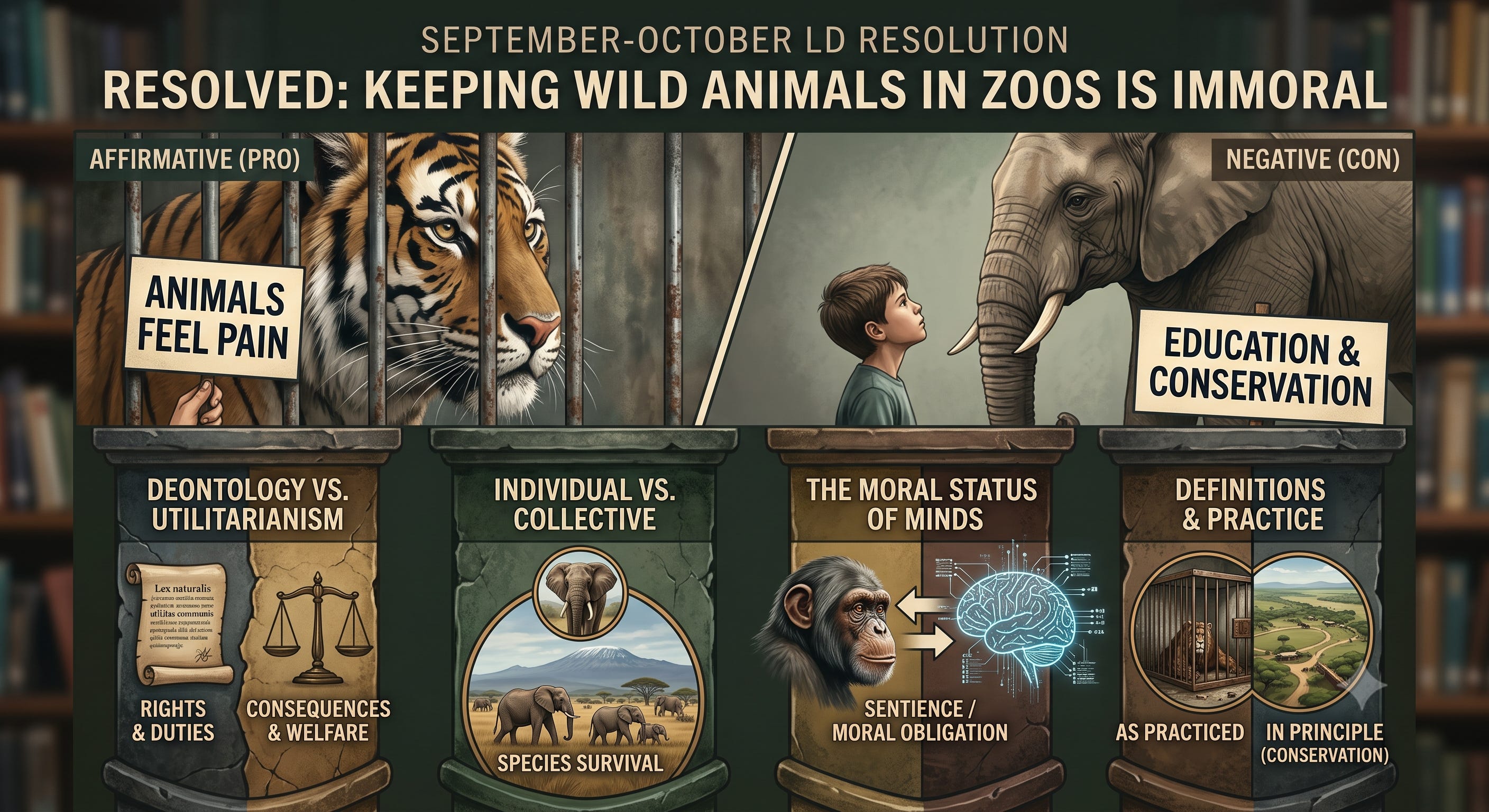
Why This Topic — and Why It’s Deceptively Deep
I’ll admit my first reaction was skepticism. Keeping wild animals in zoos is immoral? It didn’t strike me as a serious Lincoln-Douglas topic — it sounded like something you’d debate in a middle-school classroom, not at a national tournament. But the context changed my mind. As I understand it, some coaches wanted an easier, more accessible LD topic, and didn’t want to split the national service topic — the one used to bring novices in — by running it against a separate JV/Varsity resolution. A single approachable topic that works across all levels solves that problem. On those terms, this is a genuinely viable resolution.
And the more I sat with it, the more I realized that “approachable” and “shallow” are not the same thing. This topic has the rare quality of meeting every debater where they are. A nervous novice can stand up and argue something true and humane on the very first day — animals feel pain, cages cause suffering, that matters — or, on the other side, children who meet a tiger learn to love and protect tigers. Those are real arguments, accessible to a twelve-year-old, and they are not wrong. The topic has a low floor, which is exactly what you want for bringing new people into the activity.
But it also has a remarkably high ceiling. Scratch the surface of “should we keep animals in zoos” and you hit the foundational fault lines of moral philosophy itself — the same fault lines debaters will spend the next several years, and in some cases the rest of their lives, arguing about.
The first is the contest between deontology and utilitarianism. Is the wrong of captivity a matter of consequences — weighing animal suffering against human education and species conservation on a great cosmic ledger — or is it a matter of rights and duties, where confining a being against its nature is simply wrong no matter how the math comes out? Nearly every LD round ever run is, underneath, a fight between these two engines, and here that fight is unusually clean and unusually vivid. Sitting just beneath it is the question of the scope of moral obligation: to whom do we owe moral consideration, and why? If a being can suffer, does that alone command our concern (Bentham’s “Can they suffer?”), or does moral status require something more — rationality, autonomy, the capacity to reciprocate? Zoos force the question of whether we have genuine obligations to non-human but biologically intelligent beings, and of what those obligations rest on.
Then there is the question I find most exciting — the throughline to intelligent machines, the point where a “silly” topic about pandas and elephants quietly becomes one of the most important debates of the coming century. The criteria a debater builds here for why an animal mind deserves moral standing — sentience, the capacity to suffer, having a subjective point of view, being (in Tom Regan’s phrase) a “subject-of-a-life” — are precisely the criteria we will soon have to apply, under real pressure, to artificial minds. If we decide a creature merits rights because it can suffer and has interests of its own, what do we owe a machine that may one day do the same? If we decide it does not, on what grounds, and will those grounds survive contact with a system that argues back? A student who learns to reason carefully about the moral status of a captive orca is, without knowing it, building the exact toolkit they will need for the moral status of a synthetic intelligence; the zoo is a warm-up for a much larger arena. This is no longer hypothetical — philosophers now argue in print over whether a sufficiently advanced machine could be owed rights on the very sentience-and-interests criteria the animal debate runs on (John-Stewart Gordon, “Are Superintelligent Robots Entitled to Human Rights?”, Ratio, 2022), and over “substrate non-discrimination,” the principle that two beings with the same conscious experience have the same moral status even if one is silicon and the other flesh. Whatever criterion a debater defends for the orca, they are tacitly defending for the machine.
Several other large questions open off the same resolution. There is the tension between liberty and paternalistic welfare — whether a safe, well-fed, long life in a cage is better or worse than a free, dangerous, short one, which is not only an animal question but one of the oldest questions in political philosophy about the value of freedom itself, and about what, if anything, justifies overriding another’s autonomy “for their own good.” There is the individual versus the collective: do we owe our duties to this elephant, or to elephants as a species? Animal ethics, which counts individuals, and conservation ethics, which counts populations and ecosystems, can pull violently apart — the same structural tension that runs through every debate about whether the one may be sacrificed for the many. There is the distinction between principle and practice — whether the claim is that zoos are inherently wrong or only that they are currently done badly — and learning to separate a critique of an institution’s essence from a critique of its execution is one of the most transferable analytical skills a debater can acquire, showing up in arguments about capitalism, democracy, policing, and nearly everything else worth arguing about. There is the fight over the definitions themselves, because before any of the above can even be argued, students discover that the resolution’s own words are slippery: what counts as a wild animal — the species, or the individual? (A tiger born at the zoo belongs to a wild species but has never lived free, and a captive-bred animal may have no wild to return to.)
And what counts as a zoo — a roadside menagerie, an accredited conservation institution, a SeaWorld-style marine park, a true sanctuary? Each reading quietly hands the round to one side; these are not pedantic quibbles, because in debate whoever controls the definition often controls the outcome, and learning to interrogate, defend, and contest definitions — to see that the terms of a question are never neutral — transfers to law, policy, and any argument where everything turns on what a word is taken to mean. And there is the ethics of the human gaze — what it does to us, to our character and to how we see the natural world, to keep other beings as spectacle, a virtue-ethics question hiding inside an institutional one that generalizes to every relationship in which one party watches and the other is watched.
None of these is settled. All of them are live, and all of them are winnable on either side by a debater who has thought hard enough. That combination — a low floor and a high ceiling, simple humane intuitions sitting directly on top of the deepest problems in ethics — is exactly what makes a topic worth a season.
I have a personal reason for believing this one rewards the effort. As an undergraduate I took a philosophy of animal rights course in which the professor, unusually, let each student choose how they wanted to be graded. I showed up the first day, chose my method — and then didn’t go back. With about a month left in the semester I walked into his office and told him I’d like to write a paper, despite not having attended a single class since day one. He told me I had a lot of guts. And then, to his credit, he agreed.
I wrote sixty-four pages. This was well before generative AI — there was no tool to lean on, no model to draft against — so every word of it was mine, worked out the hard way. I got an A+, and a recommendation to graduate school strong enough that it mattered. But the grade was honestly the least of it. I spent that month thinking as hard as I have ever thought about anything: about suffering, about obligation, about what we owe the minds that aren’t ours and can’t argue their own case. It was one of the best intellectual projects of my life, and I came out of it changed — not because someone lectured me, but because the questions themselves were deep enough to reward a month of genuine attention.
That is what this topic can be, at its best. It looks like it’s about zoos. It’s actually about almost everything.
SECTION 1 — DEFINITIONS
1.1 “Wild animals”
The core contrast is with domesticated animals — species shaped over many generations by selective breeding for human use and tolerance of human proximity (dogs, cattle, chickens). “Wild animals” are members of species not so altered; they retain the behavioral and physiological repertoire shaped by natural selection. This matters because much of the affirmative welfare case rests on a mismatch between evolved needs (ranging, foraging, social structure) and captive conditions — a mismatch that is by definition smaller for domesticated animals.
A second, pivotal definitional wrinkle concerns the wild/captive-bred distinction: most animals in accredited modern zoos were born in captivity, not taken from the wild — the AZA itself notes that its access to wild animals has narrowed and that managed breeding now sustains its collections. An individual born at the Bronx Zoo is a member of a wild species but is not itself “wild” in the sense of ever having lived free. This splits the resolution. If “wild” refers to the species, the resolution covers essentially all non-domesticated zoo animals; if it refers to the individual’s history, the resolution might be read narrowly as condemning only the capture of free-living animals — a practice modern accredited zoos have largely (though not entirely — see cetaceans, some elephants) moved away from.
The affirmative generally wants the species reading (the wrong is confining a being whose nature is wild); some negative arguments exploit the individual reading (a captive-born animal has known no other life, never had liberty to be “deprived” of, and may be ill-suited to release). Donaldson and Kymlicka’s Zoopolis complicates both by adding a third category — “liminal” animals (raccoons, pigeons) that are wild but live among humans — showing “wild” is not binary.
A further question is which taxa count. The intuitive force of the anti-zoo argument scales with presumed sentience and cognitive complexity: it is strongest for mammals (especially great apes, elephants, cetaceans), strong for birds, and progressively more contested for reptiles, fish, and invertebrates. Welfare science (e.g., Georgia Mason’s work) increasingly extends concern to fish and even some invertebrates, but the moral intuitions and the empirical evidence are both thinnest there. A debater who defines “wild animals” to foreground elephants and orcas argues on the strongest affirmative ground; one who foregrounds invertebrates, fish, and amphibian breeding arks argues on the strongest negative ground. This taxonomic choice is itself a load-bearing definitional move.
1.2 “Zoos”
The institutional range is wide, and the moral analysis shifts across it. At one end sit traditional municipal zoos and menageries, historically built for entertainment and civic display; barren cages; the historical target of critiques like Dale Jamieson’s.
Modern accredited zoos are members of AZA (Association of Zoos and Aquariums, North America), EAZA (Europe), BIAZA (Britain & Ireland), and the global umbrella WAZA. Accreditation imposes welfare, husbandry, conservation, and education standards; AZA coordinates Species Survival Plans (SSPs).
Safari parks offer larger enclosures, drive-through formats; better for space but still confinement.
Aquariums include the hardest cetacean-captivity cases (SeaWorld-style marine parks).
Roadside zoos are unaccredited, often substandard; even most zoo defenders concede these are indefensible.
Conservation breeding centers are facilities (often closed to the public, e.g., the National Black-footed Ferret Conservation Center) focused on breeding for release, not display.
Sanctuaries differ in kind. A true sanctuary (e.g., accredited by the Global Federation of Animal Sanctuaries) takes in animals that cannot be released, does not breed, does not buy/sell/trade, and does not exhibit for entertainment or profit; its telos is the resident animal’s interest, not display or a breeding program. The Nonhuman Rights Project’s demand for Happy the elephant was transfer to a sanctuary, not “release,” underscoring that the sanctuary/zoo distinction (not captivity per se) is often the operative line.
Whether accreditation changes the moral analysis is genuinely disputed. Welfarists say yes — accreditation is precisely what separates “high-welfare, conservation-oriented captivity” (potentially permissible) from “spectacle captivity” (not). Rights-based abolitionists say no — accreditation improves the conditions of a wrong but does not cure the wrong itself (”a gilded cage is still a cage,” as Judge Rivera wrote in dissent in Happy’s case). The resolution’s force depends heavily on whether one is condemning zoos as a class or bad zoos.
1.3 “Immoral”
The single most important analytical move is recognizing that different ethical frameworks render different verdicts. Begin with consequentialism or utilitarianism (Bentham, Singer). What matters is aggregate welfare — suffering and satisfaction. Captivity is permissible if and only if the net balance (animal welfare + conservation + education benefits − animal suffering) is positive. This framework permits high-welfare zoos and condemns low-welfare ones; it is intrinsically an “as practiced,” empirically contingent verdict. Notably, Singer explicitly rejects rights-talk and accepts that animals’ interests can be weighed against other interests.
Deontology, or rights-based ethics (Regan), takes a different view. Animals that are “subjects-of-a-life” have inherent value and a right not to be treated merely as means. On this view, confining a being for our purposes (education, entertainment, even species-level conservation) violates its rights regardless of how well it is treated — an in-principle condemnation.
Virtue ethics asks what a person of good character would do, and it can cut both ways — stewardship, wonder, and care as virtues (pro-zoo), versus domination and objectification as vices (anti-zoo).
Care ethics (Gruen’s “entangled empathy”) emphasizes relationships and attentiveness to the particular animal; tends to be critical of institutional captivity but open to obligations of care toward animals already dependent on us.
The capabilities approach (Nussbaum) holds that each sentient creature is entitled to flourish according to the “form of life” characteristic of its species. Captivity is wrong where it forecloses central capabilities (movement, social life, choice) — which strongly indicts confinement of wide-ranging, complex species but might tolerate environments that genuinely enable a species’ capabilities.
Contractualism holds that rights and duties arise from agreements among rational agents; animals (non-agents) fall outside the contract on strict versions (a route to denying animals rights, as Carl Cohen argues), though contractualists like Mark Rowlands extend it via a Rawlsian veil of ignorance.
Finally, Buddhist or dharmic ethics — a non-Western lens, included because the menu above is otherwise entirely Western — centers ahimsa (non-harm) and the First Precept against killing or harming sentient beings; on the doctrines of interdependence (pratītyasamutpāda) and rebirth across species, there is no sharp moral line between human and animal — all sentient beings are fellow travelers in saṃsāra owed compassion (karuṇā). It tends to disfavor captivity that inflicts suffering, but frames the deeper task as cultivating compassion and non-attachment rather than asserting rights. The mapping is contested: scholars caution that Buddhist concepts do not translate cleanly into Western “rights” or “welfare” categories (the tradition also contains hierarchy among rebirths and a long practice of keeping and “merit-releasing” animals), so a debater should wield it as a distinct moral vocabulary, not a restatement of Singer or Regan. See Paul Waldau, The Specter of Speciesism (Oxford, 2002).
The word “immoral” is itself ambiguous between condemning the institution in principle and condemning it only as currently practiced. The in-principle question is whether captivity of wild animals is inherently wrong, such that no reform could fix it; the in-practice question is whether zoos as they actually operate are wrong, even if an idealized zoo might not be. This is the is/ought and institution-vs-practice fault line. An abolitionist affirms the in-principle claim; a reformist welfarist may deny it but affirm much of the in-practice critique. A debater must pin down which claim is being defended — the strongest affirmative ground is often the in-practice one (pointing at real harms and surplus culling), while the strongest negative ground is often the in-principle defense (of an idealized conservation institution). Conflating them is the most common error in this debate.
1.4 The deeper cut: is “the wild” even a coherent category?
§1.1 handled the surface question — which animals count as “wild.” There is a deeper and more interesting move available to a sophisticated debater: contesting “the wild” itself. The idea of wilderness — nature as a pristine domain existing apart from and untouched by humans — is one of the most criticized concepts in environmental thought, and the resolution’s central word sits right on top of it.
The foundational statement is William Cronon’s “The Trouble with Wilderness; or, Getting Back to the Wrong Nature” (1995), which argues that “wilderness” is not a pristine sanctuary but a human cultural invention — a relatively recent one, freighted with Romantic and frontier mythology — and that treating it as the benchmark of “real” nature is both historically false and ethically corrosive. Historically false because the landscapes Europeans called “untouched” had in fact long been shaped and managed by Indigenous peoples; the supposedly pristine pre-Columbian Americas were a worked landscape, not a virgin one (William Denevan, “The Pristine Myth: The Landscape of the Americas in 1492,” Annals of the Association of American Geographers 82, 1992, 369–385). Ethically corrosive because the wilderness ideal erases human presence: the U.S. national parks were literally emptied of their Native inhabitants to manufacture the “pristine” scenery visitors came to admire (Mark David Spence, Dispossessing the Wilderness: Indian Removal and the Making of the National Parks, Oxford UP, 1999). And in an epoch of pervasive human influence, the notion of nature “apart from us” arguably no longer describes anything real (Bill McKibben, The End of Nature, 1989); what we have instead is a managed, hybrid, “post-wild” world (Emma Marris, Rambunctious Garden: Saving Nature in a Post-Wild World, Bloomsbury, 2011). The deepest version of the critique simply denies the nature/culture binary on which “wild versus captive” rests: there is no clean line where the human world stops and a separate wild one begins.
This cuts both ways, which is what makes it good debate material rather than a gimmick. For the affirmative, the zoo is the purest machine for manufacturing the “wrong nature” Cronon describes — it sells visitors a curated, captive image of “the wild” that displaces the real thing in their imaginations (the same point as the Baudrillard/spectacle argument in §2.1e, now with a deeper genealogy). And if “wild animal” is a culturally loaded, unstable category, the affirmative can press the negative to defend exactly what it thinks it is preserving.
For the negative, the picture inverts: the affirmative’s most romantic arguments — liberty, “freedom of the wild,” the animal’s sovereign territory (Jamieson; Regan; Donaldson & Kymlicka’s Zoopolis) — all presuppose a pristine wild to return animals to. If that wild is a myth, or is vanishing, or is itself a managed human landscape, then “free them into the wild” is far less clean than it sounds: often it means releasing them into a degraded, bounded, human-dominated remnant — or into non-viability. That is precisely the negative’s “insurance population” argument (§2.2j), now reinforced: ex-situ collections matter more, not less, in a post-wild world. The nature/culture binary that makes “captivity = unnatural confinement, wild = natural freedom” feel self-evident is doing unexamined work, and the negative can expose it.
There is also an Indigenous-sovereignty thread that links back to §2.5: the romantic “wilderness” that excludes humans is the same construct that, historically, excluded Indigenous humans — and the same animal-rights discourse that idealizes untouched wild animals has, in practice, sometimes targeted Indigenous subsistence hunting. Recent work tries to rebuild “wild animal sovereignty” on Indigenous rather than Romantic foundations (Dennis Papadopoulos, “Indigenizing Wild Animal Sovereignty”, Journal of Social Philosophy, 2022) — a sophisticated way to keep the affirmative’s sovereignty argument while shedding its colonial baggage.
The crux it surfaces is this. If “wild” names a real, value-laden state of being-apart-from-human-control, the affirmative’s liberty and sovereignty arguments keep their full force. If “wild” is a cultural construct — or a degree on a continuum of human management rather than a binary — then the gap between a zoo, a fenced reserve, a rewilded tract, and a “wild” population shrinks to a matter of degree, and the affirmative’s in-principle case softens into an empirical one about how much management is too much. (This is the same conceptual instability that ran through the Nov–Dec rewilding resolution: rewilding to which baseline, and in what sense is a deliberately re-engineered ecosystem “wild”? A debater who worked that topic already owns half of this argument.)
One caveat: deployed clumsily, the wilderness critique collapses into a non-sequitur — “nothing is truly wild, therefore captivity is fine” — which does not follow: a managed continuum can still have a morally relevant good end and bad end. This is framework-level depth for a thoughtful judge, not a stock card, and it lands best paired with a positive account of what the debater thinks does ground an animal’s claims (sentience, interests, a life of its own) once “wildness” is set to one side.
SECTION 2 — ARGUMENTS ON BOTH SIDES
2.1 AFFIRMATIVE: Zoos ARE immoral
The affirmative’s most foundational argument is from liberty and autonomy, and it operates in principle. Jamieson’s foundational 1985 essay “Against Zoos” (in Singer’s In Defense of Animals) argues there is “a moral presumption against keeping wild animals in captivity” — depriving them of liberty, natural habitat, and self-determination — that the supposed benefits (amusement, education, scientific research, species preservation) fail to overcome. The presumption is the load-bearing premise: confinement is a prima facie harm requiring strong justification, and Jamieson argues the four standard benefits are individually too weak and partly incompatible (amusement and education favor urban zoos; research and preservation favor large preserves).
A second in-principle argument is rights-based, resting on the idea of a subject-of-a-life. Regan’s The Case for Animal Rights (1983): mammals (at least) are “subjects-of-a-life” with inherent value; treating them as means to human ends (display, education, even conservation of their species) violates their rights. On this view even a perfect zoo is wrong.
A third in-principle argument widens the rights frame into a claim about wild-animal sovereignty. Donaldson & Kymlicka’s Zoopolis (2011) reframes wild animals as members of sovereign communities entitled to non-interference and self-determination on their own territory; capturing/confining them is akin to a violation of sovereignty, not merely of individual welfare.
The affirmative’s empirically strongest ground is welfare and suffering, an in-practice argument. It begins with stereotypic behavior, sometimes called “zoochosis”: pacing, swaying, and other abnormal repetitive behaviors are widespread in captivity and are validated (if imperfect) markers of compromised welfare (Mason & Latham, Animal Welfare 2004; Mason & Rushen, Stereotypic Animal Behaviour, 2nd ed. 2006, CABI).
The animals that fare worst are the wide-ranging ones. Clubb & Mason (Nature, 2003, 425:473–474), analyzing carnivore species, found that naturally wide-ranging lifestyles predict both stereotypic pacing and infant mortality in captivity; the polar bear — whose home range can span thousands of square kilometres and which is typically kept in enclosures a tiny fraction of that size — is the paradigm. Their explicit conclusion: the keeping of wide-ranging carnivores “should be either fundamentally improved or phased out.” (Flag for rebuttal: a 2023 re-analysis updating the dataset replicated the home-range effect on route-tracing pacing but did not replicate the infant-mortality correlation.)
The elephant data are especially stark. Clubb et al. (Science, 2008, 322:1649) state: “We analyzed data from over 4500 elephants to show that animals in European zoos have about half the median life span of conspecifics in protected populations in range countries.” Asian zoo elephant infant mortality runs about twice that seen in Burmese timber camps, and inter-zoo transfer and early maternal separation are identified risk factors. (Flag for rebuttal: a 2022 Zoo Biology study using the Species360 database found adult survivorship has improved significantly since the early 20th century, and from 1960 onward significantly for African elephants — so the 2008 benchmark is contested and arguably improving.)
Cetaceans present the hardest case of all. Lori Marino and colleagues (Marino et al., Journal of Veterinary Behavior, 2020, 35:69–82) argue orcas and other cetaceans — large-brained, wide-ranging, socially complex — suffer chronic stress, disease, and abnormal behavior in tanks, and that the mismatch between who cetaceans are and tank life is not a problem a bigger tank can solve. (Note: the authors are advocacy-aligned scientists; the paper is peer-reviewed.)
A further charge concerns commodification and spectacle. Critics (Malamud, Reading Zoos; Acampora) argue zoos objectify animals as entertainment, train the “human gaze” to see animals as spectacle, and convey a false narrative of human dominion over a sanitized nature. John Berger’s essay “Why Look at Animals?” is a touchstone. A postmodern variant pushes the point further: on a Baudrillardian reading, the zoo animal is a hyperreal simulacrum — a managed, captive stand-in that displaces the real wild animal in our imagination and trains us to mistake the copy for the thing. The caged creature becomes, in Berger’s phrase, a “living monument” to a disappearance the institution itself helps stage.
The affirmative also argues that conservation is largely a post-hoc justification, and it marshals several kinds of evidence. Threatened species are a minority of zoo holdings: Conde et al., “Zoos through the Lens of the IUCN Red List” (PLOS ONE, 2013), found that “695 of the 3,955 (23%) terrestrial vertebrate species in ISIS zoos are threatened. Only two of the 59 taxonomic orders show a higher proportion of threatened species in ISIS zoos than would be expected if species were selected at random.” Roughly 15% of threatened vertebrate species are represented in zoos at all (Conde et al., Science, 2011), and only about 6.2% of threatened amphibians were held in zoos (Dawson et al. 2016).
Born Free’s report “Conservation or Collection?” (2021) found that only 26.6% of species housed by the surveyed UK Consortium of Charitable Zoos are threatened with extinction, while 52.4% are classified IUCN “Least Concern,” and only 35.4% of species bred at these zoos are threatened. A companion Born Free report, Zoos: Financing Conservation or Funding Captivity? (2021), found these zoos spend on average just ~4.2% of annual income on in-situ conservation. Born Free’s captivity research officer Chris Lewis: “Claims by zoos that they contribute to species conservation and public education require careful scrutiny and cannot be taken at face value as justifications for the keeping and breeding of wild animals in captivity.” (Source: advocacy; methodology built on FOI’d zoo inventories.)
Finally, “surplus” animals are routinely culled: the Marius the giraffe case (Copenhagen Zoo, February 2014) — a healthy young giraffe (reported as 18 months; the zoo’s scientific director said two years) killed because “genetically redundant,” publicly dissected before a crowd including children, and fed to lions — exposed the practice. An EAZA spokesman estimated member zoos kill on the order of ~1,735 “surplus” animals per year (explicitly an estimate — EAZA does not release figures), and a 2003 CAPS study suggested anywhere from ~7,500 up to ~200,000 “surplus” animals exist in European zoos at any one time (flag the enormous range). EAZA defends management euthanasia in its Management Euthanasia / Culling Statement (current version April 2023). The “ark” thus jettisons passengers.
Closely tied to the conservation question is the poor record of reintroduction, an in-practice argument. Most captive-bred animals are never released, and release programs often fail. Empirical surveys put reintroduction success low — Beck et al. (1994), “Reintroduction of captive-born animals” (in Olney, Mace & Feistner eds., Creative Conservation, Chapman & Hall), found only ~11% of captive-born programs produced self-sustaining wild populations; Griffith et al. (Science, 1989, 245:477–480) found captive-bred animals do significantly worse than wild-caught translocated animals (38% vs. 75% success), as did Wolf et al. (Conservation Biology, 1996, 50% vs. 71%); see also Jule, Leaver & Lea (Biological Conservation, 2008) and Frankham (Molecular Ecology, 2008) on genetic adaptation to captivity reducing wild fitness. Snyder et al. (Conservation Biology, 1996) catalog seven structural limitations of captive breeding as a recovery tool. The widely cited figure that of ~145 zoo reintroduc
tion programs only ~16 genuinely restored wild populations traces to Beck (Beck et al. 1994) and is propagated mainly through advocacy outlets — cite it as Beck’s figure with advocacy framing, not as an independent statistic.
There is also a paternalism critique. Deciding “for” the animal what life it should lead — even a comfortable one — substitutes human judgment for the animal’s own ends; the rights tradition treats this as a wrong even when well-intentioned.
Finally, the affirmative can press an abolitionist argument from justice. Francione’s abolitionist approach: the root wrong is animals’ status as property; so long as animals are owned and used as means (including in zoos), incremental welfare reforms entrench rather than end the injustice. The remedy is abolition, not bigger cages.
2.2 NEGATIVE: Zoos are NOT immoral
The negative’s first and strongest argument is conservation, which holds in principle and, for some species, in practice: ex-situ breeding has prevented extinctions that in-situ measures alone could not. The clearest case is the California condor: the species hit a low of 22 birds in 1982; after the last free-flying condor was taken into captivity in spring 1987, the entire species — by then 27 birds, the number having risen through captive hatching — survived only at the Los Angeles Zoo and San Diego Wild Animal Park. (Note the two distinct figures: 22 was the 1982 low; 27 was the 1987 captive total.) The world population now exceeds 560 (561 reported for 2022; USFWS updated the total to 607 in late 2025), with more than half flying free.
The black-footed ferret is a second success: a captive-breeding program built from 18 individuals captured in 1985–87 (15 survived, the genetic equivalent of 7 founders) has since produced thousands of offspring and reintroduced ferrets to dozens of sites across the western U.S., Canada, and Mexico.
The Przewalski’s horse is a third: extinct in the wild by the 1960s, survived only in zoos; coordinated breeding and reintroductions from the 1990s have re-established the species in Mongolia, China, and Central Asia (roughly 2,000 in human care plus several hundred reintroduced).
The Arabian oryx, golden lion tamarin, and Père David’s deer are other stock examples (Père David’s deer became extinct in the wild but survived in collections and was returned to China).
WAZA-affiliated institutions are collectively a major funder of in-situ conservation. Gusset & Dick (Zoo Biology, 2011) report that “more than 700 million people visit zoos and aquariums worldwide” and that “the world zoo and aquarium community reportedly spends about US$350 million on wildlife conservation each year” — described as the third-largest contributor among conservation organizations. (Flag: these are self-reported survey figures; the survey counted ~600 million actual 2008 visits, adjusted upward.) The negative argues these are species that would not exist without zoos.
A central negative argument is educational, built around empathy and the idea of an “extinction of experience.” Zoos reach hundreds of millions of visitors and may build the conservation constituency. Moss, Jensen & Gusset (Conservation Biology, 2015, 29:537–544) surveyed 5,661 visitors to 26 zoos and aquariums from 19 countries and found biodiversity understanding rose from 69.8% pre-visit to 75.1% post-visit, and knowledge of actions to protect biodiversity rose from 50.5% to 58.8%; Jensen, Moss & Gusset (Zoo Biology, 2017) found gains persisting up to two years. This connects to the “extinction of experience” — a term coined by Robert Michael Pyle (developed in his book The Thunder Tree, Houghton Mifflin, 1993) and elaborated by Soga & Gaston (Frontiers in Ecology and the Environment, 2016, 14:94–101) — the worry that urban populations with no contact with wildlife will not care to protect it, creating “a cycle of disaffection toward nature.”
Research is a third benefit the negative cites. Zoos enable veterinary, reproductive, nutritional, and behavioral research (assisted reproduction, disease, cognition) that benefits both captive and wild populations and underpins reintroduction science.
The negative further argues that welfare can in practice be good for many species. Modern enclosure design and environmental enrichment can produce good welfare; captive animals are free from predation, starvation, parasites, and drought, and many live longer than wild conspecifics. WAZA’s Caring for Wildlife: The World Zoo and Aquarium Animal Welfare Strategy (2015), built on the Five Domains model, formalizes the aspiration. The negative concedes Mason’s wide-ranging-species findings but notes the same literature shows some species (ring-tailed lemurs, snow leopards, many small mammals, reptiles, amphibians, fish, invertebrates) cope well in captivity — welfare is species-specific, not uniform.
Underlying much of this is a contrast between welfare framing and rights framing. On a welfarist (Singer-style) view, what’s wrong is suffering, not captivity as such; high-welfare captivity that serves conservation is permissible. The negative argues the affirmative smuggles in a contested rights premise that most people and most welfare science do not share.
The negative also insists that the wild is not idyllic. Predation, starvation, disease, parasitism, infanticide, and habitat loss mean wild lives are often short and brutal; romanticizing “freedom” ignores that a wild animal’s liberty includes the liberty to starve. (Even Singer acknowledges wild-animal suffering as a serious issue; Jeff McMahan’s “The Meat Eaters” pushes this hard.) For some individuals, captivity may be a better life.
Zoos additionally supply funding for in-situ conservation. Gate revenue and zoo philanthropy fund field projects, anti-poaching, and habitat protection that abolition would eliminate (the ~$350M/yr figure above).
A deeper structural argument turns on the divergence between individual and species-level ethics. Conservation ethics (species, ecosystems) and animal ethics (individuals) can diverge; the negative argues species-level value (and the interests of future wild populations) can outweigh costs to individual captive animals — a trade the affirmative’s individualism refuses to make. This is the Leopoldian “land ethic” vs. Reganite individualism tension.
The negative can also appeal to stewardship, contractualist, and virtue-based considerations. Humans have brought many species to the brink; stewardship and a caring human-animal relationship are virtues, and we may owe positive duties of care to animals already in our charge. Korsgaard’s Kantian view (Fellow Creatures, 2018) — that we owe animals treatment as ends — is arguably compatible with providing a circumscribed but genuinely good life, analogous to her acceptance of responsible pet-keeping.
Finally, there is a pragmatic case against abolition. Abolition would not return captive-born animals to a wild many cannot survive in; the realistic alternatives are euthanasia or unfunded sanctuaries. With accelerating habitat loss, the wild is increasingly non-viable, making ex-situ “insurance populations” more, not less, important.
2.3 In-principle vs. in-practice, and where the evidence actually stands
The affirmative’s strongest in-principle argument is the rights or sovereignty claim (Regan, Donaldson & Kymlicka), which, if sound, defeats even a perfect zoo; its strongest in-practice argument is the welfare science on wide-ranging and complex species (Clubb & Mason 2003; Clubb et al. 2008; Marino 2020), together with surplus culling (Marius) and the weak conservation and reintroduction record. The negative’s strongest in-principle argument is the welfarist claim that captivity per se is not a harm where welfare is high, combined with stewardship duties; its strongest in-practice argument is the documented extinction-prevention successes and the visitor-education gains.
Several empirical questions remain genuinely contested, and honesty about them matters. Do reintroductions work? Rarely and unevenly; success is low (~11–38%) and captive-bred animals underperform wild-caught — but a few high-value successes exist. Both sides overstate: the affirmative ignores the genuine saves; the negative generalizes from a handful.
What fraction of zoo animals are endangered or in breeding programs? A minority — ~23% of zoo-network vertebrate species are threatened, only ~15% of threatened species are in zoos at all, and most zoo species are not threatened. This is strong affirmative ground.
Does visitation change behavior? Knowledge and stated intention rise (Moss/Jensen); whether actual long-term behavior changes is weakly supported — the knowledge-behavior gap is real and acknowledged even in pro-zoo literature (Moss, Jensen & Gusset themselves found biodiversity knowledge and pro-conservation behavior only weakly correlated).
And what does welfare science show? Robust evidence of harm for wide-ranging and large-brained species; genuinely good welfare achievable for many others. The science supports a species-specific verdict, not a blanket one.
2.4 The CRUX
The resolution turns on four hinge points, in roughly descending order of decisiveness. The first and master crux is the framework choice between rights and welfare: accept Regan, Francione, or sovereignty and zoos are immoral in principle, full stop, while accepting Singer-style welfarism makes the question empirical and conditional — most of the apparent factual disagreement is downstream of this. The second is whether the resolution is read “in principle” or “as practiced”: if it targets the institution in principle, the negative’s idealized conservation zoo is the battleground, whereas if it targets actual practice, the affirmative’s catalog of real harms dominates. The third is the contest between species-level and individual ethics — whether conservation value to a species can outweigh liberty and welfare costs to individuals, the point where conservation ethics and animal ethics collide. The fourth is the empirical question of conservation efficacy: if ex-situ breeding and education robustly work, the welfarist ledger tips toward zoos; if they are largely pretextual, it tips against, and the evidence is real but limited, which is why this remains live.
A debater wins by forcing the framework choice first, then fighting on the terrain it creates.
2.5 A third axis: the political-economy critique
Almost all of this debate is fought on the rights-versus-welfare axis above. There is a third position — from the eco-socialist and social-ecology left — that reframes the whole question, and it is worth keeping in a back pocket both because it can wrong-foot an unprepared opponent and because it is genuinely illuminating.
The core move relocates the wrong from the institution to the political-economic system that produces it. On this view (David Nibert, Animal Rights/Human Rights, 2002; Ted Benton, Natural Relations, 1993), the oppression of animals and of devalued humans are entangled products of capitalism, and the affirmative’s favored remedies — abolition through individual consumer choice, “marketing compassion,” boycotting — are a voluntarist theory of change that misreads how capitalist economies work and leaves the structure intact. Benton goes further: the very discourse of rights is a liberal-capitalist artifact that “adds to oppression” by dressing a substantively unjust order in the language of formal entitlements. The sharp implication for this resolution: declaring zoos “immoral” and walking away satisfied may itself be the bourgeois move — it moralizes a symptom (the cage) while leaving untouched the commodification of nature that built the cage and sells tickets to it. (This is also the home of the affirmative’s strongest impact framing — the claim that animal exploitation is the historical template for human oppression, since “every subjugated people has first been characterized as animals”; see Charles Patterson, Eternal Treblinka, 2002. Handle with care: the explicit Holocaust and slavery analogies are powerful but contested, and many judges find them more alienating than persuasive.)
The same tradition supplies an edge against the affirmative. Peter Staudenmaier’s Ambiguities of Animal Rights (2003) argues animal-rights doctrine is at once “anti-humanist and anti-ecological”: it misconstrues what is distinctive about human moral agency, and — by targeting individual consumption and even low-impact Indigenous subsistence hunting — carries a class and cultural bias, universalizing “the nutritional choices typical of a narrow socio-economic stratum.” A negative can borrow this to argue the affirmative’s framing is not the radical stance it imagines but a recuperation of liberal individualism.
A few caveats are in order. These are positions from a specific left school (social ecology / eco-socialism) — scholarly but advocacy-adjacent — so cite them as such. And most LD judges will treat a structural-capitalism turn as outside the resolution’s plain meaning, so it works best as a framework-level kritik in front of a receptive critic, or as analytical depth rather than a stock case. But the crux it surfaces is real: is “immoral” a property of the practice (the debate’s default), or of the system that makes the practice profitable? Naming that ambiguity can itself score.
SECTION 3 — ANNOTATED BIBLIOGRAPHY
3.1 Foundational animal-ethics philosophy
Peter Singer, Animal Liberation (1975; rev. Animal Liberation Now, 2023, Harper). The founding utilitarian text; introduces “speciesism.” Supports a welfarist verdict — captivity wrong where it causes net suffering, not inherently. Complicates the affirmative because Singer explicitly rejects rights-talk.
Tom Regan, The Case for Animal Rights (1983, University of California Press). The deontological cornerstone; “subjects-of-a-life” have inherent value and rights. Strongly supports the in-principle affirmative.
Gary L. Francione, Animals, Property, and the Law (1995, Temple UP); with Robert Garner, The Animal Rights Debate: Abolition or Regulation? (2010, Columbia UP). Abolitionism: the wrong is animals’ property status; welfare reform entrenches it. Supports the most radical affirmative.
Christine M. Korsgaard, Fellow Creatures: Our Obligations to the Other Animals (2018, Oxford UP). Kantian case that animals are “ends in themselves”; nuanced — can support a circumscribed but genuinely good captivity, so cited by both sides.
Martha C. Nussbaum, Justice for Animals: Our Collective Responsibility (2023, Simon & Schuster); Frontiers of Justice (2006, Harvard UP). Capabilities approach: each creature entitled to species-typical flourishing. Indicts confinement that forecloses central capabilities; complicates simple pro-zoo claims.
Sue Donaldson & Will Kymlicka, Zoopolis: A Political Theory of Animal Rights (2011, Oxford UP). Wild animals as sovereign communities; liminal animals as denizens; domesticated animals as co-citizens. Supplies the sovereignty affirmative argument.
Bernard E. Rollin, Animal Rights and Human Morality (1981, Prometheus). Welfare/telos-based; animals have natures (”telos”) that ought to be respected. Mixed implications for zoos.
Mary Midgley, Animals and Why They Matter (1983, University of Georgia Press). Critiques the human/animal moral boundary; relational, anti-absolutist.
Cora Diamond, “Eating Meat and Eating People” (1978, Philosophy 53). Reframes the debate around moral vision/imagination rather than rights; complicates both camps.
Carl Cohen, “The Case for the Use of Animals in Biomedical Research” (1986, New England Journal of Medicine); The Animal Rights Debate with Tom Regan (2001, Rowman & Littlefield). The leading philosophical case against animal rights — only moral agents can hold rights. Key negative resource.
R. G. Frey, Interests and Rights: The Case Against Animals (1980, Oxford UP). Denies animals have the interests/desires needed to ground rights. Negative resource.
David DeGrazia, Taking Animals Seriously: Mental Life and Moral Status (1996, Cambridge UP); Animal Rights: A Very Short Introduction (2002, Oxford UP). Balanced moral-status analysis; excellent for mapping the middle ground.
Lori Gruen, Entangled Empathy (2015, Lantern). Care-ethics approach centering relationships and attentiveness; broadly critical of institutional captivity but attentive to obligations toward dependent animals.
Clare Palmer, Animal Ethics in Context (2010, Columbia UP). Relational view: duties depend on relationships and how animals came to depend on us — directly relevant to obligations toward already-captive animals.
Jeff McMahan, “The Meat Eaters” (2010, New York Times) and related work on wild-animal suffering. Pushes the “wild is not idyllic” line; complicates romanticized freedom. Negative-leaning.
3.2 Historical / classical sources
Jeremy Bentham, An Introduction to the Principles of Morals and Legislation (1789). “The question is not, Can they reason?... but, Can they suffer?” — the utilitarian foundation for moral consideration of animals.
Immanuel Kant, Lectures on Ethics (delivered c. 1770s–80s). Animals as mere means; duties regarding animals are only indirect (cruelty corrupts the agent). The view Korsgaard and Regan explicitly contest.
Aristotle, Politics and History of Animals. Natural hierarchy (the “scala naturae”) but also the concept of species-typical flourishing/telos, later repurposed by Nussbaum’s capabilities approach.
René Descartes, Discourse on the Method (1637). The “beast-machine” — animals as unfeeling automata; the historical antithesis that modern welfare science overturns.
Aldo Leopold, A Sand County Almanac (1949, Oxford UP). The “land ethic”; holistic/ecosystem and species value — the basis for a conservation ethics that can conflict sharply with individual animal ethics.
3.3 Zoo-specific ethics and analysis
Dale Jamieson, “Against Zoos” (1985, in P. Singer, ed., In Defense of Animals, Blackwell; rev. as “Zoos Revisited,” 1995, in Ethics on the Ark). The canonical philosophical case against zoos; the “moral presumption against captivity.” Core affirmative text.
Stephen St C. Bostock, Zoos and Animal Rights: The Ethics of Keeping Animals (1993, Routledge). A measured defense of good zoos against the rights-based critique. Core negative text.
Ralph R. Acampora, ed., Metamorphoses of the Zoo: Animal Encounter after Noah (2010, Lexington); and Acampora, Corporal Compassion (2006, Pittsburgh). Phenomenological/critical-theory critiques of the zoo gaze and encounter.
Irus Braverman, Zooland: The Institution of Captivity (2012, Stanford UP). Ethnographic, deliberately even-handed account (70+ interviews) of how zoos govern animals through “care/power” (Foucault). Neither condemns nor defends — excellent for nuance.
Randy Malamud, Reading Zoos: Representations of Animals and Captivity (1998, NYU Press). Cultural-studies critique of zoos as spectacle/objectification. Affirmative (commodification) resource.
Lori Marino et al., “The Harmful Effects of Captivity and Chronic Stress on the Well-being of Orcas (Orcinus orca)” (2020, Journal of Veterinary Behavior 35:69–82). Leading scientific brief against cetacean captivity. Strong affirmative resource for the hardest case.
Ben A. Minteer, Jane Maienschein & James P. Collins, eds., The Ark and Beyond: The Evolution of Zoo and Aquarium Conservation (2018, University of Chicago Press). Wide-ranging, mostly sympathetic treatment of the conservation mission and its ethics.
Bryan G. Norton, Michael Hutchins, Elizabeth F. Stevens & Terry L. Maple, eds., Ethics on the Ark: Zoos, Animal Welfare, and Wildlife Conservation (1995, Smithsonian Institution Press). Key multi-author volume; includes Jamieson’s “Zoos Revisited” and Norton’s stewardship defense.
John Berger, “Why Look at Animals?” (1980, in About Looking, Pantheon). Influential essay on the alienated human-animal gaze; underpins the spectacle critique.
3.4 Conservation science and zoo biology
WAZA, Building a Future for Wildlife: The World Zoo and Aquarium Conservation Strategy (2005) and Committing to Conservation (2015). The industry’s self-definition of its conservation mission. Negative resource (and a target for affirmative scrutiny).
IUCN/SSC, Guidelines for Reintroductions and Other Conservation Translocations (2013). The standard for designing and evaluating release programs; adopted by WAZA and EAZA.
Dalia A. Conde et al., “Zoos through the Lens of the IUCN Red List” (2013, PLOS ONE 8:e80311); and Conde et al., “An emerging role of zoos to conserve biodiversity” (2011, Science 331:1390–1391). Finds 695/3,955 (23%) of zoo-network vertebrate species threatened, ~15% of threatened species in zoos. Key for the “small fraction” affirmative point.
Noel F. R. Snyder et al., “Limitations of Captive Breeding in Endangered Species Recovery” (1996, Conservation Biology 10:338–348). Catalogs seven structural limitations of captive breeding. Affirmative resource.
Richard Frankham, “Genetic adaptation to captivity in species conservation programs” (2008, Molecular Ecology 17:325–333). Captive populations genetically adapt to captivity, reducing wild fitness. Affirmative resource.
Cristina Jule, Lisa Leaver & Stephen Lea, “The effects of captive experience on reintroduction survival in carnivores: A review and analysis” (2008, Biological Conservation 141:355–363). Captive-born animals survive release worse than wild-caught. Affirmative resource.
Markus Gusset & Gerald Dick, “The global reach of zoos and aquariums in visitor numbers and conservation expenditures” (2011, Zoo Biology 30:566–569). Source of the >700 million visitors and ~US$350 million/year conservation-spending figures. Negative resource (self-reported survey data).
AZA Species Survival Plan (SSP) documentation and conservation statistics. Negative resource; AZA reports ~900 IUCN Vulnerable-to-Extinct species and 117 reintroduction programs across member facilities (figures vary slightly by AZA page and update date).
3.5 Animal welfare science (stereotypies, stress, enrichment)
Georgia Mason & Jeffrey Rushen, eds., Stereotypic Animal Behaviour: Fundamentals and Applications to Welfare, 2nd ed. (2006, CABI). The definitive reference on stereotypies as welfare indicators.
Ros Clubb & Georgia Mason, “Captivity effects on wide-ranging carnivores” (2003, Nature 425:473–474). Wide-ranging lifestyle predicts pacing and infant mortality; recommends phasing out or fundamentally improving such captivity. Cornerstone affirmative welfare citation. (See 2023 re-analysis for partial non-replication.)
Georgia Mason & Naomi Latham, “Can’t stop, won’t stop: is stereotypy a reliable animal welfare indicator?” (2004, Animal Welfare 13:S57–S69). Refines (and partly qualifies) the interpretation of stereotypies as welfare markers — useful for nuance on both sides.
WAZA, Caring for Wildlife: The World Zoo and Aquarium Animal Welfare Strategy (2015). Five Domains framework. Negative resource.
3.6 Cetaceans and elephants (the hardest cases)
Ros Clubb, Marcus Rowcliffe, Phyllis Lee, Khyne U. Mar, Cynthia Moss & Georgia J. Mason, “Compromised Survivorship in Zoo Elephants” (2008, Science 322:1649). Zoo elephants live about half as long as protected wild/working elephants. Decisive affirmative datum for elephants.
Counterpoint — 2022 Zoo Biology / Species360 re-analysis, “The historical development of zoo elephant survivorship”. Shows improving adult survivorship since 1960; negative resource demonstrating the 2008 benchmark is contested.
Lori Marino & Toni Frohoff, “Towards a New Paradigm of Non-Captive Research on Cetacean Cognition” (2011, PLOS ONE 6:e24121); Marino et al. (2020), above. Cetacean captivity critiques.
3.7 Legal scholarship and personhood litigation
Nonhuman Rights Project, Inc. ex rel. Happy v. Breheny (2022, N.Y. Court of Appeals, 5–2; No. 52). Denied habeas corpus/legal personhood to Happy, a Bronx Zoo elephant; majority (Chief Judge DiFiore) held the writ protects “human beings”; powerful dissents by Judges Rivera (”a gilded cage is still a cage”) and Wilson. Official decision PDF; NhRP statement. The leading captivity-personhood case; majority and dissents both essential.
Steven M. Wise, Rattling the Cage: Toward Legal Rights for Animals (2000, Perseus). Founder of the NhRP; the legal-personhood argument.
Paola Cavalieri & Peter Singer, eds., The Great Ape Project: Equality Beyond Humanity (1993, St. Martin’s). Argues for basic rights for great apes; intellectual root of personhood litigation.
Cass R. Sunstein & Martha C. Nussbaum, eds., Animal Rights: Current Debates and New Directions (2004, Oxford UP). Leading law-and-philosophy collection.
Tilikum v. SeaWorld (842 F. Supp. 2d 1259, S.D. Cal. 2012). PETA’s Thirteenth Amendment orca suit, dismissed 2012 — a notable (if unsuccessful) personhood artifact.
3.8 Key reports and position statements
AZA position materials and conservation statistics. Pro-zoo; conservation and education claims; SSP and reintroduction figures.
WAZA conservation and animal-welfare strategies (2005, 2015). Pro-zoo industry self-definition.
HSUS and PETA materials on captivity and marine parks. Abolition-leaning advocacy; PETA’s (unsuccessful) Tilikum v. SeaWorld orca suit (dismissed 2012) is a notable artifact.
Born Free Foundation, Conservation or Collection? (2021); and Zoos: Financing Conservation or Funding Captivity? (2021). Co-founded by Virginia McKenna and Bill Travers as “Zoo Check” in 1984, Born Free explicitly campaigns to phase out zoos. The 2021 report found 26.6% of housed species threatened, 52.4% IUCN “Least Concern,” 35.4% of bred species threatened, and ~4.2% of income spent on in-situ conservation. Core affirmative empirical resource (advocacy).
Captive Animals’ Protection Society (CAPS, now Freedom for Animals), surplus-animal and UK-zoo reports. Source of the “~7,500–200,000 surplus animals in European zoos” figure (2003).
EAZA Culling/Management Euthanasia Statement (2023) and Population Management Manual. Industry defense of management euthanasia (the Marius context).
3.9 Empirical studies on zoo education and visitor attitudes
Andrew Moss, Eric Jensen & Markus Gusset, “Evaluating the Contribution of Zoos and Aquariums to Aichi Biodiversity Target 1” (2015, Conservation Biology 29:537–544). 5,661 visitors, 26 zoos, 19 countries; biodiversity understanding rose 69.8%→75.1%, knowledge of protective actions 50.5%→58.8%. Core negative resource.
Eric Jensen, Andrew Moss & Markus Gusset, “Quantifying long-term impact of zoo and aquarium visits on biodiversity-related learning outcomes” (2017, Zoo Biology 36:294–297). Gains persist up to two years.
Moss, Jensen & Gusset, “Probing the Link between Biodiversity-Related Knowledge and Self-Reported Proconservation Behavior” (2017, Conservation Letters 10:33–40). Finds knowledge and behavior only weakly correlated — honest acknowledgment of the knowledge-behavior gap. Cited by both sides.
Eric Jensen, “Evaluating children’s conservation biology learning at the zoo” (2014, Conservation Biology 28:1004–1011). Documents children’s learning gains (and limits).
Lori Marino et al., “Do Zoos and Aquariums Promote Attitude Change in Visitors? A Critical Evaluation of the American Zoo and Aquarium Study” (2010, Society & Animals 18:126–138). A methodological critique of zoo education claims. Key affirmative counter-resource.
Masashi Soga & Kevin J. Gaston, “Extinction of experience: the loss of human–nature interactions” (2016, Frontiers in Ecology and the Environment 14:94–101). Develops Robert Michael Pyle’s concept (popularized in The Thunder Tree, 1993); the theoretical basis for the education/empathy negative argument.
3.10 Political-economy, non-Western, forward-looking, and the “wilderness” critique
David Nibert, Animal Rights/Human Rights: Entanglements of Oppression and Liberation (2002, Rowman & Littlefield). The eco-socialist case that human and animal oppression are entangled products of capitalism and that consumer-choice abolitionism cannot succeed within it. Anchors the §2.5 political-economy critique.
Ted Benton, Natural Relations: Ecology, Animal Rights, and Social Justice (1993, Verso). The foundational attempt to bring animal rights into the Marxist tradition; argues the liberal discourse of rights itself can entrench oppression. Pairs with Nibert.
Peter Staudenmaier, “The Ambiguities of Animal Rights” (2003, Communalism / Institute for Social Ecology). A social-ecology critique that animal-rights doctrine is “anti-humanist and anti-ecological” and class-biased. The sharpest left attack on the affirmative — useful negative ground. (Advocacy-adjacent; a specific left school.)
Charles Patterson, Eternal Treblinka: Our Treatment of Animals and the Holocaust (2002, Lantern). The strongest statement of the “animal exploitation is the template for human oppression” framing. Powerful but its Holocaust analogy is contested (see David Sztybel, “Can the Treatment of Animals Be Compared to the Holocaust?,” Ethics & the Environment 11, 2006). Deploy with care.
Paul Waldau, The Specter of Speciesism: Buddhist and Christian Views of Animals (2002, Oxford UP). The scholarly basis for the non-Western (Buddhist/dharmic) framework added to §1.3; reads animal moral status through ahimsa, interdependence, and an integrated cosmos rather than rights.
John-Stewart Gordon, “Are Superintelligent Robots Entitled to Human Rights?” (2022, Ratio 35:181–193). Argues the sentience/personhood criteria used to ground animal moral status extend, by parity, to advanced machines — the scholarly anchor for the brief’s machine-minds throughline. The animal-rights/AI-rights “spillover” is, in policy debate, run as a negative disadvantage; here it doubles as a reason the topic matters.
William Cronon, “The Trouble with Wilderness; or, Getting Back to the Wrong Nature” (1995, in Uncommon Ground, Norton). The foundational critique of “wilderness” as a human cultural construction rather than pristine reality. Anchors §1.4 and cuts both ways — see also Denevan’s “pristine myth” (1992), Spence’s Dispossessing the Wilderness (1999), and Marris’s Rambunctious Garden (2011) cited there.
Dennis Papadopoulos, “Indigenizing Wild Animal Sovereignty” (2022, Journal of Social Philosophy 54:583). Reconstructs the Zoopolis “wild animal sovereignty” argument on Indigenous philosophical foundations rather than the Romantic wilderness ideal — lets the affirmative keep sovereignty while shedding its colonial baggage. Open access.
RECOMMENDATIONS
To argue the affirmative — that zoos are immoral — lead with framework. Establish either the rights premise (Regan/Donaldson-Kymlicka) for an in-principle win, or define the resolution as “as practiced” and bury the negative under welfare and surplus-culling evidence.
Next, anchor on the hardest cases: elephants (Clubb et al. 2008 — about half the lifespan of protected wild conspecifics), polar bears and wide-ranging carnivores (Clubb & Mason 2003), cetaceans (Marino 2020). These are your most defensible factual ground — but be ready for the 2022/2023 re-analyses.
Then detonate the conservation defense: only ~23% of zoo-network species and ~15% of threatened species are in zoos; reintroduction success is low (~11–38%) and worse for captive-bred animals; Marius/surplus culling; Born Free’s “Conservation or Collection?” findings (26.6% threatened). Concede the genuine saves (condor, ferret) but frame them as rare exceptions achievable by dedicated closed breeding centers without public-display zoos.
Finally, pre-empt the “wild isn’t idyllic” reply by distinguishing the wrong of confining from the duty to reduce suffering — you can favor sanctuaries and in-situ habitat protection over both the wild’s cruelty and the cage.
To argue the negative — that zoos are not immoral — reject the rights premise, using Cohen/Frey and Singer’s welfarism; insist the burden is to show net harm, not mere captivity.
Define the resolution in principle and defend the idealized accredited conservation institution, distancing yourself from roadside zoos and (optionally) conceding elephants/cetaceans as cases for reform or phase-out — a strategic concession that protects the rest of the institution.
Lead with the extinction-prevention saves (condor: 27 birds in 1987 → 560+; black-footed ferret: 18 founders → thousands; Przewalski’s horse: extinct-in-wild → ~2,000), in-situ funding (~US$350M/yr, >700M visitors, Gusset & Dick 2011), and education gains (Moss/Jensen 2015), while honestly flagging the knowledge-behavior gap.
And press the pragmatic point: abolition euthanizes captive-born animals and defunds field conservation in a world of collapsing habitat; “insurance populations” are increasingly vital.
A few benchmarks should change your position. If welfare science showed good welfare achievable even for elephants and cetaceans, the strongest affirmative cases weaken. If reintroduction success rose substantially and zoos held a much larger share of threatened species, the conservation defense strengthens decisively. If robust studies showed zoo visits causing durable behavior change (not just knowledge), the education defense strengthens. Conversely, if accredited zoos cannot demonstrate conservation or education output proportionate to the animals confined, even welfarists should conclude current practice is unjustified.
CAVEATS
Several caveats bound everything above. Framework-dependence is unavoidable: there is no framework-neutral answer; the “right” verdict is largely determined by the ethical theory chosen, which is itself contested.
Species heterogeneity matters just as much: “zoo animals” range from invertebrates to orcas; almost every blanket empirical claim is false for some taxa. Treat welfare and conservation claims as species-specific.
Much of the data is contested. The Clubb et al. (2008) elephant benchmark has been re-analyzed (improving survivorship since 1960); reintroduction success figures vary widely by method and definition; the “~7,500–200,000 surplus animals” (CAPS, 2003), “~1,735 surplus animals culled/year” (EAZA spokesman’s estimate), and “only 16 of 145 reintroductions succeeded” (Beck’s figure) circulate widely but trace to advocacy or older sources and should be cited with attribution, not as settled fact. Visitor-education studies are largely self-report and partly sector-funded, and even sympathetic researchers concede a knowledge-behavior gap.
Finally, there is advocacy sourcing on both sides: AZA and WAZA materials are industry self-representation; Born Free/PETA/CAPS are abolition-oriented. Cross-check both against peer-reviewed literature.
WORKS CITED
This quick-reference list collects every source linked above, plus additional sources surfaced during verification (e.g., Griffith et al. 1989, Wolf et al. 1996, Dawson et al. 2016, the 2022/2023 re-analyses). It is organized to mirror Section 3.
Definitions — captive breeding, wild capture & sentience (§1.1)
AZA, “Reimagining the Animal Management Puzzle” (most AZA-zoo animals are now born in managed care).
Wild capture of cetaceans — Russia’s “whale jail” (belugas/orcas caught for aquariums), National Geographic.
Wild capture of elephants — 18 wild elephants imported from Swaziland to US zoos (2016), National Geographic.
Sneddon, Lynne U. “Evolution of nociception and pain: evidence from fish models,” Phil. Trans. R. Soc. B 374 (2019).
Birch, J., Burn, C., Schnell, A., Browning, H. & Crump, A. Review of the Evidence of Sentience in Cephalopod Molluscs and Decapod Crustaceans (LSE, 2021).
Amphibian Ark (ex situ “arks” for amphibians at risk of extinction).
Foundational & classical philosophy
Bentham, Jeremy. An Introduction to the Principles of Morals and Legislation (1789).
Cohen, Carl. “The Case for the Use of Animals in Biomedical Research,” NEJM (1986).
Francione, Gary L. & Robert Garner. The Animal Rights Debate: Abolition or Regulation? (2010).
Korsgaard, Christine M. Fellow Creatures (2018).
Leopold, Aldo. A Sand County Almanac (1949).
McMahan, Jeff. “The Meat Eaters,” NYT (2010).
Nussbaum, Martha C. Justice for Animals (2023).
Regan, Tom. The Case for Animal Rights (1983).
Singer, Peter. Animal Liberation Now (2023).
Donaldson, Sue & Will Kymlicka. Zoopolis (2011).
Zoo-specific ethics
Jamieson, Dale. “Against Zoos” (1985).
Berger, John. “Why Look at Animals?” (in About Looking, 1980).
Braverman, Irus. Zooland: The Institution of Captivity (2012).
Minteer, Maienschein & Collins, eds. The Ark and Beyond (2018).
Welfare science (incl. contested re-analyses)
Clubb, Ros & Georgia Mason. “Captivity effects on wide-ranging carnivores,” Nature 425 (2003).
2023 carnivore stereotypy re-analysis (partial non-replication).
Clubb, Ros et al. “Compromised Survivorship in Zoo Elephants,” Science 322 (2008).
“The historical development of zoo elephant survivorship,” Zoo Biology (2022) — counter-evidence.
Mason, Georgia & Naomi Latham. “Can’t stop, won’t stop,” Animal Welfare 13 (2004).
Marino, Lori et al. “The Harmful Effects of Captivity… on Orcas,” J. Vet. Behav. 35 (2020).
Marino, Lori & Toni Frohoff (2011), PLOS ONE.
Conservation science, breeding & reintroduction
Conde, Dalia A. et al. “Zoos through the Lens of the IUCN Red List,” PLOS ONE (2013).
Conde, Dalia A. et al. “An emerging role of zoos to conserve biodiversity,” Science 331 (2011).
Dawson et al. (2016) amphibian/zoo-holdings synthesis (via).
Griffith, B. et al. “Translocation as a Species Conservation Tool,” Science 245 (1989).
Jule, Leaver & Lea. “Effects of captive experience on reintroduction survival in carnivores,” Biol. Conserv. 141 (2008).
Frankham, Richard. “Genetic adaptation to captivity,” Mol. Ecol. 17 (2008).
Snyder, Noel F. R. et al. “Limitations of Captive Breeding,” Conserv. Biol. 10 (1996).
Beck, B. B. et al. “Reintroduction of captive-born animals” (1994).
Conservation success stories (official)
California condor recovery — NPS profile · USFWS recovery program
Arabian oryx — “first species rescued from extinction in the wild” by captive programmes, Royal Society Open Science (2022).
Golden lion tamarin (zoo-born reintroduction to Brazil), Smithsonian NZP.
Père David’s deer (extinct in the wild; survived at Woburn Abbey; returned to China), Encyclopædia Britannica.
Education / visitor studies
Moss, Jensen & Gusset (2015), Conservation Biology.
Jensen, Moss & Gusset (2017), Zoo Biology.
Moss, Jensen & Gusset (2017), Conservation Letters (knowledge-behavior gap).
Jensen (2014), Conservation Biology.
Marino et al. (2010), Society & Animals (critique of AZA study).
Gusset & Dick (2011), Zoo Biology (visitor/spend figures).
Soga & Gaston (2016), Front. Ecol. Environ. (extinction of experience).
Pyle, Robert Michael. The Thunder Tree: Lessons from an Urban Wildland (1993; origin of “extinction of experience”).
Industry strategies & advocacy reports
WAZA, Building a Future for Wildlife (2005).
WAZA, Committing to Conservation (2015).
WAZA, Caring for Wildlife (Welfare Strategy, 2015).
IUCN/SSC, Guidelines for Reintroductions (2013).
Born Free, Conservation or Collection? (2021).
Born Free, Financing Conservation or Funding Captivity? (2021).
Legal / personhood
NhRP ex rel. Happy v. Breheny (N.Y. 2022) — Court of Appeals decision · NhRP statement
Tilikum v. SeaWorld (S.D. Cal. 2012).
Wise, Steven M. Rattling the Cage (2000).
Political economy, non-Western & forward-looking (§1.3, §2.5, §3.10)
Nibert, David. Animal Rights/Human Rights: Entanglements of Oppression and Liberation (2002).
Benton, Ted. Natural Relations: Ecology, Animal Rights, and Social Justice (1993, Verso).
Staudenmaier, Peter. “The Ambiguities of Animal Rights” (2003).
Waldau, Paul. The Specter of Speciesism: Buddhist and Christian Views of Animals (2002, Oxford UP).
Gordon, John-Stewart. “Are Superintelligent Robots Entitled to Human Rights?” Ratio 35 (2022).
The “wilderness” critique (§1.4)
Cronon, William. “The Trouble with Wilderness; or, Getting Back to the Wrong Nature” (1995).
Papadopoulos, Dennis. “Indigenizing Wild Animal Sovereignty,” Journal of Social Philosophy 54 (2022).
Cited inline in §1.4 (full bibliographic detail there): Denevan, “The Pristine Myth,” Annals of the Assoc. of American Geographers 82 (1992); Spence, Dispossessing the Wilderness (Oxford UP, 1999); Marris, Rambunctious Garden (Bloomsbury, 2011); McKibben, The End of Nature (1989).