

Need Coaching? info@debateus.org
Overview
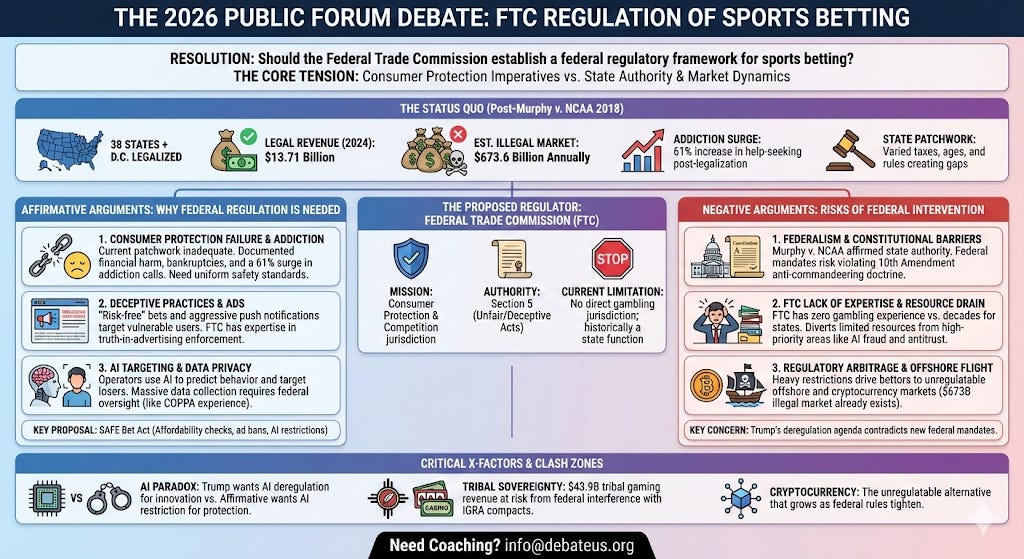
The February Public Forum debate resolution asks whether the Federal Trade Commission should establish a federal regulatory framework for sports betting.
An explosion of sports betting occurred after the Supreme Court’s 2018 Murphy v. NCAA decision that returned gambling regulation to the states. Since that ruling, 38 states plus D.C. have legalized sports betting, generating $13.71 billion in revenue in 2024 alone, while Americans still wager an estimated $673.6 billion annually through illegal and unregulated markets.
At a broad level, the resolution looks at whether the FTC’s should establish a framework (not not necessarily regulations) to try to solve the harms of sports betting, including a 61% surge in gambling addiction help-seeking without unconstitutionally commandeering state authority or disrupting the $9.3 billion in state tax revenue collected since 2018.
It is worth noting that while the topic areas in an interesting one, the FTC doesn’t play a significant role in regulating sports betting and has limited authority to pursue a greater role. And a “framework” certainly isn’t going to do very much. Throughout the essay, I do discuss different legislative proposals and ideas, as I think the Pro will have to “spin” these as things the FTC can do. I also discuss some very narrow areas where the FTC could regulate sports betting.
In this essay, I will review the Pro and Con arguments, but first I will start with an overview of the key concepts and terms.
The Federal Trade Commission Explained
The Federal Trade Commission was established by the Federal Trade Commission Act of 1914 and began operating in 1915. It is the only federal agency with both consumer protection and competition jurisdiction across broad sectors of the economy. The FTC’s mission is “protecting the public from deceptive or unfair business practices and from unfair methods of competition through law enforcement, advocacy, research, and education.”
The agency is led by five commissioners appointed by the President and confirmed by the Senate for seven-year staggered terms, with no more than three commissioners from the same political party. The FTC operates through three main bureaus: the Bureau of Consumer Protection, the Bureau of Competition, and the Bureau of Economics.
FTC Enforcement Mechanisms and Authority
The FTC’s primary enforcement tool is Section 5(a) of the FTC Act, which declares unlawful both “unfair methods of competition” and “unfair or deceptive acts or practices” in or affecting commerce. Under FTC standards, a practice is “deceptive” if it involves a material representation or omission likely to mislead a consumer acting reasonably. A practice is “unfair” if it causes substantial injury to consumers that is not reasonably avoidable and not outweighed by countervailing benefits.
The “deceptive” part is important because it basically means the FTC has authority to regulate false advertising. This is valuable, but it’s not exactly the key issue related to sports betting. Similarly, “unfair methods of competition” refers to a company or companies trying to establish monopolies. Again, not exactly a core issues in the sports gaming debate.
The FTC possesses multiple enforcement pathways. Through administrative adjudication, the agency can issue complaints, negotiate consent agreements, or pursue contested cases before Administrative Law Judges with appeals to the full Commission. Through Section 13(b), the FTC can seek preliminary and permanent injunctions in federal court. The agency’s civil penalty authority allows it to seek up to $51,744 per violation when companies knowingly engage in conduct previously determined to be unfair or deceptive.
However, the FTC faces significant limitations. The Supreme Court’s unanimous 2021 decision in AMG Capital Management v. FTC eliminated the FTC’s ability to seek equitable monetary relief such as restitution or disgorgement in federal court—historically the agency’s primary tool for obtaining consumer refunds. The FTC also lacks criminal prosecution authority and must refer such matters to the Department of Justice. Additionally, the FTC has jurisdictional carve-outs for banks, insurance companies, nonprofits, and common carriers.
The FTC’s Current Relationship with Gambling
With the only exceptions above, the FTC does not currently have direct regulatory jurisdiction over gambling or sports betting. Gambling regulation has traditionally been a state function under the Tenth Amendment, with limited federal criminal law enforcement through the DOJ. The agency’s only gambling-adjacent authority is its oversight role under the Horseracing Integrity and Safety Act of 2020, which established uniform national standards for thoroughbred horseracing through a private authority (HISA) with FTC oversight of proposed rules. Maybe a good horse racing aff?
The FTC does have enforcement responsibility for the Unlawful Internet Gambling Enforcement Act (UIGEA) with respect to non-exempt money transmitting businesses, though this is limited to payment blocking rather than comprehensive gambling oversight. In 2015-2016, Senators Richard Blumenthal and Bob Menendez urged the FTC to investigate daily fantasy sports companies for deceptive practices, but the agency did not take formal enforcement action.
Under existing Section 5 authority, the FTC could potentially address sports betting through several mechanisms: challenging false advertising claims like “risk-free bets” that contain undisclosed conditions, enforcing truth-in-advertising standards for promotional offers, pursuing unfair practices in data collection and targeting, and using its antitrust authority against anticompetitive conduct. In December 2024, Senators Mike Lee and Peter Welch requested an FTC investigation into potential anticompetitive practices by FanDuel and DraftKings.
A number of concerns have been expressed about this resolution — namely that the Pro can’t advocate for much. Based on my reading so far, this is true, but they could potentially make strong cases about these limited areas — horse racing, false advertising, anti competitive practices.
Types of Wagers and Betting Structures
Moneyline betting involves wagering on which team or individual will win outright, without a point spread. Odds are expressed with negative numbers for favorites (indicating how much must be wagered to win $100) and positive numbers for underdogs (indicating how much a $100 bet would return). Point spread betting involves wagering on the margin of victory, with favorites required to win by more than the spread and underdogs permitted to lose by less than the spread or win outright.
Over/under (totals) betting involves wagering whether combined scores will exceed or fall below a specified number.
Proposition bets (props) are wagers on specific events or statistics within a game not necessarily tied to final outcomes—including player props (individual statistics), game props (team-based outcomes), and exotic props (unusual occurrences like coin toss results). Notably, 14 states have banned college player props due to integrity concerns.
Parlay bets combine multiple wagers into a single bet where all legs must win for payout, offering higher potential returns at greater risk. Same-game parlays (SGPs) have become particularly significant, with parlay revenue reaching 69% of operator revenue in September 2024.
Futures bets are placed on events occurring in the distant future, such as championship winners or MVP awards. Live/in-game betting involves wagers placed after events begin, with continuously updating odds—now representing approximately 33% of overall handle, up from 20% four years ago.
Platforms, Channels, and Market Structure
Mobile betting dominates the market, accounting for 95% of total betting handle in some states. The legal U.S. sports betting market spans 38 states plus Washington D.C., with 30 states permitting online betting. Major operators include FanDuel (40-43% market share), DraftKings (25-33%), BetMGM (10-13%), and Caesars (approximately 12%), with FanDuel and DraftKings together controlling 65-67% of the total market (note the “anti competitive argument).
Tribal gaming operations present unique considerations under the Indian Gaming Regulatory Act (IGRA). Sports betting is classified as Class III gaming, requiring tribal-state compact approval. As of September 2024, 243 tribes operated 532 gaming establishments in 29 states, generating $43.9 billion in gaming revenue. Would the Pro undermine this?
Related Activities and Regulatory Ambiguities
Daily fantasy sports (DFS) were explicitly exempted from UIGEA as “games of skill,” though the FTC blocked the FanDuel-DraftKings merger in 2017 citing 90%+ market control concerns. Both companies subsequently pivoted to sports betting following Murphy.
Prediction markets present emerging regulatory challenges. Kalshi operates under CFTC regulation as a derivatives exchange, but state gaming regulators including Nevada, New Jersey, and Maryland have issued cease-and-desist orders claiming these platforms constitute unlicensed sports gambling. A November 2025 Nevada court ruling found Kalshi not exempt from state gaming regulations, illustrating the jurisdictional confusion that federal regulation could address. As a side note, another benefit of a “framework” the Pro could claim is to reduce this jurisdictional confusion.
Esports betting on competitive video game tournaments is explicitly legal in 19 states, prohibited in 13, and unaddressed in 19 others. Horse racing operates under the Interstate Horseracing Act with pari-mutuel wagering legal in 43 states, historically treated separately from sports betting.
What a Federal Regulatory Framework Would Entail
A federal regulatory framework is a structured set of rules, laws, guidelines, and standards established by government agencies to govern operations across industries. Such frameworks typically include legal statutes enacted by Congress, regulatory agencies with enforcement powers, registration and licensing requirements, compliance standards, reporting requirements, and penalty mechanisms.
Under this resolution, the Pro is limited to arguing for the FTC, an executive agency, establishing a framework. For the purposes of understanding, however, I’ll explain it more broadly.
Core Components and Establishment Mechanisms
Federal regulatory frameworks are created through Congressional legislation granting agencies regulatory authority, agency rule making under the Administrative Procedure Act, or executive action. The FTC’s existing Section 18 authority permits trade regulation rules through formal procedures including public hearings, though this process is lengthier than standard notice-and-comment rulemaking.
Federal preemption of state law operates through three mechanisms. Express preemption occurs when statutes explicitly supersede state law. Field preemption occurs when federal law occupies an entire regulatory field. Conflict preemption applies when compliance with both federal and state law is impossible or when state law frustrates federal objectives. A sports betting framework could employ floor preemption, establishing federal minimums while permitting states to exceed those standards—the model used in environmental regulation under the Clean Air Act.
Arguing for “floor preemption” would be a way for the Pro to argue for some type of regulation with some teeth, but it obviously then involves preempting state law, which links to the federalism disadvantage that will be discussed.
Models from Other Regulated Industries
The Securities and Exchange Commission model offers a multi-layered approach combining federal oversight with self-regulatory organizations (SROs) like FINRA as front-line regulators. Applied to sports betting, this could involve federal standards with industry organizations handling day-to-day compliance. The SEC’s registration requirements, mandatory disclosure obligations, and anti-fraud enforcement provide templates for consumer protection.
The Food and Drug Administration model demonstrates pre-market approval regulation with risk-based classification systems—Class I products face minimal regulation, Class II requires pre-market notification, and Class III demands full pre-market approval. This tiered approach could inform regulation of different betting products based on risk profiles.
The Alcohol and Tobacco Tax and Trade Bureau (TTB) model is particularly relevant, demonstrating mixed federal-state regulation. TTB handles permits for producers and importers, certificate of label approval, excise tax collection, and unfair trade practice enforcement, while states manage retail licensing, three-tier system enforcement, and local requirements. This cooperative federalism model allows “control states” to operate more restrictive regimes while maintaining federal baselines.
These are interesting models, but the FTC doesn’t have this type of authority.
Existing Federal Gambling Law Framework
The Wire Act (1961) prohibits using wire communications for interstate sports betting, currently interpreted to apply only to sports wagering. The Unlawful Internet Gambling Enforcement Act (2006) prohibits financial institutions from processing transactions for unlawful internet gambling, with exemptions for legal intrastate gambling, fantasy sports, and horse racing. The Indian Gaming Regulatory Act (1988) established the National Indian Gaming Commission and the tribal-state compact framework for Class III gaming.
Murphy v. NCAA created the current regulatory vacuum by striking down PASPA while Congress declined to enact replacement federal standards. As Justice Alito wrote, “Congress can regulate sports gambling directly, but if it elects not to do so, each state is free to act on its own.” This is very important because it suggests that absent Congressional authorization, The Supreme Cout would strike-down attempted regulations.
Existing Federal Regulation Proposals
Since Murphy v. NCAA, multiple proposals for federal sports betting regulation have emerged from Congress, academia, industry groups, and advocacy organizations.
Congressional Legislation
The SAFE Bet Act (H.R. 9590/S. 5057) represents the most comprehensive recent federal sports betting bill. Introduced September 12, 2024 by Rep. Paul Tonko (D-NY) and Sen. Richard Blumenthal (D-CT), it would require states to apply to the Department of Justice for approval to offer sports betting, with approvals valid for three-year renewable periods. Key provisions include:
Prohibiting broadcast advertising between 8 AM and 10 PM
Banning advertising during live sporting events
Prohibiting terms like “bonus bet” and “risk-free bet”
Requiring “affordability checks” before accepting wagers exceeding $1,000 per day or $10,000 per month
Banning credit card deposits
Prohibiting AI tracking of individual gambling behavior
Establishing a national self-exclusion list administered by SAMHSA
The Sports Wagering Market Integrity Act (S.3793) was introduced December 19, 2018 by Sen. Orrin Hatch (R-UT) and Sen. Chuck Schumer (D-NY). This first comprehensive post-Murphy bill would have created a National Sports Wagering Clearinghouse to collect and analyze betting data, required states to apply to the Attorney General for sports betting approval, mandated use of official league data through 2024, funded problem gambling treatment through a 0.25% federal excise tax, and established a national self-exclusion list. The bill did not advance after Sen. Hatch’s retirement in January 2019.
The GRIT Act (Gambling Addiction Recovery, Investment, and Treatment Act), introduced by Sen. Blumenthal and Rep. Andrea Salinas (D-OR), would dedicate 50% of the existing federal sports betting excise tax to gambling addiction programs—75% distributed to states through SAMHSA block grants and 25% to the National Institute on Drug Abuse for research. The WAGER Act, introduced August 2024 by Sens. Catherine Cortez Masto (D-NV) and Cindy Hyde-Smith (R-MS), would repeal the federal sports betting excise tax on legal operators entirely.
Sen. Brian Schatz (D-HI) announced in December 2025 that he is developing legislation for federal prop betting regulation following MLB and NBA gambling scandals, stating: “When every in-game moment and outcome can be wagered on, it creates real risks.”
These are proposed acts — not proposals for FTC regulation.
Academic and Think Tank Proposals
There are different proposals for regulating sports betting, but many are not “topical.” Legal scholars John T. Holden (Oklahoma State), Marc Edelman (Baruch College), and Keith C. Miller (Drake Law) proposed in the Cardozo Law Review a Federal Interstate Sports Gambling Agency funded by taxes on interstate wagers to promote “honesty, fairness, and transparency” and identify suspicious transactions. Sadie Sand of the University of Cincinnati College of Law proposed federal regulation to curb online sports gambling addiction through stricter advertising limits and mandatory industry funding for addiction treatment. The Georgetown Law Technology Review published “A Safe Bet: Advocating for a Uniform Federal Approach” in May 2024, arguing that VPNs and technology blur geographical lines, making state-by-state regulation inadequate.
Cole Eisenshtadt proposed in the Administrative Law Review that the FTC adapt its tobacco advertising regulatory regime to sports gambling, requiring display of gambling hotline numbers and disclosure of odds to enable informed decisions. This may be one of the few viable topical cases.
Industry and Organizational Positions
Lobbies are mixed. The American Gaming Association strongly opposes federal regulation, stating: “The AGA does not believe an additional layer of federal regulatory oversight is needed. Sports betting is regulated by states and tribes. This position is clear and unwavering.” The AGA’s Chris Cylke called the SAFE Bet Act “a slap in the face to state legislatures and gaming regulators who have dedicated countless time and resources to developing thoughtful frameworks unique to their jurisdictions.”
Professional sports leagues hold nuanced positions. The NFL endorsed S.3793 in 2018, stating “without continued federal guidance and oversight, we are very concerned that sports leagues and state governments alone will not be able to fully protect the integrity of sporting contests.” However, the league expressed concerns about SAFE Bet Act provisions banning live betting and restricting advertising. The NCAA strongly supports federal regulation, with VP Naima Stevenson Starks stating: “We are absolutely supportive of federal regulation. Having some minimum standards, we are very supportive of.”
Pro Arguments for FTC Regulation
These are some of the core Pro arguments. More Pro and Con arguments are covered at the end of the essay.
It is important to note that when writing this section I didn’t give much weight to the importance of the FTC regulating sports betting. Here I’m just trying to outline the common advantages of doing it, figuring you may be able to find proposals for FTC action.
Consumer Protection Failures Require Federal Intervention
The rapid expansion of sports betting has caused documented financial harm to American consumers. A UCLA/USC study published in August 2024 found that states with legalized sports betting saw bankruptcies increase 28%, debt collections increase 8%, and auto loan delinquencies rise. Northwestern University’s Kellogg School research found legalized sports betting led to lower credit scores and reduced savings among households. Scott Baker, Associate Professor of Finance, warned: “Legalization is not a free lunch... If no action is taken, it is highly likely that the large increase in sports betting will lead to a long-term increase in financial stress on many consumers.”
Sports betting has created a documented addiction crisis. A UC San Diego study published in JAMA Internal Medicine found online sportsbooks caused a 61% increase in gambling addiction help-seeking searches, with the probability of these results occurring randomly being less than 1 in 25.6 billion. The FDU Poll (September 2024) found 10% of men ages 18-30 show problem gambling indicators versus 3% of the overall population, and that the rate of problem gambling among sports bettors is at least twice as high as among other gamblers.
An NCAA survey found 58% of 18-22 year-olds placed at least one wager despite many being underage, with 70% of college students living on campus being bettors. Minnesota research found 37% of adolescents reported prior-year sports gambling. Age verification often occurs only at sign-up, and 56% of underage survey respondents recalled seeing ads encouraging them to bet. Teenagers who gamble are 4x more likely to develop gambling problems later in life according to Massachusetts DPH.
The FTC has proven expertise in consumer protection directly applicable to sports betting. The agency’s track record includes enforcement against dark patterns, hidden fees, deceptive subscription practices, and children’s data collection. Its experience with “negative option” features—identical to sports betting auto-renewal subscriptions—demonstrates transferable regulatory capability.
Deceptive Advertising Practices Demand FTC Expertise
Sports betting companies engage in systematically deceptive advertising. National Consumers League research found that 93% of smartphone push notifications from FanDuel, DraftKings, and BetMGM contained advertising material, with more than 60% encouraging users to “bet now.” Push notifications can increase user engagement by 300% and app retention rates by 820%. Eden Iscil, NCL Senior Public Policy Manager, observed: “Sports betting companies have 24/7 access to consumers through their phones... when it comes to push notifications... there are no protections.”
“Risk-free bet” promotions exemplify deceptive practices. When refunds are bonus credits with complicated wagering requirements rather than cash, these claims arguably violate FTC truth-in-advertising standards, yet the Harvard Journal of Sports & Entertainment Law notes “there has not been any enforcement action by the Federal Trade Commission” regarding sports betting advertising.
The Problem Gambling Epidemic Requires Uniform Federal Standards
Current state protections are inadequate. The NCPG’s September 2024 report found states met only 32 out of 82 player protection standards on average, with 11 states meeting fewer than 25 standards. Keith Whyte, NCPG Executive Director, stated: “This report reflects the patchwork nature of existing regulations and the significant gaps in consumer protections.”
Senator Richard Blumenthal declared: “We are in the midst of a sports betting boom that is one of the most severe public health problems today. It is the cause of addiction for millions of Americans... tearing apart families—literally divorces, abandonment.”
Americans wager approximately $673.6 billion annually through illegal and unregulated markets according to the FBI. Offshore platforms generate over $400 billion in illegal online gaming annually, causing more than $4 billion in lost state tax revenue. A bipartisan coalition of all 50 state attorneys general urged DOJ action in August 2025, warning that offshore operators “fail to effectively verify age of users, ignore state boundaries, evade tax obligations” with “no oversight or accountability” for problem gambling. Federal coordination is necessary to address operators beyond state jurisdiction.
State Patchwork Creates Gaps and Confusion
The Georgetown Law Technology Review observed: “This lack of uniformity creates situations in which individuals in one state are subject to a completely different set of rules and protections than those just across the border, allowing people to exploit these discrepancies in the law.” States have different tax rates (6-51%), licensing processes, age requirements (18 vs. 21), and advertising rules. NCAA President Charlie Baker noted: “When you have 39 states that have legalized sports betting, in every single state the data they collect is different, who they can share it with is different... you have a situation where it is really hard to get a national sense about what’s going on.” This is a specific area where a strong cases for a federal framework could work.
Sports Betting Data Privacy Requires FTC Oversight
Sports betting apps collect extensive sensitive data. Incogni research found DraftKings collects 22 data points including precise location, photos, videos, contacts, and files. Caesars, Sky Bet, and William Hill collect 17 data points including health information, credit scores, and bank account data. Caesars shares 14 data points with third parties including precise location and search history. More than half of major apps have been affected by data breaches, including BetMGM’s May 2022 breach affecting 1.5 million users. The FTC has existing expertise in privacy enforcement through COPPA, the Health Breach Notification Rule, and Section 5 unfairness authority.
Con Arguments Against FTC Regulation
These are some of the core Con arguments.
Federalism — Murphy v. NCAA Affirms State Authority Over Gambling
Federal regulation of sports betting potentially violates constitutional principles of federalism and the Tenth Amendment’s anti-commandeering doctrine. In Murphy v. NCAA (2018), the Supreme Court ruled 7-2 that PASPA was unconstitutional because Congress cannot “dictate what a state legislature may and may not do.” Justice Alito wrote: “A more direct affront to state sovereignty is not easy to imagine.”
The Congressional Research Service explains that “under several longstanding Supreme Court precedents, the Tenth Amendment prevents the federal government from compelling the states to enforce federal law.” The Heritage Foundation characterized Murphy as striking “a blow against federal overreach and restored to states the power to set their own policies related to gambling.”
Justice Brandeis’s famous laboratories of democracy concept—that “a single courageous State may, if its citizens choose, serve as a laboratory; and try novel social and economic experiments without risk to the rest of the country”—argues for preserving state experimentation in gambling regulation.
Federalism has been a popular debate argument for decades and will certainly big a big part of this topic. Cases arguing for very general frameworks will not link very much (if at all), but cases that interpret the resolution for more direct regulatory approaches will link.
The FTC Lacks Gambling-Specific Expertise & Authority
The States are Better
As noted, the FTC’s gambling-related authority is limited to truth-in-advertising enforcement and UIGEA payment blocking—not comprehensive gambling oversight. While the FTC oversees HISA (horse racing integrity), this is fundamentally different from sports betting regulation. An inexperienced federal agency would face a steep learning curve that could create consumer protection gaps during implementation.
On the other hand, state gaming commissions have developed decades of specialized expertise that the FTC cannot replicate. As one industry analyst explained: “Where gambling is legal, states regulate it heavily. Gaming commissions license operators, conduct background checks, monitor compliance and enforce responsible gaming requirements.” More than 5,000 state and tribal regulators have developed extensive industry controls with specialized technology systems and established relationships with operators.
Connecticut, New Jersey, and Virginia lead in responsible gambling standards, meeting 49 of 82 NCPG standards. States have developed mobile betting platforms, geolocation technology, and self-exclusion programs without federal direction.
The American Gaming Association vigorously opposes federal regulation, with SVP Chris Cylke calling the SAFE Bet Act “a slap in the face to state legislatures and gaming regulators who have dedicated countless time and resources to developing thoughtful frameworks unique to their jurisdictions.” The iDevelopment & Economic Association called federal legislation “an unnecessary and harmful federal overreach into an area that has been successfully regulated at the state level.”
Rep. Dina Titus (D-NV) stated: “While the SAFE Bet Act is perhaps well-intentioned, pre-empting state gaming regulators by outlawing most forms of advertising and restricting the types and methods by which customers can place bets is a misguided approach.” Gaming lawyer Jeff Ifrah characterized the bill as including “an unconstitutional registration requirement” that appears to “fill some sort of need that doesn’t exist.”
State Budgets
The Tax Foundation reports states collected more than $1.8 billion in sports betting tax revenue in fiscal year 2023, with total state tax revenue reaching $9.3 billion since 2018. New York alone generated $876 million in 2023—more than a third of the nation’s total. The Reason Foundation argues that “state licensing creates a more competitive market than state control” and that “competitive markets increase state revenue... Lower barriers to entry encourage participation in the legal market and migration out of illicit markets.”
Con teams can argue that limits on gaming will undermine state budgets and lead to impacts such as tax increases and cut backs in education.
Tribal Sovereignty and IGRA Protections Would Be Threatened
The Indian Gaming Regulatory Act established tribal gaming as a sovereign right, with tribes generating $43.9 billion in gaming revenue in 2024. Federal regulation would “depreciate the value of tribes’ bargained-for exclusivity to offer sports betting pursuant to compacts under IGRA, which in turn would threaten important government revenue,” according to the Confederated Tribes of Siletz Indians in CFTC filings.
Indian Gaming Association Chairman David Z. Bean stated: “Indian gaming is the economic bloodline for more than 240 Tribal Governments. Revenue generated from gaming empowers Tribes to build critical infrastructure and provide basic services to reservation residents.” The Tribal Alliance of Sovereign Indian Nations argued federal regulation would “impermissibly infringe on tribal sovereignty and run afoul of federalism principles enshrined in the Constitution.”
Jurisdictional Conflicts Would Create Regulatory Chaos
Federal FTC regulation would overlap with existing federal agencies (DOJ, CFTC), state attorneys general, and state gaming commissions. The current prediction market controversy illustrates this danger: more than 30 states have filed briefs supporting state authority, courts have split on preliminary injunctions, and multiple states have moved to block Kalshi from offering sports prediction markets. A coalition of 34 state attorneys general filed briefs defending state regulatory authority.
Adding FTC gambling framework beyond existing consumer protection mandates and create “turf wars” with established regulators. That fact that it’s a vague “framework” only heightens the risks
Over-Regulation Risks Driving Betting Underground
Heavy-handed federal regulation could push bettors toward the illegal market. Despite legalization in 38 states, Birches Health reports that around 23% of wagers in 2024 were placed through offshore accounts or online bookies, even in states with regulated sports betting. The Tax Foundation warns that “optimal sports betting tax design would ensure that rates are low enough to bring consumers into legal, regulated markets rather than gambling illicitly” and that “restrictions on where consumers are allowed to gamble, or limits on their choices... are also likely to push consumers into black markets.” Even in Florida with one legal sportsbook, offshore operators account for around 80% of the market.
Implementation Would Face Insurmountable Obstacles
The Council for Citizens Against Government Waste warned that federal legislation would “create two new federal bureaucracies to regulate and manage the personal betting decisions of millions of Americans.” Cornell Law analysis observed: “Congress simply has no interest in regulating this market... Any new legislation... would significantly disrupt the current profitable ecosystem and, therefore, is effectively dead on arrival.”
Regulatory Arbitrage and Offshore Migration
The Offshore Licensing Ecosystem
Federal regulation could trigger significant regulatory arbitrage, with companies relocating operations to jurisdictions with more favorable regulatory environments. The global offshore gambling licensing industry has become increasingly sophisticated, offering operators streamlined entry into markets without burdensome oversight.
According to Yogonet International, offshore licensing authorities are reporting “a sudden spike in applications” as companies reassess operations amid “compliance becoming less forgiving and a new wave of regulatory crackdowns.” Key offshore jurisdictions include:
Anjouan (Comoros Islands): Considered “the most startup-friendly offshore licensing hub” with fast approval times, cost-efficient fees, zero-tax regime, and minimal bureaucracy.
Curaçao: Home to major offshore operators including Bovada, offering established regulatory infrastructure with significantly lighter requirements than U.S. states.
Costa Rica, Panama, Latvia, Antigua: Traditional havens for U.S.-facing offshore sportsbooks, collectively hosting operations that generate over $400 billion annually in illegal online gaming.
Inteliumlaw gaming consultants report that offshore licensing has become “a catalyst for growth rather than a simple ‘paper’ or nominal authorization,” with operators using these jurisdictions to “experiment with new products, enter quickly, and restructure without losing momentum.”
Why Companies Migrate Offshore
Tax Advantages: Offshore jurisdictions typically offer zero or minimal taxation compared to U.S. rates ranging from 6-51% at state level plus potential federal taxes. Pennsylvania charges a $10 million license fee, Illinois $20 million, and New York $25 million for online operations—costs that disappear in offshore jurisdictions.
Regulatory Flexibility: Birches Health research notes offshore platforms “operate without compliance with U.S. regulatory bodies.” There are “no mechanisms for account restraint” and minimal responsible gaming requirements, allowing operators to maximize profit without consumer protection obligations.
Speed to Market: Offshore licenses can be obtained in weeks rather than months or years required for U.S. state licensing. Operators can launch immediately without extensive background checks, financial audits, or operational reviews.
Product Freedom: Offshore operators face no restrictions on AI-powered personalization, prop bets, live betting, credit betting, or advertising—all potentially regulated under federal frameworks like the SAFE Bet Act.
The Offshore Market’s Resilience
Despite 38 states legalizing sports betting, the offshore market remains enormous. GeoComply data shows that around 23% of wagers were placed through offshore accounts or online bookies in 2024, even in states with legal sports betting. In Florida, with only one legal sportsbook, offshore operators account for around 80% of the market.
The American Gaming Association estimates $673.6 billion is wagered annually in illegal and unregulated markets—vastly exceeding the $13.71 billion legal U.S. market. This represents more than $4 billion in lost state tax revenue annually.
Why Heavy Federal Regulation Would Accelerate Offshore Migration
The Regulatory Burden Argument: If FTC regulation imposes requirements like:
Prohibition on AI behavioral tracking and personalized marketing
Banning credit card deposits
Mandatory “affordability checks” at $1,000 daily/$10,000 monthly limits
Restrictions on advertising times and content
National self-exclusion databases
Then regulated U.S. operators face severe competitive disadvantages against offshore platforms offering:
Unlimited credit betting
AI-powered personalized promotions and bonuses
No deposit limits or affordability checks
24/7 aggressive advertising via push notifications
Complete anonymity with no self-exclusion requirements
Historical Precedent: The 2006 Unlawful Internet Gambling Enforcement Act (UIGEA) intended to eliminate offshore poker and casino gambling. Instead, offshore operators adapted by using cryptocurrency, alternative payment processors, and VPNs. Major platforms like PokerStars and Full Tilt Poker continued serving U.S. customers for years after UIGEA passage, only stopping after federal indictments in 2011.
Cross-Border Arbitrage: AP News analysis explains how “cross-border arbitrage involves using differences in rules between countries to gain advantages in sports betting and financial trading operations.” The UK’s Financial Conduct Authority takes a “more permissive approach” without extra restrictions on event contracts, “positioning the UK as a potential hub for cross-border activities.”
The Negative Argument: Heavy federal regulation doesn’t eliminate the offshore market—it strengthens it. The Tax Foundation warns that “optimal sports betting tax design would ensure that rates are low enough to bring consumers into legal, regulated markets rather than gambling illicitly” and that “restrictions on where consumers are allowed to gamble, or limits on their choices... are also likely to push consumers into black markets.”
Current data supports this concern. Even with legal options available, 23% of bettors choose offshore platforms. If legal platforms face AI restrictions, advertising bans, affordability checks, and credit card prohibitions while offshore platforms offer unrestricted access, the percentage choosing offshore will increase substantially.
The Enforcement Challenge: Multiple states have sent cease-and-desist orders to offshore operators with minimal effect. Rhode Island sent six cease-and-desist letters; Louisiana sent 40; Michigan sent over 100. Yet offshore operators continue operating, using VPNs, cryptocurrency, and constantly changing domain names.
A bipartisan coalition of all 50 state attorneys general urged DOJ action in August 2025, acknowledging “we seek the DOJ’s cooperation in holding these companies accountable... for any potential violations” because states “cannot eliminate the market on their own.”
If states cannot enforce against offshore operators, federal regulation faces identical challenges.
Consumer Protection Failures: Birches Health identifies critical dangers:
No Licensing & Oversight: “Offshore sportsbooks operate without compliance with U.S. regulatory bodies. If an offshore book refuses to pay winnings or blocks withdrawals, bettors have no authorities or customer service to turn to for help.”
Absence of Player Protection: “Without responsible gaming measures, there are no mechanisms for account restraint. Offshore operators do nothing for consumers who are at risk for Gambling Addiction.”
Betting on Credit: “Some offshore sportsbooks and illegal new-age ‘bookies’ allow bettors to use pre-loaded credit for wagering... it doesn’t feel like their own real money that they’re risking.”
Data Security Risks: More than half of major offshore apps have been affected by data breaches. Users are “left vulnerable to identity theft and fraud” with no legal recourse.
The affirmative can argue that even if some bettors migrate offshore, federal regulation protects those who remain in legal markets—and makes the legal market more attractive to responsible bettors who value consumer protections.
The Regulatory Race to the Bottom
International Competitive Dynamics: If U.S. federal regulation is too stringent, U.S.-based companies may establish offshore subsidiaries to serve U.S. customers indirectly. Prediction market analysis notes that “most international jurisdictions classify sports outcome contracts as gambling, not financial derivatives” and that “this global norm weakens arguments that U.S. sports prediction markets are purely financial instruments.”
Companies could:
Maintain U.S. operations for compliant states
Establish offshore entities for regulatory arbitrage
Use geo-blocking technology to segment markets
Leverage cryptocurrency and decentralized platforms to avoid jurisdiction entirely
The Innovation Exodus: Beyond gambling companies, the technology and AI firms supporting sports betting infrastructure could relocate. If the U.S. prohibits AI behavioral tracking and personalized marketing in sports betting, companies developing these technologies will focus on offshore markets where such restrictions don’t apply.
This creates a competitive disadvantage for U.S. tech firms and potentially drives AI innovation offshore—directly contradicting Trump’s argument that AI regulation “thwarts” American competitiveness.
Business Confidence
The business confidence disadvantage is a classic economic argument in policy debate that claims government action—particularly new regulations—undermines business willingness to invest, hire, and expand, leading to economic decline.
The Core Business Confidence Argument
Structure:
Uniqueness: The economy is currently stable/growing, or business confidence is currently high
Link: The plan signals increased government regulation/intervention
Internal link: Regulatory uncertainty or expansion destroys business confidence
Impact: Reduced confidence leads to decreased investment, hiring freezes, economic contraction, potentially recession
The argument rests on the premise that businesses make investment decisions based partly on their confidence in regulatory stability and predictability. Uncertainty about future government action causes businesses to hold capital rather than deploy it.
Links to FTC Sports Betting Regulation
Direct links:
Regulatory expansion signal: FTC creating a new federal framework signals government willingness to increase regulatory reach—businesses across sectors interpret this as a harbinger of increased compliance burdens in their industries
Preemption/federalism uncertainty: Federal framework potentially conflicts with existing state regulations, creating legal uncertainty about which rules apply—businesses hate regulatory ambiguity
Industry-specific chilling effect: Sports betting is a rapidly growing sector attracting significant investment; new federal regulations immediately chill investment in this industry as investors wait to see compliance costs and restrictions
Precedent concerns: If FTC can regulate sports betting (arguably peripheral to their traditional consumer protection mandate), businesses worry about scope creep—what other industries are next?
Specific evidence angles you’d need:
Current business confidence indicators (surveys, investment data)
Statements from business groups opposing regulatory expansion
Economic analysis linking regulatory uncertainty to investment decisions
Historical examples of regulations causing business pullback
Evidence that sports betting industry is attracting substantial investment that would be threatened
Uniqueness problems to watch for:
Government is already regulating heavily (infrastructure bills, etc.)
Economy already facing headwinds (making it hard to claim current stability)
Business confidence already low for other reasons
The affirmative would likely answer this with: regulation creates certainty (businesses prefer clear rules to regulatory vacuum), sports betting harms that justify regulation, or impact defense on the economy.
WTO/GATS and International Trade Law Implications
The Antigua-U.S. Gambling Dispute: A Cautionary Tale
Federal sports betting regulation must navigate complex international trade obligations that could expose the United States to WTO challenges. The precedent case involved Antigua and Barbuda’s challenge to U.S. gambling restrictions under the General Agreement on Trade in Services (GATS).
Case Background and Findings
In 2003, Antigua filed a WTO complaint (DS285) arguing that U.S. federal laws (the Wire Act, Travel Act, and Illegal Gambling Business Act) violated U.S. GATS commitments by preventing cross-border supply of gambling services. The U.S. had committed to “Other Recreational Services (except sporting)” in its GATS schedule with “none” listed as market access limitations.
The WTO Panel and Appellate Body found:
Gambling is covered: The U.S. Schedule commitment includes gambling and betting services under “Other Recreational Services.”
Violation of Article XVI: U.S. federal laws prohibiting cross-border gambling constitute a “zero quota” prohibited by GATS market access commitments.
Article XIV “moral defense” partially succeeds: The laws were “necessary to protect public morals or maintain public order” BUT
Chapeau failure: The Interstate Horseracing Act created discriminatory treatment by allowing domestic horse-race betting while prohibiting foreign sports betting.
The WTO awarded Antigua the right to suspend $21 million annually in U.S. intellectual property rights—an unprecedented remedy allowing a small nation to legally pirate U.S. copyrights, patents, and trademarks.
U.S. Response and GATS Article XXI Withdrawal
Rather than comply, the United States invoked GATS Article XXI to modify its schedule and remove gambling services from coverage. This required compensating affected WTO members. The U.S. reached settlements with the EU, Japan, Canada, Australia, India, Macau, and Costa Rica—but not Antigua, leading to ongoing arbitration.
Public Citizen notes this dispute “exemplifies the potential for market access commitments to have unexpected and undesirable consequences.” The U.S. had unknowingly committed to allowing foreign gambling services when it signed GATS in 1994—years before internet gambling existed.
GATS Implications for Federal Sports Betting Regulation
The National Treatment Obligation
GATS Article XVII prohibits discrimination between domestic and foreign service providers. Federal sports betting regulation must apply equally to U.S. and foreign operators. This creates several problems:
Licensing Requirements: If federal regulation requires FTC licensing, can the U.S. refuse licenses to foreign operators? Under GATS national treatment, foreign operators meeting U.S. requirements must receive equal treatment. This means:
Antigua-based sportsbooks could demand U.S. market access
The U.S. cannot favor domestic operators in licensing
Tax advantages for U.S. companies could violate national treatment
The Domestic Preference Problem: Many federal regulation proposals implicitly assume U.S.-based operators. The SAFE Bet Act requires DOJ approval for states to offer sports betting—but doesn’t explicitly address whether foreign operators can apply for such approval.
If the U.S. grants approvals only to domestic operators, this likely violates GATS. If it grants approvals to foreign operators, it undermines the entire consumer protection rationale (foreign operators beyond effective U.S. jurisdiction).
The Article XIV Moral Defense: A Narrow Path
The U.S. successfully argued in Antigua that gambling restrictions are “necessary to protect public morals or maintain public order”—but failed the chapeau test due to discriminatory enforcement.
For federal sports betting regulation to survive WTO challenge:
Requirements Under Article XIV:
Necessity: Measures must be necessary (not just convenient) to achieve the stated objective
No Less Restrictive Alternative: The U.S. must show no WTO-consistent alternative achieves the same objective
Chapeau Compliance: Measures must not constitute “arbitrary or unjustifiable discrimination” or “disguised restriction on trade”
The Affirmative Challenge: Affirmative teams arguing for FTC regulation must explain how federal standards avoid the Horseracing Act problem. If the U.S. permits:
Tribal gaming under IGRA
State-licensed operators
Horse racing under Interstate Horseracing Act
Daily fantasy sports as “games of skill”
Then prohibiting or heavily restricting foreign operators appears discriminatory. The Cambridge analysis notes the Appellate Body found this inconsistency fatal: permitting domestic gambling while prohibiting foreign gambling “is not designed to guard against the very same risks in connection with domestic supply.”
Market Access Commitments (Article XVI)
GATS Article XVI prohibits quantitative restrictions on market access where specific commitments exist. The U.S. currently has no gambling commitments in its GATS schedule after the Article XXI withdrawal. This provides protection only if the U.S. maintains this position.
However, future trade negotiations could pressure the U.S. to make services commitments. The proposed US-EU Framework Agreement “eliminates tariffs on industrial goods and improves market access for agricultural products which indirectly benefits firms in the gambling sector.” If services are added to such agreements, gambling could be included.
Negative Argument: Federal regulation risks creating GATS obligations. If federal regulation establishes licensing standards, and the U.S. later makes GATS commitments on recreational services, those licensing standards could become entrenched international obligations—removing future Congressional flexibility to modify the regulatory approach.
Other Trade Agreement Concerns
USMCA (United States-Mexico-Canada Agreement)
USMCA replaced NAFTA in 2020 and contains services provisions. If the U.S. permits sports betting, USMCA national treatment obligations could require equal access for Canadian operators. Canada legalized single-event sports betting nationwide in August 2021, creating a mature regulatory environment.
Canadian operators could argue that any U.S. federal licensing regime must accept Canadian provincial licenses as equivalent—similar to how professional licensing (doctors, lawyers) often has reciprocity arrangements.
Bilateral Investment Treaties (BITs)
The U.S. has BITs with numerous countries providing foreign investors protection against discriminatory treatment and regulatory expropriation. If foreign companies invest in U.S. sports betting operations, then regulatory changes could trigger BIT claims for compensation.
For example, if the FTC implements strict AI regulations that render existing business models unprofitable, foreign investors could claim this constitutes indirect expropriation requiring compensation.Prediction Markets vs. Sports Betting: The Critical Distinctions
Surface-Level Similarities
From a user’s perspective, prediction markets and sports betting look nearly identical:
Both involve:
Risking money on sports outcomes
Winning if prediction is correct, losing if wrong
Using mobile apps or websites
Making wagers on game winners, player performances, season outcomes
Potential for significant financial gain or loss
MGM CEO Bill Hornbuckle testified: “Prediction markets on sports are without a doubt sports betting.”
Legal/Structural Differences (Per Operators)
Prediction market operators argue fundamental distinctions justify different regulatory treatment:
1. Trading vs. Betting Against the House
Traditional Sportsbook Model (per industry analysis):
You vs. Operator: Bet against the house (FanDuel, DraftKings, Caesars)
Fixed odds: Operator sets lines; you take them or leave them
Operator risk: House takes opposite side of your bet
Revenue model: Operator profits from vig/juice (typically -110 odds, 4.5% edge)
No secondary market: Once bet is placed, it’s locked in until settlement
Prediction Market Model:
Peer-to-peer exchange: You trade with other users, not the platform
Dynamic pricing: Market determines odds through supply/demand
Platform neutral: Facilitates trades but doesn’t take positions
Revenue model: Transaction fees (typically 2-7% per trade), similar to stock exchange commissions
Continuous trading: Can buy/sell shares before event concludes, locking in profits or cutting losses
As one analysis explains: “Prediction markets function like financial exchanges: users trade contracts that represent yes/no outcomes... prices reflect current market sentiment on the likelihood of the event occurring.”
Practical difference: If you bet $100 on Eagles -3 at a sportsbook, you’re stuck until game ends. On prediction market, you could buy “Eagles win” at $0.70, watch the line move to $0.80 as news breaks, and sell for a $10 profit before kickoff.
2. Regulatory Framework
Sports Betting:
State-level regulation: 38 states + DC have legalized, each with own rules
State gaming commissions: Nevada Gaming Control Board, New Jersey Division of Gaming Enforcement, etc.
Licensing requirements: Extensive background checks, suitability determinations, capital requirements ($10M-25M+)
Ongoing compliance: Responsible gambling programs, integrity monitoring, tax collection (ranging from 6.75% in Nevada to 51% in New York)
Age restrictions: 21+ in most states, 18+ in some
Geographic limits: Can only operate where specifically licensed
Prediction Markets (per CFTC framework):
Federal regulation: Commodity Futures Trading Commission (CFTC) under Commodity Exchange Act (CEA)
DCM registration: Platforms register as Designated Contract Markets, similar to derivatives exchanges
Self-certification: Can list new contracts without prior approval; CFTC can later review and prohibit
National operation: If federally approved, claims preemption over state laws
Age restrictions: 18+ (lower than most sports betting states)
No state taxes: Don’t pay state gambling taxes because “not gambling”
As Legal Sports Report notes: “Prediction markets challenge [the state system] by arguing that sports-related event contracts are not sports betting at all, but federally regulated financial instruments governed by the Commodity Exchange Act and overseen exclusively by the CFTC.”
3. Information Aggregation vs. Entertainment
Prediction market justification (from platforms’ legal arguments):
“Truth machines”: Aggregate dispersed information to produce accurate forecasts
Financial utility: Allow hedging against real-world event risks
Price discovery: Create publicly visible probability assessments
Research value: More accurate than polls or statistical models
Economic function: Similar to weather derivatives, insurance markets, agricultural futures
Sports betting reality:
Entertainment: Primarily recreational activity
No hedging: Very few users bet on sports to hedge actual economic risks
Speculative: Vast majority purely speculative, not informational
The counterargument (per critics): This distinction is pretextual. When 90% of prediction market volume is sports, and users are doing the exact same thing as sportsbook customers (risking money on game outcomes), calling it “information aggregation” is semantic gamesmanship.
4. A Tricky Con Argument
One tricky argument the Con can make is that if there is a greater shift to regulation of sports betting by the FTC, there would just be a shift to prediction markets.
Related: Prediction Markets and Sports Betting - The Regulatory Collision
Introduction: The $44 Billion Question
In 2025, a new player entered the sports wagering arena—and it’s causing regulatory chaos.
Prediction markets—platforms like Kalshi, Polymarket, and Robinhood’s prediction products—processed over $44 billion in trading volume in 2025, with monthly volumes exceeding $10 billion by November. Sports-related contracts drive approximately 90% of this volume.
Yet these platforms claim they’re not sports betting—they’re federally regulated financial instruments exempt from state gambling laws. States vehemently disagree, sending cease-and-desist letters and filing lawsuits arguing prediction markets are “sports betting in everything but name.”
This collision between federal derivatives regulation and state gaming authority creates a massive wrinkle for FTC sports betting regulation proposals: Would FTC regulations apply to prediction markets? Could they? Should they?
The answer profoundly affects the debate topic’s scope and the viability of federal regulation.
What Are Prediction Markets?
The Basic Mechanism
Prediction markets are platforms where users trade contracts tied to the outcomes of future real-world events—elections, papal conclaves, economic indicators, movie review scores, and increasingly, sports.
How they work (per Kalshi’s model):
Binary contracts: Users buy “yes” or “no” shares on specific outcomes
Market pricing: Prices range from $0.01 to $0.99 per share
Probability reflection: A “yes” share trading at $0.70 reflects 70% probability
Settlement: If correct, share pays $1.00; if wrong, share expires worthless
Trading: Unlike traditional betting, shares can be bought/sold before event concludes
Example: Philadelphia Eagles to win NFC Championship
Yes shares: Trading at $0.24 (24% implied probability)
You buy: 100 “yes” shares for $24
Eagles win: You receive $100 (profit of $76)
Eagles lose: Your shares expire worthless (loss of $24)
Market Scope Beyond Sports
As of late 2025, prediction markets offer contracts on:
Financial/Economic: Fed rate decisions, inflation reports, GDP forecasts, company earnings, stock price movements
Political: Election outcomes (2024 presidential election drove initial mainstream adoption), congressional control, appointments, policy decisions
Cultural: Award shows, movie box office, celebrity events, product launches
Sports: NFL, NBA, MLB, NHL, NCAA, European soccer, golf, tennis, chess, individual player props
Crypto/Tech: Token prices, network upgrades, regulatory decisions, company valuations
Climate/Science: Temperature readings, natural disasters, research outcomes
However, sports contracts dominate actual trading volume—approximately 90% at Kalshi despite platform rhetoric emphasizing broader “information markets.”
Major Platforms
Kalshi (valued at $11 billion December 2025):
CFTC-registered as Designated Contract Market (DCM) since November 2020
Fully U.S.-based, KYC/AML compliant
Operates in all 50 states (with ongoing litigation)
Launched sports contracts January 24, 2025
Polymarket (valued between $9-10 billion):
Originally crypto-native, blockchain-based
Forced to block U.S. users in 2022 following CFTC settlement for operating unregistered derivatives platform
Acquired CFTC-licensed exchange QCEX for $112 million July 2025 to facilitate U.S. reentry
CFTC issued no-action letter September 2025 exempting from certain reporting requirements
Monthly volumes approximately $700 million
Robinhood: Launched prediction markets March 2025 partnering with Kalshi, bringing concept to mainstream retail investors
Crypto.com: Launched sports prediction platform, operates in 49 states (forced to exit Nevada after court loss)
Traditional sportsbooks entering space:
DraftKings: Acquired CFTC-registered exchange Railbird
FanDuel: Partnership with CME Group to develop event contracts platform
Fanatics: Built through federal derivatives infrastructure
Artificial Intelligence: AI’s Transformative Role in Sports Betting
Artificial intelligence (AI) has become deeply embedded in sports betting operations, creating both consumer protection concerns and potential benefits that federal regulation could address.
AI-Driven Odds-Making and Trading Systems
Major operators have invested heavily in AI capabilities. DraftKings acquired Simplebet (micro-markets and automated in-game pricing), Mustard Golf (specialist pricing), and Sports IQ Analytics (AI oddsmaker). Co-founder Paul Liberman stated: “We’ve been using it for pricing our odds feeds when you go and make a bet. We have machine learning models that are taking a whole bunch of data, they’re simulating it.” FanDuel uses AI through its PlayAction live betting system, analyzing “an innumerable amount of conditions like weather, formations, players on the field, score, time on the clock.”
AI-driven dynamic pricing algorithms reportedly produce 10-15% higher profit margins compared to manual odds-setting. Around 50% of DraftKings’ sports betting volume now comes from live/in-play betting powered by real-time AI adjustment.
Predatory Targeting Through Personalized Marketing
This represents the most significant regulatory concern. Timothy Fong of UCLA’s Gambling Studies Program warned: “It’s really the use of AI that creates predatory scenarios, where people who are already vulnerable because of mental health issues or a gambling addiction could be manipulated or targeted without their knowledge.” UNLV clinical psychologist Shane Kraus explained: “AI in the gambling space tailors incentives and better understands a player’s interest, so they’re ensuring the options that they are feeding to a player are going to resonate with them. It’s going to want to, A, make them engage and, B, stay on longer.”
A UK court case revealed a betting company bombarded a recovering gambling addict with 1,300+ promotional emails over two years. Rather than flagging him as high-risk, they labeled him a “high-value VIP.” Senator Blumenthal stated: “Let’s be very clear. Right now, the gambling industry methodically and relentlessly targets losers because that’s where the money is.”
Problem Gambling Detection Capabilities
AI also enables responsible gambling interventions. Mindway AI’s GameScanner, developed from 10+ years of neuroscience research at Aarhus University, uses a “virtual psychologist approach” to identify at-risk players. An NIH study found AI algorithms can predict self-reported problem gambling “with high accuracy based on player tracking data.” Research shows players receiving tailored feedback based on machine learning detection “cut their potential losses by as much as 42% in just a week. However, adoption remains limited—less than 3% of users utilize responsible gaming tools on DraftKings, and less than 1% of bettors aged 21-24 use such tools.
Fraud Detection and Integrity Monitoring
Sportradar’s Universal Fraud Detection System monitors 850,000+ matches annually across 70+ sports. In 2023, AI assisted in detecting 73% (977 instances) of all suspicious matches—a 123% increase from 2022. The system monitors 600+ global bookmakers at odds level, receives intelligence from 120+ betting operators, and processes thousands of wagers per second to flag unusual betting patterns.
Regulatory Proposals Addressing AI
The SAFE Bet Act would specifically prohibit AI tracking of individual bettor behavior, ban personalized promotions based on gambling habits, and prohibit AI-generated betting products including microbets and AI-priced live betting. Rep. Tonko described AI-powered pricing as “predatory.”
Multiple states have introduced AI-specific legislation. Illinois SB 2398 would ban AI tracking and tailored offers; New York A8916 would prohibit AI for tracking and advertising. The FTC’s Operation AI Comply (September 2024) cracked down on deceptive AI claims, with Chair Lina Khan stating: “Using AI tools to trick, mislead, or defraud people is illegal. There is no AI exemption from the laws on the books.”
The UK Gambling Commission requires that “licensees must demonstrate an understanding of how algorithms function—including the weightings, thresholds, and escalation logic that underpin automated decisions.” The Commission found operators using AI for AML “cannot clearly explain how those systems actually work.”
The EU AI Act specifically bans AI that manipulates or deceives individuals in ways impairing autonomy or that exploits vulnerabilities related to age, disability, or socio-economic conditions. Analysis suggests gambling industry practices using “variable-ratio reinforcement” or AI-driven suppression of features based on invisible scoring could trigger liability—even from design alone, not just usage.
While these are not proposals for “FTC regulations,” but they are examples of related actions that could be taken.
The AI Regulation Paradox: Trump’s Deregulation Agenda vs. Pro-FTC Arguments
The Fundamental Contradiction
A critical dimension complicates this debate: the Trump administration’s comprehensive effort to prevent AI regulation directly contradicts the most prominent affirmative arguments for FTC sports betting regulation, which rely heavily on restricting AI-powered features. This contradiction has profound implications for AI policy coherence and debate strategy.
On December 11, 2025, President Trump signed an Executive Order titled “Ensuring a National Policy Framework for Artificial Intelligence” establishing U.S. policy as maintaining “a minimally burdensome national policy framework for AI” and directing the Attorney General to establish an “AI Litigation Task Force” to challenge state AI laws. Meanwhile, the SAFE Bet Act, for example, would specifically prohibit AI tracking of individual bettor behavior, ban personalized promotions based on gambling habits, and prohibit AI-generated betting products. These positions are irreconcilable.
Trump’s Comprehensive AI Deregulation Strategy
The Foundational Policy Framework
The Trump administration has pursued AI deregulation through multiple coordinated mechanisms. On January 23, 2025, Trump issued Executive Order 14179, “Removing Barriers to American Leadership in Artificial Intelligence,” which revoked Biden’s AI oversight framework and established a “clean slate” prioritizing innovation over safety regulation. As Squire Patton Boggs analysis explained, “The Trump EO explicitly frames AI development as a matter of national competitiveness and economic strength, prioritizing policies that remove perceived regulatory obstacles to innovation.”
The administration’s July 2025 AI Action Plan operationalized this philosophy through three pillars: Accelerating Innovation, Building AI Infrastructure, and Leading International Diplomacy and Security. Notably absent from these pillars: consumer protection, algorithmic accountability, or oversight of predatory AI practices. The plan warned that state AI regulations create regulatory “fragmentation” harmful to U.S. competitiveness.
Active Preemption of State AI Laws
Trump’s December 11, 2025 Executive Order represents the administration’s most aggressive move against AI regulation. The order explicitly declares: “To win, United States AI companies must be free to innovate without cumbersome regulation. But excessive State regulation thwarts this imperative.” It establishes several enforcement mechanisms:
AI Litigation Task Force: The Attorney General was directed to establish within 30 days a task force “whose sole responsibility shall be to challenge State AI laws inconsistent with the policy” of minimal federal AI regulation. The task force can challenge laws “on grounds that such laws unconstitutionally regulate interstate commerce, are preempted by existing Federal regulations, or are otherwise unlawful.”
Conditional Federal Funding: The order directs federal agencies to condition broadband and infrastructure funding on states not maintaining “onerous” AI regulations. CNN reported that the order would “withhold federal funding” from states with strong AI protections, with the Commerce Department instructed to announce funding conditions.
Agency Preemption Directives: The order instructs the FCC to initiate proceedings to determine whether to adopt federal AI standards that would preempt state disclosure requirements, and directs the FTC to evaluate whether its existing authority can be used to challenge state AI consumer protection laws.
White House AI and Crypto Czar David Sacks told Bloomberg that while he was uncertain about challenging California and New York laws, he “explicitly singled out the Colorado AI Act as ‘probably the most excessive.’” The Colorado law requires algorithmic impact assessments and prohibits “algorithmic discrimination”—precisely the type of consumer protection that sports betting AI regulation would require.
The “Light Touch” Philosophy
Republican lawmakers have consistently characterized their approach as “light touch” regulation. At an April 2, 2025 House Judiciary hearing, Rep. Scott Fitzgerald (R-Wis.) stated: “Unfortunately, some in government want to step in and start regulating before they even understand what they are regulating. They want to decide which models are, quote unquote, responsible, which approaches are fair and who gets to build what. That’s very dangerous... overregulation can kill innovation.”
The administration has specifically targeted what it calls “woke AI”—AI systems with algorithmic fairness or bias mitigation measures. Trump’s July 2025 Executive Order “Preventing Woke AI in the Federal Government” argued that diversity, equity, and inclusion considerations in AI “distort reality.” This directly contradicts the consumer protection rationale for regulating AI in sports betting, which relies on exactly these fairness and bias considerations.
The SAFE Bet Act’s Extensive AI Restrictions
The SAFE Bet Act, for example represents the most comprehensive federal sports betting regulation proposal, and its AI-related provisions are extensive and restrictive:
Prohibition on AI Behavioral Tracking: The bill would ban sports betting operators from using “artificial intelligence to track individual bettor behavior.” This includes monitoring betting patterns, loss chasing, time spent on platforms, or any individualized behavioral analysis.
Ban on AI-Powered Personalization: Operators would be prohibited from using AI to generate “personalized promotions based on gambling habits.” This targets algorithms that identify vulnerable users and send targeted inducements to continue betting.
Prohibition on AI-Generated Betting Products: The legislation would ban “AI-priced live betting” and “microbets”—betting products created through real-time algorithmic pricing. Given that live betting now represents 33% of overall handle, this would fundamentally transform the industry.
Rep. Paul Tonko (D-NY), the bill’s sponsor, characterized AI-powered pricing as “predatory” and stated the bill aims to address “AI tracking that creates personalized and often manipulative advertisements.”
FTC proposals won’t necessarily incorporate all of these, but it could incorporate some of them.
The Irreconcilable Policy Conflict
The contradiction is stark and unavoidable:
Trump’s AI Position: AI companies “must be free to innovate without cumbersome regulation.” State and federal AI restrictions “thwart” American competitiveness. Algorithmic fairness requirements may “force AI models to produce false results.” The DOJ should actively sue states that require algorithmic impact assessments or transparency.
Pro-FTC Sports Betting Position: Sports betting operators must be prohibited from using AI for behavioral tracking, personalized marketing, and dynamic product creation. The FTC should enforce algorithmic fairness, require transparency in AI pricing systems, and protect vulnerable populations from AI-driven manipulation.
These positions cannot coexist. If the Trump administration’s philosophy is correct—that AI regulation “kills innovation” and creates “cumbersome” barriers—then FTC sports betting regulation is harmful overreach. If pro-regulation advocates are correct that AI enables “predatory” and “manipulative” practices requiring federal intervention, then Trump’s deregulatory crusade leaves consumers defenseless.
Jurisdictional Chaos
Trump’s December 2025 Executive Order specifically directs the FTC to evaluate using its authority to preempt state AI laws. Simultaneously, pro-FTC sports betting regulation advocates want the same agency to aggressively regulate AI in gambling. This creates an impossible mandate: the FTC cannot simultaneously lead federal preemption of state AI consumer protections while enforcing comprehensive federal AI consumer protections in sports betting.
Freshfields analysis noted the order “issues separate mandates to the Federal Communications Commission (’FCC’) and Federal Trade Commission (’FTC’) in a further attempt to preempt state AI laws.” The order directs agencies to establish federal standards that override state disclosure and transparency requirements—precisely what sports betting AI regulation would require.
The Colorado Example
Colorado’s AI Act provides the clearest illustration of this contradiction. The law requires:
Algorithmic impact assessments for high-risk AI systems
Prohibition of “algorithmic discrimination”
Transparency in AI decision-making
Consumer protections against manipulative AI
White House AI Czar David Sacks called this law “probably the most excessive” and implied it would be a primary target for DOJ litigation. Yet sports betting AI regulation would require identical provisions: impact assessments for AI pricing algorithms, prohibition of discriminatory targeting of vulnerable populations, transparency in how AI determines odds, and protection against manipulative personalization.
If Colorado’s requirements are “excessive” for AI generally, they are equally excessive for sports betting AI. If they are necessary consumer protections in sports betting, they are necessary consumer protections everywhere AI interfaces with consumers.
The Regulatory Arbitrage Problem
Accepting both positions simultaneously creates a system of regulatory arbitrage where AI regulation depends entirely on the industry deploying it rather than the technology’s inherent risks or consumer protection needs. This approach has several fatal flaws:
No Principled Distinction: There is no coherent principle differentiating sports betting AI from other consumer-facing AI. Personalized advertising using behavioral tracking exists across e-commerce, social media, and digital services. If AI-powered manipulation is harmful in sports betting, it is harmful in TikTok’s recommendation algorithm, Amazon’s dynamic pricing, or Facebook’s engagement optimization.
Sectoral Incoherence: A regime that heavily regulates AI in sports betting while deregulating it everywhere else contradicts basic regulatory logic. The Trump administration argues AI regulation harms competitiveness in cloud computing, autonomous vehicles, healthcare diagnostics, and financial services. Sports betting operators use identical AI techniques—machine learning for prediction, natural language processing for customer service, reinforcement learning for personalization. Why should operators face restrictions tech companies escape?
Constitutional Vulnerability: If sports betting AI regulation survives Trump’s Commerce Clause challenges to state AI laws, the administration’s entire preemption strategy collapses. Conversely, if DOJ successfully argues that state AI laws unconstitutionally regulate interstate commerce, FTC sports betting AI regulation faces identical constitutional vulnerability.
Companies would fear the FTC regulations on sports betting would indirectly or eventually apply to them. This could undermine the AI industry. The Pro could claim AI is bad and the Con could claim it is good. The overall desirability of AI and related regulations have been making their way into many PF topics recently and I expect these arguments to play a big role of this topic.
Related: The “Brussels Effect” in Reverse: U.S. Standards Going Global?
The “Brussels Effect“ describes how EU regulations become de facto global standards because companies prefer single compliance regimes. Could U.S. federal sports betting regulation create similar effects?
Unlikely for Three Reasons:
Market Size Differential: The EU represents a $450+ billion legal gambling market. The U.S. legal sports betting market is $13.71 billion. Companies won’t restructure globally to meet U.S. standards when larger markets (EU, Asia) have different requirements.
Fragmentation: Even with federal regulation, state-by-state variations would persist (similar to how EU members maintain gambling variations despite EU framework). This prevents the regulatory uniformity necessary for Brussels Effect.
Offshore Alternative: Unlike pharmaceuticals or automobiles where offline production requires jurisdiction, digital gambling can operate entirely outside U.S. territory. Companies can simply serve U.S. customers from offshore locations, as currently occurs.
Negative Strategic Argument: Federal regulation that drives U.S. operators offshore while failing to create global standards represents the worst outcome—domestic industry harm without international regulatory harmonization benefits.
Related: Organized Crime, Illegal Gambling, and Money Laundering
The Persistent Organized Crime Connection
Despite legalization in 38 states, organized crime maintains significant involvement in sports betting operations. The FBI’s Crime and Corruption in Sport and Gaming Program reports that “organized crime groups run illegal gambling operations, including online sportsbooks, to generate revenue for other criminal activities, such as human, drug, and weapons trafficking.”
Recent High-Profile Cases
New Jersey Lucchese Family Operation (November 2025): Fourteen people were charged, including Joseph M. “Little Joe” Perna, 55, identified as a Lucchese crime family member. Charges included racketeering, conspiracy, gambling offenses, and money laundering. The operation involved:
A “nationwide web” of bookmakers using offshore websites
Approximately $2 million in bets between 2022 and 2024
College athletes operating sportsbooks under mob direction
Sophisticated money laundering through the criminal network
New Jersey Attorney General Matthew Platkin stated: “Despite the proliferation of legal betting of all kinds, gambling remains a mainstay of members and associates of organized crime. The locations and methods may have evolved, but illegal gambling—in this case, sports betting—remains a problem.”
INTERPOL’s SOGA X Operation (June-July 2024): A coordinated global crackdown involving 28 countries resulted in:
5,100 arrests
Tens of thousands of illegal gambling websites shut down
Exposure of human trafficking linked to gambling operations
Money laundering syndicate disruption
Stephen Kavanagh, INTERPOL Executive Director of Police Services, stated: “Organized crime networks reap huge profits from illegal gambling, which is often intertwined with corruption, human trafficking, and money laundering.”
Notable International Cases:
Vietnam: Authorities dismantled a gambling ring generating $800,000 in daily transactions, powered by servers in multiple countries using elaborate networks of bank accounts and e-wallets.
Thailand: Police raided two major illegal betting websites, arresting ringleaders for gambling and money laundering offenses and seizing assets worth over $9 million.
Greece: Authorities took down a major illegal betting ring using VPNs to bypass internet blocks, operating at least seven illegal gambling sites.
How Organized Crime Uses Sports Betting
The Association of Certified Gaming Compliance Specialists identifies multiple methods:
Odds Manipulation for Money Laundering: “Criminals will buy shares in a particular outcome of a game so that they know what the odds will be when they place their bet. This allows them to make profits while hiding the origin of their illegal funds.”
Layering Through Multiple Small Bets: Rather than placing one large suspicious bet, criminals “place multiple small bets instead of one large bet” to avoid detection thresholds.
Complicit Bookmakers: “They may place bets with bookmakers who are known to be complicit in money laundering, or they may use online betting platforms” that don’t enforce anti-money laundering (AML) requirements.
Match-Fixing Integration: The UN Office on Drugs and Crime reports that “’Illegal betting is the number one factor fuelling corruption in sports.’” Match-fixing allows organized crime to guarantee outcomes, ensuring money laundering through gambling appears as legitimate winnings.
The $1.7 Trillion Global Illegal Gambling Market
According to Asian Racing Federation research cited by INTERPOL, the global illegal gambling market is worth $1.7 trillion. In the United States alone:
$673.6 billion wagered annually in illegal and unregulated markets (FBI/AGA)
$400 billion in illegal online gaming annually
More than $4 billion in lost state tax revenue
Estimated $64 billion with illegal online sportsbooks and bookies (FBI)
Organized Crime’s Business Model
Revenue Generation: The FBI explains that “organized crime groups often use the money made from illegal gambling to fund other criminal activities, like the trafficking of humans, drugs, and weapons.”
Extortion and Violence: “Placing a wager with illegal sportsbooks puts individuals at risk of extortion and threats of violence, which bookmakers may use to collect debts.” Unlike legal sportsbooks that write off unpaid debts, organized crime enforcers use physical threats, intimidation, and violence to collect.
No Consumer Protections: Birches Health notes that illegal operations have “no licensing and oversight” and “no mechanisms for account restraint.” Bettors have “no authorities or customer service to turn to for help” if winnings are withheld.
Tax Evasion Facilitation: The FBI warns that “illegal betting can also lead bettors to other criminal activity, such as tax evasion and money laundering, due to the illicit nature of” these transactions.
Affirmative Argument: Federal Regulation Combats Organized Crime
Unified Federal Enforcement: State-by-state enforcement is ineffective against nationwide or international criminal organizations. The coalition of 50 state attorneys general acknowledged that states “cannot eliminate the market on their own” and need DOJ cooperation.
The FTC, in coordination with DOJ, could:
Coordinate nationwide investigations across state lines
Use federal conspiracy and racketeering statutes (RICO)
Leverage federal financial crime enforcement (FinCEN, Treasury)
Collaborate with international law enforcement (INTERPOL, Europol)
Consumer Migration to Legal Markets: GeoComply data shows that states taking action against offshore sports betting successfully direct players toward regulated markets. Following removal of illegal operators, licensed platforms reported:
Increases in new account registrations
Higher levels of user activity
Growth in legal market share
Federal coordination could amplify these effects by:
Blocking financial transactions to illegal operators nationwide
Seizing domains and assets of offshore entities
Creating uniform enforcement across all states
Eliminating the Competitive Advantage: Illegal operators succeed partly because state regulations vary. Some states permit features (credit betting, unlimited prop bets, aggressive advertising) that others prohibit. This creates arbitrage opportunities where illegal operators can offer the “best” features from each state’s rulebook. Uniform federal standards eliminate this advantage.
Negative Argument: Federal Regulation Strengthens Organized Crime
The Prohibition Parallel: Heavy federal regulation creates profitable opportunities for organized crime by increasing the gap between legal and illegal offerings. If federal regulation:
Bans AI personalization (illegal operators won’t comply)
Prohibits credit card betting (illegal operators will offer it)
Restricts advertising (illegal operators will advertise aggressively)
Imposes affordability checks (illegal operators won’t)
Then illegal operators gain competitive advantages proportional to regulatory stringency. This is the classic prohibition dynamic—the stricter legal restrictions, the more profitable illegal alternatives become.
Historical Evidence: New Jersey Attorney General Platkin acknowledged that “despite the proliferation of legal betting of all kinds, gambling remains a mainstay of members and associates of organized crime.” Legal options haven’t eliminated organized crime; they’ve simply added another market segment.
The November 2025 Lucchese family case demonstrates this: the operation ran from 2022-2024, entirely during New Jersey’s legal sports betting era (legalized 2018). Legal availability didn’t eliminate mob bookmaking—it coexisted with it.
Enforcement Limitations: The reality is that organized crime adapts. After federal crackdowns:
New domains appear: Illegal operators change URLs constantly
Cryptocurrency adoption: Payments move to untraceable crypto
VPN usage: Geo-blocking is easily circumvented
Offshore safe havens: Operators locate in jurisdictions refusing U.S. cooperation
Multiple states have sent hundreds of cease-and-desist letters with minimal impact. What evidence suggests federal enforcement would be more effective?
The Money Laundering Dimension
AML Requirements in Legal Markets: Legal U.S. sportsbooks must comply with the Bank Secrecy Act, filing Suspicious Activity Reports (SARs) for transactions exceeding $10,000 or showing patterns consistent with money laundering. They must verify customer identity (Know Your Customer/KYC requirements) and maintain transaction records for federal inspection.
Illegal Markets Have No AML Compliance: ACGCS explains that “criminals use sports betting to hide or disguise the origin of their illegal proceeds. They may place bets with bookmakers who are known to be complicit in money laundering.”
Federal Regulation Could Strengthen AML: The FTC could:
Mandate enhanced due diligence for high-value customers
Require real-time transaction monitoring using AI (ironic given AI restrictions elsewhere)
Create national database sharing suspicious activity across all operators
Coordinate with FinCEN to identify cross-platform money laundering patterns
Or It Could Drive Money Laundering Underground: If legitimate operators face heavy AML compliance costs while illegal operators face none, money launderers will simply use illegal platforms. The $673.6 billion illegal market already processes vast sums without AML scrutiny—adding restrictions to legal markets won’t change illegal market behavior.
The United States as Global Regulatory Model
The Global Regulatory Landscape
Sports betting regulation varies dramatically worldwide, creating opportunities for the U.S. to establish international standards—or demonstrating why federal regulation is unnecessary given successful international models.
European Models
United Kingdom: The UK Gambling Commission operates one of the world’s most developed regulatory frameworks:
Comprehensive licensing for all operators
Mandatory responsible gambling tools
Strict advertising standards
Financial risk checks at £150 monthly deposits
Transparent operations with extensive consumer protections
The UK model emphasizes preventing gambling harm through:
Affordability assessments for high-spending customers
Self-exclusion programs (GAMSTOP)
Restrictions on gambling with credit cards
Whistleblowing mechanisms for employees
Extensive data sharing between operators and regulators
Germany: The Interstate Treaty on Gambling (2021) created standardized rules across 16 states including:
Strict advertising limitations
Deposit caps
5.3% tax on every sports betting stake (not gross revenue—every stake)
Cross-operator self-exclusion database
German regulation prioritizes public health over revenue maximization, accepting reduced market size to minimize gambling harm.
Netherlands: The Dutch Remote Gambling Act (KOA, 2021) imposed:
Mandatory self-exclusion systems
Heavy advertising restrictions
Taxes ranging up to 29% of gross revenue
1.5% contribution to regulatory bodies
0.5% allocation to anti-gambling programs
Emerging Market Models
Brazil: After years of delays, Brazil passed legislation regulating fixed-odds sports betting in 2023, setting 15% gross gaming revenue tax and creating clearer legal frameworks. The licensing process remains complex but signals Latin America’s largest market entering regulation.
Australia: LSports analysis notes Australia’s unique approach:
Federal oversight combined with regional autonomy
All bets must be placed before match start (live in-game betting prohibited)
Strong responsible gambling emphasis
State-based variations in implementation
Asian Complexity
Japan: Limited to integrated resorts with heavy government oversight and restrictions.
China/Macau: Outright gambling bans in mainland China except Macau, which operates under separate framework as special administrative region.
Philippines/Southeast Asia: Mixed regulatory approaches with significant illegal market challenges.
Could U.S. Federal Regulation Become the Global Standard?
The Brussels Effect Requirements
For U.S. regulation to achieve Brussels Effect status (becoming de facto global standard), it would need:
Large Market Size: The U.S. must represent such significant revenue that global operators comply to access it.
Regulatory Capacity: Sophisticated enforcement making non-compliance costly.
Stringent Standards: Regulations stricter than other jurisdictions, creating “race to the top.”
Inelastic Targets: Companies cannot easily relocate production/operations offshore.
Why U.S. Sports Betting Likely WON’T Create Brussels Effect
Market Size Is Insufficient:
U.S. legal sports betting: $13.71 billion (2024)
Global illegal gambling market: $1.7 trillion
EU online gambling: €6.16 billion+ (2008, much larger now)
The U.S. represents a fraction of global gambling revenue. Companies won’t restructure globally to meet U.S. standards when they can serve U.S. customers from offshore locations.
Elastic Targets: Unlike automobile manufacturing (requires physical factories) or pharmaceuticals (requires extensive clinical trials), digital gambling can relocate instantly. Servers can be in Curaçao, customer service in Costa Rica, payment processing in Latvia—all serving U.S. customers remotely.
State Fragmentation Prevents Uniformity: Even with federal regulation, state-level variations would persist. This is antithetical to Brussels Effect, which requires single unified standard.
Existing Mature Regulatory Models: The UK, EU member states, and Australia have more developed frameworks with longer operational history. U.S. federal regulation would be following international standards, not setting them.
Where U.S. Regulation COULD Influence Global Norms
AI and Technology Standards: If U.S. federal regulation addresses AI-powered targeting, algorithmic accountability, and data privacy in sports betting, this could influence global standards because:
U.S. tech companies dominate globally
Silicon Valley platforms have global reach
International regulators monitor U.S. tech regulation closely
However, this only works if U.S. regulation is less restrictive than Trump’s AI deregulation agenda suggests. If the U.S. prohibits beneficial AI uses (fraud detection, problem gambling identification), other jurisdictions won’t follow.
Anti-Money Laundering Standards: U.S. FinCEN standards and Bank Secrecy Act requirements are globally respected. If FTC regulation enhances AML requirements for sports betting, international regulators might adopt similar approaches to combat transnational money laundering.
Integrity Monitoring: The U.S. could lead in sports integrity standards given:
Major professional leagues (NFL, NBA, MLB, NHL) are U.S.-based
NCAA represents massive college sports market
Sophisticated data analytics capabilities
The [SIGA Universal Standards on Sports Betting Integrity](https://www.icsspe.org/system/files/SIGA Universal Standards on sport betting integrity.pdf) already provide international framework—U.S. participation could strengthen implementation.
International Cooperation Mechanisms
Existing International Bodies
International Association of Gaming Regulators (IAGR): Platform for regulators to share best practices and coordinate efforts. U.S. state regulators participate, but lack federal coordination limits effectiveness.
World Lottery Association (WLA): Certification program promoting consistency in regulatory standards, adopted by multiple countries.
International Olympic Committee (IOC) / IAGR Partnership: Focused on combating match-fixing and promoting integrity.
INTERPOL: Coordinates international law enforcement against illegal gambling and organized crime involvement.
What U.S. Federal Regulation Could Contribute
Centralized Data Sharing: Currently, 38 U.S. states collect different data using different systems. Federal regulation could create:
Unified data standards for suspicious activity reporting
Cross-border information sharing with international partners
Real-time integrity monitoring accessible to international leagues
Research and Development: Federal resources could fund research on:
Problem gambling prevalence and treatment efficacy
AI applications in responsible gambling
Financial crime detection methodologies
Longitudinal studies on gambling’s societal impacts
This research would have global application and could inform international best practices.
Diplomatic Leadership: A federal regulatory framework would give the U.S. unified voice in international forums. Currently, individual state regulators cannot negotiate treaties or binding international agreements—only federal government can.
The Negative Perspective: U.S. Should Learn From International Models
Why Reinvent the Wheel?: The UK has decades of gambling regulation experience. Germany has implemented comprehensive public health approaches. Australia has tested various advertising restrictions. Rather than creating new federal frameworks, the U.S. could:
Encourage states to adopt proven international standards
Create interstate compacts based on successful European cooperation
Leverage existing international frameworks (SIGA standards, WLA certifications)
Allow states to serve as “laboratories of democracy” testing different approaches
International Models Don’t Support Heavy Federal Regulation: Even the EU, with stronger supranational governance than the U.S., maintains significant gambling regulation at member state level. The EU Green Paper on Online Gambling notes “there are currently two models of national regulatory framework... one based on licensed operators... and the other on a strictly controlled monopoly.”
The EU permits this variation because “Member States remain free to determine their approach to this sector within the limits of the principles as set out by CJEU case law.” If the EU—with formal supranational structure—doesn’t mandate uniform gambling regulation, why should the U.S. federal government?
Strategic Implications for Debaters
Affirmative teams arguing that U.S. federal regulation could become a global model should:
Focus on areas where the U.S. has genuine leadership: AI regulation, data privacy, financial crime prevention
Emphasize that federal coordination enables international cooperation that state-by-state systems prevent
Point to U.S. influence in other areas (securities regulation, pharmaceutical approval) as precedent
Argue that even if full Brussels Effect doesn’t occur, marginal improvements in international standards justify regulation
Negative teams opposing federal regulation using international comparisons should:
Highlight successful international models that don’t require federal-level regulation (Australia, Canada with provincial systems)
Note that EU permits significant member state variation despite stronger supranational structure than U.S.
Emphasize that global operators already serve multiple regulatory regimes—U.S. federal regulation wouldn’t simplify this
Point out that most successful international models (UK, Netherlands) evolved over decades—rushing federal regulation risks errors
The fundamental question: Does the U.S. need to create a global regulatory model, or should it adopt proven international standards through state-level implementation? The debate reveals whether regulatory innovation requires federal action or whether learning from international experience makes federal intervention unnecessary.
Online Gambling and Human Trafficking
The POGO Crisis: When Gambling Becomes a Front for Trafficking
One of the most disturbing developments in global gambling has been the transformation of Philippine Offshore Gaming Operators (POGOs) from licensed gambling businesses into fronts for massive human trafficking operations. This dimension has profound implications for U.S. sports betting regulation debates.
The Bamban Scandal and Presidential Ban
In March 2024, Philippine authorities raided a Chinese-run online gambling center in Bamban, just north of Manila, where hundreds of foreigners and Filipinos were forced to run scams or risk torture. The sprawling complex featured:
Plush offices and luxury apartments
Swimming pools
Torture rooms with handcuffs and bloodstains
Barber shops and medical clinics
VIP karaoke bars for senior managers
Clandestine cosmetic surgery facilities
The scandal exposed connections reaching the highest levels of government: Alice Leal Guo, the mayor of Bamban, was accused of human trafficking and money laundering. The National Bureau of Investigation determined her fingerprints matched those of a Chinese national who had acquired a special investor resident visa. Senator Risa Hontiveros stated: “Alice Guo is only the tip of an iceberg... a deep and deadly web of bad actors involving international criminal syndicates, local and national politicians, and perhaps malevolent elements of a foreign state.”
President Ferdinand Marcos Jr. banned POGOs entirely in July 2024, declaring “the grave abuse and disrespect to our system of laws must stop.” Authorities estimate there are several hundred illegal online gambling entities plus “a good number of the more than 40 licensed operators” running scam centers.
Scale of the Trafficking Operation
UNODC estimates there are approximately 400 criminal enterprises in the Philippines alone operating as “scam farms” alongside licensed gambling operations. Official figures show:
More than 60,000 foreigners and Filipinos working for licensed online gambling companies
Estimated 100,000 employed by illegal operations
Operations flourished under former President Rodrigo Duterte after regulators received nationwide licensing authority
Many lost licenses in 2023 and went underground
2025 Raid Statistics (ScamWatchHQ):
February 2025, Pasay City: 401 foreign nationals arrested (207 Chinese, 132 Vietnamese, 24 Koreans)
52 Filipino workers found
Evidence of cryptocurrency fraud, romance scams, investment fraud seized
Text blasters, OTP generators, cold crypto wallets confiscated
How the Operations Work
UNODC Deputy Regional Representative Benedikt Hofmann toured raided facilities and explained the business model:
Recruitment: Workers are “lured, kidnapped or coerced” into positions. According to Philippine police, operators continue recruiting Filipino workers with promises of $1,000 a month for “POGO-like” operations in Cambodia. Victims are escorted by boat to Phnom Penh and compelled to work as online romance scammers for just $300 a month.
Forced Labor Conditions: Workers reported:
Cannot leave—held against their will
Monthly targets of 300,000 yuan ($41,200) or risk torture
10% commission but no salary
At least 12 hours a day, 7 days a week
Punished with beatings, handcuffing, and torture for failing to meet quotas
Sexual Exploitation: UN News documented that “women are trafficked as sex slaves, and the managers in one farm had what they called ‘the aquarium’ where women were forcibly put on display and then chosen by the men to perform sex.”
The Gambling-Scam Connection
These operations are disguised as sports betting and online casino platforms. The Philippine legal analysis notes:
POGOs originally offered “online casino games, sports betting and lottery play to patrons outside the Philippines, primarily in China, where gambling is illegal”
Licensed industry contributed estimated PHP 35 billion (US$570 million) in 2023 before being unveiled as scam centers
National Bureau of Investigation lists 113 POGO-related cases from 2022-23:
57% involve human trafficking
28% involve pure online fraud
AMLC findings: Internet-casino sector generated PHP 14.01 billion suspicious proceeds (2013-19)
What Scam Workers Are Forced To Do
Trafficked workers operate multiple types of fraud schemes, all connected to gambling platforms:
Romance/Pig Butchering Scams: The most common operation involves workers being introduced to potential victims, building romantic relationships, then convincing them to invest in fake investment schemes or gambling platforms. Workers who don’t meet quotas face physical abuse.
Sports Betting Scams: February 2025 raids found operations targeting victims with sports betting and investment schemes, using platforms like Viber and Telegram.
Cryptocurrency Fraud: Operations increasingly focus on crypto scams, taking advantage of cryptocurrency’s anonymity to move funds and avoid detection.
International Scope: Southeast Asia “Criminal Service Providers”
The problem extends far beyond the Philippines. UNODC identifies “Southeast Asia as the ground zero for the global scamming industry”:
Cambodia, Laos, Myanmar: Scam farms in the Mekong region “started out as casinos tied into regional money laundering of the proceeds from drug trafficking and other criminal activity” but evolved during COVID-19, “turning into criminal service providers by selling cybercrime, scamming and money laundering services, but also data harvesting and disinformation.”
Scale: The United States Institute of Peace reported in May 2024 that online scammers “target millions of victims around the world and rake in annual revenues of $64 billion.”
U.S. State Department Concerns: The 2025 Trafficking in Persons Report criticized:
Failure to adequately screen trafficking victims during raids
3,000+ foreign nationals deported without victim identification
Many trafficking victims criminalized rather than protected
Implications for U.S. Sports Betting Regulation
Affirmative Argument: Federal Oversight Prevents Trafficking
Licensing Requirements Deter Criminal Operations: FTC regulation could require:
Extensive background checks on all operators and beneficial owners
Physical verification of operational facilities
Regular on-site inspections
Employee protections and labor law compliance
Whistleblower mechanisms
International Cooperation: Federal regulation enables coordination with international law enforcement:
INTERPOL’s SOGA X operation resulted in 5,100 arrests globally
UNODC collaboration with multiple countries to disrupt scam farms
FBI’s transnational organized crime programs
AML Requirements Detect Trafficking: Money laundering indicators often overlap with trafficking:
Unusual cash flows
Payments to multiple foreign jurisdictions
Structured transactions to avoid reporting thresholds
Use of cryptocurrency mixing services
The Philippines example shows that even licensed operators can serve as fronts. Federal regulation with robust enforcement could detect these patterns.
Negative Argument: Regulation Doesn’t Prevent Underground Operations
The Philippines Had Regulation: POGOs were licensed operations under government oversight. The industry was legally regulated with:
PAGCOR licensing requirements
Mandatory suspicious transaction reports
Real-time game-server mirroring to PAGCOR
Geo-blocking requirements
Information security management systems
Yet 57% of POGO-related cases still involved human trafficking. Regulation existed but failed to prevent the most egregious abuses.
Enforcement is the Bottleneck: The problem wasn’t lack of rules—it was lack of enforcement. Officials acknowledged that “mayors and police chiefs” allowed scam centers “to operate in plain sight.” One facility was meters from the municipal hall.
Illegal Operations Adapt: After the ban, operations continue. Philippine National Police report workers still recruited via “back-door sea passages from Palawan Island to Sabah, Borneo... with final destinations in Myawaddy, Myanmar or Phnom Penh.”
Federal Regulation Won’t Stop Offshore Trafficking: U.S. FTC has no jurisdiction over operations in Southeast Asia. Heavy U.S. regulation would simply drive more operations offshore to jurisdictions where trafficking is easier, not harder.
The Disturbing Lesson
The POGO crisis demonstrates that even well-intentioned regulatory frameworks can be subverted when:
Economic incentives are enormous (PHP 35 billion/$570 million annually)
Corruption reaches high levels (mayors, police chiefs, potentially national officials)
International criminal networks coordinate across borders
Vulnerable populations (foreign workers promised good jobs) can be exploited
For U.S. debate purposes:
Affirmative teams should emphasize that U.S. institutional quality and rule of law exceed Philippines’, making similar abuses less likely
Negative teams should emphasize that even licensed, regulated gambling became a trafficking front, showing regulation’s limitations
The fundamental question: Does federal regulation prevent trafficking by creating oversight, or does it create a false sense of security while actual trafficking shifts to less-regulated jurisdictions?
Cryptocurrency in Sports Betting
What is Cryptocurrency?
Cryptocurrency is decentralized digital currency that operates on blockchain technology—a distributed ledger secured by cryptography. Unlike traditional “fiat” currency (dollars, euros) controlled by central banks, cryptocurrency exists without any central authority.
Key Characteristics
Decentralization: No government, bank, or company controls cryptocurrency. Transactions are verified by a network of computers (nodes) running blockchain software.
Anonymity/Pseudonymity: Users are identified by wallet addresses—long strings of letters and numbers—rather than names. While transactions are publicly recorded on the blockchain, the identity behind a wallet can remain unknown unless the user reveals it.
Irreversibility: Once a cryptocurrency transaction is confirmed on the blockchain, it cannot be reversed. There’s no chargeback mechanism like credit cards.
Borderless: Cryptocurrency operates globally without jurisdictional limits. Someone in the U.S. can send Bitcoin to someone in the Philippines instantly without any bank intermediary.
Common Cryptocurrencies in Gambling:
Bitcoin (BTC): The original and most widely accepted
Ethereum (ETH): Second-largest, supports “smart contracts”
Tether (USDT): A “stablecoin” pegged to the U.S. dollar
Litecoin (LTC), Monero (XMR), Dogecoin (DOGE): Various alternative coins
How Cryptocurrency Works in Sports Betting
Crypto sportsbooks operate fundamentally differently from traditional sportsbooks:
Traditional Sportsbook Process:
User provides extensive personal information (name, address, SSN, ID photo)
Links bank account or credit card
Deposits take 1-3 business days
All transactions traceable to user’s identity
Withdrawals require verification, take 1-5 days
Subject to bank/card issuer restrictions (some decline gambling transactions)
Crypto Sportsbook Process:
User provides only an email address (or sometimes nothing)
Generates a cryptocurrency wallet address
Sends crypto from personal wallet to sportsbook wallet
Deposits confirmed in minutes to hours (sometimes seconds with Lightning Network)
Withdrawals processed instantly or within hours
Complete transactions with no identity verification (on many platforms)
No Know Your Customer (KYC) requirements on some sites up to certain thresholds
BetPanda, for example, allows users to “play and withdraw up to a certain threshold (e.g., 2 BTC)” without submitting ID documents. Many platforms “require only an email or wallet connection, keeping users anonymous.”
How Federal Regulation Would INCREASE Cryptocurrency Use
Heavy federal regulation would massively accelerate cryptocurrency adoption in sports betting for multiple interconnected reasons:
1. Regulatory Avoidance
If FTC regulation imposes burdens like:
Extensive KYC verification requirements
Affordability checks at $1,000 daily/$10,000 monthly limits
Prohibition on credit card deposits
Banning AI personalization
Restricting advertising
Mandatory self-exclusion databases
Reporting all transactions over $10,000 to FinCEN
Then bettors seeking to avoid these restrictions will shift to cryptocurrency platforms offering:
Anonymous betting with no ID verification
No deposit limits whatsoever
Unlimited credit (some platforms allow pre-loaded credit betting)
Full AI personalization without restrictions
Aggressive advertising via crypto-native channels
No self-exclusion lists or responsible gambling tools
The University of New Hampshire Law Review explains: “Cryptocurrency is decentralized and anonymous by design, but those features are in direct conflict with how legal sportsbooks must operate. These strict regulations are the main obstacle that legal sportsbooks must clear before fully accepting cryptocurrency payments.”
The stricter U.S. regulations become, the wider this gap grows, and the more attractive crypto platforms become.
2. Financial Institution Cooperation Problems
Federal regulation requires banks and card processors to cooperate:
Block transactions to unlicensed operators
Report suspicious gambling activity
Enforce deposit limits
But cryptocurrency bypasses the traditional financial system entirely. There are “no traditional financial intermediaries“ to block transactions. Banks and card companies have zero visibility into cryptocurrency transactions.
If someone wants to bet $50,000 despite regulatory limits, they simply:
Buy cryptocurrency with cash/bank transfer (legal purchase)
Send crypto to offshore sportsbook wallet (borderless, unblockable)
Bet without limits (no regulatory oversight)
Withdraw winnings in crypto (instant, anonymous)
Convert crypto back to cash (via peer-to-peer or crypto ATMs)
No regulatory intervention point exists in this chain.
3. The Prohibition Dynamic
The Tax Foundation warns that restrictions “push consumers into black markets.” Cryptocurrency enables a sophisticated black market that’s far more accessible than traditional illegal bookmaking.
Traditional illegal bookmaking requires:
Physical meetings or phone calls
Trust-based credit arrangements
Risk of non-payment
Exposure to organized crime
Crypto illegal betting requires:
Downloading an app
Creating a wallet
Instant deposits/withdrawals
No personal contact needed
Appears legitimate (professional websites, customer service)
The barrier to entry is dramatically lower, meaning more users will make the jump if legal betting becomes sufficiently restricted.
4. Offshore Platform Advantages
Offshore crypto platforms offer competitive advantages that regulated platforms cannot match:
Lower Operating Costs: “Crypto gambling sites that specialize exclusively in digital currencies often have much lower overheads compared to fiat-centric platforms. This is because crypto payments operate outside of the traditional financial system, so there is a lot less red tape.”
These savings translate to:
Better odds for bettors
Larger bonuses (some offer 100% welcome bonuses)
Lower fees (near-zero transaction costs)
Global Market Access: Regulated U.S. sportsbooks can only accept customers from specific states. Crypto sportsbooks “operate globally, covering international leagues, esports, and niche markets. Without jurisdictional limits, they attract players who want broader and more diverse betting options.”
Technology Innovation: Freed from regulatory constraints, crypto platforms innovate faster:
Decentralized betting protocols using smart contracts
“Provably fair” gambling using blockchain verification
Integration with DeFi (decentralized finance) protocols
NFT-based betting systems
If U.S. regulation bans AI features in sports betting, crypto platforms will offer cutting-edge AI tools while regulated platforms cannot—creating massive competitive disadvantage.
How Cryptocurrency Makes Regulation DIFFICULT or IMPOSSIBLE
Cryptocurrency fundamentally undermines traditional regulatory mechanisms in ways that cannot be easily solved:
1. Identity Verification is Impossible to Enforce
AML experts note that “even sites that initially allow deposits without asking for personal details may still require identity verification before you can access your winnings, particularly for larger sums.”
But this is voluntary compliance. Offshore platforms located outside U.S. jurisdiction simply don’t comply. And enforcement is nearly impossible because:
No Choke Point: Traditional gambling requires licensed payment processors. Regulators can force Visa, Mastercard, and banks to block transactions to unlicensed operators. But cryptocurrency has no payment processor to pressure. Blockchain transactions are peer-to-peer—there’s no intermediary to regulate.
Wallet Anonymity: Creating a cryptocurrency wallet requires no identification. Someone can generate thousands of wallets instantly. Even if regulators identify one wallet as belonging to an illegal operator, they can simply create a new one.
Mixer/Tumbler Services: Cryptocurrency “mixers” scramble the transaction trail by routing funds through multiple wallets, making it virtually impossible to trace the original source. If an illegal operator receives deposits into Wallet A, they can send funds through a mixer to emerge in Wallet B with the connection obscured.
2. Cross-Border Enforcement is Practically Impossible
The U.S. has tried to shut down offshore cryptocurrency gambling platforms repeatedly. The results are instructive:
Polymarket Example: “Polymarket had been forced out of the U.S. [in 2022]. FBI agents even raided the CEO’s house last year [2024].” Yet by 2025, Polymarket is making a comeback and planning return to U.S. markets.
Whack-a-Mole Problem: Shut down one domain, ten more appear. Platforms use:
Multiple domain registrations
Bulletproof hosting in countries refusing cooperation
Mirror sites automatically launching if one is seized
Tor/darknet access for sophisticated users
Decentralized protocols with no central servers to shut down
Jurisdictional Safe Havens: Many platforms operate from jurisdictions with:
No extradition treaties with the U.S.
Crypto-friendly regulatory environments
Corruption enabling bribe-based protection
Technical sophistication beyond U.S. enforcement capacity
Curaçao, Costa Rica, and Anjouan provide licenses specifically designed to enable serving U.S. customers while remaining beyond U.S. legal reach.
3. Financial Surveillance Systems Don’t Work
The entire U.S. anti-money laundering framework depends on financial institutions reporting suspicious activity. The Bank Secrecy Act requires:
Currency Transaction Reports (CTRs) for transactions over $10,000
Suspicious Activity Reports (SARs) for unusual patterns
Know Your Customer (KYC) verification
Customer Due Diligence (CDD) procedures
Cryptocurrency transactions occur entirely outside this system. There’s no bank filing SARs. There’s no financial institution implementing KYC. The entire infrastructure for detecting money laundering and illegal gambling does not apply.
Some regulated crypto exchanges (like Coinbase in the U.S.) do implement KYC and report to FinCEN. But:
Users can buy crypto on regulated exchanges, then transfer to unregulated wallets
Peer-to-peer crypto purchases (meeting someone with cash) require zero KYC
Decentralized exchanges (DEXs) like Uniswap have no KYC whatsoever
Privacy coins like Monero are designed to be untraceable
4. Smart Contract Betting is Unstoppable
The most sophisticated crypto betting platforms use smart contracts—self-executing code on blockchains like Ethereum. These platforms “are fully decentralized applications (dApps) that operate on blockchain technology. Smart contracts automatically handle bet placement and payouts without a central operator.”
Why This Matters: There’s literally no company to shut down. The betting protocol exists as code on a blockchain. It runs automatically. There’s no:
CEO to arrest
Bank account to freeze
Domain to seize
Server to raid
The code simply executes bets according to programmed rules, sending payouts automatically based on verified outcomes. Regulators cannot stop this without shutting down the entire blockchain—which is globally distributed across thousands of nodes and effectively impossible to stop.
Current Examples:
Augur: Decentralized prediction market using Ethereum
Polymarket: Originally centralized, moving toward decentralization
Multiple DeFi protocols enabling sports betting derivatives
5. The Compliance Cost Arbitrage
Legal sportsbooks face massive compliance costs:
Licensing fees: Pennsylvania $10M, Illinois $20M, New York $25M
AML/KYC systems: Sophisticated identity verification platforms
Responsible gambling tools: Self-exclusion databases, deposit limit systems
Regulatory reporting: Staff dedicated to compliance reporting
Legal fees: Ongoing monitoring of regulatory changes
Taxes: Varies by state but can reach 51% of gross revenue
Offshore crypto platforms pay zero of these costs. This creates price competition that legal operators cannot win. They can offer:
Better odds (taking smaller margins)
Bigger bonuses (no regulatory restrictions)
More betting options (no regulatory approval needed)
Faster payouts (no KYC delays)
The University of New Hampshire analysis concludes: “Taxes and payouts are not of primary concern for the black market and offshore sportsbooks. They do not have the robust AML/KYC protocols that U.S. books must abide by.”
Other Critical Cryptocurrency Considerations
Volatility Creates Accounting Nightmares
Cryptocurrency prices fluctuate dramatically. Bitcoin’s value can swing 10-20% in a single day. This creates serious problems:
For Operators: “Depending on the cryptocurrency volume, this volatility makes accounting for actual revenue difficult, and paying out taxes even more difficult.”
If a bettor deposits 1 BTC when Bitcoin is worth $40,000, places a bet, and withdraws 1.1 BTC when Bitcoin is worth $50,000, did they win $4,000 or $11,000? How does the operator report revenue? What tax basis applies?
For Regulators: Traditional gambling revenue reporting assumes stable currency values. Cryptocurrency breaks these assumptions, making tax collection and revenue verification extraordinarily complex.
The Legal Gray Area Problem
Current legal status is uncertain: “We can’t say that any country has explicitly legalized cryptocurrency sports betting. Instead, it’s very much a case of crypto sports betting sites operating in a legal gray area.”
Regulatory Classification Disputes:
Is cryptocurrency a currency? (Treasury says sometimes)
Is it a commodity? (CFTC says yes for certain purposes)
Is it a security? (SEC says sometimes)
Is it property? (IRS says yes for tax purposes)
This ambiguity makes enforcement difficult. When regulators try to shut down crypto gambling, operators argue:
“We’re not offering gambling, we’re offering derivatives trading” (CFTC jurisdiction)
“We’re not in the U.S., we’re offshore” (no U.S. jurisdiction)
“We don’t handle fiat currency, only crypto” (not subject to banking regulations)
Court battles over prediction markets like Kalshi demonstrate this confusion, with different courts reaching different conclusions about whether event contracts are gambling or legitimate financial instruments.
Connection to Money Laundering and Organized Crime
The same features making cryptocurrency attractive for regulatory avoidance make it attractive for money laundering:
The Philippine example shows how “internet-casino sector generated PHP 14.01 billion suspicious proceeds (2013-19)” using cryptocurrency and other digital payment methods.
INTERPOL’s SOGA X operation found illegal gambling “often intertwined with corruption, human trafficking, and money laundering.”
The same platforms enable both:
Recreational bettors avoiding regulation
Money launderers washing criminal proceeds
Organized crime hiding gambling revenues
Terrorist financing (cryptocurrency’s anonymity)
Federal regulation cannot distinguish between these use cases at the transaction level.
The Technological Arms Race
Regulators are always playing catch-up with cryptocurrency technology:
Current Enforcement Tools:
Blockchain analysis companies (Chainalysis, Elliptic) can sometimes trace transactions
Centralized exchange cooperation (Coinbase, Kraken) provides some oversight
International cooperation through INTERPOL, Europol
Counter-Technologies Already Deployed:
Privacy coins (Monero, Zcash) designed to be untraceable
Decentralized mixers scrambling transaction trails
Atomic swaps allowing cross-chain trading without intermediaries
Layer-2 solutions (Lightning Network) making small transactions invisible
Decentralized VPNs hiding user locations
By the time regulators understand and adapt to one technology, three new ones have emerged.
Strategic Implications for Debate
Affirmative Response to Crypto Challenge
Dual-Track Approach: Affirmative teams can argue for:
Regulated crypto adoption: Allow U.S. sportsbooks to accept cryptocurrency but with KYC requirements
Cooperative framework: Work with crypto exchanges to implement monitoring
Technology Solutions: Argue that blockchain analysis is getting better:
Chainalysis successfully traced billions in criminal proceeds
Most users don’t use privacy coins or advanced techniques
The “good enough” standard: catch 70-80% of illicit activity
The Perfect is Enemy of the Good: Even if some bettors escape to crypto platforms, federal regulation protects the majority who use regulated operators.
Negative Exploitation of Crypto Problem
The Fatal Flaw: Heavy federal regulation guarantees massive migration to crypto platforms that are completely unregulatable. This makes the problem worse, not better.
Empirical Evidence: Point to:
UIGEA (2006) failed to stop online poker—it went to crypto
China’s gambling ban didn’t stop gambling—it went to crypto
Every restrictive regime pushes users to unregulatable platforms
The Irony: If affirmative’s goal is consumer protection, driving users to anonymous crypto platforms with zero consumer protection is the opposite of protecting consumers.
Trump’s Own Position: Trump administration is crypto-friendly (appointing crypto advocates, backing crypto deregulation). FTC sports betting regulation requiring crypto restrictions would contradict this stance.
Cryptocurrency Bottom Line
Cryptocurrency creates an unregulatable alternative to traditional sports betting. The more burdensome federal regulation becomes, the more attractive this alternative gets. And once bettors shift to crypto platforms, they’re beyond the reach of U.S. regulators—operating in a truly global, decentralized, anonymous marketplace that cannot be shut down using traditional regulatory tools.
This presents debaters with a fundamental dilemma:
Light regulation: Allows crypto to compete on equal footing with traditional betting
Heavy regulation: Drives users to crypto platforms where zero regulation applies
There may be no middle ground that achieves the affirmative’s consumer protection goals without triggering mass migration to the unregulatable crypto ecosystem.
Trump’s Deregulatory Agenda and the Business Confidence Contradiction
Trump’s Core Deregulatory Philosophy
President Trump has made deregulation the centerpiece of his economic agenda. Understanding this comprehensive approach is essential for debating whether FTC sports betting regulation contradicts Trump’s broader philosophy and risks undermining business confidence.
The “Largest Deregulation Campaign in History”
At the World Economic Forum in Davos (January 2025), Trump declared: “Under the Trump administration, there will be no better place on Earth to create jobs, build factories, or grow a company than right here in the good old USA.” He emphasized that his administration had embarked on the “largest deregulation campaign in history.”
Trump’s message to global CEOs was clear: “America is back and open for business.” The National Federation of Independent Business found that its Small Business Optimism Index hit its highest point since 2018. Trump added: “The economic confidence is soaring like we haven’t seen in many, many decades.”
Executive Orders and Institutional Framework
Trump’s deregulatory agenda operates through multiple coordinated mechanisms:
1. Regulatory Freeze and Withdrawal (January 20, 2025)
Brookings Institution analysis explains Trump issued a “regulatory moratorium titled ‘Regulatory freeze pending review’” halting all rulemaking processes and directing agencies to withdraw any unpublished rules submitted to the Office of the Federal Register.
2. Ten-for-One Deregulation Mandate (January 31, 2025)
Trump’s “Unleashing Prosperity through Deregulation” executive order directs agencies, when proposing a new regulation, to “identify at least 10 existing regulations to be repealed” unless prohibited by law. This is five times more aggressive than his first-term “two-for-one” policy.
The order also requires “the total incremental cost of all new regulations shall be significantly less than zero“—meaning regulatory rollbacks must exceed any new regulatory costs.
3. Constitutional Review of Existing Regulations (February 19, 2025)
Skadden legal analysis explains the EO “Ensuring Lawful Governance and Implementing the President’s ‘Department of Government Efficiency’ Deregulatory Initiative” requires agencies to identify regulations that:
Exceed statutory authority
Violate constitutional limits on federal power
Impose undue burdens on small businesses
Adopt “anything other than the best reading of the statute”
Agencies must deprioritize enforcement of these regulations while reviewing them for repeal.
4. Sunset Provisions for Energy Regulations (April 9, 2025)
Trump issued orders requiring key agencies to insert “Conditional Sunset Dates” into existing regulations—meaning regulations will automatically expire after one year unless agencies take affirmative action to extend them (for maximum of five years at a time).
This flips the regulatory burden: instead of needing Congressional/Presidential action to remove regulations, regulations automatically disappear unless agencies justify their continuation.
Quantified Deregulatory Claims
Trump’s Chief Counsel for Advocacy Casey Mulligan testified to the Senate Small Business Committee (November 19, 2025) that Trump’s regulatory rollback was “Saving Americans $907 Billion and Counting.”
Key statistics cited:
Biden Administration finalized 12,000 rules costing almost $6 trillion
Trump Administration removed 16 regulations via Congressional Review Act
EPA’s halted greenhouse-gas vehicle regulation alone saves small businesses $500 billion
“One Big Beautiful Bill” zeroed out penalties on auto manufacturers, positioning small entities to save tens of billions
Whether these numbers are accurate is debated. Penn Law Professor Cary Coglianese notes Trump’s first-term claims of “22 deregulatory actions to each new regulatory one” were exaggerated—the actual ratio was “about three to one.” But the political narrative is what matters for business confidence.
Institutional Dismantling
Trump hasn’t just removed individual regulations—he’s dismantling regulatory institutions:
Consumer Financial Protection Bureau: Trump fired the CFPB head and directed all employees to “cease all supervision and examination activity.” The CFPB was created after the 2007-08 financial crisis and tasked with consumer protection in lending.
A coalition of 23 state attorneys general sued, arguing dismantling the CFPB “would harm consumers and make consumer protection laws harder to enforce.” Trump proceeded anyway.
Department of Government Efficiency (DOGE): Led by Elon Musk, DOGE aims to “deconstruct” the administrative state—Trump’s orders explicitly invoke this goal.
Foreign Corrupt Practices Act Pause: Trump directed DOJ to pause all FCPA enforcements for 180 days, representing “a broader and significant shift in priorities for DOJ enforcement.”
The Business Confidence Framework
Trump’s deregulation isn’t just about removing specific rules—it’s about signaling to businesses that America is “open for business” with predictable, minimal regulation.
The Psychological Component
European business federations noted the U.S. approach and “urged EU policymakers to reform regulation to make sure companies can compete with the U.S. private sector.” They cited former ECB President Mario Draghi’s report warning “European competitiveness was waning at an alarming speed.”
Trump’s deregulation creates competitive pressure forcing other nations to deregulate. UK Chancellor Rachel Reeves announced “a full audit of all 130 regulators, to consider whether they align with the Government’s growth agenda, and to identify whether any regulators should be scrapped.”
The U.S. is winning a regulatory race to the bottom where nations compete to offer businesses the lightest touch.
The Investment Response
When businesses believe regulation will be minimal and stable, they:
Make long-term capital investments
Hire workers
Expand operations
Innovate aggressively
Conversely, regulatory uncertainty causes businesses to:
Delay investments
Hoard cash
Reduce hiring
Slow innovation
Trump’s consistency on deregulation creates the predictability businesses crave.
How FTC Sports Betting Regulation Contradicts This Framework
Federal sports betting regulation would represent a 180-degree reversal on multiple dimensions:
1. Expanding Rather Than Contracting Federal Authority
Trump’s entire agenda is about reducing federal regulatory reach. His orders direct agencies to identify regulations that exceed statutory authority or violate constitutional limits.
FTC sports betting regulation would:
Create new federal authority where none currently exists
Override state sovereignty in an area traditionally regulated by states
Expand FTC jurisdiction into gambling, an area it has minimal expertise in
Increase federal regulatory burden on businesses
This directly contradicts the “ten regulations eliminated for each new one“ mandate. Sports betting regulation wouldn’t just be one new regulation—it would be an entirely new regulatory regime with dozens of component rules.
2. Undermining Trump’s “America First” Business Message
Trump tells global CEOs: “There will be no better place on Earth to create jobs, build factories, or grow a company than right here in the good old USA.”
But FTC sports betting regulation would:
Force U.S. operators to compete against offshore operators with no regulatory burdens
Drive sports betting companies to relocate to Curaçao, Costa Rica, or Anjouan
Create competitive disadvantage for American businesses
Send message that America adds regulatory burdens rather than removing them
As offshore licensing analysis shows, companies are already seeing “a sudden spike in applications” to offshore jurisdictions as “compliance becomes less forgiving.” FTC regulation would accelerate this exodus.
3. Targeting Small Business
Trump’s testimony to Senate emphasized identifying “regulations that impose undue burdens on small businesses“ and flagged “roughly 300 issues... particularly those giving large organizations an artificial advantage over small ones.”
FTC sports betting regulation would disproportionately harm small operators:
Massive compliance costs favoring FanDuel/DraftKings
Licensing fees potentially in the millions (see state examples)
Sophisticated AML/KYC systems requiring technical infrastructure
Legal and regulatory staff that small operators cannot afford
This exactly reverses Trump’s stated goal of helping small businesses compete against large corporations.
4. Consumer Protection Bureaucracy Expansion
Trump shut down the Consumer Financial Protection Bureau—an agency dedicated to consumer protection. The legal challenge argues this “would harm consumers,” but Trump proceeded because he views consumer protection agencies as regulatory overreach.
FTC sports betting regulation is consumer protection regulation. The entire affirmative case rests on:
Protecting consumers from predatory practices
Preventing problem gambling
Ensuring advertising standards
Mandating affordability checks
This is precisely the type of paternalistic consumer protection Trump’s agenda rejects. If Trump believes CFPB consumer protection for financial services is regulatory overreach, why would FTC consumer protection for sports betting be acceptable?
5. The Messaging Catastrophe
Trump’s political brand is consistency on deregulation. Brookings notes regulatory changes are being “tracked” because they represent “significant policy changes.”
If Trump’s FTC creates major new sports betting regulation, the message to businesses becomes:
“We said deregulation but created new regulations”
“We’re unpredictable—we might regulate your industry next”
“Our ‘open for business’ message can’t be trusted”
This destroys the business confidence that’s central to Trump’s economic strategy. The Small Business Optimism Index is at highs because businesses believe Trump will deregulate. Contradicting this expectation would tank confidence.
Counter-Arguments and Responses
Affirmative: “Gambling is Different—Protecting Children and Problem Gamblers”
Response: Trump dismantled CFPB despite its mission of protecting vulnerable consumers from predatory lending. Trump paused FCPA enforcement despite its anti-corruption mission. Trump has shown zero willingness to carve out exceptions for sympathetic regulatory goals.
Moreover, gambling regulation has traditionally been state, not federal. Murphy v. NCAA explicitly returned this authority to states. Federal sports betting regulation doesn’t just create new regulation—it violates federalism principles Trump champions.
Affirmative: “The SAFE Bet Act is Bipartisan—Congress Wants This”
Response: The SAFE Bet Act is “dead on arrival” with Republican Congress according to lobbyists. Trump’s Republican party controls both chambers. If Trump opposed FTC sports betting regulation, Congressional Republicans would not advance it.
Moreover, Trump has shown willingness to ignore Congressional intent when it conflicts with deregulation. His sunset provision orders and enforcement deprioritization directives apply even to regulations Congress mandated.
Affirmative: “This Isn’t Trump’s Agenda—It’s Hypothetical FTC Action”
Response: The FTC is part of the executive branch. Trump appoints FTC commissioners. Trump’s orders direct all agencies, including independent agencies, to submit proposed rules to OMB before publication.
The idea that the FTC would pursue major new sports betting regulation against Trump’s deregulatory agenda is implausible. Either Trump supports it (contradicting his agenda) or the FTC wouldn’t pursue it.
The International Competitive Implications
Trump’s deregulation is explicitly framed as international competition:
At Davos, when asked about regulation, Trump said his effort to reduce regulations will have a “huge impact on the economy.” The World Economic Forum’s Chief Economists Outlook found 68% expect very significant changes to U.S. trade policy and 47% expect positive short-term growth impact.
FTC sports betting regulation sends the opposite message:
U.S. creating new regulatory burdens while claiming to reduce them
Businesses should be skeptical of U.S. “open for business” messaging
Other nations don’t need to compete on deregulation if U.S. isn’t serious
The Competitive Enterprise Institute praised Trump’s “specifically invoking ‘deconstruction’ of an administrative state now largely regarded as unconstitutional and irredeemable.”
Sports betting regulation would be constructing new administrative authority, not deconstructing it.
Political Liability for Trump
If Trump’s FTC creates major new sports betting regulation:
Democratic Attack: “Trump claims to deregulate but he’s expanding federal control over gambling—he’s a hypocrite who doesn’t follow his own agenda”
Republican/Libertarian Defection: Base voters who supported Trump for deregulation become disillusioned, reducing turnout in 2026 midterms
Business Community Backlash: The American Gaming Association already opposes federal regulation as a “slap in the face to state regulators.” Industry opposition would force Trump to either:
Alienate business supporters by proceeding
Reverse course, appearing weak and inconsistent
Neither outcome is politically attractive.
Conclusion: The Irreconcilable Contradiction
Trump has staked his economic agenda on comprehensive deregulation as the path to growth, competitiveness, and business confidence. FTC sports betting regulation would:
Create new federal authority (not reduce it)
Expand regulatory burden (not eliminate it)
Override state sovereignty (not respect federalism)
Impose consumer protection mandates (not trust markets)
Harm American businesses internationally (not help them compete)
This isn’t a minor inconsistency—it’s a fundamental contradiction of Trump’s entire governing philosophy. Debaters arguing for FTC regulation must either:
Explain why gambling uniquely deserves federal intervention despite deregulatory philosophy
Concede regulation contradicts Trump’s agenda but argue it’s worth the political cost
Argue Trump’s deregulatory rhetoric is selective and sports betting represents an exception
None of these positions is particularly strong given Trump’s comprehensive and consistent deregulatory messaging across all sectors.
Political Implications for the 2026 Midterms and Trump’s Political Capital
The 2026 Midterm Landscape
The 2026 midterm elections occur November 3, 2026—less than two years into Trump’s second term. These elections will determine whether Republicans maintain unified control of government or whether Democrats can reclaim power in Congress.
Current Political Dynamics
Cook Political Report analysis shows:
House: Democrats need to flip only 3 seats to regain majority
10 Democratic districts and 8 Republican districts rated as toss-ups
Republicans have 83% chance of holding the Senate (only one-third up for re-election)
Only two Senate races categorized as toss-ups: both Democratic seats (Jon Ossoff in Georgia, Michigan’s open seat)
Early March 2025 reports suggest Democrats will “make the midterms a referendum on Trump, Musk, and DOGE.” Indiscriminate government firings and budget decisions could hurt Republicans in close 2024 races.
The margins are razor-thin. Small shifts in voter sentiment could flip control of the House.
Historical Pattern: Midterm Backlash Against Presidents
Historically, the president’s party loses seats in midterms:
2022: Biden Democrats lost House control
2018: Trump Republicans lost House control (gained Senate)
2014: Obama Democrats lost Senate control
2010: Obama Democrats lost House control massively
The pattern is so consistent that it’s almost a political law: the president’s party suffers in midterms as voters express dissatisfaction with governance.
Trump needs to avoid controversies that energize Democratic turnout or alienate swing voters. Sports betting regulation could become exactly such a controversy.
How Sports Betting Could Become a Midterm Issue
Sports betting is not currently a top-tier political issue like healthcare, immigration, or the economy. But it could become one under specific circumstances:
Scenario 1: The “Nanny State Overreach” Attack
If Trump’s FTC pursues heavy federal regulation of sports betting, Republicans and libertarians would attack it as government overreach:
AGA Response: The American Gaming Association represents major casino operators and has already called potential federal regulation a “slap in the face to state regulators.” They would fund opposition campaigns.
Tribal Gaming Opposition: 243 tribal nations with $43.9B in gaming revenue would mobilize. The Siletz Tribes have already warned federal regulation would “depreciate bargained-for exclusivity.” Native American political organizations have substantial influence in swing states like Arizona, Nevada, Wisconsin, and Michigan.
State Sovereignty Argument: Republican governors in states like Nevada, New Jersey, Pennsylvania who have built successful regulatory frameworks would resent federal intrusion. They’d position themselves as defenders of states’ rights against federal overreach.
Conservative Media Narrative: Fox News, conservative talk radio, and right-wing media would frame it as:
“Biden-style regulatory expansion under Trump’s watch”
“Deep state undermining Trump’s deregulatory agenda”
“Washington bureaucrats telling states how to govern gambling”
This narrative would depress Republican turnout (”Trump isn’t really fighting the swamp”) and potentially flip libertarian-leaning independents.
Scenario 2: The “Protecting Our Kids” Attack
Conversely, if Trump’s FTC fails to regulate despite mounting evidence of gambling harm, Democrats would weaponize it:
Youth Gambling Crisis: Democrats would highlight:
FDU Poll: 10% of young men show addiction indicators
UC San Diego study: 61% increase in addiction help-seeking
NCAA survey: 58% of ages 18-22 have wagered
College athletes operating illegal bookmaking rings
Campaign Messaging: “Trump Chooses Gambling Industry Profits Over Protecting Our Children”
Swing Voter Appeal: Parents are concerned about sports betting’s impact on youth. This cuts across partisan lines—suburban moms in swing districts could be persuaded that Trump is weak on family values.
Organized Labor: NCPG and consumer protection groups would mobilize, producing sympathetic victims for media coverage—families destroyed by gambling addiction, young people with massive debts, etc.
This narrative could energize Democratic turnout and swing suburban moderates who voted for Trump on economic issues but care about social concerns.
Scenario 3: The Procedural Legitimacy Attack
If FTC regulation is rushed through without proper process, both parties could attack:
Democrats: “Trump is ramming through gambling regulation to benefit his billionaire donors without public input”
Republicans: “Unelected bureaucrats at FTC creating major policy without Congressional approval”
Trump’s April 2025 directive to speed deregulation by eliminating public comment periods has already prompted legal challenges. Public Citizen declared: “President Trump is not a king. He cannot simply roll back regulations... without going through the legally required process.”
If this same approach is applied to creating sports betting regulations, the backlash would be severe.
Trump’s Political Capital and Spending It
Political capital is finite. Every controversial action Trump takes depletes his reservoir of goodwill, making subsequent actions more difficult.
Current Capital Expenditures
Trump is already spending political capital on:
DOGE/Government Efficiency: Massive federal workforce reductions causing bureaucratic chaos
Tariffs: Trade war with China, Mexico, others
Immigration Enforcement: Mass deportations creating humanitarian concerns
Foreign Policy: Ukraine, Middle East, etc.
Each generates opposition. Each costs capital.
The Sports Betting Capital Calculation
If Trump pursues FTC sports betting regulation, he spends capital on:
Low Priority Issue: Sports betting regulation is not why Trump was elected. Voters care about:
Economy/inflation
Immigration
Crime
Healthcare
Education
Sports betting isn’t in the top 10. Spending capital here means less capital for higher priorities.
Divided Constituency: Unlike immigration (unified Republican support) or tax cuts (unified business support), sports betting regulation splits coalitions:
Casino operators vs. online operators
Tribal gaming vs. commercial gaming
State regulators vs. federal regulators
Deregulation advocates vs. consumer protection advocates
No political upside: Even if regulation succeeds, Trump gets no credit:
Problem gambling advocates will say it doesn’t go far enough
Industry will blame him for overreach
States will resent federal intrusion
Libertarians will see betrayal of principles
Significant downside risk: But if regulation fails or backfires, Trump owns the failure.
The Opportunity Cost
Political capital spent on sports betting regulation is capital not spent on:
Confirming judicial appointments
Passing tax reform
Advancing immigration enforcement
Negotiating trade deals
Building infrastructure
These are Trump’s actual priorities. Sports betting is a distraction.
Prediction Markets on 2026 Midterms
Interestingly, sports betting and prediction markets are now offering odds on the 2026 midterms themselves:
Polymarket and Kalshi “topped $4 billion in weekly trading volume” in December 2024 during presidential election. The 2026 midterms are “projected to be even bigger than the 2024 presidential election” for betting handle.
The Irony: If Trump’s administration regulates sports betting heavily, those same regulations could restrict prediction markets allowing people to bet on the 2026 midterms. Trump would be:
Restricting markets predicting his own political fate
Alienating the crypto/prediction market community that supports him
Creating a self-fulfilling prophecy where regulation becomes a midterm issue
Trump’s son Donald Trump Jr. is an advisor to Kalshi, and Truth Social “says it will soon unveil its own prediction market.” Heavy FTC regulation could undermine Trump family business interests.
State-Level Ballot Initiatives
Sports betting ballot initiatives could appear in 2026 midterms in states without legal sports betting:
California (tried 2022, failed)
Texas
Georgia
Other non-betting states
If federal regulation is pending, these ballot initiatives become referendums on federal vs. state control:
Anti-Federal Messaging: “Vote YES on state sports betting to keep Washington bureaucrats out of [State Name]’s business”
Pro-Federal Messaging: “Vote NO—we need federal standards to protect our kids, not a patchwork”
Either way, sports betting becomes a state-level political issue in competitive states, potentially driving turnout in unexpected ways.
The “SAFE Bet Act Dead on Arrival” Reality
Industry lobbyists predict the SAFE Bet Act is “dead on arrival” with Republican Congress. This matters because:
No Legislative Pathway: If Congress won’t pass sports betting regulation, FTC action would be:
Agency overreach without Congressional authorization
Vulnerable to legal challenge under major questions doctrine
Politically toxic (unelected bureaucrats creating policy)
Trump’s Two Options:
Support FTC regulation: Contradicts deregulatory agenda, spends political capital on doomed initiative
Oppose FTC regulation: Angers consumer protection advocates but consistent with philosophy
Option 2 is clearly preferable from political capital perspective.
Strategic Implications for Debaters
Affirmative Teams
Must argue either:
Gambling harms are severe enough to justify spending political capital despite costs
Regulation won’t become midterm issue because it’s low-salience to voters
Trump’s political capital is secure and can absorb this controversy
None is particularly strong. The harm from gambling is real but not catastrophic. And political capital is always finite—spending it poorly has real consequences.
Negative Teams
Should emphasize:
Opportunity cost: Capital spent on sports betting is capital not spent on actual priorities
No political upside: Trump gets no credit even if successful
Coalition fracturing: Divides Republican/libertarian base unnecessarily
2026 vulnerability: Midterms are less than 2 years away—creating controversies now is politically foolish
Empirical precedent: Trump avoided similar controversies in first term by deferring to states
The Bottom Line
Sports betting federal regulation is a political loser for Trump:
Contradicts core deregulatory message
Provides no electoral benefit
Risks alienating key constituencies
Wastes limited political capital
Creates midterm vulnerability
Even if regulation would produce better policy outcomes, the political costs likely outweigh benefits. Trump’s incentive is to avoid the issue entirely—letting states continue their own regulations while Trump focuses on issues that actually helped him win.
For debaters, this creates difficult terrain for affirmative teams. They must explain why Trump should spend political capital on sports betting when:
He has limited capital to spend
Sports betting wasn’t why he was elected
Regulation contradicts his philosophy
Midterms are approaching
No political upside exists
That’s a hard case to make when weighed against Trump’s actual political incentives and strategic imperatives.
FTC Resource Trade-Offs and Opportunity Costs
The Finite Resource Reality
The Federal Trade Commission operates with limited budget, staff, and enforcement capacity. Every initiative the FTC pursues necessarily means resources not devoted to other consumer protection priorities. Sports betting regulation would represent a massive new undertaking consuming capacity desperately needed elsewhere.
FTC 2025 Priority Areas
Under Chairman Andrew Ferguson’s leadership in the Trump administration, the FTC has identified critical enforcement priorities:
AI Enforcement (Top Priority)
Perkins Coie legal analysis notes the FTC will continue strong enforcement of:
AI Washing: Companies exaggerating or making unsubstantiated claims about AI product capabilities. This directly protects consumers from fraudulent AI marketing across all sectors.
AI-Enabled Fraud: Use of deepfakes, synthetic media, and AI-generated scams. The explosion of AI-generated fraud schemes requires sophisticated FTC response.
Algorithmic Disgorgement: The FTC seeks the “draconian remedy” of destroying AI models when businesses unlawfully collect or use personal information. This requires extensive technical expertise.
Why This Matters: AI fraud affects millions of consumers across all economic sectors. Sports betting AI issues affect primarily sports bettors—a much smaller population.
Content Moderation and Viewpoint Discrimination
Wilson Sonsini analysis reports Chairman Ferguson launched a Request for Information on content moderation practices in February 2025, investigating whether platforms violate antitrust or consumer protection laws through:
De-platforming of conservative voices
Collusion on content moderation standards
Deceptive application of terms of service
This aligns with Trump administration priorities and requires sustained investigation.
Children’s Online Privacy and Safety
Crowell & Moring conference notes emphasize protecting children remains bipartisan FTC priority under:
COPPA (Children’s Online Privacy Protection Act): Preventing data collection from children under 13
Section 5 of FTC Act: Unfair/deceptive practices targeting minors
FTC launched 6(b) study on chatbots, focusing on alarming interactions with children/teens (illegal activity, suicide, romantic relationships)
Commissioner Holyoak indicated this will remain enforcement focus regardless of administration changes.
Labor Markets and Wage Suppression
Chairman Ferguson announced launching a “labor markets task force” in February 2025, investigating:
Noncompete agreements
No-hire clauses
No-poach agreements
Corporate practices suppressing American wages
Ferguson stated this is “one of the top priorities of the new Administration” and “President Trump is the party of the working American.” This requires Bureau of Competition, Bureau of Consumer Protection, and Bureau of Economics coordination.
Price Transparency and “Junk Fees”
FTC priorities include aggressive enforcement against:
Hidden fees
Deceptive pricing practices
Subscription traps
Negative option marketing
This directly affects everyday purchases for all Americans.
Made in USA Claims
Both FTC and National Advertising Division identified Made in USA enforcement as major 2025 priority, protecting American manufacturers and consumers from fraudulent origin claims.
Data Privacy and Security
Despite lack of comprehensive federal privacy law, FTC enforces:
Narrow statutes (COPPA, ROSCA)
Section 5 unfairness standard for data practices
Behavioral advertising and data collection standards
Legal analysis notes these cases are “very dependent on facts” (what data collected, from whom, how used), requiring intensive investigation.
Major Merger and Antitrust Enforcement
The FTC continues investigating:
Tech platform monopolies
Healthcare consolidation
Pharmaceutical mergers
Section 2 Sherman Act enforcement (monopolization)
These cases require years of investigation, extensive economic analysis, and complex litigation.
The Sports Betting Resource Burden
Establishing federal sports betting regulation would require massive FTC resource commitments:
Building New Expertise From Scratch
The FTC has zero gambling regulatory experience. Compare this to state gaming commissions with decades of specialization:
Nevada Gaming Control Board: Established 1955, 70+ years experience
New Jersey Division of Gaming Enforcement: Established 1977
5,000+ state and tribal gaming regulators nationwide
The FTC would need to:
Hire gambling experts: Recruiting from state agencies or casino industry
Develop specialized knowledge: Game integrity, odds calculation, responsible gambling science
Build technical infrastructure: Monitoring systems, data analytics platforms
Create enforcement protocols: Specific to gambling’s unique characteristics
This takes years and millions of dollars.
Ongoing Operational Burden
Unlike one-time enforcement actions, sports betting regulation requires continuous oversight:
License Management:
Initial application review (extensive background checks, financial audits, operational assessments)
Ongoing compliance monitoring
License renewal processes
Handling violations and sanctions
Market Surveillance:
Monitoring odds and betting patterns for manipulation
Detecting problem gambling indicators
Tracking advertising compliance
Investigating consumer complaints
International Coordination:
Working with offshore jurisdictions
Cross-border enforcement
Treaty negotiations
Mutual legal assistance requests
Rule Development and Updates:
Adapting to new betting products (AI-generated markets, cryptocurrency, etc.)
Responding to industry innovation
Public comment processes
Economic impact analyses
Legal Challenge Defense
Sports betting regulation would face immediate and sustained litigation:
Constitutional Challenges:
Tenth Amendment/federalism (Murphy v. NCAA precedent)
Major questions doctrine (requiring clear Congressional authorization)
First Amendment (advertising restrictions)
Due process (licensing denials)
Industry Challenges:
AGA representing casino operators
iDEA representing online operators
Individual company challenges
Tribal sovereignty litigation
State Challenges:
States defending their authority
Conflicts between state and federal rules
Preemption disputes
Defending these cases requires:
Elite appellate lawyers (scarce FTC resource)
Years of litigation (tying up staff)
Multiple court levels (district, circuit, Supreme Court)
Continuous legal research (evolving doctrine)
The Opportunity Cost Analysis
Every dollar and hour spent on sports betting is a dollar and hour not spent on higher-priority consumer protection:
By the Numbers
FTC FY2025 Budget: Approximately $430 million FTC Staff: Approximately 1,100 employees
Comprehensive sports betting regulation could consume:
10-15% of enforcement budget ($40-65 million annually)
50-100 FTE staff (attorneys, economists, investigators, compliance specialists)
25-30% of litigation capacity (high-stakes constitutional cases)
This equals resources that could instead:
Investigate 500+ AI fraud cases protecting millions of consumers
Conduct 1,000+ children’s privacy enforcement actions
Prosecute 200+ major merger challenges preventing monopolies
Stop 2,000+ deceptive advertising campaigns
Strategic Priorities vs. Sports Betting
EPIC and civil society organizations criticized the FTC’s proposed 2026-2030 Strategic Plan for “aim[ing] too low both for protecting consumers and competition.” They urged the FTC to:
Resume meaningful unfairness enforcement in privacy
Maintain performance metrics on substantive consumer protection
Focus on market-wide policy initiatives with deterrent effects
Avoid “scattershot case-by-case enforcement”
Sports betting regulation exemplifies “scattershot enforcement”:
Narrow impact: Affects sports bettors, not general population
Resource intensive: Requires ongoing specialized oversight
Lower stakes: Financial harm to individuals vs. AI fraud, data breaches, monopolies
Alternative solutions exist: State regulation, DOJ criminal enforcement
Compare the consumer protection impact:
Stopping AI deepfake fraud:
Protects millions of potential victims
Prevents billions in losses
Addresses technology affecting all sectors
Establishes precedent for AI governance
Regulating sports betting:
Protects sports bettors (estimated 70 million Americans engage occasionally)
Most already have state protections
Addresses single-industry issue
Duplicates state regulatory efforts
The “Low-Hanging Fruit” Principle
Regulatory economics teaches that agencies should prioritize enforcement where:
Impact is greatest (most consumers affected)
Alternatives are fewest (no one else can address it)
Resources are most efficient (biggest bang for buck)
Sports betting fails all three tests:
Limited Impact:
70M occasional sports bettors < 330M total Americans
Other FTC priorities (AI fraud, children’s privacy, monopolies) affect everyone
Multiple Alternatives:
38 state gaming commissions already regulating
DOJ enforces criminal gambling laws
States can coordinate through interstate compacts
Industry self-regulation (AGA standards)
Resource Inefficiency:
FTC starting from zero expertise
International/offshore enforcement extremely difficult
Cryptocurrency makes compliance voluntary
Ongoing operational burden (not one-time action)
Compare to FTC’s natural advantages:
AI Fraud Enforcement:
FTC has Section 5 authority perfectly suited
No state agency has equivalent expertise
Cross-state/international nature requires federal coordination
Precedent-setting value for emerging technology
Children’s Privacy (COPPA):
FTC is designated enforcer
Expertise developed over decades
Parents nationwide lack other protection
Bipartisan support, minimal controversy
The Political Economy Problem
Civil society criticism warns that scattershot enforcement “makes the agency more vulnerable to corruption, such as shakedowns of corporate executives for political donations to top Administration officials and their allies in exchange for favorable treatment.”
Sports betting’s high-profit margins and political connections create corruption risk:
Major operators (FanDuel, DraftKings, Caesars) are massive corporations with lobbying power
Trump family connections to prediction markets (Don Jr. advises Kalshi)
Campaign contributions from gambling industry
State-level political influence
Resource-intensive sports betting regulation creates opportunities for:
Selective enforcement benefiting political allies
Delayed action against donors
Regulatory capture by industry
Pay-to-play dynamics
Contrast with less politically fraught FTC priorities like AI fraud or children’s privacy where enforcement faces less industry pushback.
The Expertise Mismatch
The FTC’s comparative advantage is in:
Consumer protection law (Section 5 expertise)
Antitrust economics (merger analysis, market definition)
Digital privacy (data practices, online advertising)
Deceptive marketing (advertising claims, disclosure requirements)
Sports betting regulation requires completely different expertise:
Gaming mathematics (odds calculation, payout structures)
Responsible gambling science (addiction indicators, intervention protocols)
Game integrity (detecting manipulation, insider trading)
International gambling law (offshore operators, jurisdiction issues)
Tribal gaming law (IGRA, tribal-state compacts, sovereignty)
The FTC would be learning on the job while states already have this expertise.
It’s inefficient to have the FTC develop expertise that 5,000+ state regulators already possess when the FTC’s unique expertise (AI, digital privacy, antitrust) is urgently needed elsewhere.
The Affirmative Response
Affirmative teams must argue either:
Sports betting harms are severe enough to justify diverting resources from other priorities
FTC can handle both - budget increases or reallocation makes sports betting regulation feasible without sacrificing other enforcement
Expertise transfers - FTC’s consumer protection skills apply to sports betting more readily than suggested
Multiplier effect - Sports betting regulation establishes precedent for AI governance, benefiting broader enforcement
None is particularly strong given documented harms in other FTC priority areas and the FTC’s finite capacity.
The Negative Leverage
Negative teams should emphasize:
Opportunity cost is dispositive - Even if sports betting regulation would help, other priorities help more
Existing alternatives work - States, DOJ, industry self-regulation already address issues
Resource inefficiency - FTC starting from scratch when states have decades of expertise
Political capital tradeoff - Trump won’t support initiative draining resources from deregulatory agenda
Expertise mismatch - FTC’s comparative advantage is elsewhere
The trade-off question becomes: Would you rather the FTC stop AI fraud affecting millions or regulate sports betting affecting thousands? That framing is very powerful.
Strategic Implications
This trade-off dimension is critical for impact calculus debates:
Affirmative Impact: Problem gambling, bankruptcies, youth addiction from sports betting
Negative Impact: Opportunity cost of not enforcing against AI fraud, children’s privacy violations, monopolies, data breaches
Negative teams can argue that even if affirmative’s harms are real, the harms from diverting FTC resources are larger.
This also affects solvency arguments: An under-resourced FTC trying to regulate sports betting while maintaining other priorities will do neither well. Better to let states handle sports betting while FTC focuses on issues requiring federal expertise.
The resource trade-off may be the most powerful negative argument because it accepts affirmative’s harms while showing that addressing those harms through FTC creates larger harms elsewhere.
Ayn Rand and Objectivism: The Moral Case for Capitalism
Capitalism as the Only Moral System
Ayn Rand argued that “capitalism is not only the most effective economic system; it’s the only system that works in synergy with human dignity, rationality, and freedom.”
Her central thesis from Capitalism: The Unknown Ideal (1966): “The moral justification of capitalism lies in the fact that it is the only system consonant with man’s rational nature, that it protects man’s survival qua man, and that its ruling principle is: justice.”
This is a moral argument, not an economic one. As Rand emphasized: “This book is not a treatise on the economics of capitalism, but a collection of essays on the philosophy of capitalism.”
The Altruism-Capitalism Conflict
Rand identified the fundamental enemy of capitalism as not Marxism or socialism per se, but altruism—the moral doctrine that self-sacrifice for others is the highest virtue.
She wrote: “By their silence—by their evasion of the clash between capitalism and altruism—it is capitalism’s alleged champions who are responsible for the fact that capitalism is being destroyed without a hearing, without a trial, without any public knowledge of its principles, its nature, its history, or its moral meaning.”
The altruist premise underlying regulation:
Individuals must sacrifice their interests for the “common good”
Problem gamblers’ welfare justifies restricting everyone’s freedom
Society’s collective interests supersede individual rights
The state knows better than individuals what’s good for them
Rand’s counter-premise:
Each individual’s life is their own ultimate value
Pursuing rational self-interest is virtuous, not selfish
No one has the right to sacrifice others for collective ends
Each person is an end in themselves, not a means to others’ ends
Rational Self-Interest vs. Selfishness
Rand’s philosophy of “rational self-interest” is often misunderstood as encouraging hedonism or recklessness. It’s not.
The Montreal Economic Institute explains: “If my life is my own, and your life is your own, then human society should be organized through a system of limited government whose primary responsibility is to protect people and their property.”
Rational self-interest means:
Acting by reason, not whim or emotion
Pursuing genuine long-term flourishing
Respecting others’ rights (because coercing them violates rationality)
Trading value for value through voluntary exchange
A person betting $10,000 they don’t have, chasing losses, destroying their family—this is not rational self-interest. It’s irrational self-destruction.
But the libertarian response is: Protecting people from their own irrationality through force is still immoral.
Freedom and Reason Are Corollaries
Rand’s central epistemological argument: “Freedom being the primary condition for the practical use of reason, the role of government in protecting individual rights is therefore fundamental.”
Why? Because rational thought is rendered inoperative under conditions of compulsion:
If I’m forced to act against my judgment, my reasoning becomes irrelevant
Whether it’s force of an armed robber or force of law makes no difference
Compulsion neutralizes the source of wealth and survival itself—human reason
“A free mind and a free market are corollaries”
Applied to sports betting regulation:
The FTC tells me: “You cannot bet more than $1,000 per day, regardless of your financial situation or judgment.”
My response: “I’m a professional gambler. I have $500,000 in my bankroll. I want to bet $10,000 on this game where I’ve identified a pricing error.”
FTC: “Irrelevant. The rule is $1,000.”
My rational judgment has been rendered meaningless. I’m forced to act on the FTC’s judgment rather than my own.
This, Rand argues, is the fundamental evil: treating humans as if they lack the capacity for rational thought.
The Trader Principle
Rand advocated the “trader principle”: wealth should be created through voluntary exchange, not through force or political favors.
She distinguished between:
Genuine capitalists: Create value, trade voluntarily, earn wealth by serving others’ needs Crony capitalists: Curry political favors, get rich through regulations benefiting them at competitors’ expense
Modern analysis notes: “If she were alive today, Rand would rail against the tariffs and quotas that continue to limit free trade in the name of protectionism for favoured industries, and against the subsidies and other privileges accorded to special interests that have the ear of government.”
Applied to sports betting:
FTC regulation creates crony capitalism:
Large operators (FanDuel, DraftKings) can afford compliance costs
Small operators cannot compete
Licensing creates barriers to entry
Established players lobby for regulations that hurt competitors
The “separation of state and economics” is violated
True capitalism would mean: No state involvement at all. Let consumers choose freely, and operators compete without regulatory privilege.
Government’s Proper Role
Rand’s essay “The Nature of Government” defines government’s only moral function:
“A government is an institution that holds the exclusive power to enforce certain rules of social conduct in a given geographical area. The only proper purpose of a government is to protect man’s rights, which means: to protect him from physical violence.”
Government’s legitimate functions:
Police: Protect from domestic criminals
Military: Protect from foreign invaders
Courts: Resolve disputes through objective law
Everything else is illegitimate—including consumer protection regulation of voluntary transactions.
Rand emphasized: “Instead of being a protector of man’s rights, the government is becoming their most dangerous violator; instead of guarding freedom, the government is establishing slavery; instead of protecting men from the initiators of physical force, the government is initiating physical force and coercion in any manner and issue it pleases.”
This perfectly describes consumer protection regulation: The government initiates force (FTC enforcement) to prevent voluntary transactions (sports betting) that involve no force, fraud, or rights violations.
Robert Nozick: Entitlement Theory and the Wilt Chamberlain Argument
The Opening Salvo
Robert Nozick’s Anarchy, State, and Utopia (1974) opens with a shot across the bow: “Individuals have rights, and there are things no person or group may do to them (without violating their rights).”
This assertion flows from “the fact of our separate existences.” Each person has their own life, plans, and values. Moral and political theory must respect that separateness.
Self-Ownership: The Foundation
The libertarian theory holds that “individuals have exclusive control over their bodies, choices, and actions.”
Self-ownership means:
You own your body
You own your labor (what your body produces)
You own the fruits of your labor
Others cannot use you as a means to their ends
As explained: “The right to property is ‘the right to gain, to keep, to use and to dispose of material values.’ Like the mind-body dichotomy, the common dichotomy between ‘human rights’ and the right to property is a false one, because to own one’s life is to own one’s actions and their fruits.”
Applied to sports betting:
I own my money (fruit of my labor)
I own my time and attention
I can use these resources as I choose
No one else has a claim on them
FTC regulation violates self-ownership by:
Restricting how I use my money (deposit limits)
Controlling how I spend my time (mandatory cool-off periods)
Limiting my exposure to information (advertising restrictions)
The Entitlement Theory of Justice
Nozick’s theory holds that justice in holdings (property) depends on how they were acquired, not on patterns of distribution:
Justice in Acquisition: Property justly acquired if:
First appropriated from nature without worsening others’ situation (Lockean proviso)
Or acquired through voluntary exchange from someone who justly held it
Justice in Transfer: Property justly transferred if:
Both parties voluntarily consent
No force, fraud, or coercion involved
Justice in Rectification: If acquisition or transfer was unjust, rectification may be required
Key insight: If every step in the chain is just, the final distribution is just, regardless of inequality.
There’s no separate principle of “distributive justice” requiring equal or fair outcomes. As Nozick emphasized: “Liberty upsets patterns.”
The Wilt Chamberlain Argument
Nozick’s famous thought experiment demonstrates why enforcing distributional patterns requires constant coercion:
Setup: Imagine we’ve achieved your ideal distribution—complete equality, Rawlsian principles, whatever you want. Everyone has exactly what they should have.
Voluntary Exchange: Wilt Chamberlain (famous basketball player) signs a contract: he gets 25 cents for every ticket sold to games he plays. One million people voluntarily pay extra to watch him. He earns $250,000.
Result: We now have inequality. Chamberlain is much richer than others.
Question: Did anything unjust happen?
Nozick’s answer: No. Every transaction was voluntary. People were entitled to spend their money as they chose. Chamberlain earned his wealth through voluntary exchange.
The Problem: If you want to maintain your preferred pattern (equality), you must either:
Forbid the transactions (prevent people from paying extra to watch Chamberlain), or
Constantly redistribute (take Chamberlain’s earnings immediately)
Nozick’s conclusion: “The socialist society would have to forbid capitalist acts between consenting adults.”
This is not a regrettable side-effect of pursuing justice—it’s a positive injustice, violating the principle of self-ownership.
Application to Sports Betting Regulation
The Wilt Chamberlain logic applies directly:
Imagine FTC establishes “fair” sports betting:
No excessive losses
No predatory promotions
Equal access for all bettors
Voluntary transactions occur:
Professional gamblers develop sophisticated strategies
They win consistently, accumulating wealth
Operators adjust odds to profitable levels
Some bettors choose to bet large amounts
AI developers create better analytical tools
Result: Inequality emerges
Sophisticated bettors make millions
Casual bettors lose money
Some people develop problems
AI gives advantages to tech-savvy bettors
To maintain the FTC’s “fair” pattern, regulators must:
Limit winnings (redistribution from winners)
Restrict bet sizes regardless of sophistication
Ban AI tools that create advantages
Prohibit voluntary transactions deemed “unfair”
Nozick’s point: You cannot maintain distributional patterns without continuous coercion forbidding peaceful voluntary acts.
The Minimal State
Nozick argues that a “minimal state”—limited to police, courts, and defense—can emerge without violating rights through a “dominant protective association” process.
But any state that does more—redistributing income or regulating personal behavior—steps beyond its warrant.
FTC sports betting regulation clearly exceeds minimal state boundaries:
Not protecting rights (sports betting violates no one’s rights)
Not punishing initiated force (betting is voluntary)
Not resolving disputes (this is ex ante regulation, not dispute resolution)
Actively restricting voluntary exchange
This is illegitimate state action under Nozickian theory.
Friedrich Hayek: The Knowledge Problem and Spontaneous Order
The Fatal Conceit
Hayek’s central argument is that regulators cannot possess the knowledge required to improve upon spontaneous market outcomes.
The knowledge problem:
Knowledge is dispersed among millions of individuals
Each person has unique “knowledge of time and place”
This knowledge cannot be aggregated by central planners
Prices convey information more efficiently than any planning system
Attempting comprehensive regulation is epistemically impossible
Hayek emphasized “the limits of governmental knowledge,” arguing that governments are “generally incapable of knowing enough to guide large numbers of people.”
Application to Sports Betting
The FTC cannot know:
Whether a particular $5,000 bet is affordable for a specific person
Whether someone’s betting pattern indicates problem gambling or sophisticated strategy
Whether an AI recommendation is “predatory” or helpful
What advertising message will benefit vs. harm a specific individual
Whether deposit limits should be $1,000, $5,000, or $10,000
How operators should weight dozens of risk factors
This knowledge exists only dispersed among:
Individual bettors who know their financial situations
Operators who see patterns across millions of users
Families who understand their loved ones’ behaviors
Problem gambling counselors working one-on-one with clients
Market process coordinates this dispersed knowledge through:
Prices (communicating supply/demand)
Competition (rewarding those who serve customers better)
Profit/loss (providing feedback on success)
Innovation (allowing experimentation)
Regulation destroys this knowledge-coordination mechanism by:
Imposing uniform rules ignoring individual contexts
Preventing experimentation with different approaches
Freezing current practices regardless of evidence
Creating perverse incentives through rigid compliance
Spontaneous Order vs. Designed Order
Hayek distinguished between:
Spontaneous order (cosmos): Emerges from individuals pursuing their own ends under general rules
Language, common law, market prices, cultural norms
No one designed English; it evolved through use
Superior because it incorporates more knowledge
Designed order (taxis): Deliberately constructed to achieve specific ends
Organizations, armies, planned economies
Someone designed the structure
Limited by planner’s knowledge
The mistake: Treating society as if it were (or should be) a designed order.
Hayek argued for “a legal system that emerges spontaneously from societal interactions rather than through centralized planning.”
Applied to sports betting:
Spontaneous order:
Industry norms for responsible gambling developed through trial and error
American Gaming Association’s 82 standards evolved from practical experience
Operators experiment with different approaches, learning what works
Bad actors get punished through reputation, lawsuits, customer defection
Designed order:
FTC imposes uniform standards based on bureaucratic judgment
No room for experimentation or local knowledge
One-size-fits-all rules ignore context
Regulators cannot adapt as quickly as markets
Hayek’s prediction: The designed order will be inferior because it cannot incorporate the dispersed knowledge that spontaneous order utilizes.
The Rule of Law vs. Arbitrary Power
Hayek emphasized that liberty requires general rules that:
Apply equally to everyone
Are known in advance
Don’t target specific people or outcomes
Can be followed by all
He distinguished this from arbitrary discretion where regulators decide case-by-case.
FTC sports betting regulation risks arbitrary discretion:
Interpretive guidance changing based on political winds
Enforcement priorities shifting with administrations
Vague standards like “unfair” or “predatory” requiring judgment calls
Selective enforcement against disfavored operators
Ayn Rand made a similar point: “Instead of serving as the instrument of objectivity in human relationships, the government is creating a deadly, subterranean reign of uncertainty and fear, by means of non-objective laws whose interpretation is left to the arbitrary decisions of random bureaucrats.”
The “Regulation is Immoral” Argument: Core Principles
Principle 1: Each Person is an End in Themselves (Kantian Imperative)
Nozick built on Kant: Rights are “side constraints [that] reflect the underlying Kantian principle that individuals are ends and not merely means.”
What this means:
You cannot sacrifice one person for another’s benefit
Each individual’s life has inherent value
Using someone as a means to others’ ends violates their dignity
Applied to sports betting regulation:
Problem gambler John loses his house
To prevent future Johns from similar harm, FTC restricts everyone
Responsible gambler Jane can no longer bet as she chooses
Jane is sacrificed as a means to protect Johns
This violates the Kantian imperative: Jane is treated as a means (preventing harm to others) rather than an end (respecting her autonomous choices).
Principle 2: Rights as Side Constraints, Not Goals
Nozick emphasized that we are “not allowed to violate rights in order to prevent a worse violation of rights.”
Rights as goals (utilitarian): Minimize total rights violations
If violating Jane’s rights prevents 10 violations to others, do it
Treat rights as outcomes to be maximized
Rights as side constraints (Nozickian): Never violate rights, period
Even if it would produce better outcomes
Rights are not trade-offs
Applied to sports betting:
Utilitarian argument: Restricting freedom to bet protects 100,000 problem gamblers from self-harm, worth it
Nozickian response: You don’t get to violate 70 million bettors’ rights even to help 100,000 people
The numbers don’t matter. Rights are constraints, not commodities to be traded.
Principle 3: Voluntary Exchange Creates No Victims
The core libertarian claim: “In a capitalist society, all human relationships are voluntary. Men are free to cooperate or not, to deal with one another or not, as their own individual judgments, convictions, and interests dictate.”
If both parties consent, no rights violation occurred:
I choose to gamble
Operator chooses to offer gambling
We both benefit in our own judgment (or we wouldn’t transact)
No third party is harmed
The regulator intervenes: “This transaction harms you, even though you consented.”
Libertarian response: If I consented, then by definition I judged it beneficial. Your disagreement with my judgment doesn’t make it a rights violation.
Principle 4: Paternalism Violates Human Dignity
The anti-paternalist argument: “Libertarianism holds that individuals should be left free, as much as possible, to answer [moral questions] for themselves, in their own way.”
Paternalism = The state knows better than you what’s good for you, and can force you to act accordingly.
Why it’s wrong:
Treats adults like children
Denies capacity for rational self-governance
Assumes state officials have superior judgment
Violates autonomy—the right to make your own mistakes
Rand’s formulation: “Freedom…comes down to a single question: do you consider it moral to treat men as sacrificial animals and to rule them by physical force?”
Sports betting regulation is quintessential paternalism:
Affordability checks: “You don’t know if you can afford this; we’ll decide”
Deposit limits: “We know better than you how much is safe”
Advertising restrictions: “You can’t be trusted to evaluate promotions”
AI prohibitions: “You might be manipulated; we’ll protect you”
All of these assume you lack the capacity to govern yourself.
Principle 5: There is No “Society” with Interests Distinct from Individuals
Nozick insisted there is “no social entity but only different individual people, with their own individual lives.”
Collectivist language:
“Society’s interest in preventing problem gambling”
“The common good requires regulation”
“Public welfare justifies restrictions”
Libertarian response: These are abstractions hiding whose interests are being served.
When you say “society benefits from regulation,” which specific people benefit, and which specific people bear the costs?
Benefits: Future problem gamblers who won’t develop addictions
Costs: Current responsible gamblers whose freedom is restricted
It’s not “society” vs. “individuals.” It’s some individuals (regulators, problem gambling advocates, paternalists) imposing their preferences on other individuals (bettors, operators).
Responding to the “But People Are Harmed!” Objection
The Self-Regarding vs. Other-Regarding Distinction
The classic response to libertarianism: “But problem gambling harms families, communities, society!”
John Stuart Mill’s harm principle provides the framework:
Self-regarding actions: Affect only yourself (or consenting others) Other-regarding actions: Affect unconsenting third parties
Liberty applies to self-regarding actions. Government may intervene only to prevent harm to unconsenting others.
Problem gambling as self-regarding:
I harm myself financially
I harm my future self through addiction
I harm my family through my choices
But I don’t initiate force against anyone. My family is harmed derivatively, through my voluntary choices.
Libertarian position: This is tragic, but not a justification for force.
As explained: “’Rights’ impose no obligations on [neighbors] except of a negative kind: to abstain from violating his rights.”
My neighbor has no right to force me to stop gambling, even if my gambling indirectly affects them.
The Slippery Slope of “Indirect Harm”
If indirect harm justifies regulation, there’s no limiting principle:
Eating unhealthy food harms your family (they’ll care for you when sick)
Not exercising harms your employer (you’re less productive)
Watching TV harms society (you could be doing something useful)
Reading certain books harms community standards
Choosing the “wrong” career harms economic efficiency
Everything affects others indirectly. If that justifies regulation, nothing is protected.
Hayek’s warning: This leads to “compulsory redistribution” where every personal choice becomes subject to state control.
The Consent Defense
Response: “But problem gamblers don’t really consent—addiction impairs judgment!”
Libertarian reply: This proves too much.
If addiction invalidates consent, then:
No one can consent to alcohol (potentially addictive)
No one can consent to social media (dopamine manipulation)
No one can consent to shopping (shopping addiction exists)
No one can consent to relationships (love can be obsessive)
Where does consent become impossible?
The paternalist has no principled line. It’s always: “This behavior I disapprove of shows impaired judgment.”
The “Positive Liberty” Debate
Some argue regulation increases freedom by protecting people’s capacity for autonomous choice.
This invokes “positive liberty” (freedom to achieve certain ends) vs. “negative liberty” (freedom from interference).
Libertarian position: Only negative liberty is coherent.
Positive liberty always requires forcing others to provide resources/constraints:
“Freedom from want” requires taxing others to provide welfare
“Freedom from manipulation” requires restricting others’ speech
“Freedom from addiction” requires limiting others’ business practices
Isaiah Berlin’s warning: Positive liberty historically justifies totalitarianism—the state knows your “true” self better than you do.
Applied to sports betting:
Affordability checks don’t make you “more free”
They make you less free to bet
Calling restriction “freedom” is Orwellian
Application to FTC Sports Betting Regulation: The Libertarian Indictment
Every Provision is Illegitimate Force
Let’s examine SAFE Bet Act provisions through the libertarian lens:
Affordability Checks:
What it does: Operator must assess if bet is affordable before accepting it
Libertarian analysis: Violates self-ownership (my money is mine to use as I judge)
Coercion: Operator forced to judge my finances; I’m forbidden from betting my own money
Deposit Limits:
What it does: Maximum $1,000 daily/$10,000 monthly deposits
Libertarian analysis: Arbitrary restriction on property rights
Coercion: Federal agents will fine/imprison operators who let me deposit my own money
AI Restrictions:
What it does: Prohibit behavioral tracking and personalized promotions
Libertarian analysis: Prevents voluntary information exchange
Coercion: Operator wants to offer AI tools; I want them; government forbids consensual transaction
Advertising Limits:
What it does: Restricts commercial speech promoting gambling
Libertarian analysis: Violates operator’s speech rights and my right to receive information
Coercion: Government decides what information I can access
Mandatory Exclusions:
What it does: Operators must exclude those deemed problem gamblers
Libertarian analysis: Forces private businesses to refuse service to willing customers
Coercion: Operator punished for serving someone who wants to be served
Every single provision involves:
Initiating force against peaceful actors
Restricting voluntary exchange
Substituting government judgment for individual judgment
Violating property rights
Paternalistically “protecting” people from themselves
No Limiting Principle
If FTC can regulate sports betting for these reasons, it can regulate everything:
The precedent: Voluntary transactions can be restricted if:
Some people make poor choices (addiction, financial harm)
Sophisticated actors use advanced technology (AI manipulation)
Advertising influences decisions (commercial speech)
Third parties are indirectly harmed (families, communities)
What else fits these criteria?
Social media (addiction, mental health, manipulation)
Video games (excessive use, microtransactions)
Online shopping (debt, impulse purchases)
Credit cards (high interest, over-borrowing)
Fast food (obesity epidemic, health costs)
Alcohol (addiction, family harm)
Investing (people lose money, manipulation)
Libertarian warning: Accept FTC sports betting regulation, and you’ve conceded the principle that government can restrict any voluntary transaction if outcomes are sometimes bad.
There’s no principled way to limit regulatory scope once you’ve abandoned the voluntary exchange boundary.
Counter-Arguments: The Case Against Libertarian Absolutism
Debaters must be prepared to respond to libertarian arguments. Here are the strongest counter-positions:
Counter 1: Children Cannot Consent
Argument: Libertarian theory assumes rational, informed consent. Children lack capacity for such consent.
Strength: Even hardcore libertarians accept parental authority over minors. Sports betting targeting youth violates consent principle.
Libertarian response: Fine—prohibit gambling by minors (as already done). But this doesn’t justify restricting adults.
Counter 2: Fraud and Deception Violate NAP (Non-Aggression Principle)
Argument: “Risk-free bets” that aren’t actually risk-free is fraud, which libertarians oppose.
Strength: Libertarians accept fraud prohibitions. False advertising violates informed consent.
Libertarian response: Agreed—punish actual fraud. But “predatory” AI isn’t fraud; it’s just effective marketing. Don’t ban all AI because some uses might mislead.
Counter 3: Externalities Justify Regulation
Argument: Problem gambling creates social costs (bankruptcy, crime, welfare dependency) borne by taxpayers.
Strength: Even libertarians accept that externalities can justify intervention. Your gambling affects my taxes.
Libertarian response:
First, eliminate welfare state—then no externalized costs
Second, make gamblers liable for harms they cause (not restrict ex ante)
Third, this reasoning justifies regulating everything (all behavior has externalities)
Counter 4: Addiction Negates Consent
Argument: Neuroscience shows addiction physically changes the brain, impairing decision-making capacity. Addicts don’t “freely choose.”
Strength: This isn’t paternalism if person literally can’t form rational judgments.
Libertarian response:
When does this kick in? Everyone agrees murder victims can’t consent; not everyone agrees about addiction threshold
Dangerous precedent: any “bad” choice can be labeled “impaired judgment”
If true, prohibition is the answer (like we don’t allow “consensual” heroin use)
Counter 5: Market Failures Justify Intervention
Argument: Information asymmetries (operators know AI’s effects, users don’t) and bounded rationality (humans are predictably irrational) create market failures.
Strength: Behavioral economics shows people make systematic errors. Pure libertarianism assumes unrealistic rationality.
Libertarian response:
Public choice theory: Government failures are worse than market failures
Regulators have even less information and worse incentives than markets
“Nudging” through information, not coercion, respects autonomy
Counter 6: Democracy Legitimizes Coercion
Argument: In democracy, we collectively decide rules through voting. This isn’t “coercion”—it’s self-governance.
Strength: Social contract theory—we consent to be governed by majority will.
Libertarian response: Nozick’s point—democracy “merely changes a single master into 10,000 masters; it does not solve the problem of coercion.”
Majority vote doesn’t make rights violations legitimate. Rights protect minorities from majorities.
Strategic Guidance for Debaters
Using Libertarian Arguments (Negative)
When to deploy:
Against consequentialist affirmatives: If they argue “regulation produces good outcomes,” shift to deontology
With conservative judges: Libertarian philosophy resonates in Republican/conservative contexts
When affirmative lacks principled limiting: “If this, why not regulate everything?”
How to deploy:
Start with self-ownership: “Do individuals own their own bodies and property?”
Establish voluntary exchange: “If both parties consent, who’s harmed?”
Demonstrate coercion: “What happens if someone refuses compliance? Ultimately, armed agents enforce these rules.”
No limiting principle: “If government can restrict sports betting, what can’t it restrict?”
Key quotes:
Rand: “Freedom comes down to: do you consider it moral to treat men as sacrificial animals and rule them by physical force?”
Nozick: “Individuals have rights, and there are things no person or group may do to them.”
Hayek: “Liberty upsets patterns—any distributional pattern requires constant coercion to maintain.”
Frame: Rights vs. Outcomes
Aff focuses on outcomes (preventing harm)
Neg focuses on rights (respecting autonomy)
Force judge to choose which matters more
Responding to Libertarian Arguments (Affirmative)
Don’t dismiss as extreme:
Libertarian philosophy is mainstream in American conservatism
Judges may find these arguments compelling
You must engage substantively
Core responses:
Children exception: “We agree adults shouldn’t be restricted, but 58% of 18-22 bet—the brain isn’t fully developed until 25. Youth protection justifies regulation.”
Fraud exception: “Libertarians oppose fraud. AI behavioral manipulation through dopamine exploitation is functional fraud even if technically legal.”
Consent requires information: “You can’t consent to being manipulated by algorithms you don’t understand. Regulation ensures genuine informed consent.”
Externalities: “Problem gamblers create billions in social costs. Taxpayers didn’t consent to subsidizing gambling addiction.”
Public choice cuts both ways: “Gambling industry has massive lobbying power. Regulatory capture favors operators, not consumers. We need federal standards to prevent race-to-bottom.”
Moral intuition: “Some regulations are just right—child labor laws, environmental protection, food safety. Pure libertarianism is extreme.”
Strategic concession: “We agree government coercion requires strong justification. Sports betting meets that threshold because [children/fraud/addiction negating consent].”
The Meta-Debate Question
This topic forces a fundamental question:
What matters more: Aggregate welfare or individual rights?
Utilitarian/Consequentialist (often Affirmative):
Minimize total harm
Regulation prevents addiction, bankruptcy, family destruction
Rights can be restricted if benefits outweigh costs
“Greatest good for greatest number”
Deontological/Rights-Based (often Negative with libertarian arguments):
Respect individual autonomy
Each person owns themselves
Rights are side constraints, not trade-offs
“Individuals are ends in themselves”
Neither side can prove their framework correct—it’s a foundational philosophical divide.
For debaters: Recognize this is ultimately a values debate. Win the framework debate, win the round.
Conclusion: The Enduring Power of Liberty
The libertarian case against regulation—articulated by Rand, Nozick, Hayek, and contemporary classical liberals—rests on a simple but powerful moral intuition:
People should be free to live their own lives, make their own choices, and face the consequences of their decisions—unless they initiate force against others.
Sports betting involves:
Voluntary exchange between consenting adults
No initiation of force
Self-regarding behavior (harms, if any, are to oneself)
Private choices about how to spend one’s time and money
FTC regulation involves:
Government force restricting peaceful exchange
Paternalistic substitution of bureaucratic judgment for individual judgment
Treating adults as if they lack capacity for self-governance
Coercing businesses to refuse service to willing customers
From the libertarian perspective, this isn’t a close call: Regulation is simply wrong, regardless of whether it would produce better outcomes.
The Debate Significance
This argument is powerful because it:
Shifts the burden: Affirmative must justify not just that regulation works, but that coercion is morally permissible
Resonates with American values: Liberty, individualism, limited government—deeply embedded in U.S. political culture
Forces uncomfortable questions: If you accept this regulation, what limits exist on government power?
Can’t be refuted by evidence: It’s a moral claim, not an empirical one
Debaters who understand libertarian philosophy—whether they agree with it or not—have access to arguments that transcend utilitarian calculations and force judges to grapple with fundamental questions about the proper relationship between individuals and the state.
The sports betting debate, through this lens, becomes a referendum on whether we still believe in individual liberty—or whether we’ve accepted that government knows best and should protect us from ourselves, even at the cost of our freedom.
That’s what makes these arguments so powerful, so dangerous, and so essential for serious debaters to master.