

NDCA novice packet · UTNIF 2026 · JDI 2026 · Georgetown 2026 · Mean Green 2026 · Emory 2026 · Michigan 2026 (general release, BCFP, BFHR) — national health insurance topic
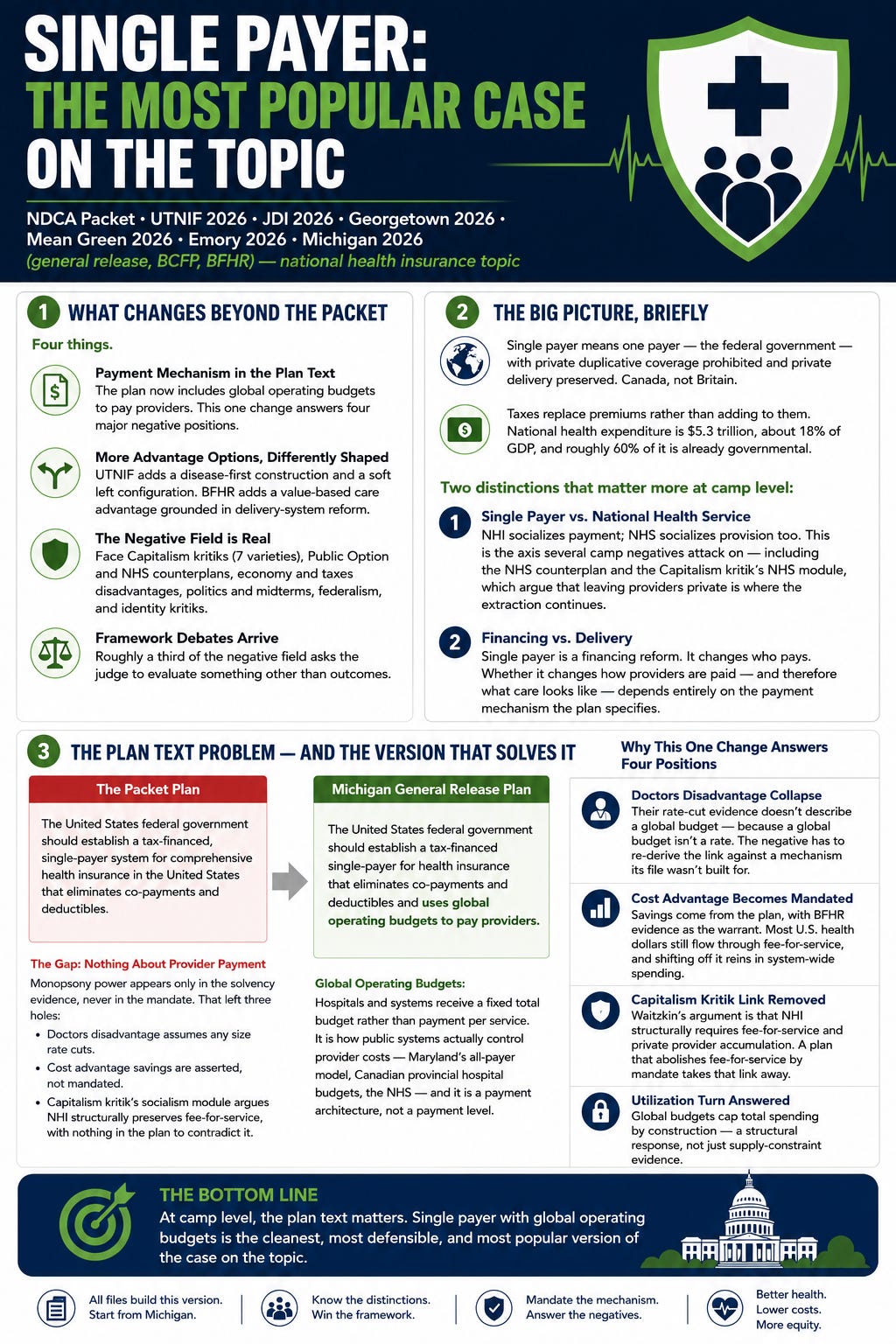
1. What Changes Beyond Novice
Four things.
The plan text gets a payment mechanism. The novice plan says the government should establish single payer and eliminate cost-sharing. It says nothing about what providers get paid — which meant monopsony solvency was asserted rather than mandated, and the Doctors disadvantage had a free link. The camp files supply the mechanism, and section 3 explains why that one change answers four separate negative positions.
There are more advantage options and they’re differently shaped. The novice packet gave you costs, coverage, inequality, and death gaps. UTNIF adds a disease-first construction and a soft left configuration. BFHR adds a value-based care advantage that runs on delivery-system reform rather than on coverage — a genuinely different kind of argument.
The negative field is real. The novice negative had no off-case whatsoever, so the whole round was case turns. At camp level you face the Capitalism kritik in seven varieties, the Public Option and NHS counterplans, an economy disadvantage, a taxes disadvantage, politics and midterms, federalism, and identity kritiks.
Framework debates arrive. The novice packet had none. Now roughly a third of your negative field asks the judge to evaluate something other than outcomes, and the affirmative needs a position on that.
2. The Big Picture, Briefly
Assuming you have the basics: single payer means one payer — the federal government — with private duplicative coverage prohibited and private delivery preserved. Canada, not Britain. Taxes replace premiums rather than adding to them. National health expenditure is $5.3 trillion, about 18% of GDP, and roughly 60% of it is already governmental.
Two distinctions that matter more at camp level than they did in novice rounds:
Single payer versus national health service. NHI socializes payment; NHS socializes provision too. This is the axis several camp negatives attack on — the NHS counterplan and the Capitalism kritik’s NHS module both argue that leaving providers private is where the extraction continues.
Financing versus delivery. Single payer is a financing reform. It changes who pays. Whether it changes how providers are paid — and therefore whether it changes what care looks like — depends entirely on the payment mechanism the plan specifies. The novice plan specified none. The camp files do, and that’s the whole story of this revision.
3. The Plan Text Problem — and the Version That Solves It
The novice plan:
The United States federal government should establish a tax-financed, single-payer system for comprehensive health insurance in the United States that eliminates co-payments and deductibles.
The gap: nothing about provider payment. Monopsony power — the mechanism behind every cost claim — appears only in the solvency evidence, never in the mandate. That left three separate holes. The Doctors disadvantage got to assume rate cuts of whatever size it liked. The cost advantage’s savings were asserted. And the Capitalism kritik’s socialism module argued that NHI structurally preserves fee-for-service, with nothing in the plan to contradict it.
Michigan’s general release fixes it in the plan text:
The United States federal government should establish a tax-financed single-payer for health insurance that eliminates co-payments and deductibles and uses global operating budgets to pay providers.
That final clause is the most important eleven words in any version of this affirmative, and if you are writing a single payer 1AC you should start from this text rather than from the novice one.
Global operating budgets means hospitals and systems receive a fixed total budget rather than payment per service. It is how public systems actually control provider costs — Maryland’s all-payer model, Canadian provincial hospital budgets, the NHS — and it is a payment architecture rather than a payment level.
Why that distinction answers four positions at once:
The Doctors disadvantage’s magnitude collapses. Their evidence is about Medicare rates — the AHA figure of 87 cents per dollar of hospital cost, the CBO comparison showing private payers pay 11 to 139 percent more. None of it describes a global budget, because a global budget isn’t a rate. The negative has to re-derive the link against a mechanism its file wasn’t built for.
The cost advantage becomes mandated rather than asserted. Your savings now come from the plan, and the BFHR evidence supplies the warrant: most U.S. health dollars still flow through fee-for-service, and shifting off it is the single lever that reins in system-wide spending.
The Capitalism kritik’s NHS and socialism modules lose their specific link. Waitzkin’s definitional argument is that NHI structurally requires fee-for-service and private provider accumulation. A plan that abolishes fee-for-service by mandate takes that link away.
The utilization turn gets a structural answer. Global budgets cap total spending by construction, which is a cleaner response than relying entirely on the supply-constraint evidence.
UTNIF’s plan takes a different route, specifying covered categories rather than payment:
The United States federal government should establish single-payer national health insurance in the United States, including coverage of primary, preventive, and emergency care.
That answers “comprehensive is undefined” and preempts benefit-package attacks. It doesn’t address payment.
JDI’s plan is the most minimal in circulation:
The United States federal government should establish a health insurance mechanism, financing healthcare through a single public authority.
No cost-sharing clause, no payment mechanism, no benefit specification. That’s a deliberate trade and you should understand both sides of it. What it buys: no “eliminates co-payments and deductibles” language means no link to the utilization turn — the negative’s Silver and Hyman evidence is specifically about what happens when out-of-pocket costs go to zero, and this plan never says they do. What it costs: no monopsony mandate, no benefit definition, and maximum exposure to “what does the plan actually do,” including a topicality press on whether “a health insurance mechanism” establishes national health insurance at all.
The seven texts compared:
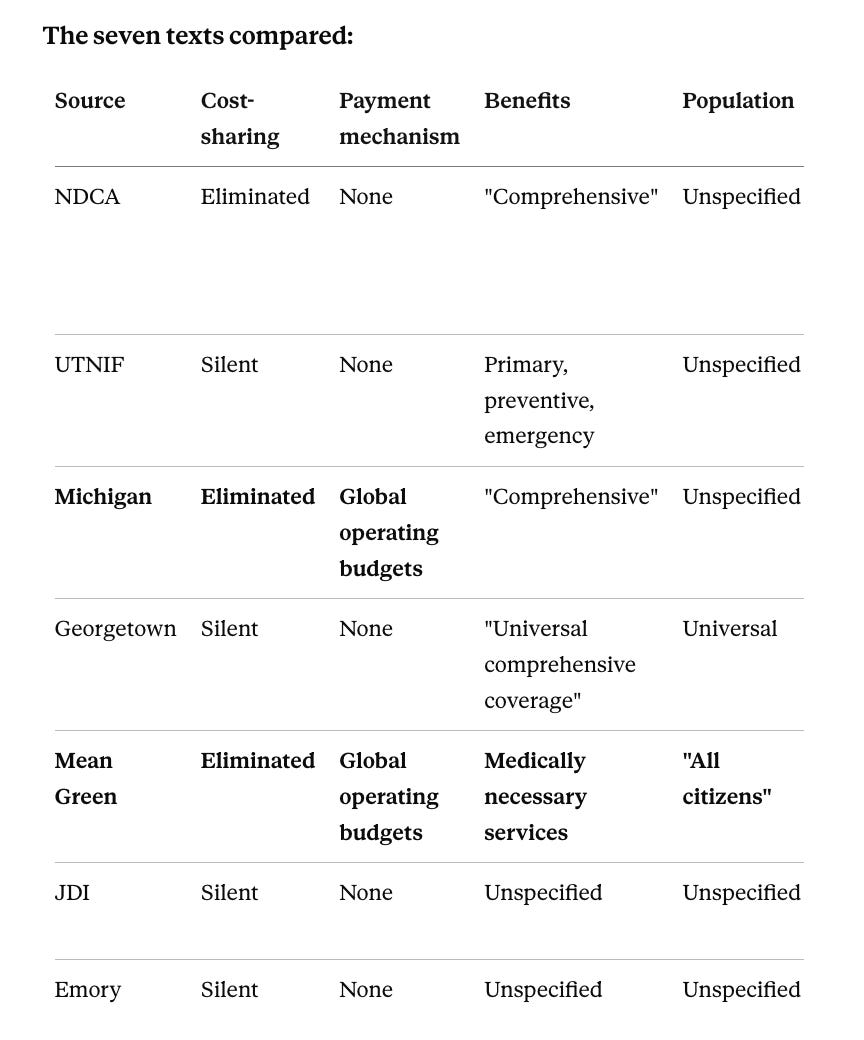
Georgetown’s text — “establish universal comprehensive coverage, single-payer health insurance in the United States” — front-loads universality and comprehensiveness, which is useful against a topicality interpretation requiring universal compulsory enrollment. Like UTNIF and JDI, it stays silent on payment.
Mean Green’s is the most complete on mechanism and the most exposed on population:
The United States federal government should establish national health insurance that includes medically necessary services to all citizens, eliminates co-payments and deductibles, and uses global operating budgets to pay providers.
It has everything Michigan has plus a benefit standard — and then restricts coverage to citizens.
Read that clause before you adopt this text, because it costs more than it buys. What it buys is a clean answer to the NDCA topicality interpretation requiring that national health insurance cover citizens. What it costs:
The immigrant coverage solvency argument disappears. Michigan’s evidence is that excluding immigrants passes costs to emergency departments and raises overall insurance costs, and that undocumented immigrants represent a coverage gap of at least 6.6 million people. A citizens-only plan concedes that gap and the cost-shifting that comes with it.
Your coverage and death gaps advantages take a solvency deficit proportional to that population.
The identity kritiks get a much better link. The Racial Healthcare kritik’s core claim is that reforms present themselves as equalizing while leaving structural exclusions intact. A plan that writes an exclusion into its own text is the strongest version of that link a negative could ask for.
Recommendation: take Mean Green’s structure and drop the citizens restriction. Medically necessary services to all residents, eliminates co-payments and deductibles, uses global operating budgets to pay providers gives you the payment mechanism, the benefit standard, and the universality — which is the strongest text available and better than any single camp’s release.
Michigan also supplies a plan mechanics section, which is the thing the novice packet most conspicuously lacked: a set of blocks defending each mandate individually. Comprehensive coverage reduces costs through a prevention shift. Universality is key because a tiered system makes racial disparities inevitable. Cost sharing increases costs over time, limits access, raises mortality, and drives inequality — with a separate block establishing that Medicare for All eliminates cost sharing except on pharmaceuticals, which is a useful concession to have ready when the negative reads the utilization turn.
And one plank the other files don’t defend at all: covering immigrants. Excluding them passes costs to emergency departments and raises overall insurance costs, and undocumented immigrants represent a coverage gap of at least 6.6 million people. If your plan covers everyone regardless of status — and single payer plans generally do — you need this block, because it’s both a solvency argument and the answer to a topicality interpretation requiring “citizens.”
4. Choosing Your 1AC: Five Configurations
Source Configuration Advantages Best against NDCA v1 Policy Costs + Coverage/pandemics Judges who want quantified impacts NDCA v2 Values Inequality + Death gaps Judges who reward ethical framing UTNIF short Disease-first Disease + Inequality Time-constrained rounds, clean chains UTNIF long Expanded Disease + Inequality + more Deep case debate UTNIF soft left Access-centered Access + supporting Kritik-heavy negatives JDI Two-advantage Inequality + Disease Pharma-heavy negatives Georgetown Core + modules Disease/Growth + add-ons Building a custom 1AC Mean Green Two-advantage Costs + Rural hospitals Rural-district judges, states CP BFHR Mechanism Value-based care + payment reform Counterplan-heavy negatives
A note on “soft left.” The term describes an affirmative that runs structural or systemic impacts — inequality, access, preventable death — rather than extinction scenarios, and typically pairs them with a framing argument about probability and lived harm over magnitude. It’s not a weaker affirmative; it’s a different comparison, and it’s specifically useful against kritiks, because it’s much harder for a negative to argue that your framing is complicit when your impact is people dying from lack of care rather than nuclear war.
UTNIF’s short 1AC is the cleanest construction available. The disease advantage runs: outbreaks are increasing and cause extinction; U.S. action is key because the next pandemic starts domestically; insurance gaps leave health systems vulnerable. Then two solvency planks — access (overcomes hesitancy to testing and treatment, flattening the curve) and trust (universal coverage restores it; trust builds political will, which underpins effective recovery).
The trust plank is the interesting one and it’s underused. It gives you an internal link that doesn’t depend on treatment capacity, which insulates you from the “single payer is financing, not surveillance” analytic that beats most coverage-advantage pandemic scenarios.
BFHR’s value-based care advantage is the most novel. Its framing: the transition to value-based care is inevitable, but fragmentation collapses its outcomes — only a coordinated payer approach solves. That’s an inherency-and-solvency argument in one, and it’s hard to answer with the usual coverage-focused negative blocks, because it isn’t a coverage advantage.
5. The Advantages
Disease (UTNIF)
Outbreaks increasing, extinction impact, U.S. action key because the next pandemic starts domestically, insurance gaps create vulnerability. Solvency through access and trust.
Strength: the trust internal link is genuinely differentiated. Weakness: the same structural analytic that hits every pandemic advantage on this topic — single payer is a financing reform, and detection is public health infrastructure. Your answer is the trust plank plus early presentation as surveillance.
Inequality (NDCA v2, UTNIF, JDI)
High healthcare costs inflate debt and depress wages, which drives inequality, which drives democratic erosion, which weakens audience constraints, which produces bad foreign policy.
JDI runs a different and better-constructed version, and it’s worth stealing: private health insurance ensures economic moral hazards, which guarantee cascading inequality, economic precarity, and stalled innovation.
Two things that construction does. First, it inverts moral hazard — a concept the negative normally owns. The standard negative argument is that insurance creates moral hazard by making people overconsume care. JDI’s version is that private insurance creates moral hazard in the economy: job lock, entrepreneurship suppression, and risk-aversion in labor markets because health coverage is tied to employment. Same term, opposite direction, and a negative reading a moral-hazard block will find it doesn’t apply.
Second, “stalled innovation” is an affirmative innovation claim, which is the terrain the Pharma disadvantage occupies. If you’re expecting Pharma, running an inequality advantage that claims the status quo suppresses innovation gives you a link turn on their impact rather than only defense.
Emory adds the best Pharma uniqueness argument available: the patent cliff. A large cohort of major drugs loses exclusivity in the late 2020s, and pharmaceutical profits decline sharply on that schedule regardless of what any payer does. That’s a dated, specific, non-plan cause of exactly the revenue decline the disadvantage’s internal link requires — and it’s better than the generic “innovation is declining” non-unique because it has a mechanism and a timeline.
Strength: the premium-to-wages link is well-evidenced, and JDI’s framing is harder to block. Weakness: the longest chain in any version once it runs to democratic erosion, and the camp negatives have specific answers.
Access (UTNIF soft left)
The ACA is too small to fill the coverage gap, leaving half of all adults without adequate insurance.
Strength: two links deep, no escalation required, very hard to beat on probability. Weakness: low magnitude against a negative that wins any extinction scenario — which is why you pair it with a framing argument.
Value-based care and payment reform (BFHR)
The transition off fee-for-service is happening; fragmentation across payers is collapsing it; only a coordinated payer solves.
Strength: it’s a mechanism advantage, so the standard coverage-focused negative blocks don’t touch it, and it doubles as solvency for every other advantage. Weakness: it’s technical, and a judge who doesn’t follow payment policy may not track it. Explain fee-for-service before you rely on it.
Costs and death gaps (NDCA)
Covered in the novice breakdown. Both remain viable; the costs advantage gets substantially stronger with a payment mechanism in the plan.
The Georgetown add-on modules
Georgetown’s updates release contains four advantages written as modules rather than as a 1AC — the tags literally read “Advantage [X] is Rural Economies,” with the bracket left for you to fill. They’re designed to be slotted into whatever core you’re running, and they’re the most useful new material in the cross-camp release after Michigan’s plan text.
Rural economies. A strong entrepreneurial ecosystem is key to small business growth in rural communities, and employer-tied coverage suppresses it. Mean Green runs a complementary rural hospital advantage, and the two pair well — one is about business formation, the other about the facilities that make rural areas habitable in the first place. This is the job lock argument built into an advantage rather than left as a solvency claim — people don’t start businesses when leaving a job means losing insurance, and that effect concentrates in places with thin labor markets. It also pairs naturally with rural hospital closure evidence.
Manufacturing. An unusual chain and worth reading carefully: lobbying and corruption by industry leaders are the leading causes of opioid deaths, and rising opioid deaths cause declines in manufacturing and general employment. So the plan reduces pharmaceutical industry capture, which reduces opioid mortality, which restores manufacturing employment.
Medical AI. Runs on the same premise — current pharmaceutical companies are plagued with corruption — and argues the plan changes drug development incentives in ways that unlock AI-driven discovery.
Biotech. Biotech innovation is stunted now because of health agency cuts. This is the most directly useful of the four, because it’s an innovation advantage — which is the Pharma disadvantage’s home terrain.
The strategic point, and it’s the reason to care about these modules: three of the four run through pharmaceutical industry conduct. That makes them link turns on the Pharma disadvantage rather than freestanding advantages. If you expect Pharma — and against a single payer affirmative you should — Georgetown gives you three separate advantages that convert their impact into your offense. Read Biotech or Manufacturing in the 1AC and the negative’s innovation disadvantage is arguing against your advantage rather than against your defense.
6. Solvency and the Payment Mechanism
Beyond the novice planks, the camp files add:
Value-based payment as the systemic fix — most dollars still flow through fee-for-service, and shifting off it is the lever that reins in spending system-wide.
Global budgeting — fixed budgets rather than per-service payment, lowering costs while improving care.
Coordinated payer necessity — fragmentation is what collapses value-based care outcomes, so a single payer isn’t merely helpful but required.
How these interact with your advantages. The payment mechanism is solvency for costs, an internal link for value-based care, and a link answer against the Capitalism kritik and the NHS counterplan. That triple duty is why it belongs in the plan text rather than only in the solvency evidence.
7. The Negative Field at Camp Level
Everything below is what you face beyond the novice packet’s case turns.
The Capitalism kritik in up to seven varieties across camps. Against single payer specifically, the modules that compete are NHS (socialize providers too) and socialism (nationalize the economy plus NHS). The single payer module doesn’t compete against you — it’s your plan.
The Public Option counterplan, which competes through mutual exclusivity and pairs with the Stock Market disadvantage.
The NHS counterplan, which argues NHI leaves providers private and extraction continues.
The economy disadvantage (BFHR neg section) and the taxes disadvantage.
Politics and midterms (BCFP updates), plus federalism.
Identity kritiks — BFHR has an “AT: Identity K” section, which tells you the camp expected them.
The novice-packet case turns — utilization, wait times, rationing, private equity, taxes — all still apply and all still portable across advantages.
8. Answering the Disadvantages
Economy DA. BFHR has a dedicated section. The core moves: the plan reduces national health expenditure rather than increasing it; employer cost relief is a supply-side benefit; and the transition is financed by redirecting existing spending rather than by new net outlays.
Taxes DA. The novice answers hold and improve. McCanne and Gaffney on taxes replacing premiums; the implicit-tax argument that premium growth already functions as taxation; and the cross-application that a negative reading both a taxes DA and an economy DA is arguing your plan both spends too much and contracts demand.
Stocks DA. BCFP has an answer section. Beyond the novice material — the Phillips concession that the sector is Facebook-sized and its disappearance “would not drop the S&P 500 by a drastic amount,” and McKeown’s finding that sector-specific shocks don’t cause recessions — the camp files add buyout and transition material.
Politics and midterms. These are fiat-vulnerable in the ordinary way, and the strongest answer is the standard one: the plan passes, and political capital arguments about whether it could pass aren’t disadvantages to what it does.
Federalism. New at camp level. The strongest answer is that health financing is already overwhelmingly federal — Medicare, Medicaid’s federal share, ACA subsidies, and the tax exclusion — so the plan consolidates existing federal authority rather than displacing state authority.
9. Answering the Counterplans
Public Option. Your best arguments are unchanged from the novice treatment and they’re strong: adverse selection turns the counterplan into a de facto high-risk pool, the Vermont modeling shows the multi-payer clearinghouse captures 3.6% of administrative savings against single payer’s 7.3–7.8%, and the theory of the second best cuts against partial reform. Add the payment-mechanism argument: a public option competing in a multi-payer market can’t implement global budgeting, because global budgets require a single payer to set them.
NHS. New at camp level and it’s the harder one, because it competes on the axis single payer leaves open. Three answers: the transition cost and disruption of nationalizing provider infrastructure; the British performance literature the Capitalism kritik files themselves flag as the best answer; and — the strongest — that a payment mechanism in your plan text captures most of the NHS’s claimed benefit without nationalizing providers. Global budgeting is how public systems control provider costs, and you can have it without owning the hospitals.
Reconciliation and process counterplans. Competition is parasitic on the net benefit; beat the disadvantage and the permutation is clean.
States. New in the Michigan file and it has a technical answer worth learning, because it wins outright rather than on balance: ERISA preempts state single payer. The Employee Retirement Income Security Act preempts state laws that “relate to” employee benefit plans, which is why Vermont’s Green Mountain Care collapsed and why every state single-payer effort has stalled on the same rock. Waivers require Congress — so the counterplan either doesn’t solve or isn’t done by the states.
And the sharper version, which closes the obvious dodge: merely incentivizing single payer triggers preemption if there’s effectively no choice between plans, because that modifies employee benefits within ERISA’s meaning. A states counterplan that tries to route around preemption by incentive rather than mandate runs into the same wall.
This is the cleanest counterplan answer available to a single payer affirmative and it’s the kind of argument that decides rounds on its own. Learn the acronym and the mechanism.
10. Answering the Kritiks
This is entirely new relative to the novice packet, and it’s where a single payer affirmative has unusual resources.
Against the Capitalism kritik, read the negative’s own single payer module. Michigan BFHR’s Cap K file — the one designed for use against ACA and public option affirmatives — argues that single payer decommodifies healthcare, removes one of capitalism’s central profit sectors, and creates a broad social movement capable of challenging profit-maximization across housing, education, labor, and environmental policy.
That is a camp’s own Capitalism K file arguing your plan is a non-reformist reform. Against the NHS and socialism modules, it is the best link turn available and it comes from inside the negative’s literature.
Against the NHS module specifically, add the payment mechanism: their link is that NHI preserves fee-for-service and private provider accumulation. A plan with global budgeting doesn’t.
Emory supplies the sharpest permutation argument in the release, and it’s worth learning as a general move against any maximalist alternative: “if socialism can overcome all of capitalism, then it can overcome the inclusion of the aff.”
That uses the alternative’s own solvency claim against its competition claim. The more the negative fiats — nationalizing the productive economy, restructuring the world — the harder it is to argue that one health policy is the thing that breaks it. Against Michigan’s socialism module and UTNIF’s central planning alternative, this is the permutation to read, and it scales with how ambitious their alternative is.
Against identity kritiks — trans, queer intelligibility, racial healthcare — the pattern is consistent and worth learning as a general approach. Check your plan text for inclusive benefit design. A plan that mandates coverage of gender-affirming care, or specifies nondiscrimination in provider participation, has a link answer about the plan rather than a generic kritik answer. BFHR’s “AT: Identity K” section exists because the camp anticipated this, and the single most valuable preparation step is making sure your plan text gives you the answer.
Against framework generally. Your soft left option is a resource here. An affirmative whose impact is preventable death from lack of care is much harder to characterize as complicit in a totalizing logic than one whose impact is hegemonic decline.
11. Analytics Against the 1AC
The novice breakdown’s analytics still apply — Pollin’s stale figures, the 68,000 provenance, the Wiley four-fixtures problem, Baumol inside the link card. What follows is new at camp level.
The plan text and the solvency evidence may not match. If your plan says nothing about payment and your solvency cards are about global budgeting, the negative gets to argue you don’t do what your evidence describes. Fix this by putting the mechanism in the text.
The disease advantage’s trust internal link is doing unusual work. It’s your best differentiation and it’s also a claim about public opinion responding to policy — which the Business Confidence and deliverism literature contests directly. Expect “policy doesn’t produce trust” and have the answer.
“Half of all adults without adequate insurance” is a striking figure and it depends on a definition of adequacy. Know the underinsurance threshold your card uses before a negative asks.
Value-based care’s inevitability claim cuts both ways. If the transition is inevitable, the negative will argue the status quo solves. Your answer is the fragmentation card — inevitable but failing without a coordinated payer — and you need to extend it explicitly rather than letting inevitability sit unqualified.
Five configurations means five sets of negative blocks. That’s an advantage in preparation and a liability in the round: a negative that has seen your 1AC before will have blocks specific to it. Rotating configurations across a tournament is worth considering.
The soft left framing and the extinction advantages don’t mix. If you read access with a probability-first framing argument and then extend a disease advantage with an extinction impact, you’ve argued that magnitude shouldn’t decide the round and also that your magnitude should. Pick one.
12. Gaps to Fill Before Your First Camp Tournament
Write the plan text from Mean Green’s structure, minus the citizens clause. Medically necessary services to all residents, eliminates cost-sharing, global operating budgets. That’s stronger than any single camp’s release and it takes about a minute.
Get the ERISA block. It beats the states counterplan outright rather than on balance.
Get the immigrant coverage block. It’s a solvency argument and a topicality answer, and only the Michigan file has it.
Get Georgetown’s Biotech or Manufacturing module if you expect the Pharma disadvantage. They convert its impact into your offense.
Check your plan text for inclusive benefit design. Gender-affirming care, nondiscrimination in provider participation. It’s your best answer to the identity kritiks and it costs a clause.
Get the negative’s Capitalism K single payer module. It’s the strongest link turn available to you and it’s in their file.
Prepare the NHS counterplan debate. It’s the newest position you face and the one the novice packet gave you nothing on.
Decide your framing before the tournament, not in the 2AC. Soft left or extinction. The two configurations need different framework arguments and reading both is incoherent.
13. Vocabulary Additions
The novice glossary and the master vocabulary cover the basics. These are new at camp level.
Fee-for-service — payment per service rendered. Most U.S. health dollars still flow through it, and shifting off it is the mechanism claim underneath the value-based care advantage.
Value-based care / value-based payment (VBC/VBP) — tying payment to outcomes rather than volume. The BFHR advantage runs on the argument that the transition is inevitable but fragmented.
Global budgeting — a fixed total budget for a hospital or system rather than per-service payment. The payment mechanism to put in your plan text, because it does triple duty as solvency, advantage internal link, and kritik link answer.
Payment architecture — the structure through which providers are paid, as distinct from the level at which they’re paid. The distinction that separates global budgeting from a rate cut, and therefore separates your plan from the Doctors disadvantage’s link.
Coordinated payer — the argument that value-based care requires a single payer to implement, because fragmentation across payers collapses the incentives.
Soft left — an affirmative running structural or systemic impacts rather than extinction scenarios, usually with a probability-over-magnitude framing. Useful against kritiks.
Underinsurance threshold — the definition determining whether coverage counts as adequate. Underneath the “half of all adults” figure, and worth knowing.
Non-reformist reform — Gorz’s concept: a reform that improves lives and shifts the balance of power. The single most important term for a single payer affirmative facing a Capitalism kritik, because the negative’s own single payer module argues your plan qualifies.
National Health Service (NHS) — socializes provision as well as payment. The axis the newest counterplan and the strongest Cap K module attack on, and the reason your payment mechanism matters.
How to Use This
Build the 1AC in this order. Start from Michigan’s plan text — it already contains global operating budgets. Add UTNIF’s specified benefit categories if you want the topicality and benefit-package preemption. Check the text for inclusive benefit design. Then pick your configuration and your framing, and stay in it.
The single change that does the most work is the payment mechanism, and Michigan has already made it. Global operating budgets convert asserted solvency into mandated solvency, take the Doctors disadvantage’s magnitude away, and remove the specific link the Capitalism kritik’s two anti-single-payer modules run on. If you’re still reading the novice plan text, you are giving away three positions for no reason.
The single best card you don’t have is in the negative’s file: the Capitalism kritik module arguing single payer decommodifies health care and builds anti-capitalist power. Get it before your first tournament.
And the single answer most likely to win a round outright is ERISA against the states counterplan. It isn’t a probabilistic argument — it’s a legal one, and it means the counterplan can’t be done by the actor it names.
The Single Payer Negative: The Cross-Camp Breakdown
Michigan 2026 (general release, BCFP, BFHR) · Northwestern 2026 · Emory 2026 — national health insurance topic
The companion to the affirmative varsity breakdown. Where that document covers six camps’ aff releases, this covers the negative field against single payer — and the Michigan negative files contain the most strategically interesting argument on either side of this topic.
1. The Organizing Insight: Consolidation Cuts Both Ways
Read the BFHR negative file’s table of contents and a pattern appears immediately:
Trump/GOP turns case — “plan puts Trump and RFK in control of nation’s healthcare”
Reproductive Rights disadvantage — “private insurance is filling in the coverage gap for abortion, but single-payer under the GOP restricts abortion rights”
Vaccines disadvantage — “private insurance supports vaccination now”
Lobbying turns case — “empirics: lobbyists pass new legislation to nullify price-control measures”
These are four versions of one argument, and it is the best anti-single-payer argument available: the plan’s mechanism is consolidation, and consolidation is only good if you control the thing being consolidated.
Single payer takes coverage decisions currently distributed across hundreds of insurers, fifty state regulators, and thousands of employer plans, and routes all of them through one federal authority. The affirmative’s entire case depends on that authority using its power well — negotiating prices, covering everyone, eliminating waste. The negative’s response is that the authority is currently held by people the affirmative does not trust, and that a system with one decision point has no redundancy when the decision goes wrong.
Why this is potent against a progressive affirmative specifically. It doesn’t argue against universal coverage as a value. It argues that the affirmative’s chosen mechanism hands a single lever to an administration hostile to the affirmative’s own commitments. The affirmative can’t answer it by defending health care as a right, because the negative agrees.
Learn this frame before the individual positions, because it’s what makes them cohere and what makes them hard to answer with generic blocks.
2. The Reproductive Rights Disadvantage
The strongest position in the file, and the one to lead with against most single payer affirmatives.
Uniqueness: private insurance is currently filling the abortion coverage gap. In a fragmented market, some plans cover abortion, some states mandate it, and the patchwork means coverage exists somewhere even where it’s restricted elsewhere.
Link: single payer routes every coverage decision through one federal authority, and under GOP control that authority restricts abortion. The sharper version, and the one the file emphasizes: even Sanders’s bill is insufficient to overcome this. That preempts the affirmative’s obvious answer — “our plan covers it” — because the argument isn’t about what the bill says, it’s about who administers it and what a subsequent Congress does with a consolidated system.
The historical mechanism the argument runs on is the Hyde Amendment, and you should know it: since 1976, federal appropriations have barred federal funds from paying for most abortions, renewed annually as a rider. Federal health financing has never covered abortion on the same terms as other care. A plan that makes all health financing federal makes the Hyde precedent the default for everyone rather than for Medicaid recipients only.
Coaching verdict. This is the best disadvantage against single payer in any camp’s release. It has real-world grounding, it’s uniquely potent against progressive affirmatives, and its link runs through the plan’s core mechanism rather than through a peripheral feature. The affirmative’s answers exist but they’re harder than they look — see section 8.
3. The Vaccines Disadvantage
Uniqueness: private insurance supports vaccination now — plans cover vaccines without cost-sharing, and coverage decisions are distributed.
Link: the same consolidation logic. Federal control of coverage means federal control of the vaccine schedule, formulary, and coverage requirements, and current federal health leadership is hostile to established vaccine policy.
Coaching verdict. Structurally identical to the reproductive rights argument and slightly weaker, because the affirmative has a cleaner answer: the ACA’s preventive services mandate already federalizes vaccine coverage requirements, so the consolidation has largely happened. But it pairs well — read both and the pattern becomes the argument.
4. Turns Case: Trump/GOP, Lobbying, and Vagueness
Three case turns, all in the BFHR file, all with affirmative sections.
Trump/GOP turns case. The plan puts the current administration in control of the nation’s health care. This is the consolidation frame in its most direct form, and it functions as an internal link turn against every advantage: coverage, costs, and equity all depend on administration.
Lobbying turns case. The empirical claim: lobbyists pass new legislation to nullify price-control measures. This is the answer to the affirmative’s monopsony solvency — it doesn’t dispute that a single payer could set low prices, it argues the political economy prevents it. Note that this is the same argument as Ginsburg’s in the NDCA packet, with empirics attached rather than asserted.
Vagueness turns case (filed under No Solvency/Circumvention). If the plan doesn’t specify implementation, the negative gets to assume the implementation is bad. This one is much weaker against the current generation of affirmative plan texts — Michigan’s and Mean Green’s specify global operating budgets, which is exactly the specification the argument says is missing. Check the plan text before reading it.
5. Physician Burnout and Stagnation (BCFP)
Burnout. The BCFP negative runs physician burnout as a negative argument — the inversion of the affirmative’s moral injury turn from the NDCA packet.
Both sides claim the same phenomenon. The affirmative says prior authorization, coverage denials, and productivity quotas are insurer behaviors that drive physicians out, and that single payer removes them. The negative says single payer substitutes different constraints — rationing in the name of cost control, higher patient volumes, and administrative requirements set by a payer with no competitor to defect to.
Whoever explains the mechanism better wins this, and the affirmative’s advantage is that its version is empirically documented in survey data while the negative’s is a prediction about a system the U.S. doesn’t have.
Stagnation. Economic stagnation from the tax burden and reduced dynamism. Pairs with the taxes and economy disadvantages.
6. The Northwestern Approach: Framing and Impact Defense
Northwestern’s negative is a different kind of file from Michigan’s, and the two are complementary rather than redundant. Michigan wins the link and turn debate — who controls the consolidated system. Northwestern wins the magnitude comparison — does any of this clear the bar.
The framing move is unusual and worth understanding. Most negatives facing a policy affirmative don’t argue framework at all, and most that do argue against consequentialism. Northwestern argues for it: “utilitarianism is true, and aligns with our fundamental beliefs in enabling universal happiness in an impartial manner.”
Why a negative would do that. Because it forces every advantage onto a single scale where magnitude decides, and then the file’s impact defense argues the affirmative’s impacts don’t clear it. Pandemics aren’t existential. Inequality is not an existential problem. Under a strict utilitarian comparison those claims do real work, because they convert “millions of people lack coverage” into a finite number weighed against whatever the negative is running.
This is specifically an answer to the soft left affirmative. A 1AC that runs access and preventable death with a probability-over-magnitude framing is asking the judge to weigh certainty against scale. Northwestern’s framing block refuses that trade and insists on the scale comparison — which is exactly the ground a soft left affirmative was trying to avoid.
The solvency argument is the file’s sharpest and it’s a turn, not defense: single payer fails to prevent pandemics, but it does limit flexible responses.
That’s better than the standard “financing isn’t surveillance” analytic, because it doesn’t merely deny solvency — it argues the plan makes outbreak response worse by centralizing decisions that currently happen at multiple levels. It’s the consolidation frame from the Michigan files applied to the preparedness advantage, and the two files together make it much stronger than either does alone.
Coaching verdict. Read Northwestern’s framing block when the affirmative is soft left or when you’re running large-magnitude offense. Read the flexible-response turn against any preparedness or pandemic advantage regardless of what else you’re doing — it’s the best case argument against that advantage in any camp’s release.
The Michigan general negative is organized against the general affirmative’s advantages: Costs, Coverage, Inequality, plus an “Other DA links” section.
That last section is worth knowing about structurally — it’s a link bank for disadvantages held elsewhere, which means the file assumes you’re pairing case answers with off-case positions from other files rather than running case alone.
Against the costs advantage, the standard moves are the ones from the NDCA packet strengthened: the Cutler and Klarnet evidence that the curve has already bent, the Hyman and Silver denominator argument on administrative savings, and Ginsburg’s monopsony-fails argument — now backed by the lobbying empirics.
Against coverage, the Davis-style argument that the plan barely affects pandemic outcomes, plus the alt-cause evidence about gutted public health infrastructure.
Against inequality, the chain-length attack and the Manning-style measurement dispute.
8. Building the 1NC
Against a single payer affirmative, the field now includes:
Kritiks: Capitalism (NHS and socialism modules compete; the single payer module does not), Racial Healthcare, Trans Phenomena, Queer Intelligibility, Settler Colonialism, Biopolitics, Necropolitics, Buddhism, Coercion, Security, Dualism.
Counterplans: Public Option, NHS, States (but see ERISA), Reconciliation, HSA.
Disadvantages: Reproductive Rights, Vaccines, Stock Market, Interest Rates, Doctors, Pharma, Brain Drain, Business Confidence, Capital Flight, Economy, Taxes, Politics, Midterms, Federalism.
Case: the turns above plus advantage-specific answers.
A recommended 1NC against a standard single payer affirmative:
Reproductive Rights DA — best link, hardest to answer, and it uses the affirmative’s values
NHS counterplan or Capitalism K (NHS module) — competes on the axis single payer leaves open
Doctors DA — but check the plan text first; global operating budgets change the link substantially
Case — costs, the lobbying turn, and Northwestern’s flexible-response turn if they read preparedness
What not to do. Don’t read the Capitalism kritik’s single payer module — it’s their plan. Don’t read a consequentialist disadvantage alongside the Coercion kritik. Don’t read the vagueness turn against a plan text that specifies payment.
9. How the Affirmative Answers the New Positions
Because the affirmative varsity breakdown doesn’t cover these, here they are.
Against Reproductive Rights
1. Non-unique and getting worse. Private insurance is “filling the gap” in a country where a large and growing number of states ban abortion outright, and where employer plans in those states increasingly exclude it. The status quo the disadvantage defends is not a stable equilibrium.
2. The plan text answers it if you write it that way. Specify coverage of reproductive health services in the mandate. The negative’s preempt — even Sanders’s bill is insufficient — is an argument about subsequent Congresses, which applies equally to the status quo’s protections.
3. Fiat. The disadvantage is substantially an argument that the current administration would administer the plan badly. Under fiat the plan passes and is implemented; “the wrong people are in charge” is a claim about political conditions rather than about the policy.
This is the affirmative’s strongest response and it’s contestable — the negative’s better version isn’t “Trump implements it” but “consolidation removes redundancy permanently,” which survives fiat. Expect that reframe and answer the durable version.
4. Turn — federal coverage is more defensible than state patchwork. A single national standard is subject to one political fight rather than fifty, and the fights in the fifty are currently being lost.
Against Vaccines
1. The ACA already federalized this. Preventive services coverage requirements are federal now, so the consolidation the disadvantage fears has substantially occurred.
2. Same fiat argument, same limitation.
Against Lobbying Turns Case
1. The IRA is the counterexample and it’s the strongest one available: Medicare negotiated prices on ten drugs and saved $7.5 billion, against exactly the lobbying pressure the disadvantage describes.
2. Global operating budgets change the target. Lobbying against a rate schedule is a different and easier project than lobbying against a fixed budget, because a budget has no line items to attack.
Against Vagueness
Read your plan text. If it specifies global operating budgets and medically necessary services, this argument is answered by the 1AC.
Against Northwestern’s Framing
1. Their framing block is an argument you can accept. If utilitarianism is true, then 68,000 preventable deaths a year and 27 million uninsured people are the largest quantified impact in the round, and the negative has to beat it on scale rather than on kind. Don’t fight the framework — take it and count.
2. “Not existential” is not “not important.” The negative’s impact defense establishes that pandemics and inequality don’t end the species. Under their own utilitarian framing, that’s irrelevant — utilitarianism aggregates welfare, it doesn’t require extinction.
3. Against the flexible-response turn, this is the harder one. Your answer is that fragmentation isn’t flexibility — the status quo’s multiple decision points produced 27 million uninsured people and a fractured COVID response, and a system where sick people can walk into a clinic is more responsive than one where they can’t afford to.
Against Burnout
Your evidence is survey data on physicians currently practicing; theirs is a prediction. Extend the moral injury findings — 44% unable to deliver medically necessary treatment because of insurance barriers, 27% who have already left a job over moral distress — and note that the constraints they describe are insurer behaviors the plan eliminates.
10. Analytics Against the Negative File
The consolidation frame proves too much. If federal control is dangerous because the wrong people might hold it, that’s an argument against Medicare, Medicaid, the VA, and federal public health authority generally. The negative needs a threshold at which consolidation becomes uniquely dangerous, and the file asserts one rather than establishing it.
Neg answer: the threshold is redundancy. Existing federal programs coexist with private alternatives; single payer eliminates them. That’s the right response and it’s the version of the argument that survives the affirmative’s fiat answer.
The reproductive rights uniqueness is deteriorating. Private coverage filling the gap is a description of a system under active dismantlement.
Neg answer: deteriorating uniqueness is still uniqueness, and the plan accelerates it by removing the plans currently doing the filling.
The lobbying turn and the monopsony solvency argument are the same claim from opposite directions. The negative argues lobbying prevents price control; the affirmative argues monopsony enables it. Both are predictions about political economy, and the IRA is the only real evidence either side has.
Neg answer: ten drugs is not all drugs, and the pharmaceutical industry’s lobbying response to the IRA is ongoing. Fair — and the affirmative should note the negative is arguing from an absence of evidence.
The burnout argument requires the affirmative’s own mechanism. The negative’s version depends on rationing and volume pressure, which are consequences of underfunding, not of single payer. A plan with adequate financing doesn’t produce them, and the negative’s evidence largely comes from systems under austerity.
Neg answer: every system faces budget pressure eventually, and a single payer has no alternative for physicians to defect to. That’s the strongest form.
Vagueness is answered by the current plan texts. Michigan and Mean Green both specify payment mechanism.
Neg answer: don’t read it against those texts.
11. Gaps in the Negative Files
No answer to the ERISA states counterplan problem. If you’re reading a states counterplan against single payer, the affirmative’s ERISA preemption argument beats it outright and none of these files address it.
The vagueness turn is written against an older generation of plan texts. It needs updating or retiring.
No engagement with global operating budgets. The Doctors disadvantage, the lobbying turn, and the monopsony answers were all written against plans that specify no payment mechanism. Against Michigan’s or Mean Green’s text, each needs a different argument, and none of the three files has it. This is the largest hole in the negative field and it’s worth fixing before your first tournament.
Northwestern’s framing block and Michigan’s consolidation frame aren’t connected, and they should be — the flexible-response turn is the consolidation argument applied to preparedness, and saying so makes both stronger.
The consolidation frame isn’t stated anywhere. The four positions that share it are filed separately, and the frame is what makes them mutually reinforcing. Say it in the 1NC.
12. Vocabulary
Consolidation — routing distributed decisions through a single authority. The plan’s mechanism, and the negative’s central objection.
Redundancy — the existence of alternative decision points when one fails. What the negative argues single payer eliminates and what distinguishes it from existing federal programs.
Hyde Amendment — the appropriations rider, in effect since 1976, barring federal funds from paying for most abortions. The historical mechanism underneath the reproductive rights disadvantage, and the reason “our bill covers it” is a weaker answer than it sounds.
Coverage gap (abortion) — the space between state restrictions and private plan coverage, currently filled unevenly by employer and marketplace plans.
Preventive services mandate — the ACA requirement that plans cover specified preventive care without cost-sharing, including vaccines. The affirmative’s answer to the vaccines disadvantage.
Circumvention — the argument that the actor implementing the plan won’t do what the plan says. The family the vagueness and Trump/GOP turns belong to.
Regulatory capture — the process by which regulated industries come to control their regulators. The lobbying turn’s mechanism.
Moral injury — distress from being prevented from doing what you believe is right. Claimed by both sides in the burnout debate.
Global operating budgets — fixed total budgets for providers rather than per-service payment. The plan-text feature that breaks three of the negative’s arguments, and the thing this negative field hasn’t yet adapted to.
How to Use This
The single best argument in these files is the reproductive rights disadvantage, and the consolidation frame is what makes it work. Read the frame explicitly, pair it with the vaccines module, and the pattern does more than either position alone.
The single biggest gap is global operating budgets. Three of your positions — Doctors, lobbying, and vagueness — were written against plans that don’t specify a payment mechanism, and the current generation does. Whoever adapts first has a real edge.
And if you’re affirmative: the fiat answer beats the “Trump implements it” version of the consolidation argument and does not beat the “consolidation removes redundancy” version. Prepare the second one, because a good negative will make it.