
This House, as a less economically developed country, would implement the Philippines’ 60-40 Rule

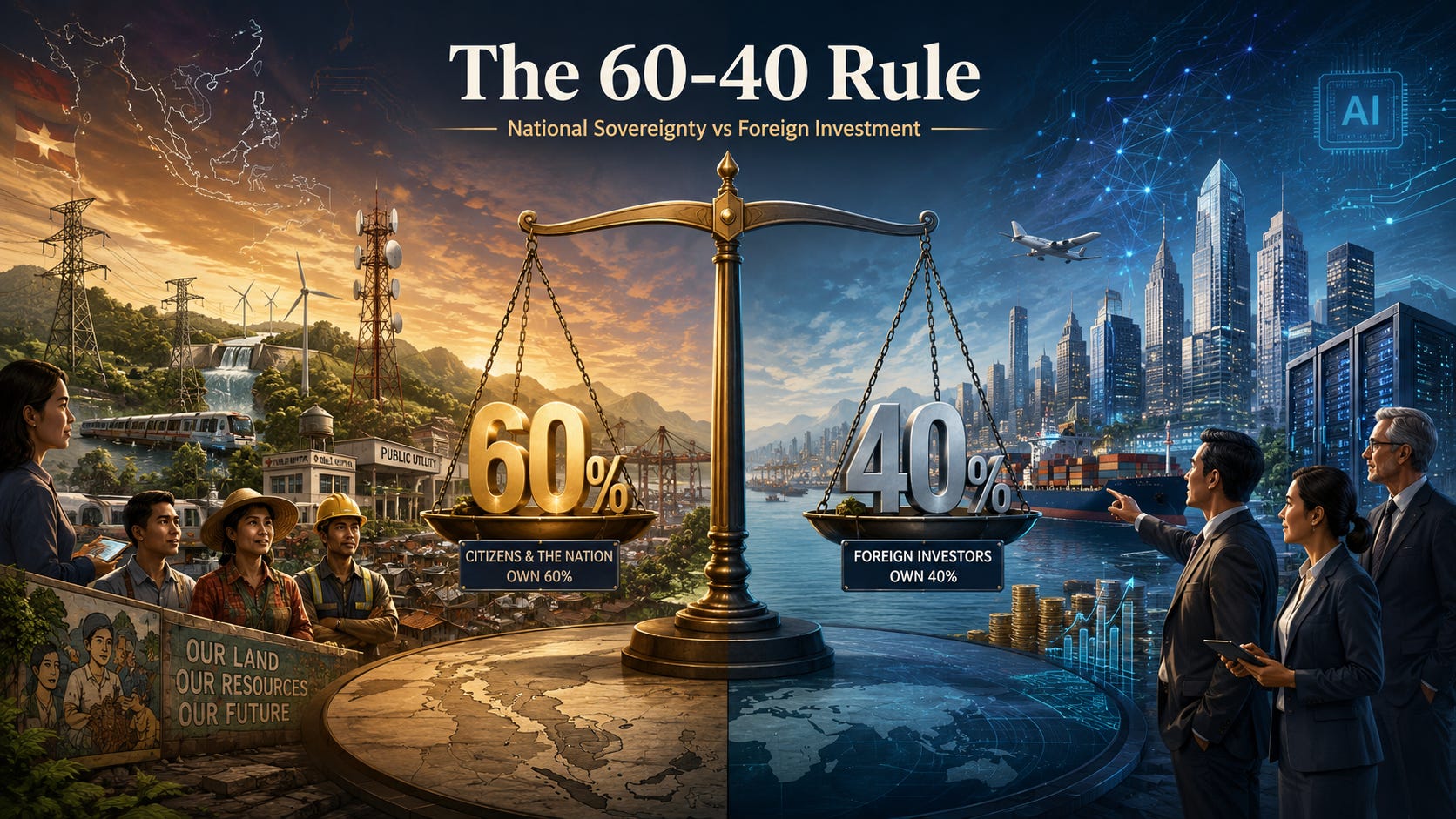
The motion’s frame. You are debating as a generic less economically developed country (LEDC), not as the Philippines. The Philippines’ 60-40 rule is the model on the table — a constitutional-style requirement that citizens own at least 60% of every business in sectors deemed critical to the national interest. So the real question is not “is the Philippine constitution good?” but “should a developing country, as a matter of development strategy, wall off its critical sectors behind a domestic-majority-ownership rule?” That reframing matters: the best evidence is comparative (China, Nigeria, Indonesia, the East Asian tigers), and the Philippines is your single richest case study of how the rule plays out over forty years.
Why this debate is live right now
This is not a museum-piece debate about 1980s economic nationalism. It is live in the exact country that gives the motion its name. The Philippines is, in 2026, in the middle of a public fight over whether to keep the rule at all. In March 2024 the House of Representatives passed Resolution of Both Houses No. 7 by 288-8-2, a measure to insert the words “unless otherwise provided by law” into the constitution’s ownership clauses so that Congress could lift the 40% foreign cap on public utilities, education, and advertising. The measure stalled in the Senate and was revived again in the House in 2025. The country’s own chief economist, NEDA Secretary Arsenio Balisacan, has publicly called the limits “impediments” that push big investments to neighboring countries. So the affirmative is, in effect, defending a policy the host nation’s own technocrats are trying to dismantle.
What makes the clash genuinely balanced is that the Philippines has already half-dismantled the rule by ordinary legislation — and we can now watch the results in real time. A 2022 reform wave amended the Public Service Act, the Foreign Investments Act, and the Retail Trade Liberalization Act, opening telecoms, transport, railways, airports, expressways, and retail to up to 100% foreign ownership. FDI did tick up — to around $8.9–9.4 billion in 2024 — but the country still trails its neighbors badly: Vietnam pulled in roughly $20 billion, Indonesia $55 billion, Singapore $143 billion the same year. That gap is the empirical heart of the debate: opponents say it proves the rule strangles investment; proponents say liberalization hasn’t closed the gap, so the rule was never the real problem.
And the deepest reason it is live: the logic of the 60-40 rule is being reinvented for the 21st century’s most important sector. In June 2026, Senator Bernie Sanders introduced the American AI Sovereign Wealth Fund Act, which would hand the public a 50% ownership stake in the largest AI companies — the same instinct that drives the 60-40 rule (citizens should own a controlling share of the sectors that define national power), applied to artificial intelligence. There is a dedicated section on this below, because it is the single freshest way to make this 1987 motion feel like a 2026 one.
This brief gives you the background, the design and enforcement reality, the worldwide track record, the full case each way, the AI extension, a weighing section, and World Schools strategy notes.
What the 60-40 rule actually is
The core definition
The 60-40 rule is a constitutional ownership floor: in sectors a country designates as critical to the national interest, citizens (and citizen-controlled corporations) must own at least 60% of the enterprise, capping foreigners at 40%. It is not a tax, a tariff, or a screening process — it is a hard equity ceiling written into the country’s highest law. In the Philippines it flows from the 1987 Constitution, and because it is constitutional, it cannot be undone by ordinary legislation — only by amending the charter, which is exactly why “charter change” (cha-cha) is such a fraught political project there.
The sectors the Philippine version walls off include land and natural resources, public utilities, mass media, and (until recently) areas like advertising and education. Some sectors are even stricter than 60-40: mass media is reserved 100% for citizens. The operational tool is the Foreign Investment Negative List (FINL), periodically updated, which sorts restricted activities into List A (restricted by the constitution or law) and List B (restricted for security, health, or morals).
The two ideas underneath it
The rule fuses two distinct rationales that a good debater should keep separate:
National patrimony / sovereignty. Some assets — land, the airwaves, water, the electricity grid — are seen as part of the nation’s birthright and as levers of political control that should not sit in foreign hands. This is a security and identity argument, not primarily an economic one.
Development strategy. Forcing foreign capital to take a local majority partner is meant to keep profits, control, and know-how in the country: locals learn the business, capital is reinvested at home rather than repatriated abroad, and a domestic capitalist class is built. This is the infant-industry / technology-transfer argument.
These can pull apart in a round. You can believe land should stay national (patrimony) while doubting that a 60% ownership rule builds a better telecom industry (development). The Opp can exploit that seam; the Prop should pick which rationale it leads with.
The enforcement reality — and the loophole problem
This is where many rounds are won, because the rule is far leakier than it looks on paper. The landmark Gamboa v. Teves (2011–2012) case had to settle what “60% Filipino” even means — the Supreme Court eventually ruled that “capital” means voting shares, after years of structures that gave foreigners economic control through non-voting preferred shares while nominally satisfying the rule. Circumvention is endemic: the Anti-Dummy Law (Commonwealth Act 108) criminalizes using Filipino “dummies” to front for foreign owners, but common schemes persist — “60-40 on paper, 100-0 in reality”: Filipino nominees pre-sign blank share transfers and collect fixed allowances while foreigners take the profits, or foreigners hold a 40% stake but retain veto rights over budgets, officers, and key contracts, giving them de facto control. The Opposition’s killer line: a rule this easy to dodge gives you all the deterrence of restriction with little of the control it promises — the worst of both worlds.
What has already changed (the natural experiment)
Crucially, the Philippines spent 2022 carving the rule back by statute wherever the constitution allowed it:
The Public Service Act amendment (RA 11659) narrowed the legal definition of “public utility” so that telecoms, domestic shipping, railways, airports, expressways, and transport were no longer covered by the 40% cap and could be 100% foreign-owned — while keeping water and electricity distribution inside the constitutional 60-40.
The Foreign Investments Act amendment (RA 11647) let foreigners own SMEs outright with a reduced capital threshold if they hire locals and bring in technology.
The Retail Trade Liberalization amendment (RA 11595) lowered the barriers to foreign retailers.
Renewable energy (solar, wind) was opened to 100% foreign ownership.
This gives both sides a real-world test bed: the country relaxed the rule across a swathe of the economy and you can argue about what happened next.
The worldwide track record
No two countries run identical versions, but ownership caps and local-partner mandates are among the most common tools in the developing-world policy kit, and the evidence cuts both ways — which is what makes the motion debatable.
The Philippines itself — four decades of the rule
The home case is genuinely mixed. Proponents note the country retained domestic control of strategic utilities and a homegrown business elite. But the persistent, embarrassing fact is that the Philippines has long been an FDI underperformer relative to ASEAN — even after the 2022 liberalization it drew roughly a third of Vietnam’s inflows and a sixth of Indonesia’s. Whether the rule caused that, or whether infrastructure, power costs, corruption, and policy instability did, is the central contested question.
China — the JV cap that (partly) worked
The strongest pro-restriction case study. For decades China required foreign automakers to operate through joint ventures capped at 50% foreign ownership, explicitly to force technology and managerial know-how into domestic firms. The U.S. Trade Representative condemned this as forced technology transfer, and that is precisely the point for the affirmative: it worked well enough that China built a car industry and then went on to dominate electric vehicles. But the academic verdict is more sober — Stanford/Harvard research estimates the JV requirement improved affiliated models’ quality by only 3.8–19.5%, “modest” relative to broader industry spillovers. And the punchline cuts for the Opp: having used the cap as a ladder, China kicked it away — removing the 50% auto ownership limit between 2018 and 2022. A tool you abandon once you’re strong is a transitional device, not a permanent constitutional rule.
Nigeria — the cautionary tale
The opponents’ empirical hammer. Nigeria’s Indigenization Decrees of 1972 and 1977 forced the transfer of foreign-owned enterprises into Nigerian hands across scheduled sectors — a far-reaching version of exactly this motion. The consensus verdict is that it failed to deliver genuine economic independence: ownership concentrated among a politically connected elite and ex-state officials rather than broadening prosperity, and the policy is widely read as a case of nationalist ownership rules entrenching cronyism without building competitiveness. It is the warning that “citizen ownership” in a weak-governance state means “well-connected citizen ownership.”
Indonesia — the reversal
Indonesia ran a restrictive Negative Investment List (DNI) for years, then in 2021 flipped its entire philosophy: Presidential Regulation 10/2021 replaced the DNI with a Positive Investment List where openness is the default and restriction the exception, cutting the number of closed or partially closed sectors by about 75%. Indonesia’s far larger FDI haul is the Opp’s evidence that the regional winners are the ones liberalizing, not the ones holding the line.
India — the calibrated middle path
India keeps sector-specific caps (e.g., historically 49% in insurance and aviation) but raises them sector by sector as confidence grows. It is the model for a nuanced Prop or Opp: ownership limits as dials to be tuned, not a single blanket constitutional rule — which doubles as an argument against the rigidity of the 60-40 approach specifically.
The East Asian tigers — the inconvenient complication
The most interesting evidence resists both sides. The Northeast Asian miracle economies — Japan, South Korea, Taiwan — industrialized while restricting FDI heavily, but they did so by buying technology through licensing and reverse-engineering rather than by forcing foreign equity into local JVs. Meanwhile the second-tier tigers — Malaysia, Thailand, Indonesia — grew through FDI-led export manufacturing. So “restrict foreign ownership” and “grow fast” can coexist (Korea) and “welcome FDI” and “grow fast” can coexist (Malaysia). The lesson both sides should steal: ownership policy is one variable among many, and what mattered most was state capacity to execute whichever strategy was chosen — which throws the spotlight back on governance.
The Case FOR the 60-40 Rule (Proposition)
The proponents’ strongest ground is that development is not just about the quantity of investment but about who controls the commanding heights and where the gains accrue.
1. It keeps the commanding heights under national control. Land, water, power, the airwaves, and the grid are levers of sovereignty. A country that lets foreigners own its public utilities and natural resources outright can have its essential services priced, rationed, or switched off by actors who answer to foreign shareholders or foreign governments. The rule guarantees that, in a crisis, decisive control sits with citizens.
2. It forces technology and skills transfer. A foreign firm that must take a 60% local partner cannot operate as a walled-off enclave; locals sit on the board, learn the management, and absorb the technology. China’s auto JV cap is the proof of concept — the policy that the USTR angrily called “forced technology transfer” is, from the developing country’s chair, simply development working as designed.
3. It keeps the profits at home. Wholly foreign-owned operations repatriate their profits — and the scale is not trivial: studies find resource- and labor-providing countries lose, on average, the equivalent of 6.7% of total domestic investment to profit repatriation, with some countries bleeding 10–25%. A 60% domestic stake keeps the majority of those returns recirculating in the national economy.
4. It builds a domestic capitalist class. Development is not only about GDP; it is about who owns the economy. Mandating local majority ownership deliberately grows a national business elite with the capital and expertise to eventually invest abroad themselves — the difference between a country that hosts industries and a country that owns them.
5. It guards against the crowding-out of local firms. Evidence suggests FDI can crowd out domestic private investment rather than complement it. Unrestricted foreign giants can use deep pockets to undercut and absorb nascent local competitors. Ownership rules give domestic enterprise the protected space to reach scale — the classic infant-industry logic that every rich country, including the US and Britain, used on its way up.
6. It is a bulwark against modern economic coercion. In an era of weaponized supply chains and strategic infrastructure, letting a geopolitical rival own your ports, telecoms, or grid is a security liability. Rich countries themselves now screen and block foreign acquisition of critical infrastructure on national-security grounds — the rule is simply the LEDC’s version of the same prudence.
7. The “it deters FDI” charge is overstated — the real constraints lie elsewhere. The Philippines liberalized telecoms, transport, and retail in 2022 and still lagged its neighbors, which suggests the binding constraints on investment are infrastructure, power costs, corruption, and policy instability, not the ownership rule. If lifting the rule doesn’t move the needle, you give up control for nothing.
8. Korea proves you can restrict ownership and still industrialize. The Northeast Asian miracle economies grew explosively while restricting FDI, acquiring technology on their own terms. The claim that openness to foreign ownership is a precondition for development is simply false — the richest development successes did the opposite.
9. It is democratically legitimate and identity-affirming. A nation emerging from colonial or neocolonial economic domination has a legitimate interest in ensuring its citizens, not former colonizers or multinationals, own its patrimony. This is a values argument that resonates strongly with World Schools judges: economic self-determination is part of political self-determination.
The Case AGAINST the 60-40 Rule (Opposition)
The opponents’ strongest ground is that the rule is a blunt, leaky, easily-corrupted instrument that scares off exactly the capital a poor country needs, while delivering far less control than it promises.
1. It chokes off desperately needed capital. An LEDC’s core problem is a shortage of capital and technology. A hard ownership cap tells global investors they can never control what they build, so the largest, longest-horizon, most technology-intensive projects — the ones that need management certainty — go elsewhere. The Philippines’ chronic FDI underperformance versus Vietnam and Indonesia is Exhibit A, and the country’s own chief economist calls the limits “impediments” that divert investment to neighbors.
2. The rule is a fiction in practice — it produces dummies, not control. Because investors who want control will get it, the rule generates an entire industry of nominee structures, blank share transfers, and veto-rights workarounds that the Anti-Dummy Law cannot fully police. You end up with the deterrence of a restriction and foreign de facto control — the worst of both worlds, plus a corrupt legal grey market.
3. It entrenches a rent-seeking oligarchy. The “domestic capitalist class” the rule builds is, in weak-governance states, a politically connected elite that captures guaranteed 60% stakes in any foreign venture — risk-free rents for being well-connected. Nigeria’s indigenization is the textbook outcome: ownership transferred, but to cronies, not to the nation. The rule can deepen inequality and oligarchy rather than spreading prosperity.
4. It raises consumer prices and protects inefficiency. Shielding domestic firms from full foreign competition is a recipe for the crony-dominated, high-cost services that plagued Philippine telecoms for decades — expensive, slow, with little incentive to improve. Ordinary citizens pay the price of “national ownership” in worse, dearer services.
5. The technology-transfer payoff is modest and temporary. Even China’s celebrated JV cap delivered only a 3.8–19.5% quality bump, small next to broader spillovers — and China itself scrapped the cap once it had served its purpose. If the benefit is real but transitional, the worst possible design is to lock it into the constitution, where it cannot be tuned or removed as the economy matures. India’s adjustable sector caps and Indonesia’s pivot to a positive list show the flexible alternative.
6. Rigidity is the specific vice of this model. The motion isn’t “use ownership policy wisely” — it’s adopt the Philippine constitutional rule. Constitutionalizing the cap is what makes it nearly impossible to reform: the Philippines has spent years on failed charter-change attempts just to adjust it. A developing economy’s needs change fast; welding the rule into the highest law guarantees you’ll be stuck with yesterday’s policy.
7. Better tools exist for every legitimate goal. Worried about strategic control? Use targeted screening of critical-infrastructure deals, like rich countries do, rather than a blanket equity cap on whole sectors. Worried about profit flight? Use partial capital controls on repatriation and good corporate taxation. Worried about skills? Mandate local hiring and training (as the amended Foreign Investments Act does) rather than equity. Each goal has a sharper instrument than a 60% wall.
8. The binding-constraints critique cuts both ways — and mostly against. If, as the Prop argues, the real obstacles are infrastructure and governance, then the ownership rule is not even doing the protective work it claims; it’s just a deterrent with no offsetting payoff. Spend the political capital on power, ports, and anti-corruption instead.
9. It expresses self-defeating distrust. A poor country signals to the world that it fears and will hamstring foreign partners. In a competitive global market for capital, the countries that made openness the default are winning the FDI race. Economic self-determination is best secured by becoming a place the world wants to invest, not by building a wall that the most desirable investors simply walk past.
AI and the Sanders proposal: the 60-40 rule reborn for the algorithmic economy
This is the freshest extension available, and it lets you argue a 1987 constitutional rule as if it were written for 2026. The underlying instinct of the 60-40 rule — citizens should own a controlling share of the sectors that decide national power — is being reinvented right now for the most consequential sector of the century. Handle it as a genuine two-way clash, not a one-sided impact.
The parallel
In June 2026, Senator Bernie Sanders introduced the American AI Sovereign Wealth Fund Act, which would impose a one-time 50% tax — paid in stock — on the largest AI companies (OpenAI, Anthropic, xAI), depositing that equity into a public fund that gives ordinary citizens voting rights, board representation, and eventually direct cash payments. Sanders’ framing is almost word-for-word the patrimony argument behind the 60-40 rule: AI, he says, is built on collective human knowledge and should be treated like a natural resource — exactly the logic the Philippine constitution applies to land, water, and the airwaves. The reference models are Norway’s $2-trillion-plus oil fund and Alaska’s dividend. Strikingly, this is no longer a fringe-left idea: OpenAI itself proposed a public wealth fund giving every citizen a stake, Anthropic floated national sovereign wealth funds with AI stakes, and even the Trump White House has shown interest in the sovereign-wealth-fund idea.
Why this strengthens the Proposition
A1. It shows the 60-40 instinct is converging, not receding. If even the United States — the world’s most FDI-friendly economy and home to the AI giants — is seriously debating mandated public ownership of its most strategic sector, then the developing country’s case for citizen ownership of its critical sectors looks prescient, not protectionist. The motion’s principle is being validated at the technological frontier.
A2. AI is the ultimate “critical sector,” and ownership is the only real control. If AI becomes the infrastructure of the economy, a country that lets it be wholly foreign-owned hands the controls of its future to firms in San Francisco or Beijing. For an LEDC, a 60-40-style requirement on AI and data infrastructure may be the only way to ensure the technology serves national priorities — the digital version of not letting foreigners own your power grid.
A3. Ownership captures the gains that taxation alone misses. Sanders’ core insight is that in a world where AI could displace enormous numbers of jobs, wages — and therefore income taxes — shrink as a share of value, while capital captures the gains. Only an ownership stake, not a tax on vanishing payrolls, lets citizens share in an automated economy. For an LEDC facing the same displacement with a thinner safety net, owning a piece of the productive capital is a more durable claim on prosperity than hoping for trickle-down.
Why this cuts against the Proposition
B1. AI ownership rules would strangle the one sector LEDCs can least afford to deter. AI investment is mobile, capital-intensive, and ferociously competitive for talent and compute. A developing country that slaps a 60-40 (or 50%) ownership requirement on AI firms will simply watch them set up in jurisdictions that don’t — and a poor country has no domestic AI champions to fill the gap, unlike the US with OpenAI. The rule that lets China bargain from strength leaves an LEDC with an empty sector.
B2. The Sanders plan is a wealth-sharing tool, not an LEDC development model — and even at home it’s contested. Critics argue the proposal misunderstands how AI value and equity actually work and would chill the investment that makes the companies valuable in the first place. A 50% stake in a company that relocates or never forms is worth nothing. The proposal works (if it works) because the US already has the dominant AI firms; the LEDC analogy breaks precisely because the developing country is trying to attract a sector it does not yet have.
B3. Sovereign wealth funds presuppose the governance the rule can’t assume. Norway’s fund succeeds because Norway has world-class institutions; the Nigeria indigenization precedent warns what happens when ownership stakes in strategic assets are handed to a state with weak governance — capture, not citizen dividends. An LEDC trying to run an AI ownership fund is more likely to get Nigeria than Norway.
The synthesis on AI: The Proposition wins this exchange if it frames the motion as forward-looking economic sovereignty — the world’s leading economies are now racing to give citizens ownership of their most strategic sector, and an LEDC should secure the same control over its patrimony before it’s too late. The Opposition wins it by drawing the disanalogy sharply: a public stake in companies you already dominate (the US in AI) is nothing like an ownership wall that deters the formation of a sector you don’t yet have — and the governance a sovereign fund requires is exactly what the LEDC in this motion lacks. Whichever side controls the analogy controls the exchange. The trap to avoid: don’t let the glamour of the Sanders headline substitute for the disanalogy work — the AI case is a frame, and the team that interrogates whether the frame actually fits a poor country wins it.
How to weigh it
The strongest pro in one line: a developing country that lets foreigners own its commanding heights surrenders both control and the lion’s share of the gains — and the fact that even the United States is now debating mandated public ownership of AI shows citizen ownership of strategic sectors is the future, not a relic.
The strongest con in one line: the rule is a leaky, rigid, easily-captured wall that deters the capital and technology a poor country most needs while delivering dummy-corporation control rather than real control — and the regional winners (Vietnam, Indonesia) are the ones tearing such walls down, while even China treated its version as a temporary ladder it kicked away.
The crux is not whether national control matters — both sides concede a country has legitimate strategic interests. The dispute turns on three things. First, the control-vs-capital trade-off: does majority ownership actually buy meaningful control (Prop: yes, decisive board control; Opp: no, dummies and veto-rights hollow it out while the deterrence is real), and is the control worth the foregone investment? Second, state capacity: the rule’s payoff — technology transfer, a productive domestic capitalist class, profits reinvested at home — depends entirely on whether the state is competent and clean enough to make ownership productive rather than extractive. China and Korea say a capable state turns ownership rules into ladders; Nigeria says a weak state turns them into cronyism. So the round often collapses into “does the generic LEDC in this motion look more like China or more like Nigeria?” Third, the right instrument: even if you accept the goals, is a blanket constitutional equity cap the best tool, or do targeted screening, capital controls, and local-hiring mandates reach each goal more cheaply and flexibly?
Each side has to believe something specific to win. The Proposition has to believe the state is capable enough to convert ownership into development — that “60% citizen-owned” will mean genuine learning, reinvestment, and control, not rents for the connected few. The Opposition has to believe foreign capital is both desperately needed and adequately tameable by lighter tools — that you can get the investment and protect sovereignty without the wall. Whichever team makes its half of that bet more convincingly, with the comparative evidence, wins the round.
World Schools strategy notes
Defining and modeling. This is a characterization debate, and most rounds are won in the setup. As Proposition, specify your LEDC and your sector list. Don’t defend “60-40 on everything everywhere” — that’s the strawman the Opp wants. Define the critical sectors narrowly and defensibly (land, natural resources, public utilities, telecoms, mass media, core data/AI infrastructure) and a country with at least functional governance, so you’re arguing the China/India end of the spectrum, not the Nigeria end. As Opposition, do the reverse: stress that the motion adopts the rule as a constitutional, blanket rule (rigidity is your friend), and that the realistic LEDC has weak institutions, so capture and dummy-corporations are the predictable result. Whoever controls “what does the generic LEDC look like?” controls the feasibility debate.
Proposition’s best three-argument spine. (1) Sovereignty and control — strategic sectors must answer to citizens, and ownership is the only real control; lead here because it’s the cleanest values clash and AI/Sanders makes it feel current. (2) Capturing the gains — technology transfer (China) plus profits reinvested at home rather than repatriated, building a national capitalist class. (3) The “FDI deterrent” charge is overstated — pre-empt the Opp’s best stat by arguing the real constraints are infrastructure and governance, so you give up little by keeping the rule. Concede that the rule must be paired with competent administration, and own that openly.
Opposition’s best three-argument spine. (1) Capital starvation — the FDI gap with Vietnam and Indonesia and the country’s own chief economist calling the rule an impediment is your empirical hammer. (2) The rule is a fiction that breeds cronyism — dummy corporations and Nigeria’s captured indigenization prove you get oligarchy, not control. (3) Run a clean counter-model — targeted infrastructure screening + capital controls + local-hiring mandates + India-style adjustable sector caps get every legitimate Prop goal without the constitutional wall. The counter-model is your strongest WS tool because it denies the Prop the sovereignty high ground: you can protect the nation and get the capital.
The clash points that decide the round.
Does ownership equal control? Prop: a 60% stake and board majority is decisive, real control. Opp: Gamboa, dummies, and veto-rights structures show the control is illusory while the deterrence is real.
Which analogue is the LEDC? Whoever makes their case study the representative one wins feasibility. Prop: China and Korea (ownership rules as development ladders). Opp: Nigeria and the Philippines’ own FDI underperformance.
Rigidity. Opp’s sharpest structural point: even if caps help transitionally, China removed its cap and Indonesia scrapped its negative list when they outgrew them — so why constitutionalize it? Prop must answer with a sunset or statutory-flexibility version, or bite the bullet that strategic sectors are permanent.
AI and the Sanders proposal. The freshest exchange — but a double-edged one (see the AI section). Prop: citizen ownership of strategic sectors is the global frontier, validated even in the US. Opp: a public stake in companies you already dominate is the opposite of a wall that deters a sector you don’t yet have, and the LEDC lacks the governance a sovereign fund needs. Whoever interrogates the analogy wins it; don’t wield it as a one-sided headline.
The counter-model. The whole Opp case can pivot on this. If the Opp wins that screening + capital controls + training mandates capture the Prop’s goals at lower cost, the Prop’s sovereignty arguments lose their exclusivity. Prop must attack the counter-model as weaker control — screening can be gamed, capital controls scare capital too, and neither builds a domestic owning class.
Rebuttal pre-empts. If you’re Prop, prepare the “dummy corporation / it doesn’t really work” answer up front (enforcement is improving via beneficial-ownership transparency, and even imperfect control beats none on truly strategic assets). If you’re Opp, prepare the “your alternative surrenders sovereignty” answer (screening and golden shares give targeted control over the genuinely critical deals without walling off whole sectors and starving them of capital). The team that has already answered the other side’s best line before it’s spoken usually controls the round.
Source list
The rule itself — definition, sectors, enforcement
Foreign Ownership Rules in the Philippines — ASEAN Briefing and China Briefing — the 60-40 rule, the sectors covered, the Foreign Investment Negative List, and the regional FDI comparison.
Understanding the 60/40 Ownership Rule — Triple i Consulting and Respicio & Co. on foreign ownership and incorporation — mechanics and the veto-rights/control workarounds.
The Anatomy of the Anti-Dummy Law — Abo & Peñaranda and Anti-Dummy Law compliance update — Triple i Consulting — circumvention schemes and enforcement reality.
SC affirms the SEC’s 60-40 rule (the Gamboa/PLDT line) — Rappler — what “60% Filipino” legally means.
The 2022 liberalization (the natural experiment)
The Philippines Amends its Foreign Investment Act — ASEAN Briefing — Public Service Act, Foreign Investments Act, and Retail Trade amendments.
Philippines amends FIA to woo investment — UNCTAD Investment Policy Monitor — the RA 11647 terms.
The live charter-change fight
Economic charter change proposal breezes through the House — Rappler and Constitutional reform in the Philippines — Wikipedia — RBH 7, the vote, and the Senate stall.
Economic Cha-cha revived in House (2025) — Tribune — the 2025 revival.
Time to scrap foreign ownership limits, says the Philippines’ chief economist — Rappler — Balisacan calling the limits “impediments.”
Charter change does not address the binding constraints — BusinessWorld and the PIATCO scandal / credible-commitment piece — the “the rule isn’t the real problem” critique and the cost of crony utilities.
Comparative country evidence
How Joint Ventures Shaped Technology Transfer in China’s Auto Industry — Harvard CID and Automotive industry in China — Wikipedia — the 50% cap, “forced technology transfer,” and the 3.8–19.5% quality estimate.
China lifts foreign ownership restriction on autos — ARC Group — the cap as a ladder that was kicked away.
Nigeria’s Indigenisation Decrees, 1972 & 1977 — eSciPub and the political economy of indigenization — the cronyism cautionary tale.
Indonesia’s Negative Investment List and its abolition — XPND and the Omnibus Law’s impact on foreign investment — DS Avocats — the ~75% cut in restricted sectors and the pivot to a positive list.
Foreign ownership restrictions and technology transfer — ScienceDirect — India’s sector caps and the welfare analysis of restrictions.
The Asian Developmental State and FDI — UNCTAD and the East Asian model — Kennesaw State — Northeast Asia’s restricted-FDI path vs. Southeast Asia’s FDI-led growth.
The economics of FDI, crowding-out, and repatriation
FDI and domestic investment crowding-out in developing countries — Comparative Economic Studies — the crowding-out evidence.
How FDI profit flows deepen the North-South divide — Critical Takes — the 6.7%-of-investment repatriation figure.
Foreign Investment and its Impact on Developing Countries — Management Study Guide — capital controls on repatriation as an alternative tool.
Economic nationalism — Wikipedia — strategic-sector screening as the rich-country analogue.
AI and the Sanders sovereign-wealth-fund proposal
Bernie Sanders wants Americans to own a piece of AI; the Trump White House seems to agree — Fortune — the American AI Sovereign Wealth Fund Act and cross-spectrum interest.
Sanders to introduce bill giving the public a 50% stake in top AI companies — Yahoo Finance and the mechanics — Common Dreams — the 50%-in-stock design, voting rights, board seats, and dividends.
“The Public Should Own Half of the Big A.I. Companies” — Sen. Sanders op-ed — the patrimony framing and OpenAI/Anthropic’s own public-fund proposals.
Direct payments under the proposed fund — Newsweek — the Norway/Alaska models.
Sanders’ AI wealth-fund bill misunderstands AI and wealth — Reason — the critique that the stake chills the investment that creates the value.
Sanders warns AI could kill nearly 100 million US jobs — Common Dreams — the displacement backdrop for the ownership-vs-taxation argument.