
This House Believes That NIL Has Done More Good Than Harm for College Athletics (NSDA World Schools 2026)

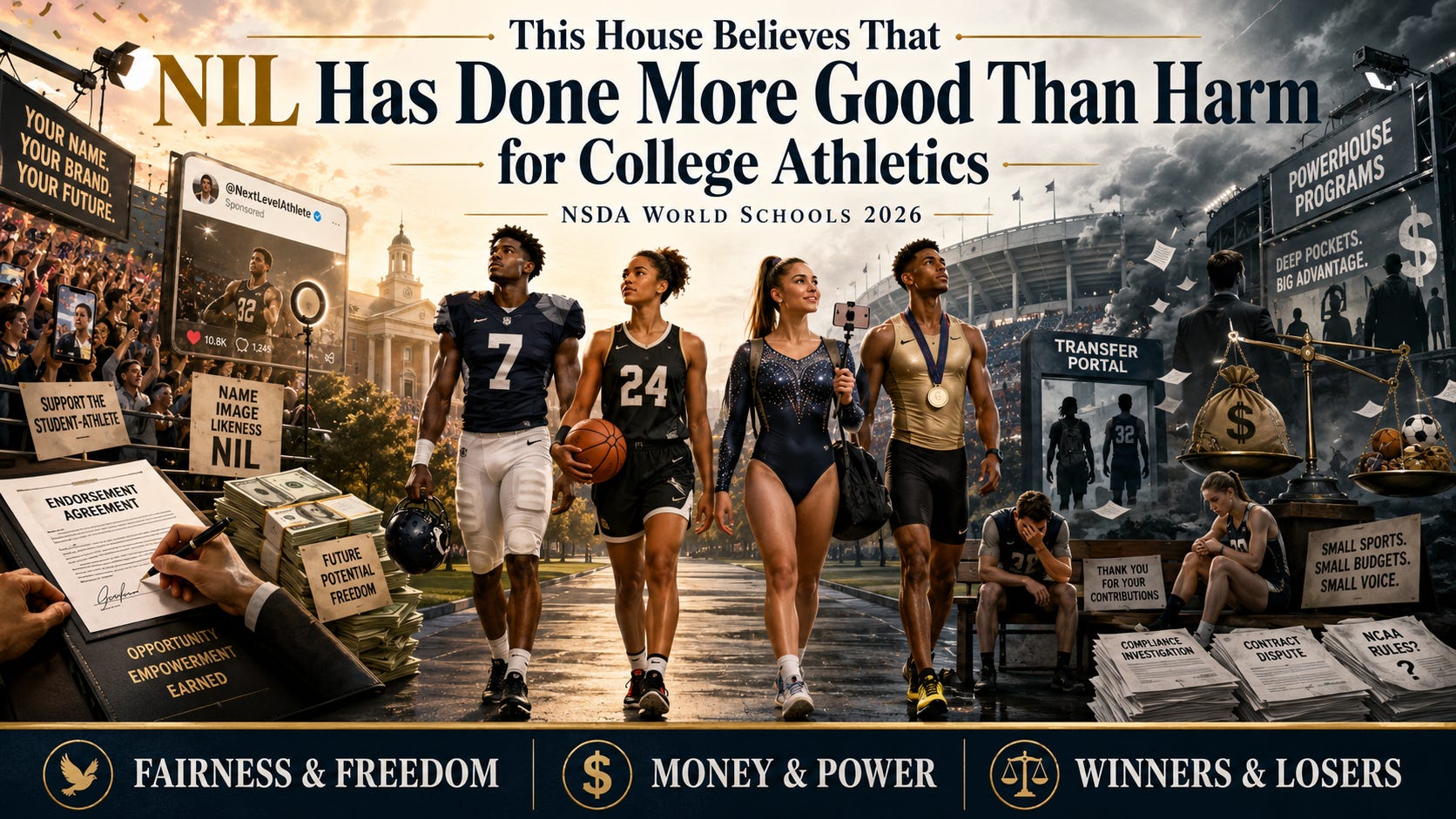
Why this debate is live right now
This motion lands at the exact moment the ground shifted under it. For four years (2021–2025), “NIL” meant athletes signing third-party endorsement deals while schools stayed officially hands-off. That era ended in 2025. On June 6, 2025, federal judge Claudia Wilken approved the House v. NCAA settlement, and on July 1, 2025, schools began paying athletes directly for the first time in NCAA history. The 2025–26 academic year is the first full year of the new world — which makes “has NIL done more good than harm” a question you are debating while the verdict is still being written.
The stakes are enormous and concrete. NIL was a $393 million market in its first year (2021); it crossed roughly $1 billion in 2024 and nearly $1.9 billion in 2025, and combined NIL-plus-revenue-sharing compensation to Division I athletes is projected above $2.3 billion in 2025–26. Money on that scale, arriving that fast, into an institution that for sixty years insisted its athletes were amateurs, guarantees both real winners and real disruption.
What makes the motion genuinely balanced is that the same facts cut both ways. Athletes who were denied any share of a billion-dollar industry now get paid — but the transfer portal has turned rosters over wholesale, wealthy programs can outbid everyone for talent, women and non-revenue athletes capture a tiny slice, and schools are cutting Olympic sports to fund the football payroll. This brief gives you the background, the law, the full case each way, and a World Schools strategy section.
What NIL actually is
The core definition
NIL stands for Name, Image, and Likeness — the legal right of a person to control and profit from the commercial use of their identity. In the college-sports context, NIL refers to the rules, beginning in 2021, that let college athletes earn money from endorsements, sponsorships, autographs, social media promotion, merchandise, personal appearances, and their own businesses — without losing their NCAA eligibility. Crucially, NIL is not the school paying the athlete to play; it is third parties paying the athlete for the commercial use of their identity.
That distinction matters for this debate (see the definitional note below), because the “NIL era” colloquially now sweeps in three related but distinct things:
NIL proper — third-party endorsement and sponsorship deals (a quarterback in a local car-dealership ad, a gymnast monetizing millions of TikTok followers).
NIL collectives — booster-funded organizations that pool donor money to pay a school’s athletes through nominally-NIL arrangements, widely understood as a vehicle for recruiting and de facto pay-for-play.
Revenue sharing — schools paying athletes directly out of athletic revenue, legalized by the House settlement starting July 2025. Strictly, this is not “NIL,” but it is the system NIL set in motion and is usually argued as part of the same phenomenon.
How it happened: the legal timeline
The dam broke in stages. California passed the Fair Pay to Play Act in 2019, the first state law barring the NCAA from punishing athletes who earned NIL money, and a wave of states followed. Then, on June 21, 2021, the Supreme Court ruled 9–0 in NCAA v. Alston that NCAA limits on education-related benefits violated antitrust law — with Justice Kavanaugh’s concurrence signaling the whole amateurism edifice was legally vulnerable. Days later, with state laws about to take effect, the NCAA adopted an interim NIL policy effective July 1, 2021, permitting athletes nationwide to profit from their NIL.
The unregulated period that followed (2021–2025) saw collectives explode and “NIL” become a thin cover for recruiting payments. The House settlement resolved three antitrust suits by having the NCAA pay $2.8 billion in back damages to athletes who competed from 2016–2024, and by letting each school share revenue with athletes up to a cap of $20.5 million in 2025–26 (set at 22% of average Power-conference revenue, rising toward ~$32.9 million by 2034–35). Two wrinkles matter for a current debate: the revenue-sharing (go-forward) payments began on schedule in July 2025, but the $2.8 billion in back pay is currently frozen by Title IX appeals before the Ninth Circuit (more below); and to fit the new pay model the settlement also replaced scholarship limits with hard roster caps — football at 105 — which are projected to cut nearly 5,000 athletes from college rosters. Judge Wilken initially refused to approve the deal over exactly that point.
Who polices it now
The settlement created a new enforcement body, the College Sports Commission (CSC), and a clearinghouse called NIL Go, built and run by Deloitte, which must approve any third-party NIL deal worth more than $600 by judging whether it reflects “fair market value” and a “valid business purpose” via a 12-point test. Tellingly, Deloitte projected that about 90% of past deals with real companies would have been approved, but more than 70% of deals with booster collectives would have been denied — an explicit attempt to separate genuine endorsements from disguised pay-for-play. President Trump also issued an executive order in July 2025 directing that revenue-sharing protect women’s and non-revenue sports, and Congress is weighing federal legislation. The system is, in short, still being built — which is part of why the “good vs harm” ledger is unsettled.
A note on global context
NIL is a distinctly American problem because the thing it reforms — a multi-billion-dollar commercial sports industry run through universities and staffed by unpaid students — exists almost nowhere else. In most of the world, elite young athletes develop through professional clubs and academies that pay them (European football), or through publicly-funded sport systems; university sport elsewhere (the UK’s BUCS, most of Europe and Asia) is genuinely amateur and commercially small, so there is no billion-dollar pie to fight over. That makes this motion implicitly US-centric. For a World Schools round, the useful comparative move is to frame the US college model as the global outlier that NIL is dragging toward the norm — athletes who generate commercial value getting paid for it, as they already are everywhere else.
The Case FOR: NIL has done more good than harm (Proposition)
The proposition’s strongest ground is moral and simple: for decades a hugely profitable industry was built on the unpaid labor of the people the public actually paid to watch, and NIL ended that. Everything else is detail.
1. It ended a genuine, large-scale injustice. The NCAA generated $1.28 billion in 2022–23 revenue, the March Madness TV deal alone is worth $8.8 billion through 2032, and coaches and administrators earned millions — while the athletes generating it got a scholarship and nothing more. A Drexel/NCPA study estimated football and men’s basketball players were denied roughly $6 billion in fair-market value over 2011–15 alone. NIL corrected an exploitation that even its defenders struggle to justify on principle.
2. It transfers real, life-changing money to the people who earn it. Athlete compensation went from $393 million in 2021 to nearly $1.9 billion in 2025. For athletes from low-income backgrounds — a large share of revenue-sport rosters — this is generational wealth arriving at exactly the moment their athletic value peaks and before career-ending injury can erase it.
3. It is a free-market right the rest of society already enjoys. Every other student can monetize their name, talent, or social media following; only athletes were forbidden. The Supreme Court’s unanimous Alston ruling made clear the old restrictions were an antitrust violation, not a noble tradition. NIL simply gives athletes the ordinary economic freedom everyone else has.
4. It opened a surprising windfall for women athletes and non-traditional stars. Because NIL value tracks audience and brand, not just revenue, it rewarded athletes the old scholarship model ignored — gymnasts, volleyball players, and social-media-savvy women. Caitlin Clark earned an estimated $3.1 million during her college career, and figures like Olivia Dunne built seven-figure brands. For individual women with reach, NIL created earning power that simply did not exist before.
5. It turns athletes into entrepreneurs and builds real skills. NIL forces athletes to build personal brands, negotiate contracts, manage taxes, and run small businesses while still in school — and universities like Duke now integrate NIL into entrepreneurship education. That is arguably more valuable preparation for life after sport than the old model offered, since the vast majority of college athletes never go pro.
6. It can keep athletes in college longer and reward staying in school. Before NIL, the only way to monetize talent was to leave early for the pros. Now an athlete can earn meaningful money while completing a degree, which can improve graduation outcomes and let fans enjoy stars for full careers rather than one-and-done departures.
7. It restored leverage and dignity to the labor side. For the first time athletes have bargaining power: they can choose schools partly on compensation, leave situations that don’t serve them, and be treated as valued contributors rather than interchangeable amateurs. The parallel push toward employee status and unionization (the Dartmouth vote, the Johnson case) is the natural extension of recognizing athletes as the workers they always were.
8. The new clearinghouse shows the system can self-correct. The early-NIL “Wild West” is being tamed: the CSC and Deloitte’s NIL Go are explicitly designed to approve genuine endorsements while rejecting the disguised pay-for-play collectives that caused most of the chaos. The harms critics cite are largely transition-period growing pains that regulation is now addressing — not permanent features of NIL itself.
9. Transparency replaced a corrupt black market. Under amateurism, top recruits were already being paid — through bagmen, under-the-table cash, and booster slush funds that periodically exploded into scandal. NIL dragged those payments into the open, where they can be taxed, contracted, and regulated. A visible market is healthier than a hypocritical hidden one.
10. It redistributes money from administrators to athletes. The pre-NIL surplus didn’t vanish into thin air — it funded soaring coach salaries, lavish facilities, and bloated athletic-department payrolls. NIL and revenue sharing redirect a share of that money to the athletes whose performance created it, which is a more defensible distribution of the industry’s spoils.
11. It strengthens the product fans pay for. Stars with NIL incentives have reason to stay, perform, and engage with fans and sponsors. The commercial energy NIL unleashed — athlete-driven content, deeper fan connection, new sponsorship categories — has arguably made college sports more visible and marketable, not less, even as traditionalists complain.
12. The harms belong to the surrounding system, not to NIL itself. Most of the damage critics name — the transfer portal’s chaos, competitive imbalance, Olympic-sport cuts — flows from other rule changes (free transfers, the revenue-sharing cap, conference realignment) that happened to arrive alongside NIL. The core idea of NIL — letting an athlete sign an endorsement deal — is almost unobjectionable; conflating it with every disruption in college sports is the opposition’s central sleight of hand.
13. The fans have rendered their verdict — and it’s booming. The single most powerful rebuttal to “NIL ruined college sports” is that audiences keep growing. College football regular-season viewership rose 2% in 2025 with eleven games topping 10 million viewers; the Rose Bowl drew 23.9 million and beat the average NFL game, College Football Playoff quarterfinals were up 14% year-over-year, and viewership among 18-to-34-year-olds jumped 15%. The NCAA basketball tournament set ratings records too. If NIL were destroying the product, the audience would be leaving; instead it is the healthiest it has ever been.
14. The real money increasingly comes from real brands, which is the whole point. As the clearinghouse pushes out disguised booster payments, the legitimate endorsement economy NIL was meant to create is emerging: the top-valued athlete, Texas quarterback Arch Manning, holds an estimated $6.8 million in deals with Red Bull, EA Sports, Vuori, and Warby Parker — genuine companies paying for genuine marketing value. That is NIL working as designed, not failing.
15. It gives athletes enforceable contracts and a formal seat at the table. The old system gave athletes nothing in writing and no recourse; the new one gives them negotiated agreements, revenue-sharing contracts, and emerging legal protections. Even the disputes now reaching court (over buyouts, tampering, and non-payment) are a sign of maturation — athletes are now parties to enforceable contracts rather than powerless amateurs with no rights to litigate.
The Case AGAINST: NIL has done more harm than good (Opposition)
The opposition’s strongest ground is that NIL, as actually implemented, replaced a flawed-but-coherent system with an unregulated arms race that is hollowing out everything except big-money football and basketball — and that the costs fall hardest on exactly the athletes proponents claim to champion.
1. It became pay-for-play recruiting, not endorsement. The promise was athletes earning from their fame; the reality is booster collectives buying rosters. That the clearinghouse projected over 70% of collective deals would fail a fair-market-value test is an admission that most “NIL” money was never really NIL — it was disguised salary to win recruiting wars, corrupting the thing it claimed to reform.
2. It wrecked competitive balance. Wealthy programs with deep donor networks can simply outbid everyone for talent, and schools without big collectives can’t compete. The revenue-sharing cap entrenches this: every Power program can now spend $20.5 million on athletes, and the average SEC school layers on roughly $13.95 million more in collective money — about $34.5 million per school in total — sums mid-majors cannot dream of. The effect is already measurable: the 2025 men’s basketball Sweet Sixteen was made up entirely of Power-conference teams for the first time since the field expanded in 1975. Mid-majors are becoming a development league that can’t keep its own talent, and the Cinderella stories that made March Madness are going extinct.
3. It supercharged roster instability via the transfer portal. NIL money turned the transfer portal into a free-agency auction with no contracts to hold it together. Coaches report losing 25–30 players a year; rosters reshuffle annually; team continuity, loyalty, and the multi-year player development that defined college sports are evaporating.
4. The gender gap is staggering and may be illegal. Far from equalizing, NIL money flows overwhelmingly to men: men’s Power-Four basketball players average $171,272 versus $16,222 for women, and an estimated 95% of collective money goes to men. A handful of female superstars mask a system that has widened, not narrowed, the resource gap between men’s and women’s sports — and revenue sharing raises live Title IX legal exposure.
5. It is killing Olympic and non-revenue sports. To fund the football-and-basketball payroll, schools are cutting non-revenue programs and imposing roster limits. US college athletics is the primary development pipeline for the country’s Olympic team; gutting swimming, track, wrestling, and gymnastics to pay quarterbacks does diffuse, long-term harm that the headline NIL numbers hide — serious enough that the July 2025 executive order specifically tried to protect them.
6. The money is concentrated in a tiny elite. Despite a ~$2 billion market, the life-changing sums go to a small number of football and men’s basketball stars; the median athlete sees little or nothing. NIL is sold as athlete empowerment but functions as a winner-take-most market that mostly enriches those who already had the most leverage.
7. Young athletes are financially exposed and under-advised. Athletes are handed large, sudden, irregular income with little financial education — an NCAA survey found 49% wanted tax and financial-literacy help but only 9% had ever met a financial counselor. The tax trap is especially brutal: NIL income arrives on a 1099 with no withholding, so athletes owe the full 15.3% self-employment tax plus income tax they must set aside themselves, and many are hit with surprise bills on non-cash perks — cars, apparel, trips — for which they received no money to pay the tax. The result is exposure to tax liabilities, predatory agents, and bad deals — exploitation that simply changed shape rather than ending.
8. It corrodes the academic mission and the “student” in student-athlete. When athletes are choosing schools by the size of the NIL package rather than coaching, fit, or education, and when programs spend tens of millions on roster construction, the pretense that these are students who happen to play sport collapses. Critics argue universities have become professional sports franchises with a tax exemption, distorting their core purpose.
9. It locks out international athletes entirely. Roughly one in eight Division I athletes — nearly 24,000 — are international students on F-1 visas who legally cannot earn NIL income while in the US. NIL created a two-tier locker room where a domestic player and their international teammate, doing identical work, have wildly different rights — a new inequity NIL manufactured.
10. It replaced clear rules with permanent legal chaos. The post-NIL landscape is a thicket of conflicting state laws, antitrust suits, Title IX exposure, an unresolved employment question (Johnson v. NCAA), executive orders, and a clearinghouse already being sued over its methods. Whatever amateurism’s faults, it was stable; NIL traded that for an arms race nobody controls and courts are still refereeing years later.
11. The “self-correction” is itself contested and may not hold. The clearinghouse opponents point to as the fix is straining under a surge of collective-linked deals and faces antitrust challenges to its very authority to set “fair market value.” Betting that regulation will tame NIL assumes a stability the current evidence doesn’t support.
12. It widened the gap between revenue and non-revenue athletes within schools. Beyond gender, NIL and revenue sharing create a caste system inside athletic departments: football and basketball players draw salaries and endorsements while their fellow athletes in the same program — often working just as hard — get roster cuts and reduced support. The communal, all-sports model of the American university is fracturing into a two-class system.
13. The same reform that “pays athletes” just cut ~5,000 of them. The cruelest irony of the new model: to afford the payroll, the House settlement replaced scholarship limits with hard roster caps (football at 105) projected to eliminate nearly 5,000 roster spots — walk-ons and developmental athletes first. Judge Wilken nearly rejected the whole settlement over it. For thousands of athletes, “NIL” meant losing the chance to compete at all.
14. The headline injustice it claims to fix is being recreated — and is legally frozen. The $2.8 billion back-pay formula allocates 75% to football players, 15% to men’s basketball, just 5% to women’s basketball, and 5% to everyone else, an estimated $1.1 billion shortfall for women. Female athletes’ Title IX appeals have triggered an automatic stay freezing the entire back-pay fund before the Ninth Circuit. A settlement sold as ending discrimination is being litigated as discrimination — and a year on, the supposed beneficiaries haven’t been paid.
15. It is imposing a new mental-health toll. NIL turns athletes into always-on content creators, and the wellbeing data is troubling: athletes who spend three or more hours a week producing NIL content have about 1.5 times higher odds of persistent sadness and hopelessness, on top of pressure to project a flawless marketable image while competing and studying. Adding professional-level financial stakes and brand demands to an already strained population is a real, underrated harm.
16. The contracts barely hold, and tampering is open. Without a stable legal framework, NIL agreements are routinely disputed: collectives stiff athletes who delivered, athletes walk away from signed deals, and schools sue each other — Wisconsin sued Miami for tortious interference after a defensive back left weeks into a two-year NIL contract. The result is a marketplace where neither side can rely on its agreements — chaos that didn’t exist under the old rules.
17. It pulls recruits away from education. Evidence suggests post-NIL three-star recruits are choosing money over fit — landing at less selective schools with lower outcomes, while serial transferring for NIL deals makes assembling a coherent degree from scattered transfer credits harder. The “student” in student-athlete, already strained, frays further when an 18-year-old optimizes for the next payment rather than the next four years.
How to Weigh It
The strongest pro in one line: a billion-dollar industry was built on athletes who were forbidden to earn a cent from it, and NIL ended that injustice and put real money in the hands of the people who created the value. The strongest con in one line: NIL, as implemented, became an unregulated pay-for-play arms race that concentrated money in a few football and basketball stars while wrecking competitive balance, gutting Olympic and women’s sports, and trading a stable system for permanent legal chaos.
The crux is a clash between justice and order, and between principle and implementation. Almost everyone concedes the old amateur model was unjust — the athletes generated the money and didn’t share it. The real fight is whether fixing that injustice was worth the disorder it unleashed, and whether the disorder is NIL’s fault or the fault of the chaotic, unregulated way it arrived. The proposition wants the debate to be about the principle (should athletes be paid for their identity? — obviously yes); the opposition wants it about the implementation (what has the actual system done to college sports? — a lot of damage). Whoever sets that framing controls the round.
Two pieces of current evidence are doing heavy lifting on each side. For proposition: the audience verdict — record viewership across football and basketball is the hardest possible rebuttal to “NIL ruined the sport,” because if it had, fans would be gone. For opposition: the frozen, lopsided back-pay fund (75% to football, 5% to women’s basketball, ~$1.1B short for women) and the ~5,000 athletes cut by roster limits are the hardest rebuttal to “athletes won,” because a year in, many of the people it was supposed to help are unpaid or off the team entirely.
Each side has to believe something specific. The proposition has to believe that the disruption is transitional and the injustice was fundamental — that a maturing regulatory system (the clearinghouse, federal legislation, revenue-sharing caps) will tame the chaos, leaving a fairer model behind, and that growing pains don’t outweigh ending decades of exploitation. The opposition has to believe the damage is structural and accelerating — that the gutting of non-revenue sports, the competitive imbalance, and the legal chaos are permanent features, not bugs, and that “the athletes finally get paid” doesn’t redeem a system where only a few get paid while the broader ecosystem of college athletics breaks. Whichever team makes its half of that bet more convincingly — and refuses to let the other side define what “NIL” even includes — wins.
World Schools strategy notes
The definitional battleground is everything. This motion is won or lost on what counts as “NIL.” Proposition wants the narrow, defensible definition: the athlete’s right to earn from endorsements and their own brand — which is almost impossible to call a net harm. Opposition wants the broad definition: the entire athlete-compensation revolution — collectives, the transfer-portal free-agency it funds, revenue sharing, Olympic-sport cuts — which is a much easier target. Settle this early and explicitly. Prop should pre-empt: “our opponents will blame NIL for every change in college sports; most of those come from separate rules like free transfers and the revenue-sharing cap.” Opp should bind them together: “you cannot judge NIL in a vacuum; it is the engine that drives the collectives and the portal, and its real-world effects are what this motion asks us to weigh.”
Remember the burden is comparative. The motion says “more good than harm” — neither side needs to prove NIL is all good or all harm. Prop does not have to defend the chaos; it has to show the core good (ending exploitation, paying athletes) outweighs the harms. Opp does not have to defend amateurism; it has to show the harms (imbalance, killed sports, chaos, inequity) outweigh the good. Don’t get trapped defending the indefensible extreme of your side.
Proposition’s best three-argument spine. (1) Justice — lead with exploitation: a billion-dollar business that paid everyone except the talent, now corrected. This is your moral high ground and it’s nearly unassailable. (2) Economic freedom and skill-building — athletes get the ordinary right everyone else has, plus entrepreneurship and leverage. (3) Transition, not destruction — the harms are growing pains of an unregulated launch that the clearinghouse and legislation are now fixing. Concede the early chaos cheerfully and reframe it as a solvable teething problem.
Opposition’s best three-argument spine. (1) Pay-for-play corruption — the clearinghouse’s own projection that 70%+ of collective deals fail a fair-value test proves “NIL” became disguised salary, not endorsement. (2) Collateral destruction — Olympic sports cut, women’s and non-revenue athletes left behind, competitive balance gone; NIL helped a few stars by breaking the ecosystem around them. (3) Chaos over order — you replaced a stable system with permanent litigation and an arms race no one controls. Run the comparative hard: the athletes you claim to help are mostly not the ones getting paid.
The clash points that decide the round.
Principle vs. implementation. The master clash. Prop: judge the idea (paying athletes is right). Opp: judge the system (look what it did). Frame this explicitly and win it.
Is NIL the cause or just a coincidence? Prop pins the chaos on the transfer portal and revenue-sharing rules; Opp argues NIL money is the fuel that makes those systems destructive. Have your causal story ready.
Who actually benefits? Prop points to Caitlin Clark, underprivileged stars, and ended exploitation; Opp points to the 95% male skew, the median athlete getting nothing, locked-out international players, the ~5,000 cut by roster limits, and women shortchanged ~$1.1B in a frozen back-pay fund. Whoever owns “the typical athlete” owns the round.
Did it ruin the product? Opp leans on competitive imbalance (the all-Power Sweet Sixteen) and the death of Cinderella; Prop counters with the unanswerable fan verdict — record viewership. Both are true, so the fight is over which metric defines the health of college sports: parity, or popularity.
Transitional or permanent? Prop: the clearinghouse and federal law will stabilize it. Opp: the clearinghouse is already strained and being sued, contracts don’t hold and tampering is open; the chaos is the new normal. This is where the most current evidence wins.
Rebuttal pre-empts. If you’re Prop, prepare the “but the chaos” answer (separate the endorsement right from the unregulated rollout; point to the new enforcement regime) and the “women lose out” answer (NIL created female earning power that never existed, and the gap reflects market audience, not NIL’s design). If you’re Opp, prepare the “but exploitation” answer (you can end exploitation with a regulated revenue-share or stipend without the collective arms race — the injustice didn’t require this chaotic version) and the “growing pains” answer (four years in, the problems are deepening, not resolving). The team that has already answered the other side’s best line before it’s spoken controls the round.
Source List (grouped by theme)
What NIL is and how it happened
NCAA v. Alston — Harvard Law Review — the unanimous 2021 antitrust ruling that cracked amateurism.
The NCAA landscape one year after Alston — Jackson Kelly and the July 1, 2021 interim policy / state-law scramble — Hirschfeld Kraemer.
The House settlement and revenue sharing
Court approves the House v. NCAA settlement — CUPA-HR — the $2.8B back pay and $20.5M cap.
How to prepare for July 1, 2025 implementation — Crowell & Moring and College Athlete Compensation: Impacts of the House Settlement — Congressional Research Service.
The College Sports Commission, NIL Go, and Deloitte’s review of collectives — Sportico and the strained clearinghouse — CBS Sports, with antitrust questions about NIL Go’s fair-value method — NACUA.
The market and who earns
NIL at 3 — Opendorse annual report ($393M → ~$1.9B growth) and 2025–26 NIL + revenue-sharing projections — nil-ncaa.com.
NIL deals lack equity for women — BestColleges — the gender gap, the 95%-male collective figure, and Caitlin Clark’s earnings.
The exploitation case (Proposition foundation)
The “$6 Billion Heist” study — National College Players Association — fair-market value denied to athletes.
NCAA revenue, March Madness, and the $8.8B media deal — Jobaaj and amateurism and exploitation — The Sport Journal.
NIL’s impact on student-athletes: from amateur to entrepreneur — McNees — skill-building and the financial-literacy gap.
The harm case (Opposition foundation)
NIL Is Bad: how the current system is failing college sports — Sportsepreneur — competitive imbalance and recruiting.
A coach blasts the transfer portal and NIL — 247Sports — roster instability.
Settlement to scrutiny: employment, NIL, and Title IX — Morgan Lewis — non-revenue cuts and Title IX exposure, and the July 2025 executive order on protecting Olympic/women’s sports — Jones Walker.
International student-athletes locked out of NIL — Hofstra Journal of International Business & Law — the F-1 visa inequity.
Roster cuts, Title IX back pay, and the legal fight
Roster-limit objectors and the ~5,000 athletes cut — Sportico and Wilken’s roster-cap concerns — Sportico.
Female athletes’ Title IX challenge to the back-pay formula — Duane Morris and the ~$1.1B shortfall and antitrust-vs-Title IX clash — Venable, with the appeal freezing the $2.8B fund — Fisher Phillips.
Contractual chaos: enforceability of NIL agreements — University of Miami Law Review and the maturing legal framework — Buchanan Ingersoll & Rooney.
Competitive balance, the fan verdict, and athlete wellbeing
NIL spending reshaping college football’s landscape (SEC ~$34.5M/school) — Yahoo/Athlon and mid-majors on the outside looking in (all-Power Sweet Sixteen) — USC Annenberg Media.
College football ratings soar amid NIL — Washington Post and record NCAA tournament viewership — OutKick.
NIL content creation and athlete mental health — Athletic Business.
Top NIL valuations 2025–26 (Arch Manning $6.8M) — DIRECTV Insider and the NIL tax trap — TurboTax / IRS Taxpayer Advocate.
The employment question (background)
Dartmouth players ruled employees; what it means — CBS Sports — the unionization and Johnson v. NCAA trajectory.