

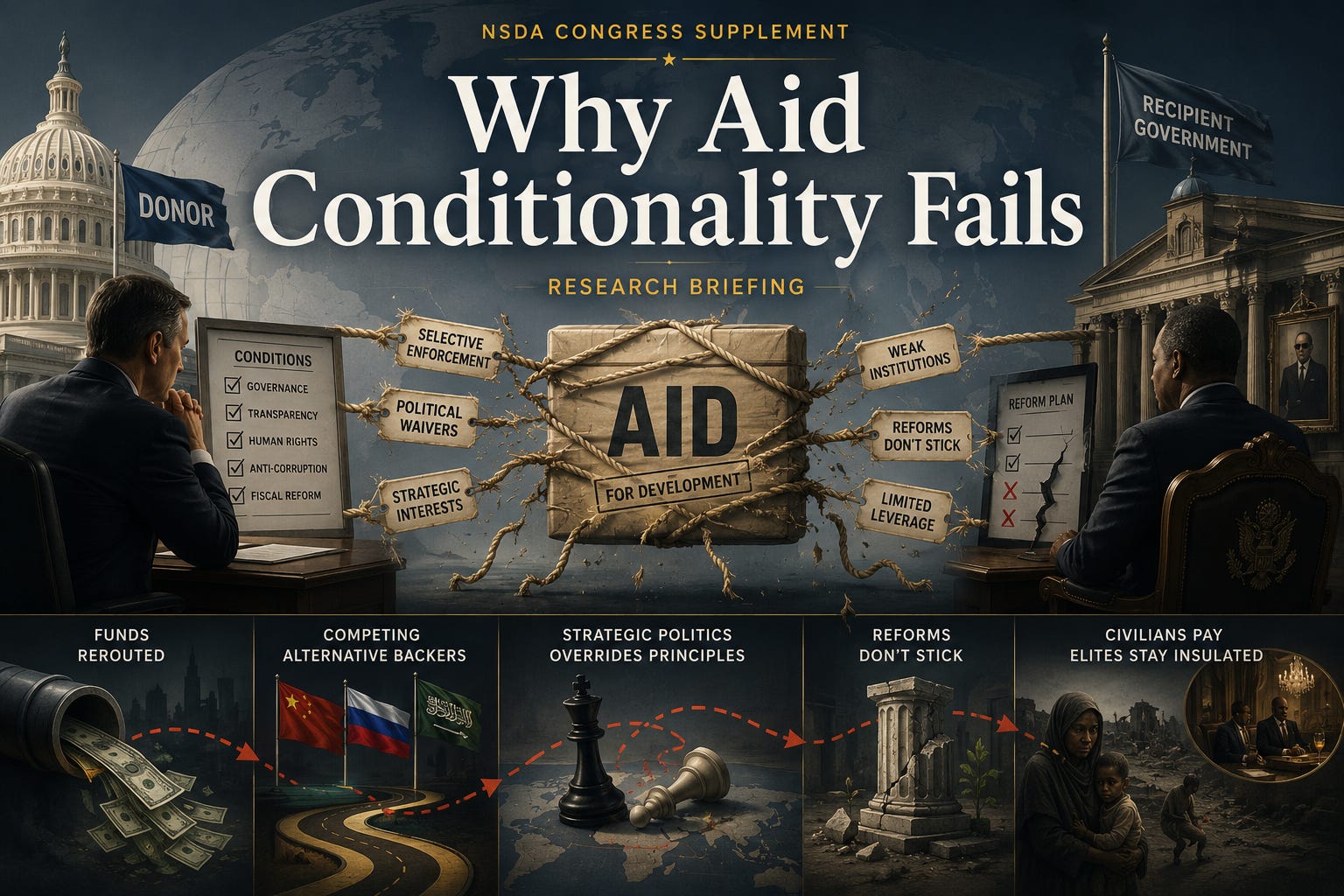
A deep dive into the empirical and scholarly record on why conditioning foreign aid on policy, governance, or human-rights reform so often fails to produce reform. Built to backstop the opposition case on A Bill to Condition U.S. Foreign Aid on Democratic Governance and Human Rights Compliance, but written evenhandedly — several of these mechanisms also tell an advocate where the design has to be fixed.
The short version: conditionality fails at both ends. When conditions aren’t enforced, they’re not credible and recipients ignore them; when conditions are met, fungibility and lack of ownership mean the reform still doesn’t stick. The literature has converged on this from several directions over forty years.
1. The credibility / time-inconsistency problem (the core mechanism)
The single most-cited reason conditionality fails is that the donor’s threat to withhold aid is not credible, so recipients rationally ignore it. Donors face powerful pressures to disburse regardless of compliance: bureaucratic pressure to meet lending targets, “defensive lending” to protect repayment of past loans, and short-sighted altruism that makes denying aid to a needy population politically impossible (Svensson, 2003). Layer on geopolitical and commercial interests in the recipient, and enforcement becomes lax.
This is a classic time-inconsistency trap. Denying relief to a country with a bad track record but desperate need is a “non-credible threat,” especially for more altruistic donors (Svensson). Because the recipient anticipates the donor will pay anyway, the condition exerts little leverage ex ante. A cross-national survey of donor officials confirms the threat to suspend aid is frequently not credible in practice.
Application to the bill: the automatic two-period suspension trigger is an attempt to solve exactly this — to bind the donor’s hands so the threat is credible. But the bill provides a national-security waiver nowhere and an undefined standard everywhere, so in practice the executive retains every incentive and avenue to keep paying strategic partners, reproducing the credibility gap.
2. Donors waive conditions for strategic partners (politicized enforcement)
Empirical work on actual disbursements shows conditions are enforced selectively, driven by donor politics rather than recipient performance. Analysis of World Bank loan disbursements finds enforcement is shaped by the political-economy interests of powerful shareholders, not just compliance. The result is a double standard: strategically important abusers keep their aid while less important ones are cut, which destroys the rule’s credibility and exposes it as a political instrument.
Application to the bill: judging compliance by standards “as determined by the United States government,” with no fixed benchmark, institutionalizes precisely this discretion — inviting the selective enforcement the literature identifies as a core failure mode.
3. Fungibility — even met conditions don’t change behavior
Even when aid is earmarked and conditions are formally satisfied, money is fungible. Recipients reduce their own spending in the targeted sector and redirect those freed-up resources elsewhere, so a fraction of the aid effectively funds whatever the government wanted to fund anyway (UNU-WIDER). The tighter and more specific the condition, the more governments route around it. This means conditionality can be fully “complied with” on paper while net policy is unchanged.
4. Externally imposed reforms lack ownership and don’t stick
A second reason met conditions fail is that reforms imposed from outside lack local ownership and political durability. This is the central lesson of the 2005 Paris Declaration on Aid Effectiveness, which pivoted the donor community away from conditionality toward “country ownership” precisely because imposed conditions had not produced sustained reform. Case evidence from structural adjustment found that conditionality produced “confused ownership” of reforms in Kenya, weakening government commitment and undermining sustainability. A reform a government adopts only to unlock a check is abandoned once the check clears.
5. The structural-adjustment record — the largest real-world test
The 1980s–90s World Bank/IMF structural adjustment programs in Africa are the biggest natural experiment in conditionality, and the verdict is sobering. The World Bank’s own 1994 Adjustment in Africa report found “limited and uneven” policy improvement and “disappointing” regional results, and the Bank’s Vice President for Africa stated that structural adjustment had failed. Crucially, the failure wasn’t only non-compliance: by the Bank’s evaluation, roughly 75% of program conditions were fully or substantially implemented in the 1980s, yet growth and poverty outcomes still disappointed. And a Bank study found that ten African countries all received large conditional loans yet ended up with vastly different policies — evidence that aid is not a primary determinant of policy. Conditional money simply did not buy durable reform.
6. The field’s own response: the shift from conditionality to selectivity
The clearest scholarly admission that conditionality fails is the discipline’s pivot away from it. After ex-post conditionality’s failure “to buy policy reform,” Collier and Dollar and the World Bank’s Assessing Aid (1998) argued for ex-ante selectivity — giving aid to countries that have already reformed rather than paying others to promise to. The logic is an explicit concession: you cannot reliably induce reform by conditioning aid, so reward demonstrated performance instead. This is now mainstream (it underpins the U.S. Millennium Challenge Corporation’s selectivity model) and stands as the field’s verdict on classic conditionality.
7. Political/democracy conditionality: sovereignty backlash and cosmetic compliance
Conditioning aid on governance and rights — the bill’s exact aim — has its own failure pattern. Recipients across the political spectrum jealously guard sovereignty and treat democracy/rights conditions as illegitimate interference, producing backlash rather than reform. The backlash can be concrete: Uzbekistan shut down most Western democracy programs in 2005, closing more than 60% of the country’s active NGOs. Where regimes don’t expel programs, they often comply cosmetically — staging elections or passing paper reforms while leaving the underlying system intact. The review literature on political conditionality and democratization finds the results “rather meager,” and notes the irony that the austerity attached to economic conditionality can undermine the very state capacity democratic reform requires.
8. Donor competition erodes leverage — the China/Gulf exit option
Conditionality only works if the recipient has no alternative financier. Increasingly, they do. China and the Gulf states offer development finance without governance strings, so a recipient cut off by Western donors can simply switch. This is not hypothetical: when the U.S. gutted foreign aid in early 2025, China moved to fill the gap and “muscle in” on programs the U.S. abandoned. Every condition that triggers a suspension is, in this environment, an invitation to a rival — which turns a values tool into a strategic loss.
9. The humanitarian cost falls on the population, not the regime
Suspending aid tends to harm vulnerable people more than the ruling elite, who can absorb the loss, find other revenue, or switch donors. Human Rights Watch documents that the 2025 U.S. aid cuts produced “immediate detrimental effects” on rights and lives worldwide — shuttering refugee, women’s, and anti-violence programs — without commensurate leverage over the governments involved. The dynamic is perverse: a human-rights condition can degrade human-rights outcomes for the population it was meant to protect.
10. Case evidence: the conditionality response is inconsistent and often inert
Concrete episodes illustrate the gap between threat and effect. The U.K. suspended aid to Malawi in 2011 over gay-rights concerns, and the World Bank suspended funding to Uganda over its 2023 Anti-Homosexuality Act — but scholarship on the earlier Ugandan episodes finds that donor responses worked, when they worked at all, through domestic actors and processes, not through the aid threat itself, and that effectiveness varied widely by how the response was delivered. Often the law passed anyway. The cases reinforce the theme: the aid lever is weak and contingent, and where reform happens, domestic politics, not the donor’s check, usually does the work.
Bottom line for the round
The advocate’s instinct — “stop funding abusers” — runs into a forty-year evidence base showing that conditioning aid on reform is one of the least reliable tools in development policy. It fails when unenforced (credibility), fails when enforced (fungibility, ownership), gets waived for strategic partners (politicization), provokes sovereignty backlash, and, in a world of Chinese and Gulf alternatives, mostly relocates the recipient rather than reforming it — while the humanitarian cost lands on civilians. The field’s own answer was to abandon ex-post conditionality for ex-ante selectivity. That is the strongest, most defensible version of the opposition case, and it doesn’t require defending a single abusive regime — only the claim that this particular tool doesn’t deliver what its sponsors promise.
For an advocate, the same literature is a roadmap: build in a credible, rules-based trigger (not executive discretion), pair suspension with engagement so it doesn’t simply hand the partner to China, protect the population from collateral harm, and consider rewarding demonstrated reformers (selectivity) rather than only punishing laggards.
Bibliography
• Svensson, Jakob. “Why conditional aid does not work and what can be done about it?” Journal of Development Economics, 2003. https://www.sciencedirect.com/science/article/abs/pii/S0304387802001025
• Svensson, Jakob. “When is foreign aid policy credible? Aid dependence and conditionality.” Journal of Development Economics, 2000. https://www.sciencedirect.com/science/article/abs/pii/S0304387899000619
• “Can foreign aid donors credibly threaten to suspend aid? Evidence from a cross-national survey of donor officials.” Review of International Political Economy, 2017. https://www.tandfonline.com/doi/full/10.1080/09692290.2017.1302490
• “The political economy of conditionality: An empirical analysis of World Bank loan disbursements.” Journal of Development Economics, 2009. https://www.sciencedirect.com/science/article/abs/pii/S0304387808000746
• “What did structural adjustment adjust? The association of policies and growth with repeated IMF and World Bank adjustment loans.” Journal of Development Economics, 2005 (and World Bank, Adjustment in Africa, 1994). https://www.sciencedirect.com/science/article/abs/pii/S0304387804000872
• “The World Bank and structural adjustment in Africa” (Kenya ownership; ~75% conditions implemented). https://journals.co.za/doi/pdf/10.10520/AJA02562804_662
• “Conditionality” (ex-post conditionality’s failure; Collier & Dollar; Assessing Aid; shift to selectivity). Wikipedia. https://en.wikipedia.org/wiki/Conditionality
• “High level forums on aid effectiveness” (Paris Declaration 2005; ownership over conditionality). Wikipedia. https://en.wikipedia.org/wiki/High_level_forums_on_aid_effectiveness
• UNU-WIDER. “The Fungibility Problem.” https://www.wider.unu.edu/publication/fungibility-problem
• “The Backlash Against Democracy Promotion.” Foreign Affairs (sovereignty resistance; Uzbekistan NGO closures). https://www.foreignaffairs.com/united-states/backlash-against-democracy-promotion
• “’Political conditionality’ and democratisation.” Review of African Political Economy (meager results). https://www.tandfonline.com/doi/abs/10.1080/03056249508704143
• Devex. “From China to the Gulf: The donors reshaping global development.” https://www.devex.com/news/from-china-to-the-gulf-the-donors-reshaping-global-development-110697
• NPR. “China sees an opportunity as the U.S. cuts aid to groups around the world.” February 18, 2025. https://www.npr.org/2025/02/18/nx-s1-5300108/aid-cuts-and-china-muscles-in
• Human Rights Watch. “US Foreign Aid Cuts Harm Human Rights Globally.” May 14, 2026. https://www.hrw.org/news/2026/05/14/us-foreign-aid-cuts-harm-human-rights-globally
• “Foreign aid donors, domestic actors, and human rights violations: the politics and diplomacy of opposing Uganda’s Anti-Homosexuality Act.” Journal of International Relations and Development, 2022. https://link.springer.com/article/10.1057/s41268-022-00257-z
• The Conversation. “World Bank suspension of Uganda funds over anti-homosexuality law” (and U.K.–Malawi 2011 suspension). https://theconversation.com/world-bank-suspension-of-uganda-funds-over-anti-homosexuality-law-what-this-says-about-the-struggle-over-funds-and-sovereignty-211635