
Data Center Moratorium or Ban: What a Pause Would Actually Accomplish?
A "Moratorium" is More Complicated than it appears

All DebateUS data centers evidence.| Intro Essay | Essay on AI/Energy Intersection | AI Good & Bad Essay
This brief combines three things:
(1) an analytical essay on what moratorium advocates argue and how a moratorium would actually work (or not work);
(2) a set of verified, annotated sources — the federal bill, state and local actions, the case for and against, and the legal mechanics;
(3) international precedents, the major U.S. local fights, organized opposition, and the federal counter-policy.
TL;DR
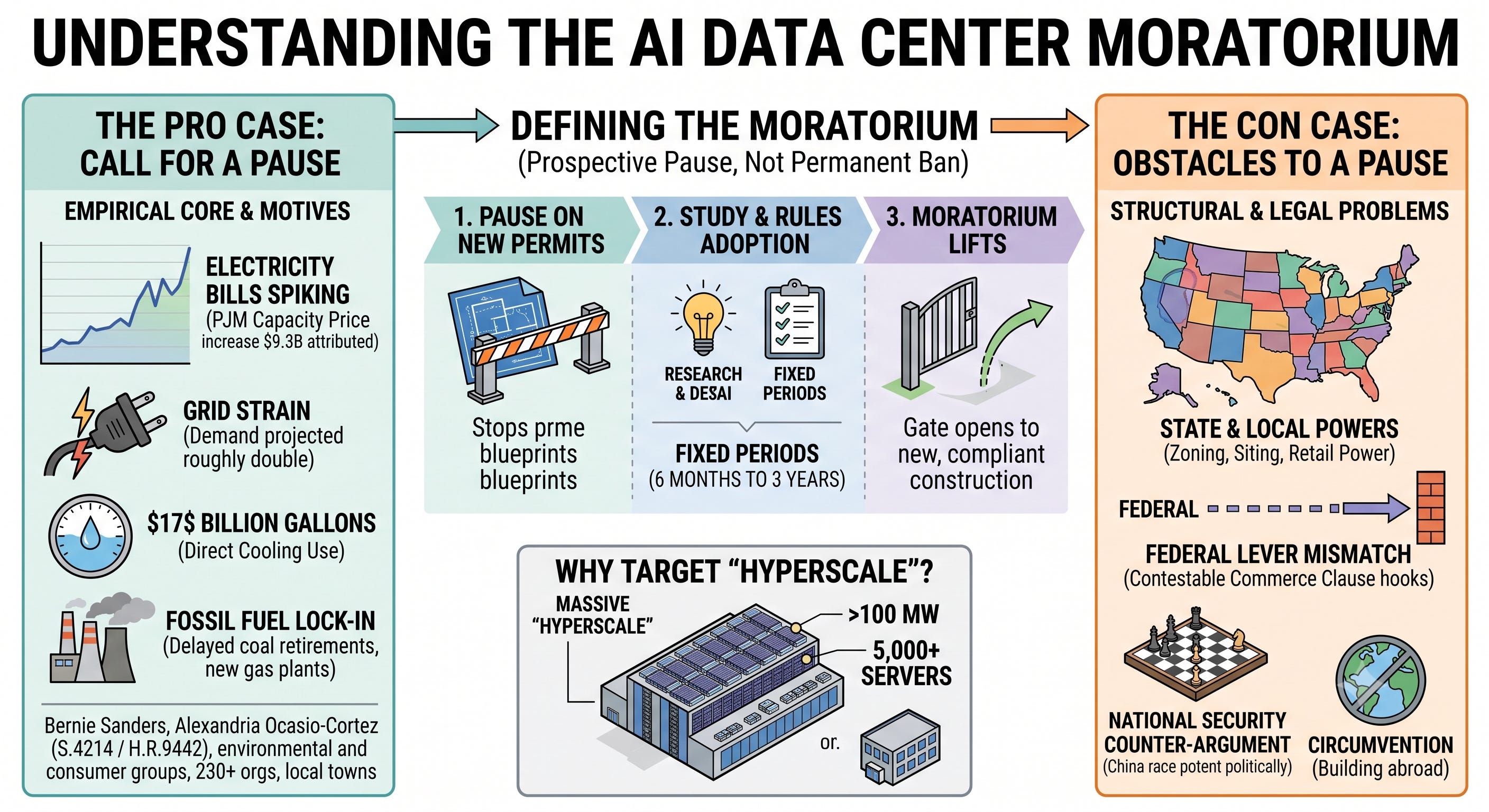
A real and fast-growing movement — from Sen. Bernie Sanders and Rep. Alexandria Ocasio-Cortez’s federal “Artificial Intelligence Data Center Moratorium Act” (S.4214 / H.R.9442) to 230+ environmental groups, ratepayer advocates, AI-safety campaigners, and dozens of towns and counties — is calling for a temporary, prospective pause on new hyperscale data centers, arguing they are spiking electricity bills, straining the grid, consuming scarce water, locking in fossil fuels, and delivering few local jobs.
The empirical core of the PRO case is strong and well-sourced: PJM’s independent market monitor, Monitoring Analytics, attributed 63% of the 2025/26 capacity-price increase — $9.3 billion in a single year — to data centers; U.S. data-center electricity use is projected to roughly double to 6.7–12% of national power by 2028 (Lawrence Berkeley National Laboratory); and 71% of Americans now oppose a data center near them, including 48% strongly (Gallup, conducted March 2026, released May 13, 2026).
The hard problem is mechanism, not motive: land use, zoning, and retail electricity are overwhelmingly state and local powers, so a federal moratorium has no clean lever and rests on contestable Commerce Clause / federal-permitting hooks — which is precisely why almost all real-world action so far has been at the state and local level, and why the strongest negative arguments (the China race, federalism (especially since the plan is “fiated”), and circumvention) target the federal mechanism rather than the underlying harms).
Finally, how can a moratorium be defined? How long will it last? What are the (agreed upon) criteria for lifting it?
Key Facts
A federal bill exists and is specific. S.4214, introduced by Sen. Bernie Sanders (I-VT) on March 25, 2026, and its House companion H.R.9442, introduced by Rep. Alexandria Ocasio-Cortez (D-NY-14) on June 24, 2026 (with nine cosponsors), would halt construction or upgrading of covered AI data centers until Congress passes safeguards and “expressly terminates” the moratorium. It is conditional, not time-limited.
State and local action is where the movement is real. Maine nearly became the first state with a statewide moratorium (LD 307) before Gov. Mills vetoed it in April 2026; New York’s legislature passed a one-year pause in June 2026; and per Good Jobs First, of at least 63 local data-center moratorium actions, 54 had already passed across dozens of towns and counties.
The ratepayer argument is the movement’s strongest. PJM capacity prices rose nearly tenfold in two years, data centers drove most of the increase, and bills are rising across the mid-Atlantic and Midwest.
The environmental case is multi-pronged: water consumption (17 billion gallons of direct cooling in 2023, projected to roughly double by 2028), delayed coal retirements and new gas plants, and local air pollution (the xAI Memphis/Southaven case).
A separate AI-safety constituency wants to slow frontier AI training itself; because hyperscale data centers are the physical substrate of frontier training, a construction moratorium functions as a brake on AI scaling (the 2023 “Pause Giant AI Experiments” letter).
The decisive obstacles are structural: federal authority over land use and retail power is limited; the China/national-security counterargument is politically potent; and circumvention (building abroad or in non-covered jurisdictions) is real.
What a “moratorium” means here
In this debate a moratorium is a temporary, prospective halt on new construction — not a permanent ban and not a shutdown of existing facilities.
In practice, real-world data-center moratoriums share a common architecture: they (1) pause the acceptance or approval of new permits, (2) for a fixed period (commonly 6 months to 3 years) or until a triggering event, and (3) end when a study is completed, new zoning or utility rules are adopted, or the legislature acts. The Columbia Law School / Sabin Center Climate Law Blog notes that local governments reduce legal risk (e.g., regulatory-takings exposure under Tahoe-Sierra Preservation Council v. Tahoe Regional Planning Agency, 535 U.S. 302 (2002), decided under the Penn Central balancing test) by keeping moratoriums short, applying them only prospectively, grandfathering pending applications, and creating hardship exemptions.
The federal Sanders–AOC bill is unusual because it is conditional rather than time-limited: under SEC. 3(b), construction “may not commence or proceed until” Congress enacts laws guaranteeing federal pre-release review of AI products, worker protections, and that future data centers do not raise utility bills, do not harm the environment, are subject to community approval, receive no subsidies, and use union labor — and until a provision in those laws “expressly terminates the moratorium.” (Read the bill text and the sponsors’ framing.) Because Congress is nowhere near passing such a law, the honest characterization is that the federal proposal sits somewhere between a multi-year pause and a conditional ban.
Defining “hyperscale” and why a moratorium targets it
There is no single codified definition, but the industry consensus — reflected by IDC and cited by the Congressional Research Service (R48646) — holds that a hyperscale facility contains at least 5,000 servers, occupies at least 10,000 square feet, and draws upward of 100 MW (some sources use a 40 MW floor). CRS notes roughly 100 MW can power about 80,000 U.S. households; new AI campuses are now being negotiated in gigawatt units, and Meta’s planned Hyperion facility in Louisiana is expected to draw more than twice the power of New Orleans.
Moratorium proposals target hyperscale specifically because the largest facilities drive the most grid strain, water use, and emissions — and because hyperscale campuses host frontier AI training. Real proposals use power thresholds as the operational definition: the Sanders–AOC bill uses >20 MW combined with either 20 kW-per-rack density or liquid/immersion cooling; New York’s bill uses 20 MW; Maine’s LD 307 used 20 MW; Oklahoma, South Dakota, Vermont, and Wisconsin used thresholds from 50 to 100 MW; and Trump’s own Executive Order 14318 defines a “Data Center Project” as one requiring more than 100 MW of new load dedicated to AI.
Part 1 — Who is calling for a moratorium, and what they argue
Federal lawmakers. The flagship vehicle is the Artificial Intelligence Data Center Moratorium Act. Sen. Bernie Sanders introduced S.4214 on March 25, 2026; Rep. Alexandria Ocasio-Cortez introduced the House companion H.R.9442 on June 24, 2026, with nine cosponsors. The bill defines an “artificial intelligence data center” as connected, commonly-owned facilities that either are used “for the development or operation of artificial intelligence models at scale” or have peak power “in excess of 20 megawatts” plus either 20 kW to a single rack or liquid/immersion cooling; imposes a moratorium lifted only when Congress passes the listed safeguards and “expressly terminates” it; bans exports of AI computing hardware to countries lacking comparable safeguards; and requires quarterly public Department of Energy reports on each facility’s finances, water, energy, emissions (with fenceline air monitoring), wastewater, cooling chemicals, noise, wages, and jobs. Ocasio-Cortez framed it as a “moral obligation to … stop the expansion of these data centers until we have a framework to adequately address the existential harm AI poses.” Sanders said Congress “cannot sit back and allow a handful of billionaire Big Tech oligarchs” to reshape the economy and democracy.
Separately, Rep. Frank Pallone, ranking member of House Energy and Commerce, called for a national moratorium at a subcommittee markup, citing the Berkeley Lab projection that data centers “may be responsible for over 15 percent of our nation’s total electricity use by 2030” and that PJM ratepayers “paid over $9 billion last year.” The moratorium is the most aggressive federal proposal; most other members favor narrower ratepayer-protection or transparency bills rather than a construction halt.
State legislators. More than 300 data-center-related bills were introduced in early 2026, with at least a dozen states weighing moratoriums. Maine’s LD 307 would have been the first statewide moratorium (banning data centers over 20 MW until November 1, 2027) but was vetoed by Gov. Janet Mills on April 24, 2026; Mills said “a moratorium is appropriate given the impacts of massive data centers in other states,” objecting only to the lack of a carve-out for a $550 million project in Jay. New York’s legislature passed the Responsible Data Center Development Act (S10642/A11560) on June 4, 2026 — a one-year moratorium on permits for large (≥20 MW) data centers — and it awaits Gov. Hochul’s signature. A Pennsylvania state senator circulated a co-sponsorship memo for a three-year moratorium on hyperscale development.
Local governments. The most concrete action is local. By the Columbia/Sabin tally, at least 100 local moratoriums have been adopted; per Good Jobs First, of at least 63 local actions, 54 had passed. Documented examples include Texas Township, MI (12 months), Springfield Township, MI (180 days), and Manitowoc County, WI (1 year). Michigan alone saw 19+ communities pass or propose moratoriums, and voters are increasingly targeting data centers via ballot measures.
Environmental, ratepayer, and civil-society groups. On December 8, 2025, more than 230 organizations — including Food & Water Watch (which organized the letter and was the first national group to call for a federal moratorium), Sierra Club, NRDC, Greenpeace, Friends of the Earth, and Physicians for Social Responsibility — sent a letter to Congress demanding a national moratorium “until adequate regulations can be enacted.” Food & Water Watch followed with a comprehensive report making the case. Public Citizen has separately pressed FERC to allow a moratorium on new data-center grid interconnections.
AI-safety advocates. A distinct constituency wants to slow frontier AI itself. The Future of Life Institute’s March 2023 “Pause Giant AI Experiments” open letter (30,000+ signatures, including Elon Musk) called for a six-month pause on training systems “more powerful than GPT-4,” and said that “if such a pause cannot be enacted quickly, governments should step in and institute a moratorium.” Because hyperscale data centers are the bricks-and-mortar of frontier training, a construction moratorium wires the AI-safety / existential-risk case directly into this resolution — and the Sanders–AOC bill explicitly cites warnings from industry figures (Musk, Amodei, Hassabis, Bezos) about mass job loss and societal risk.
The arguments advocates make:
Electricity prices and grid strain (the strongest argument). In PJM (the grid for roughly 65–67 million people across 13 states + DC), capacity-auction prices rose from $28.92/MW-day (2024/25) to $269.92 (2025/26) to the $329.17 FERC price cap (2026/27), then hit the raised $333.44 cap for 2027/28 while clearing about 6,625 MW short of PJM’s reliability requirement — the first such shortfall in the capacity market’s history. PJM’s independent market monitor, Monitoring Analytics, attributed about 63% of the 2025/26 increase — $9.3 billion in a single year — to data centers, and found that data-center forecasts made up 45% of the $47.2 billion across the last three auctions, with cumulative data-center-attributable costs reaching roughly $23 billion through May 2028. NRDC estimates the average PJM household faces a ~$70/month increase by 2028, and Gov. Josh Shapiro’s settlement with PJM capped prices but expires before the next uncapped auction. Prices are also rising in states that are not industry leaders, such as New Jersey (about 20% year over year).
Grid reliability. On July 10, 2024, a transmission fault in Northern Virginia caused ~60 data centers to simultaneously switch to backup power, dropping ~1,500 MW in seconds; NERC created a Large Loads Task Force, and has flagged that data-center interconnection delays now complicate demand forecasting itself.
Water consumption. Lawrence Berkeley National Lab estimated U.S. data centers directly consumed 17 billion gallons for cooling in 2023, with hyperscale and colocation facilities using 84%, and projected hyperscale water use rising to 16–33 billion gallons by 2028. A single large facility can consume up to 5 million gallons per day, and Texas data centers are projected to use about 49 billion gallons in 2025, rising to 399 billion by 2030.
Carbon and fossil-fuel lock-in. Dominion cited data-center demand to delay retiring its Clover coal plant by 20 years, to 2045, and to build new gas peakers. DeSmog found at least 15 coal-plant retirements delayed since January 2025, and Environment America / Frontier Group documented a resurgence of new gas-plant proposals. The IEA projects data-center emissions rising from ~180 Mt to ~300 Mt by 2035 — one of the few sectors with rising emissions — even as it notes data centers are only ~10% of global electricity-demand growth to 2030.
Local environmental harms. The clearest case: Elon Musk’s xAI built a de facto power plant of 27 unpermitted gas turbines in Southaven, MS to power its Colossus 2 data center; the NAACP, represented by SELC and Earthjustice, sued under the Clean Air Act, alleging potential emissions of more than 1,700 tons of NOx, 180 tons of fine particulate matter, and 19 tons of formaldehyde annually in an area already failing federal smog standards. The DOJ intervened on xAI’s behalf, citing national security.
Few local jobs relative to subsidies. Data centers create very few permanent jobs against large abatements; Good Jobs First finds taxpayer costs that “routinely exceed $1 million per permanent job” and documents states losing $1 billion or more a year to data-center tax breaks — Georgia about $2.5 billion, Virginia about $1.6 billion, Texas around $1 billion. (Ohio’s exemption cost $1.6 billion in 2025, about 12x the initial projection, prompting Gov. DeWine to pause new applications.) Tech firms spent an estimated $375 billion on AI infrastructure in 2025 — most of it sales-tax-free in states with exemptions.
Transparency and democratic consent. Advocates argue communities are losing control over major development, with by-right zoning, opaque deals, and roughly 80% of reviewed Virginia jurisdictions bound by NDAs.
Public opinion. A Gallup poll (telephone survey of 1,000 adults, conducted March 2–18, 2026, released May 13, 2026, ±4 pts) found 71% of Americans oppose a data center near them, including 48% strongly — higher than opposition to a nearby nuclear plant (53%), and exceeding the all-time nuclear-opposition high of 63%. Heatmap found opposition swung 49 points in nine months; a Reuters/Ipsos survey put opposition at 57%. The backlash is bipartisan, and in Q1 2026 alone, backlash delayed or blocked at least 75 projects worth a cumulative $130 billion.
Part 2 — How a moratorium would actually work
Federal mechanisms (and their limits). The central difficulty is that, as CRS R48762 states, data centers “for the most part, have a discrete geographical footprint involving mostly local and state siting authorities.” There is no clean federal lever to ban construction nationwide. The plausible — and each contestable — hooks are:
Commerce Clause legislation. Because cloud computing is interstate commerce,
